GMP IPO Watch
Skytech Infinite Platform IPO 2026 – Can Industrial Automation Drive the Company's Next Phase of Growth?
Factories are becoming increasingly automated.
Modern industrial plants need systems capable of monitoring and controlling:
motors + electrical equipment + energy consumption + production processes + water systems + plant operations.
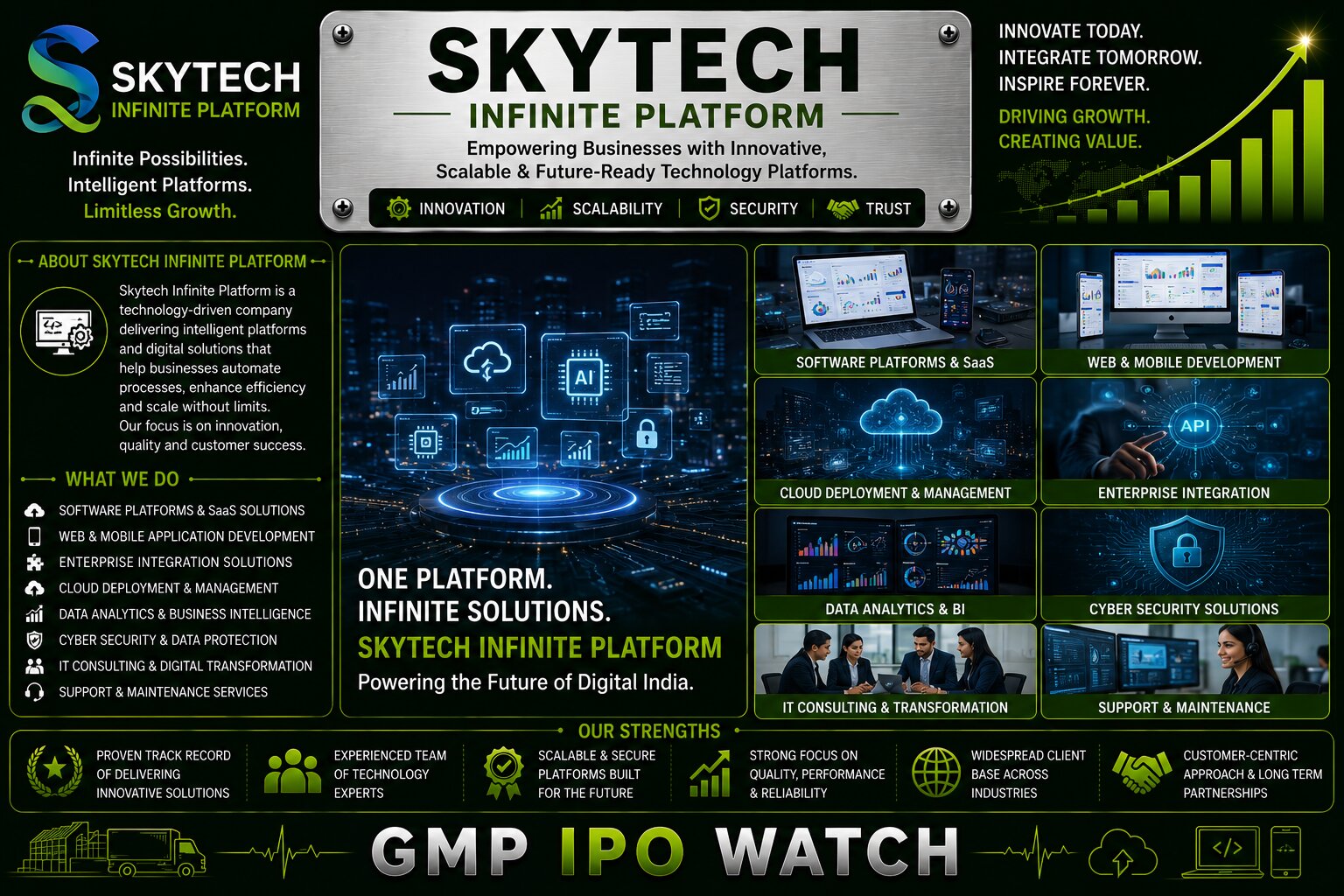
This is the market in which Skytech Infinite Platform Limited operates.
The Bengaluru-based company provides industrial automation and electrical engineering solutions across application areas such as power, water, energy management, process automation, motor management, pharmaceuticals, food and beverages and environmental systems.
Skytech was incorporated in May 2009, giving the company more than 15 years of operating history before entering the public market.
Its IPO closes today, August 18, 2026, making this the final day for investors to apply.
The larger investment question is:
Can Skytech convert India's industrial automation and digitalisation opportunity into sustained revenue growth while managing project execution, customer concentration, working capital and cash flow?
That is the core IPO story.
Skytech Infinite Platform IPO Details
| Particular | Details |
|---|---|
| Company | Skytech Infinite Platform Ltd. |
| IPO Type | Book Built SME IPO |
| Listing Platform | NSE Emerge |
| Issue Size | ₹22.68 Crore |
| Issue Structure | 100% Fresh Issue |
| Total Shares | 29,45,600 Shares |
| Price Band | ₹73 – ₹77 |
| Face Value | ₹10 Per Share |
| Lot Size | 1,600 Shares |
| Retail Minimum | 3,200 Shares |
| Retail Investment | ₹2,46,400 at ₹77 |
| IPO Open Date | August 14, 2026 |
| IPO Close Date | August 18, 2026 |
| Listing Date | August 21, 2026 |
| Lead Manager | Finshore Management Services |
| Listing | NSE Emerge |
The IPO comprises approximately 29.46 lakh shares and is entirely a fresh issue. At the ₹77 upper band, the issue size works out to approximately ₹22.68 crore.
Skytech Infinite Platform IPO Subscription Today
Today is the final day of bidding.
The latest available HDFC Sky update reports that the IPO has crossed full subscription and was approximately:
1.29× subscribed overall.
Earlier intraday data showed the issue around 0.97×, with retail at approximately 1.60× and QIB at around 1.06×, illustrating how rapidly demand has increased during the final session.
| Particular | Current Position |
|---|---|
| IPO Day | Final Day |
| IPO Closing | August 18, 2026 |
| Latest Overall Subscription | Around 1.29× |
| Issue Status | Fully Subscribed |
| Listing | August 21, 2026 |
The subscription number can continue changing until bidding closes, so the final exchange data will be more meaningful than any intraday figure.
Demand Improved Significantly on the Final Day
The IPO did not begin with overwhelming demand.
Day 2 data showed the issue below full subscription, while today's demand has pushed the overall book above 1×.
This pattern is important.
Institutional and non-institutional investors frequently place larger bids toward the end of an IPO.
Therefore, the final category-wise subscription will provide a better picture of investor interest.
What Does Skytech Infinite Platform Actually Do?
Skytech operates in the industrial automation and electrical solutions space.
Its application areas include:
- Power
- Water
- Energy management
- Process control
- Motor management
- Pharmaceutical operations
- Food and beverage manufacturing
- Environmental applications.
In simple terms, Skytech helps industrial customers make their equipment and processes:
more automated + measurable + controllable + efficient.
Industrial Automation Is Becoming More Important
Consider a traditional manufacturing plant.
Employees may manually:
- Start machinery
- Monitor temperature
- Check motors
- Record energy consumption
- Detect equipment problems
Automation systems can move many of these processes toward digital monitoring and control.
The potential benefits include:
higher productivity + lower downtime + improved safety + better energy efficiency.
This creates a structural opportunity for companies providing industrial automation solutions.
Motor Management Is an Important Industrial Application
Motors are used throughout factories.
They power:
- Pumps
- Compressors
- Conveyors
- Fans
- Production equipment
If an important motor fails unexpectedly, production can stop.
Automation and monitoring systems can help industrial operators understand:
- Motor status
- Electrical load
- Fault conditions
- Performance
This can potentially reduce unplanned downtime.
Energy Management Creates Another Growth Opportunity
Energy is a significant operating expense for many industrial businesses.
Companies increasingly want to understand:
where energy is being consumed + how efficiently equipment operates + where consumption can be reduced.
Skytech's exposure to energy-management applications therefore places it within a growing industrial-efficiency theme.
Water Automation Can Create Recurring Industrial Demand
Water systems can require automated:
- Pump control
- Flow management
- Treatment monitoring
- Distribution
Industrial plants, infrastructure facilities and treatment systems increasingly rely on electronic controls rather than purely manual operation.
Skytech's water-related applications broaden the company's opportunity beyond traditional factory automation.
Pharmaceutical Automation Requires Reliability
Pharmaceutical manufacturing operates under strict process requirements.
Automation can help maintain:
- Process consistency
- Monitoring
- Documentation
- Equipment control
This makes pharmaceutical applications potentially attractive for automation providers.
However, customers can demand strict technical and quality standards.
Food and Beverage Is Another Addressable Industry
Food manufacturing involves many processes that can benefit from automation.
These can include:
mixing → processing → packaging → utilities → temperature control → production monitoring.
A diversified customer-industry base can reduce dependence on one industrial sector.
That is strategically important for a relatively small company such as Skytech.
Skytech Is Primarily a Solutions Business
Investors should not view Skytech simply as a company selling electrical components.
Industrial automation projects often require:
- Understanding customer requirements
- Engineering
- Equipment selection
- System integration
- Installation
- Testing
- Commissioning
The real value therefore comes from combining products with technical execution.
This can create stronger customer relationships than straightforward component trading.
Engineering Expertise Can Become a Competitive Advantage
Suppose a factory wants to automate an existing production line.
It may not know exactly:
- Which controllers are required
- Which sensors should be installed
- How motors should communicate
- How data should be displayed
An automation integrator can design the complete solution.
That engineering capability is difficult to evaluate purely through revenue figures.
For Skytech, technical execution quality can therefore become an important competitive differentiator.
FY2026 Revenue Reached Around ₹51.65 Crore
Recent IPO reporting places Skytech's FY2026 revenue at approximately:
₹51.65 crore
with PAT of approximately:
₹4.20 crore.
This establishes Skytech as a relatively small business compared with mainboard industrial automation companies.
But smaller scale can also provide room for faster percentage growth if order execution increases.
FY2026 PAT Was Around ₹4.20 Crore
A ₹4.20 crore profit on approximately ₹51.65 crore revenue implies a PAT margin of roughly:
8.1%.
That means Skytech is entering the IPO as a profitable business rather than a loss-making technology company.
However, absolute profit remains small.
Even relatively modest changes in project margins or expenses can therefore materially affect PAT.
Historical DRHP Numbers Show an Improving Business
Skytech's original DRHP contained restated financial statements for FY2023 through FY2025. The company subsequently updated its financial profile as the IPO process progressed.
IPOPlatform's earlier FY2026 annualised analysis estimated:
- Revenue: ₹45.14 crore
- EBITDA: ₹6.18 crore
- PAT: ₹3.71 crore
- EBITDA Margin: 13.69%
- PAT Margin: 8.22%.
The more recent IPO reporting of ₹51.65 crore revenue and ₹4.20 crore PAT indicates that the final FY2026 performance came in above those earlier annualised figures.
Working Capital Is Critical in Project Businesses
Industrial automation companies often need to spend money before customers pay them.
A typical project can involve:
purchase equipment → engineering → installation → testing → customer approval → payment collection.
During this period, cash remains tied up.
As Skytech grows, working-capital requirements can therefore increase.
This is one reason fresh IPO capital can be important.
Revenue Growth Does Not Automatically Mean Cash-Flow Growth
Imagine Skytech wins ₹20 crore of additional projects.
That looks positive.
But suppose the company must first spend ₹15 crore on:
- Equipment
- Employees
- Installation
and customers pay several months later.
Accounting revenue can grow while cash becomes tighter.
This is why investors should closely monitor:
operating cash flow + receivable days + working-capital cycle.
Negative Operating Cash Flow Is a Risk to Watch
Recent IPO analysis has specifically highlighted negative operating cash flow among Skytech's risk factors.
This deserves attention.
For a growing engineering business, occasional negative operating cash flow can arise because more capital becomes tied up in projects and receivables.
But persistent negative cash generation would be a concern.
After listing, investors should compare:
PAT vs operating cash flow.
Customer Concentration Is Another Major Risk
Recent IPO coverage also identifies customer concentration as an important risk.
This matters especially because Skytech is still a relatively small company.
Suppose annual revenue is ₹50 crore.
Losing a customer responsible for ₹8–₹10 crore can have a significant impact.
A much larger company can absorb the same customer loss more easily.
Therefore, customer diversification should be an important post-listing goal.
A Larger Customer Base Can Improve Revenue Stability
The ideal growth path is not simply:
win one huge automation project.
A stronger model would be:
more customers + more industries + repeat projects + maintenance/upgrade opportunities.
This reduces dependence on individual contracts.
It can also improve revenue visibility.
Repeat Customers Can Become Valuable
Once Skytech understands a customer's factory systems, the relationship can become deeper.
The customer may later require:
- New production-line automation
- Upgrades
- Additional motor control
- Energy-management systems
- Plant expansion
That means one successfully executed project can potentially lead to future work.
Installed Systems Can Create Follow-On Opportunities
Industrial automation technology changes over time.
Factories may need:
- Software upgrades
- Replacement components
- Expansion
- New controls
- Improved monitoring
This can create recurring opportunities from an existing installed customer base.
A growing base of repeat and upgrade revenue could improve Skytech's business quality.
The Entire IPO Is Fresh Capital
One attractive structural feature is that the IPO is a 100% fresh issue.
There is no major OFS component in the approximately ₹22.68 crore issue.
That means IPO capital goes into the company, subject to issue expenses and the stated use of proceeds.
Existing shareholders are not using the IPO primarily as an exit route.
Fresh Capital Can Support a Larger Operating Cycle
For a small automation business, ₹22+ crore is meaningful relative to its existing scale.
Fresh funds can potentially help Skytech:
- Execute larger projects
- Finance working capital
- Expand business capabilities
- Strengthen the balance sheet
But capital alone does not create shareholder value.
Management must generate attractive returns from that capital.
The IPO Can Materially Change Skytech's Scale
Consider the relationship:
FY2026 revenue: approximately ₹51.65 crore
IPO size: approximately ₹22.68 crore.
The capital raise is therefore large relative to annual revenue.
If deployed effectively, it can materially increase the company's capacity to execute projects.
But inefficient deployment could dilute post-IPO returns.
Industrial Automation Has Structural Tailwinds
Manufacturers increasingly want:
- Higher productivity
- Lower labour dependence
- Energy efficiency
- Better quality control
- Real-time data
- Predictive maintenance
Automation supports many of these goals.
That provides a favourable industry backdrop.
The question is how much of this opportunity a small integrator such as Skytech can capture while competing against larger engineering and automation companies.
Digitalisation Can Expand the Opportunity
Industrial systems are increasingly becoming connected.
Traditional factory controls focused mainly on:
machine ON/OFF.
Modern systems increasingly collect:
- Production data
- Energy data
- Equipment performance
- Fault information
This allows factories to make better operational decisions.
Automation providers capable of integrating hardware with data platforms may therefore have greater long-term opportunities.
Competition Is Significant
Industrial automation includes major global and Indian companies.
Customers can choose from:
- Large automation OEMs
- System integrators
- Electrical engineering companies
- Specialist solution providers
Skytech cannot compete with multinational companies purely on size.
It needs advantages such as:
technical responsiveness + customisation + execution + customer service + cost efficiency.
SME Scale Creates Both Opportunity and Risk
Skytech's relatively small size means a few successful contracts can significantly increase revenue.
That is the upside.
But the reverse is also true.
A few:
- Delayed projects
- Customer losses
- Margin pressures
- Payment delays
can materially affect financial results.
This creates higher earnings volatility than investors may see in larger industrial companies.
NSE Emerge Listing Adds Liquidity Risk
Skytech is listing on NSE Emerge, not the mainboard.
SME stocks can experience:
- Lower trading volumes
- Larger bid-ask spreads
- Higher price volatility
than established mainboard companies.
This is especially important for investors who may need to exit quickly after listing.
Retail Minimum Investment Is High
The IPO lot size is 1,600 shares, while retail investors need to apply for at least 3,200 shares.
At ₹77:
3,200 × ₹77 = ₹2,46,400.
That is a considerably larger minimum commitment than a typical mainboard IPO.
Investors should factor this into portfolio allocation and liquidity planning.
Skytech Infinite Platform IPO GMP Today
Grey-market premium is an unofficial and unregulated indicator.
Current mainstream coverage does not provide a sufficiently consistent verified GMP figure for Skytech Infinite Platform today. Univest specifically notes that it does not publish a GMP figure for this IPO and recommends relying on regulated exchange subscription data rather than informal grey-market quotations.
Therefore, it is safer not to present an uncertain GMP number as fact.
The more useful current demand indicator is that the IPO has crossed full subscription on its final day.
Competitive Strengths
Skytech enters the public market with several potential strengths.
Established operating history: Incorporated in 2009.
Profitable business: FY2026 PAT is reported around ₹4.20 crore.
Growing revenue: FY2026 revenue reached approximately ₹51.65 crore.
Diversified applications: Exposure includes power, water, energy management, process automation, pharmaceuticals and food and beverages.
Structural automation opportunity: Indian manufacturing is increasingly focused on productivity and digitalisation.
Entirely fresh issue: The IPO raises capital directly for the company rather than primarily providing shareholder exits.
Final-day demand: The IPO has crossed full subscription.
Major Risks
Customer Concentration
Dependence on major customers can create revenue volatility.
Operating Cash Flow
Negative operating cash flow has been highlighted as an IPO risk.
Working-Capital Requirements
Automation projects can require upfront procurement before customer payments arrive.
Project Execution
Delays can affect revenue recognition, margins and customer relationships.
Small Scale
FY2026 revenue of approximately ₹51.65 crore remains relatively modest.
Competition
Skytech competes within a market containing much larger industrial automation companies.
SME Liquidity
NSE Emerge shares can experience lower liquidity than mainboard stocks.
What Could Drive Skytech's Next Growth Phase?
Industrial Automation
More factories adopting automated systems can expand demand.
Energy Management
Higher energy costs can encourage companies to monitor and optimise consumption.
Manufacturing Expansion
New factories create opportunities for automation and electrical systems.
Existing Customer Upgrades
Installed systems can generate repeat and expansion work.
New Industries
Diversifying across pharmaceuticals, food, water and other sectors can reduce concentration.
Fresh IPO Capital
Additional working capital can support larger project execution.
What Investors Should Track After Listing
| Metric | Why It Matters |
|---|---|
| Revenue Growth | Business expansion |
| EBITDA Margin | Project profitability |
| PAT Margin | Earnings quality |
| Operating Cash Flow | Profit-to-cash conversion |
| Receivable Days | Customer collections |
| Working Capital | Project funding |
| Top Customer Share | Concentration risk |
| Repeat Orders | Customer stickiness |
| Order Pipeline | Future visibility |
| ROCE | IPO capital efficiency |
For Skytech, cash flow and customer diversification may ultimately matter more than headline revenue growth.
The Most Important Post-IPO Equation
The strongest scenario looks like:
IPO capital → larger working-capital capacity → more automation projects → diversified customers → repeat orders → higher PAT + positive cash flow.
The weaker scenario looks like:
IPO capital → larger projects → higher receivables → delayed customer payments → cash trapped in working capital.
Both scenarios can produce revenue growth.
Only the first creates high-quality shareholder value.
Should Investors Consider Skytech Infinite Platform IPO?
The positive case includes:
- More than 15 years of operating history
- FY2026 revenue around ₹51.65 crore
- FY2026 PAT around ₹4.20 crore
- Profitable industrial automation business
- Exposure to multiple industries
- 100% fresh issue
- Structural manufacturing-automation opportunity
- IPO fully subscribed on the final day.
The caution case includes:
- Small operating scale
- Customer concentration
- Negative operating cash-flow risk
- Working-capital intensity
- Project execution risk
- Strong industry competition
- SME post-listing liquidity risk.
Skytech should therefore be evaluated as a small but established industrial automation and engineering company attempting to use public capital to scale its project-execution capabilities.
Final View on Skytech Infinite Platform IPO 2026
The Skytech Infinite Platform IPO closes today, August 18, 2026. The approximately ₹22.68 crore NSE Emerge issue has a price band of ₹73–₹77 per share and is entirely a fresh issue.
The minimum retail application is 3,200 shares, requiring approximately ₹2,46,400 at the upper price band.
The latest available final-day update shows the issue approximately 1.29× subscribed overall, meaning the IPO has crossed full subscription.
Financially, the company remains small but profitable. Recent IPO reporting places FY2026 revenue at approximately ₹51.65 crore and PAT at ₹4.20 crore.
Skytech's biggest opportunity comes from India's ongoing shift toward:
industrial automation + energy management + digital manufacturing + process efficiency.
Its relatively broad application base across power, water, motor management, pharmaceuticals, food and beverages and other industrial processes provides multiple avenues for growth.
The main concern is the quality of that growth.
Recent IPO analysis identifies negative operating cash flow and customer concentration among the risks investors need to consider.
Therefore, after listing, investors should not focus only on whether Skytech grows from ₹50 crore to ₹75 crore or ₹100 crore revenue.