GMP IPO Watch
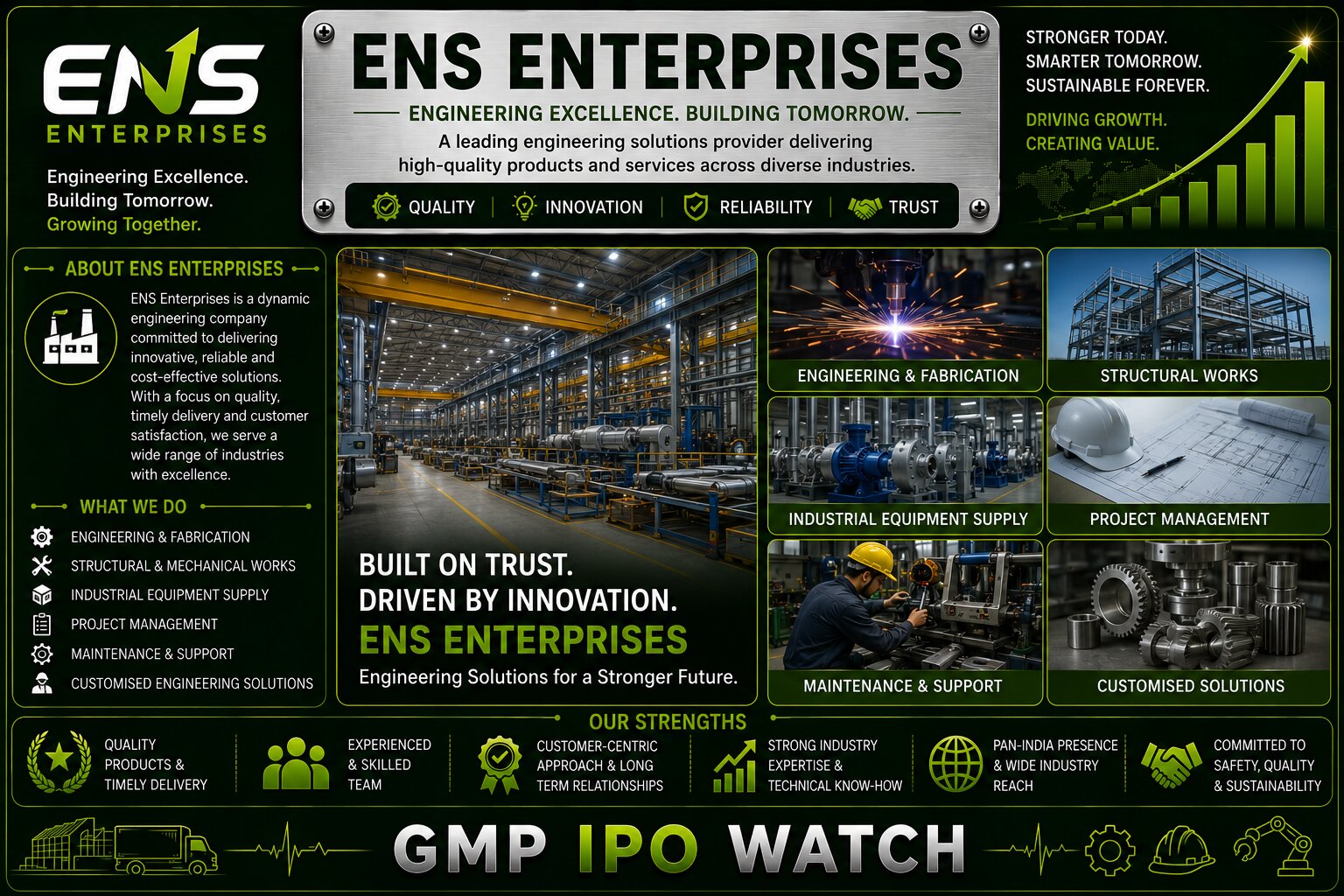
ENS Enterprises IPO 2026 – Can Digital Commerce Growth Support the Company's Next Expansion Phase?
India's digital commerce ecosystem is no longer limited to companies simply creating an online store.
Businesses increasingly need technology to manage the entire digital sales journey, including:
online commerce + software integration + digital operations + technology implementation + customer experience.
This is the opportunity ENS Enterprises Limited is targeting.
ENS Enterprises is a Noida-based technology company providing end-to-end digital commerce enablement and software solutions.
The company is now raising approximately ₹33.14 crore through its BSE SME IPO.
The IPO closes today, August 18, 2026, and investor demand has strengthened significantly on the final day. As of 11:53 AM, the public portion was approximately 2.29 times subscribed.
But subscription alone does not determine the long-term investment case.
The more important question is:
Can ENS use fresh IPO capital to scale its digital commerce and software operations while maintaining FY2026's strong profitability and improving the quality of its cash flows?
That is the central story behind this IPO.
ENS Enterprises IPO Details
| Particular | Details |
|---|---|
| Company | ENS Enterprises Limited |
| IPO Type | Book Built SME IPO |
| Listing Platform | BSE SME |
| Issue Size | ₹33.14 Crore |
| Fresh Issue | ₹33.14 Crore |
| Offer for Sale | Nil |
| Total Shares | 36,02,400 Shares |
| Price Band | ₹87 – ₹92 Per Share |
| Face Value | ₹10 Per Share |
| Lot Size | 1,200 Shares |
| Retail Minimum Application | 2,400 Shares |
| Retail Investment at ₹92 | ₹2,20,800 |
| IPO Open Date | August 14, 2026 |
| IPO Close Date | August 18, 2026 |
| Basis of Allotment | August 19, 2026 |
| Expected Listing | August 21, 2026 |
| Exchange | BSE SME |
ENS Enterprises is raising the entire ₹33.14 crore through fresh shares, with no OFS component. The company is offering approximately 36.02 lakh shares at ₹87–₹92 each.
ENS Enterprises IPO Final Day Subscription
Investor participation has accelerated substantially today.
As of 11:53 AM on August 18, 2026, the IPO had received bids for approximately 54.78 lakh shares against 23.95 lakh shares available in the public portion.
| Investor Category | Subscription |
|---|---|
| QIB | 1.00× |
| NII | 3.69× |
| Retail | 2.42× |
| Overall | 2.29× |
Among NIIs, the small-NII portion had reached approximately 4.52×, while the big-NII category stood around 3.27×.
These are intraday figures and can increase further before bidding closes.
ENS Enterprises Subscription Improved Each Day
The subscription trend itself is worth examining.
| Day | QIB | NII | Retail | Overall |
|---|---|---|---|---|
| Day 1 | 0.00× | 2.22× | 0.31× | 0.63× |
| Day 2 | 1.00× | 2.47× | 1.24× | 1.43× |
| Day 3* | 1.00× | 3.69× | 2.42× | 2.29× |
*Day 3 figures as of 11:53 AM.
The IPO therefore moved from 0.63× on Day 1 to 2.29× during the final day.
NII investors currently represent the strongest demand category.
ENS Enterprises IPO GMP Today
Current grey-market information for ENS Enterprises remains limited.
IPO Watch's August 18 update currently lists the GMP as unavailable rather than reporting a specific premium.
| Particular | Current Position |
|---|---|
| Upper IPO Price | ₹92 |
| Current Reported GMP | Not Available |
| Expected Listing Gain | Not Reliably Available |
| Official Indicator | Final Subscription & Listing Price |
It is better not to invent a GMP number when reliable sources are not showing an active premium.
GMP is also an unofficial and unregulated market indicator and should never be considered a guaranteed listing return.
What Does ENS Enterprises Actually Do?
ENS Enterprises operates as a technology company focused on digital commerce enablement and software solutions.
Digital commerce is broader than simply designing a website.
Modern businesses can require technology across:
- Online storefronts
- Software systems
- Commerce integrations
- Digital customer journeys
- Backend operations
- Data flows
- Technology implementation
ENS attempts to participate across this broader digital ecosystem.
Why Digital Commerce Is Becoming More Complex
Consider a consumer brand selling through:
its website + marketplaces + mobile channels + offline stores.
Each sales channel can create separate:
- Orders
- Inventory records
- Customer data
- Payments
- Returns
Without integration, operating the business becomes difficult.
Digital commerce technology can help connect these systems.
This creates an opportunity for technology companies that can provide end-to-end solutions instead of isolated software services.
Digital Commerce Is More Than E-Commerce
The distinction is important.
E-commerce can simply mean:
selling something online.
Digital commerce enablement can involve the infrastructure supporting that transaction.
That may include the systems behind:
product discovery → ordering → payment → fulfilment → customer interaction.
As businesses become more digitally integrated, the complexity of these systems increases.
Software Solutions Can Create Scalable Economics
Traditional engineering companies may need more:
- Factories
- Machinery
- Inventory
to grow revenue.
Technology companies can sometimes expand more efficiently.
If ENS develops reusable:
- Software components
- Technical frameworks
- Integration expertise
- Implementation processes
it may be able to serve additional customers without proportionately increasing physical assets.
This creates potential operating leverage.
Human Capital Is the Main Operating Asset
For a technology-services company, the most valuable assets are often not visible on the balance sheet.
They include:
developers + software engineers + technical architects + project managers + customer relationships.
This creates both opportunity and risk.
Talented employees can help ENS scale rapidly.
But employee attrition can:
- Delay projects
- Increase recruitment costs
- Reduce technical knowledge
- Affect customer relationships
Talent retention therefore matters considerably.
FY2026 Revenue Increased Sharply
ENS Enterprises reported strong recent financial growth.
| Financial Year | Revenue | PAT |
|---|---|---|
| FY2025 | ₹28.62 Cr | ₹3.70 Cr |
| FY2026 | ₹51.77 Cr | ₹8.40 Cr |
Revenue increased from approximately ₹28.62 crore in FY2025 to ₹51.77 crore in FY2026, while PAT increased from ₹3.70 crore to ₹8.40 crore.
That represents significant growth in both the top and bottom lines.
Revenue Grew by More Than 80%
Based on the reported numbers:
₹28.62 crore → ₹51.77 crore
represents revenue growth of approximately:
81%.
That is substantial.
For a relatively small technology company, this level of growth can materially change operating scale.
The challenge is sustaining it.
PAT More Than Doubled
Profit increased from approximately:
₹3.70 crore
to:
₹8.40 crore.
That represents PAT growth of approximately:
127%.
Profit therefore grew substantially faster than revenue.
This indicates improving operating economics during FY2026.
FY2026 PAT Margin Is Around 16%
Using the reported ₹51.77 crore revenue and ₹8.40 crore PAT:
₹8.40 crore ÷ ₹51.77 crore ≈ 16.2%.
A PAT margin around 16% is healthy for a growing technology-services business.
The important question is whether ENS can maintain that profitability as it:
- Hires more employees
- Expands its customer base
- Executes larger projects
- Invests IPO capital
Margins after listing will therefore be important to monitor.
Why Technology Margins Can Improve With Scale
Suppose ENS builds a technical solution for one customer.
Some of the:
- Architecture
- Knowledge
- Development tools
- Processes
can potentially be reused for future projects.
This means the second ₹10 crore of revenue may not require exactly the same cost structure as the first ₹10 crore.
That creates operating leverage.
However, this depends heavily on how customised ENS's projects are.
Highly Customised Projects Can Limit Scalability
If every new customer requires a completely different technology platform, ENS may need to add engineers roughly in line with revenue.
In that case, margins may not scale dramatically.
Investors should therefore eventually understand the company's revenue mix between:
repeatable software solutions vs manpower-intensive custom projects.
The greater the repeatability, the stronger the potential scalability.
The IPO Is Entirely a Fresh Issue
ENS Enterprises' approximately ₹33.14 crore IPO contains no Offer for Sale.
This is an important positive structural feature.
The IPO is primarily raising capital for the company itself rather than providing an exit to existing shareholders.
In simple terms:
₹33.14 crore IPO = fresh capital entering ENS, before issue-related expenses and deployment.
IPO Size Is Significant Relative to Existing Revenue
Compare these two figures:
FY2026 revenue: ₹51.77 crore
IPO size: ₹33.14 crore.
The IPO is therefore equivalent to roughly 64% of one year's reported revenue.
That is a meaningful capital injection relative to the company's current size.
If deployed successfully, it could materially expand ENS's operating capacity.
But More Capital Does Not Automatically Mean More Profit
This distinction is critical.
Suppose ENS receives significant IPO capital.
Management can:
Scenario A
Use it efficiently to win larger contracts, expand capabilities and generate high returns.
Scenario B
Allow capital to remain tied up in receivables or low-return expansion.
Both scenarios use IPO money.
Only Scenario A creates meaningful shareholder value.
Working Capital Matters in Technology Services
Technology companies are often considered asset-light.
But they can still require working capital.
Suppose ENS completes a project today.
The customer may pay:
- 30 days later
- 60 days later
- 90 days later
Meanwhile, ENS must continue paying:
- Salaries
- Office expenses
- Technology costs
- Vendors
This creates a cash-flow gap.
As revenue expands, the absolute amount tied up in receivables can increase.
Receivable Days Should Be Closely Watched
Imagine annual revenue grows from ₹50 crore to ₹100 crore.
If customers take 90 days to pay, a substantial amount of cash may remain locked in outstanding invoices.
This can produce an unusual situation:
revenue ↑
PAT ↑
but:
cash flow remains weak.
For this reason, operating cash flow is one of the most important post-listing metrics for ENS.
Customer Concentration Can Be a Risk
Small technology companies often depend on a limited number of significant customers.
This creates concentration risk.
Suppose ENS generates ₹50 crore of annual revenue and one major customer contributes ₹10 crore.
Losing that customer would immediately remove approximately 20% of revenue.
The ideal long-term path is therefore:
retain major customers + increase repeat business + continuously diversify the client base.
Repeat Customers Can Improve Business Quality
Technology projects can produce follow-on work.
After ENS successfully implements one system, a customer may later require:
- Enhancements
- New integrations
- Additional modules
- Maintenance
- Platform upgrades
- Expansion into new digital channels
This can lower customer acquisition costs and improve revenue visibility.
A growing share of repeat customers would therefore be positive.
Digital Commerce Has Structural Growth Drivers
Businesses continue moving more commercial activity into digital channels.
This can create demand for:
- Commerce platforms
- Software integrations
- Digital transformation
- Customer-facing applications
- Backend technology
ENS does not need the entire digital-commerce market to grow.
Because its current revenue base is only around ₹52 crore, capturing even a small additional share of the market could produce meaningful percentage growth.
Small Scale Creates Higher Growth Potential
This is one advantage of ENS's current size.
A company generating ₹50 crore revenue needs another ₹25 crore to grow 50%.
A ₹5,000 crore technology company would need another ₹2,500 crore.
Therefore, smaller companies can grow much faster in percentage terms.
But small scale also creates greater volatility.
A few delayed projects can materially affect annual results.
Project Execution Is Critical
Technology projects can fail because of:
- Scope changes
- Technical problems
- Customer delays
- Integration issues
- Employee attrition
- Cost overruns
ENS therefore needs strong project management.
Winning a contract creates revenue opportunity.
Successfully delivering the contract creates profit.
Getting paid converts that profit into cash.
All three stages matter.
Revenue Quality Matters More Than Revenue Alone
Suppose ENS reports:
₹80 crore revenue next year.
That sounds impressive.
But investors should ask:
- What was PAT?
- What was operating cash flow?
- How much remains receivable?
- Did margins decline?
- Was growth concentrated in one customer?
High-quality growth should produce:
revenue + profit + cash flow
together.
The Business Is Asset-Light
ENS does not require large:
- Manufacturing facilities
- Warehouses
- Raw-material inventories
to expand its software operations.
Its main investment is in people and technology.
That can support high return ratios if the company scales successfully.
But asset-light businesses also depend heavily on employee productivity.
Employee Cost Is Likely to Be an Important Margin Driver
Software companies effectively convert employee time and expertise into customer revenue.
If salary costs increase faster than billing rates:
margins decline.
If employee utilisation improves while billing increases:
margins can expand.
Investors should therefore watch employee-related expenses alongside revenue growth.
BSE SME Listing Creates Additional Risk
ENS Enterprises will list on the BSE SME platform, with listing currently scheduled for August 21, 2026.
SME stocks can have:
- Lower liquidity
- Wider bid-ask spreads
- Higher volatility
- Larger minimum trading quantities
than established mainboard companies.
Investors should therefore consider liquidity risk separately from business fundamentals.
Minimum Retail Investment Is ₹2.20 Lakh
The IPO lot size is 1,200 shares, but the minimum retail application is 2 lots, or 2,400 shares.
At the ₹92 upper band:
2,400 × ₹92 = ₹2,20,800.
That is substantially higher than the typical minimum application in a mainboard IPO.
This increases portfolio concentration for smaller investors.
Competitive Strengths
ENS Enterprises enters the IPO with several attractive characteristics.
Strong revenue growth: FY2026 revenue increased to approximately ₹51.77 crore from ₹28.62 crore in FY2025.
Rapid PAT growth: Profit increased from approximately ₹3.70 crore to ₹8.40 crore.
Healthy implied PAT margin: FY2026 reported figures imply a margin around 16%.
Asset-light model: Technology growth does not require major physical infrastructure.
Digital commerce exposure: The company provides end-to-end digital commerce enablement and software solutions.
100% fresh IPO: No OFS component.
Strong final-day demand: Overall subscription had reached approximately 2.29× by 11:53 AM today.
Major Risks
Small Operating Scale
FY2026 revenue remains only around ₹52 crore despite strong recent growth.
Customer Concentration
Dependence on a small group of important clients could create revenue volatility.
Project Execution
Software implementations can experience technical problems, cost overruns and delays.
Employee Dependence
Technology businesses rely heavily on skilled professionals.
Working Capital
Delayed customer payments can cause accounting profits to differ from actual cash generation.
Margin Sustainability
FY2026 profit increased substantially faster than revenue. Investors should determine whether this improvement can continue.
Competition
ENS competes within a large digital technology ecosystem containing both specialised firms and much larger IT companies.
SME Liquidity
BSE SME shares can be significantly less liquid than mainboard stocks.
What Could Drive ENS Enterprises' Next Growth Phase?
Larger Digital Commerce Projects
Winning higher-value customers could materially increase revenue from the company's relatively small base.
Existing Customer Expansion
Additional integrations and upgrades can increase revenue per customer.
New Client Acquisition
A broader customer base can reduce concentration risk.
Digital Transformation
Businesses continuing to modernise their technology infrastructure creates a structural demand opportunity.
Fresh IPO Capital
The ₹33.14 crore fresh issue provides meaningful capital relative to ENS's current scale.
Margin Scalability
Reusing technology, knowledge and development processes across customers could improve profitability.
What Investors Should Track After Listing
| Metric | Why It Matters |
|---|---|
| Revenue Growth | Business scaling |
| PAT Growth | Profitability |
| PAT Margin | Margin sustainability |
| Operating Cash Flow | Earnings quality |
| Receivable Days | Customer collections |
| Top Customer Contribution | Concentration risk |
| Repeat Business | Customer retention |
| Employee Costs | Margin pressure |
| New Client Wins | Growth visibility |
| ROCE | IPO capital efficiency |
For ENS, operating cash flow and customer diversification should be watched alongside revenue growth.
The Most Important Post-IPO Equation
The attractive scenario looks like:
₹33.14 crore fresh capital → larger project capacity → more customers → higher revenue → stable margins → stronger operating cash flow.
The weaker scenario looks like:
fresh capital → rapid project expansion → higher receivables → cash locked with customers → weaker return on IPO capital.
Both can produce revenue growth.
Only the first represents high-quality growth.
Should Investors Consider ENS Enterprises IPO?
The positive case includes:
- FY2026 revenue of approximately ₹51.77 crore
- FY2026 PAT of approximately ₹8.40 crore
- Revenue growth of around 81%
- PAT growth of roughly 127%
- Asset-light technology business
- Exposure to digital commerce
- Entirely fresh ₹33.14 crore IPO
- Stronger final-day investor demand.
The caution case includes:
- Small operating scale
- Customer concentration risk
- Dependence on skilled employees
- Project-execution risk
- Working-capital requirements
- Need to sustain FY2026's profitability
- BSE SME liquidity risk
ENS should therefore be analysed as a small, fast-growing digital commerce and software-solutions company, rather than purely on the basis of current IPO subscription numbers.
Final View on ENS Enterprises IPO 2026
The ENS Enterprises IPO closes today, August 18, 2026. The ₹33.14 crore BSE SME IPO has a price band of ₹87–₹92 per share and consists entirely of fresh shares, with no OFS.
Investor demand has improved substantially. As of 11:53 AM on the final day, the IPO was approximately 2.29× subscribed overall, with NII at 3.69×, retail at 2.42× and QIB at 1.00×. These figures remain intraday and may increase before the issue closes.
Financially, ENS enters the IPO after a strong FY2026. Revenue increased from approximately ₹28.62 crore in FY2025 to ₹51.77 crore in FY2026, while PAT increased from ₹3.70 crore to ₹8.40 crore.
The opportunity is straightforward.
India's businesses increasingly need technology to support increasingly complex digital commerce operations. ENS is attempting to participate in that transition through its end-to-end digital commerce enablement and software-solutions capabilities.
The company's relatively small scale means successful customer additions can produce significant percentage growth. At the same time, that small scale increases exposure to individual customer losses, employee attrition and project delays.
For long-term investors, the key question is therefore not whether ENS can produce another year of rapid revenue growth.