GMP IPO Watch
Horizon Industrial Parks IPO 2026 – Can Debt Reduction Unlock the Value of a 58 Million Sq. Ft. Logistics Platform?
Industrial warehouses may look like simple real-estate assets.
But modern logistics parks are increasingly becoming operating infrastructure for:
e-commerce + manufacturing + 3PL companies + FMCG + automotive + retail + supply-chain networks.
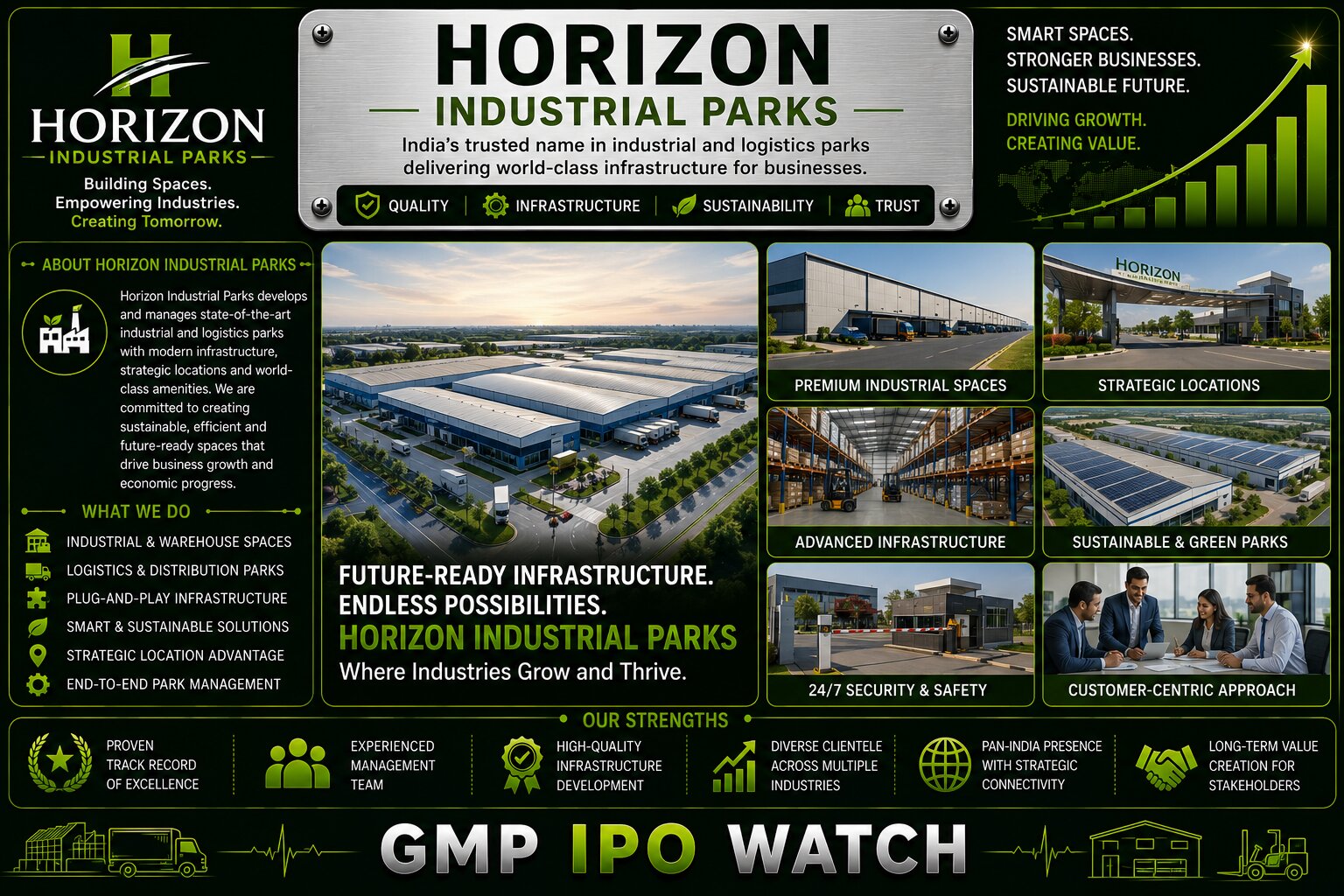
That is where Horizon Industrial Parks Limited operates.
The Blackstone-backed company develops, owns, leases and operates large industrial and logistics parks across India. Its portfolio spans approximately 58.58 million sq. ft., making it one of India's largest institutional industrial and warehousing platforms.
Horizon is currently raising ₹2,600.04 crore through a completely fresh mainboard IPO.
But unlike many growth IPOs, most of this money is not being raised to build dozens of new warehouses immediately.
The dominant purpose is:
debt reduction.
Approximately ₹2,250 crore of IPO proceeds is intended for repayment or prepayment of borrowings.
That makes Horizon's investment story fundamentally different.
The main question is:
Can a much lower debt burden allow Horizon's already strong property-level EBITDA and operating cash generation to finally translate into bottom-line profitability?
That is the real post-IPO thesis.
Horizon Industrial Parks IPO Details
| Particular | Details |
|---|---|
| Company | Horizon Industrial Parks Ltd. |
| IPO Type | Book Built Mainboard IPO |
| Listing | BSE & NSE |
| Issue Size | ₹2,600.04 Crore |
| Fresh Issue | ₹2,600.04 Crore |
| OFS | Nil |
| Price Band | ₹57 – ₹60 |
| Face Value | ₹10 Per Share |
| Lot Size | 250 Shares |
| Retail Minimum | 250 Shares |
| Retail Investment | ₹15,000 at ₹60 |
| IPO Open Date | August 17, 2026 |
| IPO Close Date | August 19, 2026 |
| Allotment Date | August 20, 2026 |
| Listing Date | August 24, 2026 |
| Lead Manager | JM Financial |
| Registrar | KFin Technologies |
The offer is a 100% fresh issue of approximately 43.34 crore shares, with no Offer for Sale.
Horizon Industrial Parks IPO Day 2 Subscription Today
As of 2:30 PM on August 18, 2026, Groww reported the IPO subscribed approximately:
| Category | Subscription |
|---|---|
| QIB | 0.18× |
| NII | 0.08× |
| Retail | 0.37× |
| Employees | 0.48× |
| Overall | 0.19× |
InvestorGain's live page was showing the overall issue around 0.20×, which is broadly consistent with the Groww figure and reflects normal intraday refresh differences.
This is still a relatively subdued response on Day 2.
However, Horizon remains open until August 19, so tomorrow's final QIB and NII participation will be much more important than today's intraday figures.
Retail Demand Is Ahead of Institutional Demand So Far
Retail subscription was approximately 0.37× at 2:30 PM, while QIB demand stood around 0.18× and NII around 0.08×.
This means retail demand is relatively stronger at the moment.
But Horizon is a large ₹2,600 crore infrastructure issue.
The final institutional book matters considerably because professional investors are likely to analyse:
- Asset quality
- Occupancy
- Rental growth
- Leverage
- Interest coverage
- Portfolio valuation
Large QIB bids frequently arrive toward the end of the issue period.
Horizon Industrial Parks IPO GMP Today
Grey-market sentiment has cooled compared with the opening day.
InvestorGain currently reports approximately:
₹1.25 GMP
against the ₹60 upper price band.
That implies an unofficial price around:
₹61.25
or a premium of roughly:
2.1%.
Economic Times separately described current grey-market sentiment as around 3% premium, confirming that expectations remain positive but modest.
On August 17, the premium was closer to 6%, so sentiment has weakened somewhat during the bidding period.
GMP is unofficial and should not be treated as a guaranteed listing price.
What Does Horizon Industrial Parks Actually Do?
Horizon develops and operates institutional-grade industrial and logistics real estate.
Its customers can include businesses involved in:
- E-commerce
- Manufacturing
- Third-party logistics
- FMCG
- Retail
- Automotive
- Renewable energy.
The company therefore sits underneath India's physical supply-chain infrastructure.
A consumer may never see Horizon's name.
But a product ordered online may pass through a warehouse developed or operated by an industrial logistics platform such as Horizon.
Horizon Is More Like Infrastructure Than Conventional Real Estate
Traditional residential real estate depends heavily on selling apartments.
Industrial logistics real estate works differently.
Horizon can develop a warehouse and lease it to customers for recurring rental income.
That creates a model closer to:
infrastructure + rental platform
than:
build-and-sell property development.
Once a facility becomes occupied, the same asset can potentially generate rental income year after year.
Why Occupancy Matters So Much
Imagine Horizon owns a 1 million sq. ft. logistics park.
Scenario A
95% occupied.
Scenario B
60% occupied.
Both assets may carry similar:
- Land costs
- Construction costs
- Maintenance requirements
But Scenario A generates substantially more rental income.
This makes occupancy one of the most important drivers of warehouse economics.
For investors, the useful equation is:
available area × occupancy × rent per sq. ft. = rental revenue potential.
Rental Escalation Can Create Growth Without Building New Assets
Suppose an existing warehouse remains fully occupied.
Horizon can still grow revenue if lease agreements include periodic rental escalation.
This is attractive because incremental rent does not require buying another piece of land.
The same physical building can generate more annual revenue.
That creates operating leverage.
58.58 Million Sq. Ft. Provides Significant Scale
Current IPO analysis places Horizon's established network at approximately 58.58 million sq. ft.
Another current profile describes around 45 assets across 10 cities, serving more than 100 customers.
This scale matters.
Large customers may require space across multiple cities.
A national logistics provider might need facilities in:
- Delhi NCR
- Mumbai
- Pune
- Bengaluru
- Chennai
A multi-city platform can serve more of the customer's network.
That can strengthen commercial relationships.
Large Customers Can Prefer Institutional Landlords
Multinational and large Indian companies often want warehouses with:
- Clear legal title
- Reliable infrastructure
- Fire-safety systems
- Efficient truck movement
- Compliance
- Sustainability standards
An institutional platform may have an advantage over fragmented local warehouse owners.
Horizon can therefore compete not only on rent but also on:
quality + compliance + scale + reliability.
Customer Concentration Is Still Meaningful
Despite its broad portfolio, the business remains somewhat concentrated.
Economic Times reports that Horizon's top 10 customers account for approximately 43% of revenue.
That is significant.
If one large tenant:
- Reduces warehouse space
- Renegotiates terms
- Does not renew
revenue can be affected.
The best future outcome would therefore involve retaining large customers while steadily adding more tenants.
Geographic Concentration Is Also High
Economic Times reports that Horizon's top four cities contribute around four-fifths of total revenue.
This means the company has a national platform but remains economically concentrated in its strongest logistics markets.
There is some logic to this.
Warehousing demand itself tends to cluster around major:
- Consumption centres
- Industrial corridors
- Highways
- Manufacturing hubs
So concentration is not automatically negative.
But investors should recognise the exposure.
FY2026 Revenue Growth Was Very Strong
Horizon reported:
| Financial Year | Revenue from Operations |
|---|---|
| FY2024 | ₹228.86 Cr |
| FY2025 | ₹390.29 Cr |
| FY2026 | ₹691.38 Cr |
FY2026 revenue from operations increased by approximately 77% year-on-year.
This is exceptional growth for a large property infrastructure business.
The increase reflects the rapid scaling of Horizon's asset and leasing platform.
EBITDA Growth Has Been Even Stronger
Horizon reported approximately:
| Financial Year | EBITDA |
|---|---|
| FY2024 | ₹151.51 Cr |
| FY2025 | ₹339.12 Cr |
| FY2026 | ₹607.80 Cr |
FY2026 EBITDA margin reached around 79.16%, compared with 77.19% in FY2025 and 61.71% in FY2024.
That is extremely high compared with ordinary operating companies.
It reflects the underlying economics of leased real estate.
Why Warehouse EBITDA Margins Can Be So High
Suppose Horizon earns ₹100 of rental revenue.
It does not need to buy ₹60 of raw materials to generate that rent.
The warehouse is already built.
Major ongoing costs may include:
- Maintenance
- Property management
- Security
- Common utilities
- Employees
Therefore, a large portion of incremental rent can convert into operating EBITDA.
This is why successful logistics real estate can generate high asset-level margins.
But Horizon Still Reported a ₹203.65 Crore Loss
Here lies the most important contradiction.
Despite approximately ₹607.8 crore of FY2026 EBITDA, Horizon reported a net loss of roughly:
₹203.65 crore.
FY2025 loss was around:
₹178.78 crore
and FY2024 loss around:
₹162.21 crore.
So the business has grown strongly operationally but has still not become profitable.
Why?
The answer is largely in the balance sheet.
Debt Is the Central Financial Problem
Horizon operates a capital-intensive business.
Building industrial parks requires money for:
- Land
- Construction
- Infrastructure
- Acquisitions
Historically, a significant portion of this growth has been funded through debt.
Economic Times reports the IPO is being used principally for deleveraging, while current financial data shows substantial external debt before the issue.
Large borrowings generate large finance costs.
That can absorb much of the EBITDA before the earnings reach PAT.
₹2,250 Crore Debt Repayment Changes the Investment Case
Approximately ₹2,250 crore of IPO proceeds is intended for repayment or prepayment of outstanding borrowings.
That equals roughly:
86.5% of the ₹2,600 crore IPO.
This is extraordinarily important.
The IPO is not primarily saying:
Give us capital so we can build much more.
It is effectively saying:
Give us equity so we can reduce the debt supporting what we have already built.
That is a very different IPO proposition.
How Deleveraging Can Improve Profitability
Imagine Horizon generates ₹600 crore of EBITDA.
If interest and other below-EBITDA costs consume ₹700 crore, the company remains loss making.
Now reduce the debt substantially.
Finance expenses fall.
The same property portfolio may still generate similar EBITDA, but more of it reaches:
PBT → PAT → shareholder cash flow.
That means Horizon could potentially improve bottom-line earnings even without another year of 70% revenue growth.
This IPO Is Essentially a Balance-Sheet Reset
That may be the cleanest way to understand Horizon.
The physical platform already exists.
The customer network already exists.
The revenue is already substantial.
The EBITDA is already substantial.
The biggest weakness is the capital structure.
Therefore:
IPO proceeds → lower debt → lower finance cost → improved earnings conversion
is the central investment thesis.
100% Fresh Issue Is Important
There is no OFS in the ₹2,600.04 crore offer.
Existing shareholders are not selling a major stake through the IPO.
All headline issue proceeds are fresh capital entering Horizon, subject to issue expenses and stated uses.
For a deleveraging IPO, this is structurally important.
The money is going toward strengthening the company rather than primarily funding shareholder exits.
Post-IPO Promoter Holding Will Still Be High
Economic Times reports promoter-group ownership is expected to decline from around:
88.7% pre-IPO
to:
75.4% post-IPO.
The promoter group therefore remains firmly in control after listing.
Blackstone Backing Adds Institutional Experience
Horizon is backed by Blackstone, one of the world's largest alternative-asset investors.
This can support:
- Institutional processes
- Capital allocation
- Large-scale real-estate expertise
- Customer relationships
But investors should not treat sponsor reputation as a substitute for valuation and financial analysis.
The company still has to prove that post-IPO deleveraging produces attractive shareholder returns.
The Business Can Benefit From India's Logistics Formalisation
India's warehousing market has been shifting toward:
- Larger facilities
- Better compliance
- Institutional ownership
- Higher-quality infrastructure
Large e-commerce, manufacturing and logistics companies increasingly need professionally operated warehouses.
This creates a structural opportunity for platforms such as Horizon.
The important long-term demand drivers include:
e-commerce + organised retail + manufacturing + supply-chain formalisation.
Manufacturing Expansion Can Be an Important Growth Driver
Factories do not only need production plants.
They also need:
- Supplier warehouses
- Finished-goods storage
- Distribution centres
- Industrial support facilities
Horizon can participate in this infrastructure layer.
As companies expand manufacturing in India, demand for industrial real estate can rise alongside them.
E-Commerce Creates a Different Kind of Demand
E-commerce requires products to be positioned near customers.
That can create demand for:
- Large fulfilment centres
- Regional warehouses
- In-city facilities
The faster consumers expect delivery, the more important inventory location becomes.
Warehouses therefore become strategic rather than simply low-cost storage buildings.
Location Can Be a Competitive Moat
A warehouse located near:
- A highway
- Major consumption centre
- Manufacturing cluster
can be much more valuable than one in a poor logistics location.
Land cannot be moved.
This gives high-quality logistics real estate a location-based competitive advantage.
Once attractive industrial land becomes fully developed, acquiring comparable sites can become difficult.
Development Pipeline Still Provides Future Growth
Horizon also has additional future development opportunities beyond the operational portfolio.
However, after this IPO, management's capital-allocation discipline becomes crucial.
The company should avoid:
repaying debt today → rebuilding the same debt burden tomorrow.
The ideal future growth model is increasingly funded through:
- Operating cash generation
- Asset monetisation
- Disciplined leverage
rather than aggressive repeated borrowing.
High EBITDA Does Not Mean Free Cash Flow Is Automatically High
Warehouse investors should distinguish between:
EBITDA
and:
free cash flow.
A property platform may need substantial capital for:
- Development
- Maintenance
- New land
- Interest
- Debt repayment
Therefore, post-listing investors should watch how much cash remains after all capital requirements.
This is more meaningful than EBITDA alone.
No P/E Means Valuation Requires Different Metrics
Because Horizon remains loss making, conventional P/E is not useful.
Instead, investors can consider metrics such as:
- EV/EBITDA
- Price-to-sales
- Net debt
- Occupancy
- Rental yield
- Cash flow
Economic Times' analysis notes that the stock should be considered a high-risk long-term infrastructure opportunity because the company has not yet recorded profit despite strong operating growth.
Deleveraging Can Change EV/EBITDA Economics
Enterprise value includes debt.
If Horizon materially reduces debt, the capital structure changes.
Therefore, investors should avoid looking only at pre-IPO leverage and assuming the post-listing business will look identical.
The most relevant valuation framework should eventually use:
post-IPO net debt + post-IPO finance cost + normalised EBITDA.
Competitive Strengths
Horizon Industrial Parks enters the IPO with several meaningful strengths.
Large logistics portfolio: Approximately 58.58 million sq. ft. of industrial and logistics infrastructure.
Large customer network: Current profiles describe more than 100 customers across several industries.
Strong FY2026 growth: Revenue from operations reached approximately ₹691.38 crore.
High EBITDA: FY2026 EBITDA reached approximately ₹607.8 crore.
79% EBITDA margin: Reflects strong asset-level rental economics.
100% fresh issue: No OFS.
Major deleveraging: ₹2,250 crore proposed for debt repayment.
Structural sector growth: Exposure to logistics, manufacturing, e-commerce and organised warehousing.
Major Risks
Continued Net Losses
Horizon reported approximately ₹203.65 crore FY2026 loss despite strong EBITDA.
High Historical Leverage
The IPO's heavy debt-repayment allocation demonstrates the capital intensity of the existing model.
Customer Concentration
Top 10 customers contribute about 43% of revenue.
Geographic Concentration
Top four cities contribute roughly four-fifths of revenue.
Capital-Intensive Expansion
New warehouses require significant upfront investment.
Occupancy Risk
Vacant space produces weaker returns despite continuing asset costs.
Interest-Rate Risk
Even after IPO deleveraging, financing costs remain relevant to a property platform.
Subdued IPO Demand
Day 2 overall subscription remains around 0.19×–0.20×.
What Could Drive Horizon's Next Growth Phase?
Lower Finance Costs
₹2,250 crore debt repayment is the clearest near-term catalyst.
Higher Occupancy
More leased area increases revenue without buying another completed asset.
Rental Escalation
Higher rent on existing leases can grow earnings from the same properties.
E-Commerce Growth
More fulfilment requirements can support warehouse demand.
Manufacturing Expansion
Industrial customers can require additional logistics and production-support facilities.
New Developments
The existing platform provides a base for disciplined future growth.
Better Free Cash Flow
Lower interest expense can allow more EBITDA to remain inside the business.
What Investors Should Track After Listing
| Metric | Why It Matters |
|---|---|
| Occupancy | Asset utilisation |
| Rental Growth | Existing asset monetisation |
| Revenue | Portfolio scale |
| EBITDA Margin | Asset-level economics |
| Net Debt | Deleveraging progress |
| Finance Cost | IPO benefit |
| PAT | Path to profitability |
| Operating Cash Flow | Earnings quality |
| Top 10 Customer Share | Concentration |
| New Development Capex | Capital discipline |
The most important number may eventually become finance cost, because that is where the IPO should create the clearest structural improvement.
The Most Important Post-IPO Equation
Horizon already has significant operating scale.
Therefore, its attractive post-IPO path looks like:
₹2,250 crore debt repayment → lower interest cost → more EBITDA reaches PAT → stronger cash flow → disciplined growth.
The weaker scenario is:
debt repayment → aggressive new developments → fresh borrowing → leverage climbs again.
Both scenarios can produce a larger warehouse portfolio.
Only the first produces a financially stronger company.
Should Investors Consider Horizon Industrial Parks IPO?
The positive investment case includes:
- 58 million+ sq. ft. platform
- Strong FY2026 revenue growth
- ₹607.8 crore EBITDA
- Approximately 79% EBITDA margin
- 100% fresh issue
- ₹2,250 crore debt repayment
- Exposure to logistics, manufacturing and e-commerce infrastructure
- Blackstone backing.
The caution case includes:
- ₹203 crore-plus FY2026 loss
- High historical leverage
- Customer concentration
- Geographic concentration
- Capital-intensive expansion
- Day 2 subscription below 1×
- Modest current GMP.
Horizon should therefore be analysed as a large industrial-logistics real-estate platform undergoing a major balance-sheet restructuring, rather than simply as a warehouse-growth IPO.
Final View on Horizon Industrial Parks IPO 2026
The Horizon Industrial Parks IPO is on Day 2 today, August 18, 2026, and closes tomorrow, August 19. The ₹2,600.04 crore mainboard IPO is priced at ₹57–₹60 per share and is entirely a fresh issue, with no OFS.
As of 2:30 PM today, the issue was subscribed approximately 0.19× overall, including 0.18× QIB, 0.08× NII, 0.37× retail and 0.48× employee demand.
Grey-market sentiment is modest. InvestorGain currently reports around ₹1.25 GMP, implying an unofficial price close to ₹61.25 against the ₹60 upper band, while Economic Times describes current GMP at roughly 3%.
The business fundamentals are more interesting than the current subscription.
Horizon generated approximately ₹691.38 crore FY2026 revenue from operations and ₹607.8 crore EBITDA, with EBITDA margin around 79.16%. Yet the company still reported a ₹203.65 crore net loss.
That contradiction defines the IPO.
The warehouse portfolio itself is generating strong operating earnings, but the capital structure has prevented those earnings from reaching shareholders as net profit.
This is precisely what the IPO is designed to address.
Approximately ₹2,250 crore of the ₹2,600 crore fresh issue is intended for debt repayment, potentially creating a materially different post-listing balance sheet.
The investment thesis can therefore be summarised simply:
large logistics portfolio + high occupancy/rental economics + strong EBITDA + much lower debt = potential path toward sustainable profitability.
The risk is that Horizon again uses significant leverage to fund aggressive expansion before the existing portfolio has demonstrated sustainable post-IPO cash generation.
For long-term investors, the key numbers after listing should therefore be net debt, finance costs, occupancy, rental growth, operating cash flow and PAT.