GMP IPO Watch
Shankesh Jewellers IPO 2026 – Can an Asset-Light Gold Jewellery Manufacturer Scale Its B2B Network?
India's jewellery industry is enormous, but not every jewellery company operates through retail showrooms.
Shankesh Jewellers Limited follows a substantially different model.
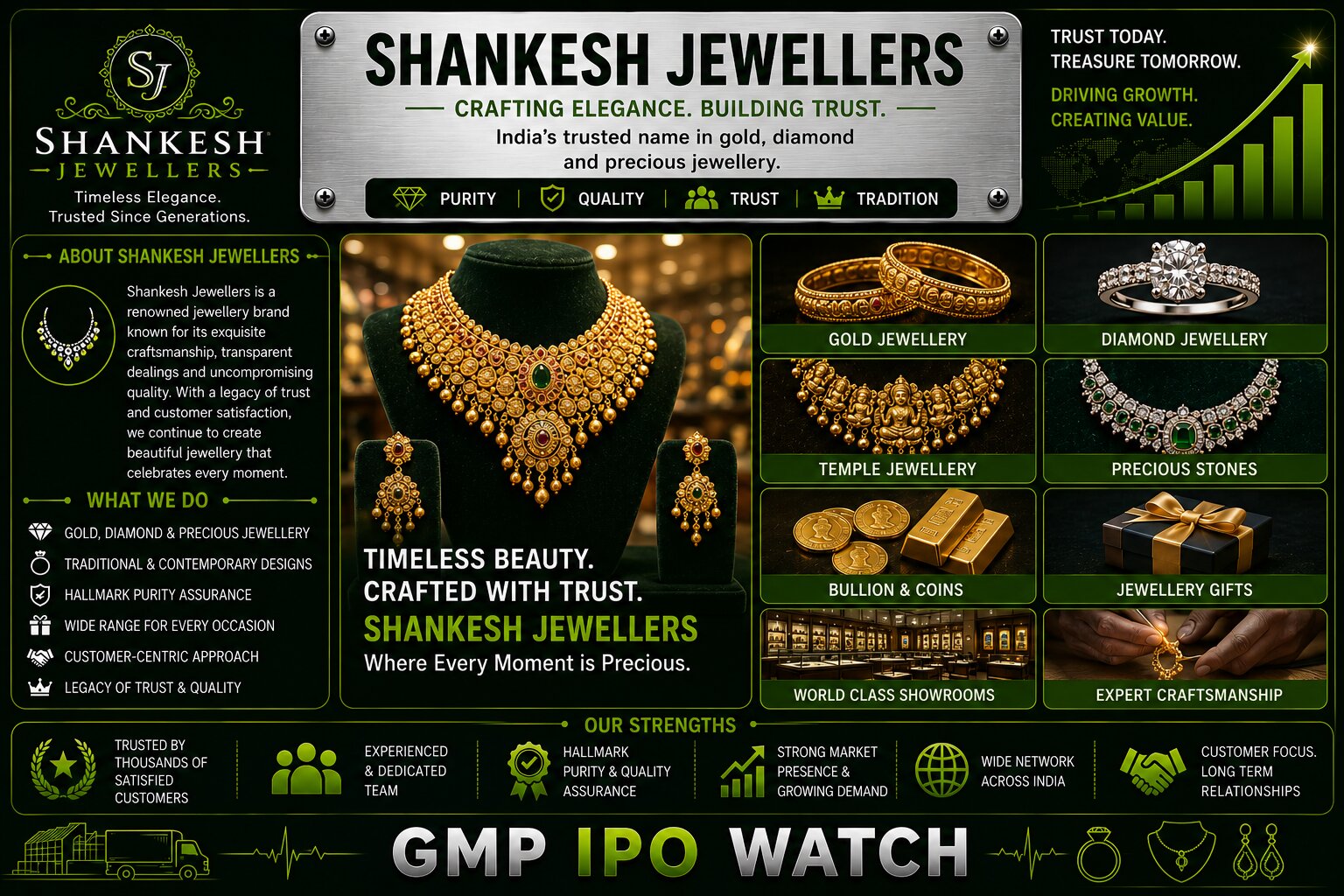
The Mumbai-based company primarily operates as a B2B handcrafted gold jewellery manufacturer and supplier, producing design-led and customised jewellery for organised jewellery retailers and regional jewellery businesses.
Its portfolio includes 22-karat and 18-karat products such as:
- Bangles
- Bridal jewellery
- Necklaces
- Chokers
- Jhumkas
- Mangalsutras
- Rings
- Antique jewellery
- Temple jewellery
- Regional jewellery designs.
Rather than building a massive network of consumer-facing stores, Shankesh uses an asset-light manufacturing model, relying significantly on skilled job workers and karigars.
That makes the company's investment story different from a conventional jewellery retailer.
The important question is:
Can Shankesh use its design capabilities, customer relationships and flexible manufacturing network to grow profitably while controlling gold-price, working-capital and customer-concentration risks?
The IPO opened for subscription today, August 18, 2026.
Shankesh Jewellers IPO Details
| Particular | Details |
|---|---|
| Company | Shankesh Jewellers Limited |
| IPO Type | Book Built Mainboard IPO |
| Issue Size | ₹367.18 Crore |
| Fresh Issue | ₹274.18 Crore |
| Offer for Sale | ₹93 Crore |
| Price Band | ₹88 – ₹93 Per Share |
| Face Value | ₹5 Per Share |
| Lot Size | 160 Shares |
| Minimum Retail Investment | ₹14,880 |
| IPO Open Date | August 18, 2026 |
| IPO Close Date | August 20, 2026 |
| Allotment Date | August 21, 2026 |
| Tentative Listing Date | August 25, 2026 |
| Listing | BSE & NSE |
| Lead Manager | Aryaman Financial Services |
| Registrar | KFin Technologies |
The ₹367.18 crore IPO contains approximately ₹274.18 crore of fresh shares and ₹93 crore through Offer for Sale. This means the majority of the issue represents fresh capital being raised by the company.
Shankesh Jewellers IPO Day 1 Subscription
Shankesh Jewellers IPO opened today and remains available for bidding until August 20.
As of the latest available Day 1 update, the IPO was subscribed approximately:
0.05 times.
This represents early-session demand rather than the final Day 1 subscription figure. Subscription can change significantly during the remaining bidding period.
| Particular | Current Status |
|---|---|
| IPO Day | Day 1 |
| Subscription Open | Yes |
| Latest Reported Overall Subscription | Around 0.05x |
| Closing Date | August 20, 2026 |
| Current Demand | Early Stage |
For IPOs, particularly mainboard issues, a significant portion of institutional and non-institutional bidding can sometimes arrive later in the subscription period.
Therefore, today's early figure should not be treated as the final indication of demand.
Shankesh Jewellers IPO GMP Today
Grey-market sentiment currently appears relatively muted.
India Infoline reported a GMP of approximately:
₹2 per share
on August 18.
Another current market report describes the shares as commanding roughly a 2% grey-market premium over the upper issue price.
| Particular | Value |
|---|---|
| Upper Price Band | ₹93 |
| Reported GMP | Around ₹2 |
| Indicative Price | Around ₹95 |
| Indicative Premium | Around 2.15% |
This suggests relatively modest unofficial listing expectations at present.
However, GMP is unofficial, unregulated and can change rapidly. It should not be considered a guaranteed listing price.
What Does Shankesh Jewellers Actually Do?
Shankesh Jewellers was incorporated in 2005 and is headquartered in Mumbai.
The company specialises in handcrafted gold jewellery with a strong focus on:
design + customisation + craftsmanship + B2B supply.
Instead of relying mainly on customers walking into Shankesh-branded stores, the company supplies jewellery to organised retail chains and established regional jewellery businesses.
This creates a B2B manufacturing relationship.
In simplified terms:
Shankesh designs/manages production → retailer purchases jewellery → retailer sells to final consumer.
Shankesh Is Not Primarily a Jewellery Retail Story
This distinction matters.
A jewellery retailer normally requires:
- Prime-location stores
- Interior expenditure
- Sales employees
- Marketing
- Store-level inventory
Shankesh can operate without building the same level of consumer-facing infrastructure.
Its strength instead comes from:
- Designs
- Skilled artisans
- Retailer relationships
- Manufacturing coordination
- Quality control
That can make expansion less physically capital intensive.
Asset-Light Manufacturing Is Central to the Business
Shankesh relies on a network of skilled job workers and karigars for a significant part of production.
This model has an important advantage.
Suppose demand increases 30%.
A fully integrated jewellery manufacturer might need:
- New factory capacity
- More permanent production employees
- Additional machinery
Shankesh can potentially increase work allocated to its artisan network.
That creates manufacturing flexibility.
But Asset-Light Does Not Mean Risk-Free
Third-party manufacturing creates its own challenges.
Shankesh needs to ensure that external artisans consistently maintain:
- Product quality
- Design specifications
- Gold purity
- Delivery schedules
- Security standards
The company's IPO-related disclosures identify dependence on third-party job workers as an important operating risk.
So the same model that provides flexibility also requires strong quality control.
Craftsmanship Is an Important Competitive Advantage
Indian gold jewellery is not a completely standardised product.
Customers often seek:
- Regional designs
- Bridal collections
- Traditional patterns
- Temple jewellery
- Antique styles
Producing these designs requires skilled artisans.
This makes access to experienced karigars strategically important.
A machine can manufacture standardised products efficiently.
But intricate handcrafted jewellery still depends heavily on human skill.
Customisation Can Strengthen Retailer Relationships
Suppose a jewellery retailer wants a collection specifically designed for customers in one region.
Shankesh can potentially create:
- Different patterns
- Different weights
- Different design themes
for that retailer.
This creates a deeper relationship than simply selling generic gold jewellery.
The more customised the product, the more valuable:
design capability + execution + reliability
become.
Pan-India Distribution Creates Scale
IPO-related company information describes Shankesh as having built a sales network across approximately 21 states and three Union Territories.
That geographic footprint matters.
Jewellery preferences vary substantially across India.
A bridal necklace popular in Maharashtra may differ significantly from jewellery preferred in:
- Rajasthan
- Gujarat
- Tamil Nadu
- West Bengal
A broad geographic presence allows Shankesh to participate in multiple regional jewellery markets.
Regional Jewellery Styles Can Reduce Dependence on One Design Trend
India does not have one uniform jewellery market.
Different regions favour different:
- Designs
- Weight categories
- Wedding traditions
- Gold-buying patterns
Shankesh's broad portfolio therefore creates diversification.
If demand for one design category slows, another category may perform better.
FY2025 Revenue Crossed ₹1,400 Crore
Shankesh reported the following restated historical financial performance:
| Financial Year | Revenue | PAT |
|---|---|---|
| FY2023 | ₹909.20 Cr | ₹10.44 Cr |
| FY2024 | ₹1,061.91 Cr | ₹12.82 Cr |
| FY2025 | ₹1,403.94 Cr | ₹40.31 Cr |
Revenue increased substantially over this period.
More importantly, FY2025 PAT increased to approximately ₹40.31 crore, compared with ₹12.82 crore in FY2024.
That represented a significant improvement in profitability.
FY2026 Profit Growth Was Even Stronger
CRISIL's June 2026 rating rationale provides provisional FY2026 figures showing:
| Particular | FY2025 | FY2026* |
|---|---|---|
| Operating Income | ₹1,403.8 Cr | ₹1,630.8 Cr |
| PAT | ₹40.3 Cr | ₹107.5 Cr |
| PAT Margin | 2.87% | 6.59% |
| Adjusted Debt/Net Worth | 1.44x | 0.80x |
| Interest Coverage | 6.15x | 12.53x |
*FY2026 figures are provisional in the CRISIL rating rationale.
The improvement is significant.
Operating income increased around 16%, while PAT increased far more sharply.
PAT Increased From ₹40.3 Crore to ₹107.5 Crore
This is arguably the most important recent financial development.
Profit increased from approximately:
₹40.3 crore in FY2025
to:
₹107.5 crore in provisional FY2026.
That is an increase of roughly 167%.
Profit therefore grew dramatically faster than operating income.
Investors need to determine whether this represents a sustainable improvement in business economics or an unusually favourable period.
PAT Margin Improved to 6.59%
CRISIL reports PAT margin increasing from:
2.87% in FY2025
to:
6.59% in provisional FY2026.
For a high-revenue jewellery business, even relatively small changes in percentage margins can have a major effect on absolute profit.
Imagine ₹1,600 crore revenue.
A 3% PAT margin generates approximately:
₹48 crore PAT.
A 6.5% margin generates:
₹104 crore PAT.
That illustrates why margin sustainability matters enormously for Shankesh.
Gold Jewellery Is a High-Value, Low-Margin Business
Jewellery companies can report very large revenue because gold itself is expensive.
But high revenue does not automatically mean high profitability.
A significant part of the selling price represents the underlying gold value.
The company's actual economics depend on factors such as:
- Making charges
- Design premium
- Procurement efficiency
- Inventory management
- Customer pricing
Therefore, investors should avoid comparing Shankesh's ₹1,600+ crore operating income directly with companies in unrelated sectors.
Gold Price Volatility Is a Major Risk
Gold prices can change significantly.
This affects:
- Inventory value
- Working-capital requirements
- Customer demand
- Purchasing decisions
Suppose the company needs 100 kg of gold.
If gold prices increase 20%, significantly more working capital is required to finance the same physical inventory.
This is why jewellery businesses can become extremely working-capital intensive.
Working Capital Is More Important Than Factory Capex
Shankesh's asset-light manufacturing model reduces the need for huge factories.
But it does not remove capital requirements.
Instead, capital becomes concentrated in:
gold + inventory + receivables.
This makes working-capital management one of the most important parts of the business.
The IPO itself specifically identifies funding working-capital requirements as one of the uses of fresh proceeds.
Higher Gold Prices Can Increase Capital Requirements Even Without Volume Growth
Consider a simplified example.
Suppose Shankesh carries ₹200 crore of gold inventory.
If gold prices rise 25%, maintaining the same physical quantity could require inventory worth roughly:
₹250 crore.
The business has not sold one additional piece of jewellery.
Yet it may need ₹50 crore more capital.
This demonstrates why jewellery businesses often depend on working-capital financing.
IPO Capital Can Reduce This Pressure
Part of the fresh issue will be used for working capital.
That can allow Shankesh to:
- Finance larger orders
- Hold appropriate inventory
- Support higher sales
- Reduce dependence on short-term borrowing
If deployed efficiently, working-capital capital can directly support revenue growth.
Debt Repayment Is Another IPO Objective
Shankesh also plans to use fresh proceeds for repayment or prepayment of certain borrowings.
This is strategically important because jewellery companies frequently rely on borrowing to finance inventory.
Reducing debt can:
- Lower finance costs
- Improve cash flow
- Strengthen the balance sheet
- Increase financial flexibility
Leverage Has Already Improved
CRISIL reports adjusted debt to adjusted net worth falling from:
1.44x in FY2025
to:
0.80x in provisional FY2026.
This is a substantial improvement.
The IPO-funded repayment could strengthen the balance sheet further.
Interest Coverage Improved Sharply
Interest coverage increased from:
6.15x
to:
12.53x in provisional FY2026.
This means operating profitability provides significantly more coverage for finance costs than in the previous year.
A higher interest-coverage ratio generally indicates stronger debt-servicing capacity.
CRISIL Maintains BBB/Stable Rating
As of its June 9, 2026 rationale, CRISIL maintained a BBB/Stable rating on ₹90 crore of fund-based bank facilities.
The facilities included:
- ₹51 crore cash credit from HDFC Bank
- ₹39 crore cash credit from Kotak Mahindra Bank.
This again illustrates the importance of working-capital financing to the business model.
Fresh Issue Is Much Larger Than OFS
The IPO consists of:
Fresh Issue: ₹274.18 crore
OFS: ₹93 crore.
That means approximately three-quarters of the overall issue is fresh capital.
This is relevant because most of the IPO proceeds are associated with strengthening the company's financial position rather than simply allowing existing shareholders to exit.
OFS Proceeds Do Not Enter the Company
The ₹93 crore OFS component goes to selling shareholders.
It does not finance:
- Working capital
- Debt repayment
- Business expansion
This distinction matters whenever investors analyse headline IPO size.
The actual growth-capital component is the fresh issue.
B2B Customer Relationships Are a Key Business Asset
Shankesh supplies jewellery to organised and established regional jewellery retailers.
These relationships can be valuable.
Retailers need suppliers capable of delivering:
- Reliable purity
- Consistent craftsmanship
- Timely production
- Suitable designs
- Appropriate quantities
Once a supplier demonstrates reliability, repeat business can become easier.
Repeat B2B Orders Can Create Revenue Visibility
Suppose a retail chain successfully sells a Shankesh bridal collection.
It may reorder similar products.
It may also request:
- New designs
- Festival collections
- Wedding collections
- Regional variations
This can increase customer lifetime value.
The ideal model is not constantly finding new retailers.
It is:
retain retailers + increase orders per retailer + add selective new customers.
Customer Concentration Remains a Risk
The downside of B2B jewellery manufacturing is dependence on large customers.
IPO-related business summaries specifically identify customer concentration as a risk.
If one major jewellery retailer reduces orders, revenue can be affected.
Therefore, investors should monitor whether the customer base becomes increasingly diversified after listing.
Asset-Light Production Can Improve ROCE
If Shankesh can increase revenue without investing heavily in owned manufacturing assets, capital efficiency can improve.
The business can potentially scale through:
more designs + more karigars + more customer orders
rather than:
more factories + more machinery.
This can support attractive returns on capital.
But only if working capital remains controlled.
Inventory Is the Real Capital-Intensity Test
A jewellery company may appear asset-light based on fixed assets.
But investors should examine:
- Inventory days
- Receivable days
- Working-capital borrowing
before concluding that the overall business is capital-light.
Gold inventory can absorb enormous amounts of capital.
For Shankesh, efficient inventory turnover will therefore be critical after the IPO.
Faster Inventory Turnover Can Transform Returns
Suppose ₹300 crore of inventory generates ₹1,500 crore of annual revenue.
If the same revenue can eventually be supported with ₹250 crore of inventory, ₹50 crore of capital is released.
That cash can then:
- Reduce debt
- Support growth
- Improve return ratios
Inventory efficiency is therefore a major shareholder-value driver.
Jewellery Demand Has Structural Tailwinds
Gold jewellery remains deeply connected to Indian:
- Weddings
- Festivals
- Gifting
- Savings behaviour
This creates a large underlying market.
Organised jewellery retail has also expanded over time, which can benefit B2B suppliers capable of meeting larger retailers' quality and design requirements.
Shankesh's opportunity is therefore connected not only to jewellery demand but also to the growth of organised retail customers.
Organised Retail Can Raise Supplier Standards
Large jewellery chains generally require:
- Reliable quality
- Standardised documentation
- Consistent delivery
- Strong compliance
This can create barriers for smaller informal manufacturers.
If Shankesh can consistently satisfy organised retailers, it can potentially strengthen its position as the jewellery market formalises.
Design Is More Important Than Gold Itself
Gold is essentially a commodity.
A kilogram of gold does not become unique because Shankesh owns it.
The company's value addition comes from converting gold into products customers want.
That means the real competitive differentiation is:
design + craftsmanship + customer relationships + execution.
This is where Shankesh must create economic value.
Promoter Experience Is Important
Shankesh is promoted by Kantilal Kheemraj Jain, Mahavir Kantilal Jain and Manoj Kantilal Jain.
CRISIL also notes that the business is owned and managed by the Jain promoter family.
Long operating experience can be valuable in jewellery because relationships with:
- Customers
- Suppliers
- Karigars
often develop over many years.
Promoter Holding Was High Before the IPO
Pre-issue promoter holding was reported at approximately 95.48% in IPO-related disclosures.
The IPO will broaden public ownership.
For investors, the more important question after listing will be whether management can maintain:
- Governance standards
- Capital discipline
- Minority shareholder alignment
as the company transitions from closely held ownership to public markets.
Competitive Strengths
Shankesh enters the IPO with several notable strengths.
Large operating scale: Provisional FY2026 operating income reached approximately ₹1,630.8 crore.
Strong recent profitability: PAT increased to approximately ₹107.5 crore in provisional FY2026.
Improved margin: PAT margin increased to approximately 6.59%.
Asset-light manufacturing: Production relies significantly on skilled job workers and karigars.
Wide jewellery portfolio: Includes bridal, antique, temple and regional styles.
Pan-India network: Presence reported across 21 states and three Union Territories.
Improving leverage: Adjusted debt/net worth declined to approximately 0.80x in provisional FY2026.
Major Risks
Gold Price Volatility
Rising gold prices can increase inventory and working-capital requirements.
Customer Concentration
Dependence on large B2B jewellery customers can affect revenue if orders decline.
Job-Worker Dependence
Asset-light production requires reliable third-party artisans.
Working-Capital Intensity
Large amounts of capital can remain tied up in gold inventory and receivables.
Margin Sustainability
Provisional FY2026 PAT margin increased significantly to 6.59%. Investors should monitor whether this improvement can continue.
Jewellery Demand
Gold jewellery purchases can be affected by high gold prices and consumer sentiment.
What Could Drive Shankesh's Next Growth Phase?
Several factors could support future expansion.
Larger Organised Retail Customers
Growth of organised jewellery chains can increase B2B demand.
More Revenue Per Customer
Shankesh can cross-sell additional jewellery categories to existing retailers.
Geographic Expansion
Its existing multi-state network provides a platform for deeper penetration.
New Designs
Frequent product development can strengthen customer relationships.
Working-Capital Expansion
Fresh IPO capital can support larger order volumes.
Lower Debt
Repayment of borrowings can reduce finance expenses.
Better Inventory Turnover
More efficient gold utilisation can significantly improve capital returns.
What Investors Should Track After Listing
| Metric | Why It Matters |
|---|---|
| Revenue Growth | Customer demand |
| PAT Margin | FY2026 profitability sustainability |
| Inventory Days | Gold capital efficiency |
| Receivable Days | Collection quality |
| Working Capital | Funding requirements |
| Debt | IPO deleveraging |
| Interest Coverage | Financial strength |
| Customer Concentration | B2B dependence |
| Operating Cash Flow | Earnings quality |
| ROCE | Capital efficiency |
For Shankesh, inventory, cash flow and margins will be particularly important.
Revenue alone does not tell the full story in a high-value gold business.
The Most Important Post-IPO Equation
The attractive scenario looks like:
fresh IPO capital → lower debt + more working capital → larger retailer orders → faster inventory turnover → higher profit + stronger cash flow.
The weaker scenario looks like:
higher gold prices → more inventory funding → slower customer demand → capital trapped in stock → higher working-capital pressure.
Both scenarios can occur even if the company remains operationally successful.
That is why cash conversion matters.
Should Investors Consider Shankesh Jewellers IPO?
The positive investment case includes:
- ₹1,630.8 crore provisional FY2026 operating income
- ₹107.5 crore provisional FY2026 PAT
- Significant recent margin improvement
- Asset-light manufacturing model
- Wide handcrafted jewellery portfolio
- Established B2B customer relationships
- Broad Indian sales network
- Improving leverage
- Majority fresh-issue IPO.
The caution case includes:
- Gold-price volatility
- Working-capital intensity
- Dependence on job workers
- Customer concentration
- Need to sustain FY2026's sharp profit improvement
- Currently muted GMP
- Early Day 1 subscription levels.
Shankesh should therefore be evaluated primarily as an asset-light B2B jewellery manufacturing and design business, rather than as a traditional jewellery retail chain.
Final View on Shankesh Jewellers IPO 2026
The Shankesh Jewellers IPO opened today, August 18, 2026, and closes on August 20. The ₹367.18 crore mainboard issue has a price band of ₹88–₹93 per share, with a lot size of 160 shares and minimum retail application of ₹14,880 at the upper band. Listing is expected on August 25 on BSE and NSE.
The offer consists of approximately ₹274.18 crore fresh issue and ₹93 crore OFS. Fresh proceeds are intended for purposes including repayment/prepayment of borrowings, working-capital requirements and general corporate purposes.
Financially, the latest provisional FY2026 figures are particularly noteworthy. Operating income increased from ₹1,403.8 crore in FY2025 to ₹1,630.8 crore, while PAT increased from ₹40.3 crore to ₹107.5 crore. PAT margin improved from 2.87% to 6.59%, adjusted debt/net worth declined to 0.80x and interest coverage improved to 12.53x.
The biggest long-term opportunity is to combine:
asset-light manufacturing + skilled craftsmanship + organised jewellery retailers + IPO-funded working capital
to scale sales without building an expensive consumer-facing store network.
The biggest question is whether the company can sustain the substantial FY2026 profitability improvement while managing gold inventory efficiently.
As of today's latest available update, the IPO was around 0.05x subscribed in early Day 1 bidding, while reported GMP was approximately ₹2, implying only a modest unofficial premium over the ₹93 upper price. Both figures can change during the remaining IPO period.