GMP IPO Watch
Madhur Knit Crafts IPO 2026 – Integrated Textile Manufacturer Opens for Subscription
Madhur Knit Crafts Limited has opened its IPO for subscription today, August 24, 2026, with bidding scheduled to continue until August 27.
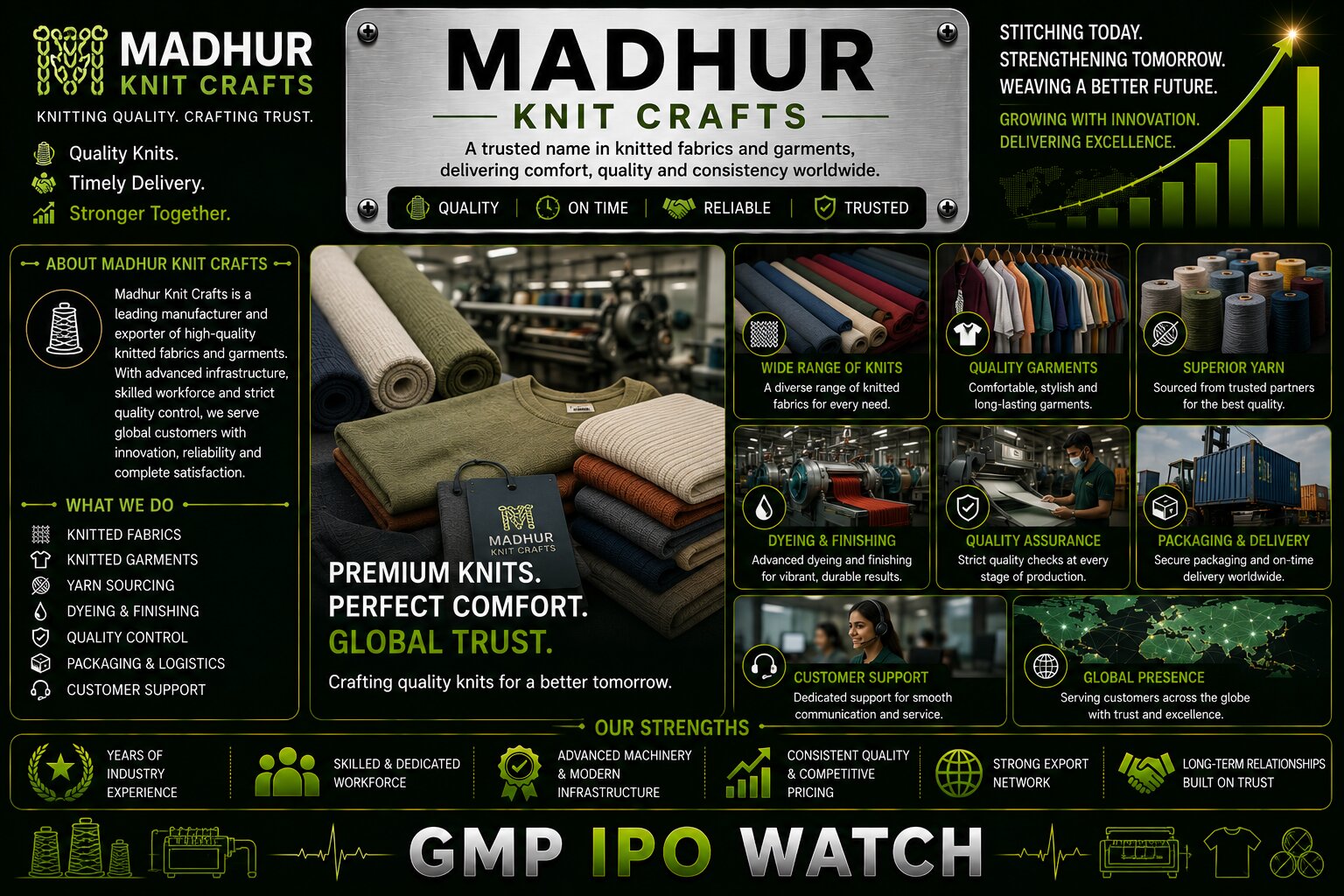
The Ludhiana-based company manufactures fabrics, blankets, winter textiles, garments and other textile products and has built an integrated manufacturing operation covering multiple stages of textile processing.
The company is proposed to list on the NSE Emerge platform, making this an SME IPO rather than a mainboard offering.
Madhur Knit Crafts IPO Details
| Particular | Details |
|---|---|
| Company | Madhur Knit Crafts Limited |
| IPO Type | SME IPO |
| Issue Type | Book Built Issue |
| Issue Size | Up to ~₹53.27 Crore |
| Total Issue | Up to 53,26,800 Equity Shares |
| Fresh Issue | 100% Fresh Issue |
| Offer for Sale | Nil |
| Price Band | ₹95 – ₹100 |
| Face Value | ₹10 |
| Bid Lot | 1,200 Shares |
| Retail Minimum Application | 2 Lots / 2,400 Shares |
| Retail Investment at Upper Band | ₹2.40 Lakh |
| IPO Open Date | August 24, 2026 |
| IPO Close Date | August 27, 2026 |
| Allotment Date | August 28, 2026 |
| Refund / Demat | August 31, 2026 |
| Listing Date | September 1, 2026 |
| Listing Platform | NSE Emerge |
The final issue size reflects the company's August 18 corrigendum. Current issue data shows 53,26,800 shares, versus earlier sources that still display the pre-corrigendum figure of ₹27 crore. At ₹100 per share, the corrected issue works out to approximately ₹53.27 crore.
Madhur Knit Crafts IPO GMP Today
Grey-market activity has begun alongside the opening of the issue.
As of August 24, one current tracker reports Madhur Knit Crafts IPO GMP at ₹9 per share. Against the upper price band of ₹100, that represents an unofficial premium of around 9%.
| GMP Particular | Current Status |
|---|---|
| Upper Issue Price | ₹100 |
| Reported GMP | ₹9 |
| Indicative Price | ₹109 |
| Indicative Premium | ~9% |
| IPO Status | Open – Day 1 |
GMP is unofficial, unregulated and can change rapidly. It should not be treated as a guaranteed listing price.
What Does Madhur Knit Crafts Do?
Madhur Knit Crafts was incorporated in 1997 and is based in Ludhiana, one of India's major textile manufacturing hubs.
The company manufactures products including:
fabrics + blankets + winter textiles + garments + other textile products.
A notable part of the business is its integrated manufacturing setup.
Its capabilities extend across knitting, dyeing, printing, brushing, polishing, sueding, stentering, bonding and finishing.
This gives Madhur Knit Crafts control over several stages of textile production rather than depending completely on outside processors.
Integrated Manufacturing Is an Important Strength
The company's manufacturing model can broadly be understood as:
yarn → knitting → processing → dyeing/printing → finishing → finished textile products.
Having several processes under one operating structure can provide advantages in:
quality control + production scheduling + turnaround time + product customisation.
It may also reduce dependence on third-party textile processors.
However, an integrated plant requires substantial investment in machinery, employees, utilities and working capital.
Winter Textiles Give Madhur Knit a Distinct Product Position
Madhur Knit Crafts has exposure to winter-related textile products, including blankets.
This differentiates it from textile companies focused entirely on basic fabric manufacturing.
Winter textile demand can be supported by domestic consumption and institutional or wholesale customers, but it can also introduce seasonality.
Managing inventory becomes particularly important when certain products have stronger demand during specific parts of the year.
Financial Performance Improved Sharply
The company's latest available financial information shows significant improvement during the 11 months ended February 2026.
| Financial Metric | 11M FY2026 |
|---|---|
| Revenue | ₹194.69 Cr |
| Profit After Tax | ₹12.35 Cr |
| Operating Cash Flow | ₹4.44 Cr |
Revenue reached approximately ₹194.69 crore, while PAT stood at around ₹12.35 crore for the 11-month period.
The improvement in profitability is particularly relevant because SME textile manufacturers often operate with relatively modest margins.
Operating Cash Flow Turned Positive
One financial development worth watching is the improvement in cash generation.
Current IPO analysis indicates that Madhur Knit Crafts had negative operating cash flows in earlier periods, but operating cash flow turned positive at approximately ₹4.44 crore during the first 11 months of FY2026.
This matters because textile businesses can consume substantial working capital.
The operating cycle involves:
raw material purchases → manufacturing → inventory → sales → customer receivables → cash collection.
Strong accounting profits are more valuable when they are also converted into operating cash.
Debt Repayment Is an Important IPO Objective
Current IPO information identifies approximately ₹40.44 crore of specific deployment from the IPO proceeds, with around ₹20.85 crore earmarked mainly for repayment or prepayment of borrowings.
| Use of Proceeds | Purpose |
|---|---|
| Debt Repayment / Prepayment | ~₹20.85 Cr |
| Working Capital | Business requirements |
| Solar / Infrastructure Investment | Operational support |
| General Corporate Purposes | Other requirements |
Because the IPO is entirely a fresh issue, the capital raised goes into the company rather than to shareholders through an OFS.
100% Fresh Issue Is a Key Feature
Madhur Knit Crafts is not using the IPO as an exit route for existing shareholders.
The issue consists of fresh equity.
That creates a straightforward structure:
IPO investors → fresh capital → Madhur Knit Crafts → debt reduction + working capital + business investment.
For a growing SME manufacturer, this can strengthen the balance sheet while providing additional capital to support operations.
Why Working Capital Matters in Textiles
Textile manufacturing requires money to be committed before customers make final payment.
Madhur Knit may need to purchase:
yarn + dyes + chemicals + packaging + other manufacturing inputs
before producing and selling finished products.
If customers take several weeks or months to pay, capital remains tied up in receivables.
As revenue expands, working-capital requirements can therefore increase even when the business is profitable.
Punjab Revenue Concentration Is a Major Risk
One of the more important risks highlighted in current IPO analysis is geographic concentration.
More than 90% of revenue is reportedly concentrated in Punjab.
This means Madhur Knit Crafts has not yet achieved broad geographic diversification despite operating at a meaningful revenue scale.
A stronger long-term progression would be:
Punjab base → wider North India distribution → pan-India customers → export opportunities.
Reducing geographic concentration could make revenue more resilient.
Ludhiana Provides a Textile Ecosystem Advantage
Being located in Ludhiana can also be advantageous.
The region has an established ecosystem involving textile manufacturers, yarn suppliers, processors, traders and skilled workers.
Operating within such a cluster can help with:
raw-material sourcing + skilled labour + vendor relationships + manufacturing expertise.
The challenge is converting this manufacturing advantage into a broader customer base outside the company's existing core market.
Solar Investment Could Help Control Energy Costs
Textile processing can consume considerable electricity because manufacturing equipment operates across knitting, dyeing, finishing and other processing stages.
Investment in solar infrastructure can potentially help reduce dependence on conventional electricity over time.
The economic benefit will depend on actual generation, utilisation and electricity-cost savings.
For an energy-intensive manufacturing company, even incremental savings can improve margins when scaled across large production volumes.
Textile Raw-Material Prices Remain a Risk
The company's profitability can be affected by fluctuations in yarn and other textile input costs.
If raw-material prices rise rapidly, Madhur Knit must either:
pass the increase to customers or absorb it through lower margins.
Passing price increases through immediately is not always possible.
Raw-material procurement and inventory management therefore remain important parts of the company's profitability.
Competition Is High
India's textile industry is highly fragmented.
Madhur Knit Crafts competes with:
organised manufacturers + regional textile companies + unorganised producers + imported products.
Price competition can be intense, particularly in relatively standardised textile categories.
The company therefore needs to compete through a combination of product quality, manufacturing efficiency, pricing, customer relationships and timely delivery.
SME IPO Liquidity Should Be Considered
Madhur Knit Crafts will list on NSE Emerge, not the NSE mainboard.
SME shares can experience:
lower trading volumes + larger bid-ask spreads + higher volatility.
The minimum retail application is also much larger than a typical mainboard IPO.
At the upper price band:
2,400 shares × ₹100 = ₹2.40 lakh.
This makes capital allocation more significant for individual investors.
Key Strengths
Madhur Knit Crafts enters the IPO with several positives. It has operated since 1997, giving it a long history in textile manufacturing, and its integrated manufacturing setup covers multiple processes from knitting through finishing.
The latest available period also shows revenue of approximately ₹194.69 crore and PAT of ₹12.35 crore, alongside positive operating cash flow of ₹4.44 crore.
Other positives include:
- Integrated textile manufacturing operations
- Exposure to fabrics, blankets and winter textiles
- 100% fresh IPO structure
- Debt-repayment component
- Working-capital funding
- Positive operating cash flow in the latest reported period
- Established Ludhiana manufacturing base
Major Risks
The biggest areas investors should watch include geographic concentration, working-capital requirements, textile raw-material volatility and the sustainability of recent profitability.
More than 90% revenue concentration in Punjab is particularly notable, while historical negative operating cash flow shows why cash conversion needs continued monitoring.
As an NSE SME issue, post-listing liquidity and price volatility are additional considerations.
What Investors Should Track After Listing
| Metric | Why It Matters |
|---|---|
| Revenue Growth | Business expansion |
| PAT Growth | Earnings momentum |
| EBITDA Margin | Manufacturing profitability |
| Operating Cash Flow | Earnings quality |
| Punjab Revenue Share | Geographic concentration |
| New State Expansion | Diversification |
| Working-Capital Days | Cash efficiency |
| Receivable Days | Collection performance |
| Borrowings | IPO deleveraging |
| Finance Costs | Benefit from debt repayment |
| Capacity Utilisation | Manufacturing efficiency |
| ROCE | Capital productivity |
One particularly important indicator will be whether Madhur Knit Crafts can grow outside Punjab while maintaining positive operating cash flow.
Final View on Madhur Knit Crafts IPO 2026
The Madhur Knit Crafts IPO opened today, August 24, and closes on August 27, 2026, at a price band of ₹95–₹100 per share. The company is scheduled to list on NSE Emerge on September 1.
Importantly, the corrected issue structure reflects up to 53,26,800 equity shares, making the offer worth approximately ₹53.27 crore at the upper band. Some IPO pages still display the older ₹27 crore figure, so the post-corrigendum share count should be used.
Financially, the company reported approximately ₹194.69 crore revenue and ₹12.35 crore PAT during the first 11 months of FY2026, while operating cash flow turned positive at ₹4.44 crore.
Today's reported GMP is around ₹9 per share, implying an unofficial premium of roughly 9% over the ₹100 upper price, although GMP can change quickly.