GMP IPO Watch
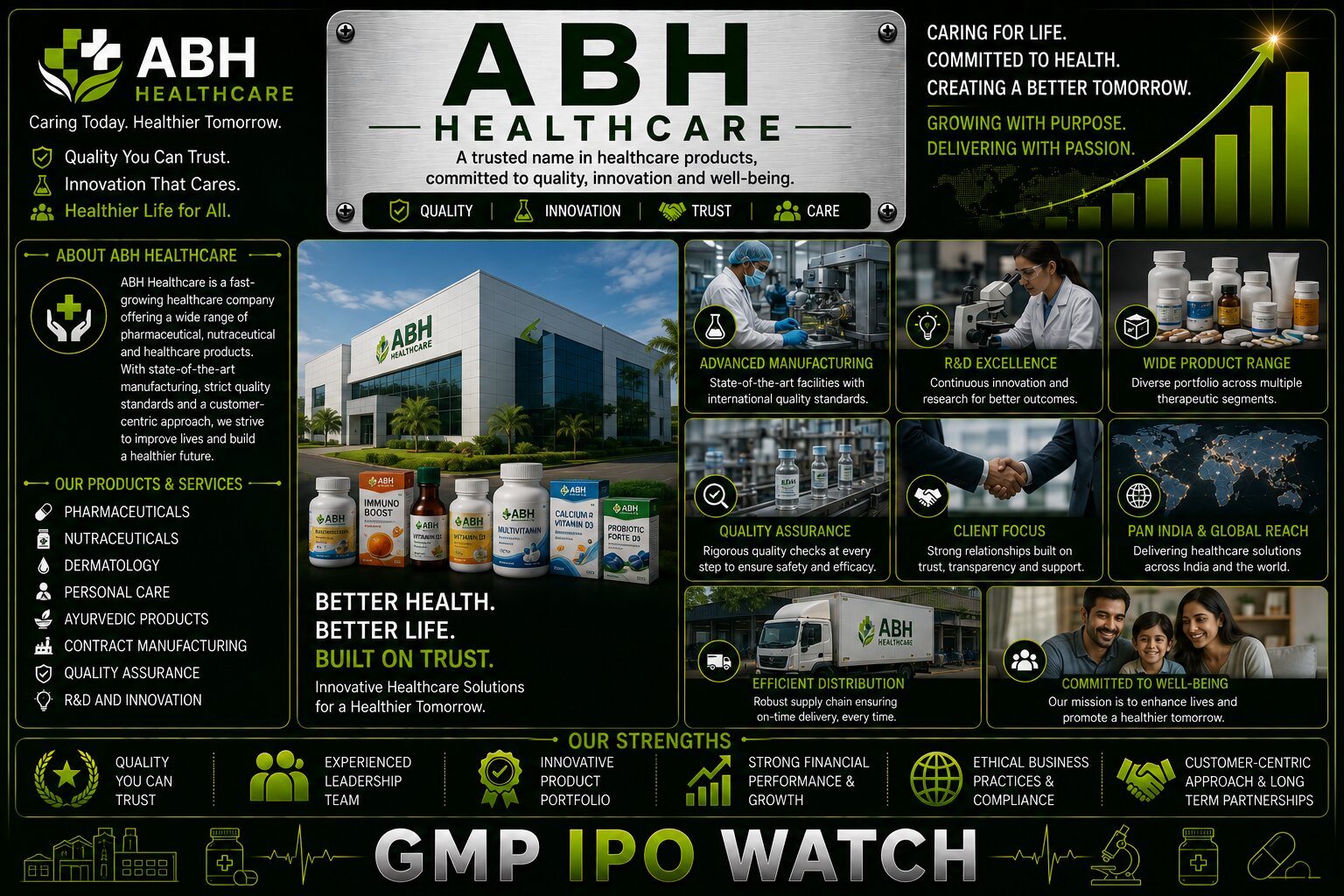
ABH Healthcare IPO 2026 – Ferozepur Hospital Operator Enters NSE SME Market
ABH Healthcare Limited opened its IPO for subscription today, August 24, 2026, with the issue scheduled to remain open until August 27.
The company operates Anil Baghi Hospital, a 150-bed tertiary-care hospital located in Ferozepur, Punjab. Its healthcare services span multiple medical and surgical specialities, making this IPO a direct play on organised healthcare demand in a regional Indian market.
Unlike an OFS-heavy IPO, the ABH Healthcare issue is entirely a fresh issue. This means the money raised, after issue expenses, is intended for the company's own requirements rather than an exit by existing shareholders.
ABH Healthcare IPO Details
| Particular | Details |
|---|---|
| Company | ABH Healthcare Limited |
| IPO Type | SME IPO |
| Listing Platform | NSE SME / NSE Emerge |
| Issue Type | Book Built Issue |
| Issue Size | ₹34.98 Crore |
| Fresh Issue | ₹34.98 Crore |
| Offer for Sale | Nil |
| Shares Offered | 34,29,600 Shares |
| Price Band | ₹96 – ₹102 |
| Face Value | ₹10 |
| Bid Lot | 1,200 Shares |
| Retail Minimum | 2,400 Shares |
| Retail Investment at ₹102 | ₹2,44,800 |
| IPO Open Date | August 24, 2026 |
| IPO Close Date | August 27, 2026 |
| Allotment | August 28, 2026 |
| Refund / Demat | August 31, 2026 |
| Expected Listing | September 1, 2026 |
Current IPO sources consistently report a ₹34.98 crore issue, a ₹96–₹102 price band and 34,29,600 fresh shares.
ABH Healthcare IPO GMP Today
Unlike several other IPOs currently attracting aggressive grey-market premiums, ABH Healthcare had no reported GMP as of August 24 on one current tracker.
| GMP Particular | Current Status |
|---|---|
| Upper Issue Price | ₹102 |
| Reported GMP | Not started / ₹– |
| Expected Premium | Not available |
| IPO Status | Open – Day 1 |
This is worth presenting accurately rather than assigning an estimated premium. Grey-market trading is unofficial and can begin or change at any point during the IPO period.
Day 1 Subscription Starts Building
Investor bidding has started on the opening day.
At around 1:20 PM on August 24, one live source reported overall subscription of approximately 0.28×, including retail subscription of around 0.16× and QIB demand of around 3.45×. Another tracker subsequently showed overall demand around 0.31×.
These are intraday figures and will continue changing until bidding closes.
What Does ABH Healthcare Do?
ABH Healthcare operates Anil Baghi Hospital, a multi-speciality tertiary-care hospital in Ferozepur.
The current company traces its healthcare operations to the acquisition of the Anil Baghi Hospital proprietorship business in 2022. The hospital itself has a much longer operating history in the region.
Its business model is straightforward:
patients → consultations/diagnostics → medical or surgical treatment → hospital revenue.
Unlike pharmaceutical or medical-device companies, ABH Healthcare's growth is primarily driven by patient volumes, treatments, hospital capacity utilisation and revenue generated per occupied bed.
150-Bed Hospital Is the Core Asset
The company currently operates a 150-bed hospital in Ferozepur.
This makes capacity utilisation an important operating metric.
For a hospital business, fixed costs such as doctors, nurses, equipment, utilities and infrastructure remain substantial regardless of whether every bed is occupied.
As occupancy improves, a larger revenue base can therefore absorb these fixed costs.
The ideal operating equation is:
higher patient footfall → stronger bed occupancy → better utilisation → higher revenue → improved operating leverage.
Multi-Speciality Model Provides Revenue Diversification
Anil Baghi Hospital provides healthcare services across multiple medical specialities rather than relying on a single treatment category.
Current IPO information describes it as offering around 25 medical specialities.
This can help generate revenue from different types of patients while allowing doctors to refer cases internally between departments.
For example, a patient entering through emergency or general medicine may subsequently require diagnostics, surgery, critical care or another specialist.
That creates multiple revenue touchpoints within the same hospital.
FY2026 Revenue Reached ₹52.51 Crore
ABH Healthcare entered the IPO after reporting profitable operations in FY2026.
| Financial Metric | FY2026 |
|---|---|
| Revenue | ₹52.51 Cr |
| Profit After Tax | ₹5.64 Cr |
| Approx. PAT Margin | 10.7% |
The company reported ₹52.51 crore revenue and ₹5.64 crore PAT in FY2026, implying a net profit margin of roughly 10.7%.
For investors, the next question is whether the company can maintain or improve profitability as it deploys IPO capital.
₹17 Crore Planned for Debt Repayment
One of the biggest uses of IPO proceeds is balance-sheet improvement.
The company plans to allocate approximately ₹17 crore toward repayment or prepayment of borrowings.
That represents a meaningful portion of the ₹34.98 crore issue.
Use of IPO Proceeds
| Purpose | Details |
|---|---|
| Debt Repayment / Prepayment | ₹17.00 Crore |
| Working Capital | Business requirements |
| General Corporate Purposes | Balance amount |
| Issue Structure | 100% Fresh Issue |
Reducing debt can potentially lower future finance costs.
For a hospital operator, this could free more operating cash for medical equipment, employees, maintenance and future expansion.
100% Fresh Issue Is an Important Positive
ABH Healthcare's IPO does not contain an Offer for Sale.
| Component | Amount |
|---|---|
| Fresh Issue | ₹34.98 Cr |
| OFS | Nil |
| Total IPO | ₹34.98 Cr |
This means the issue is primarily a capital-raising event for the company itself.
The intended cycle is:
IPO capital → debt reduction + working capital → stronger balance sheet → improved operating flexibility.
Whether that translates into higher shareholder returns will depend on how efficiently management uses the capital.
Working Capital Is Important for Hospital Operations
Hospitals need continuous liquidity.
ABH Healthcare must fund expenses such as medicines, consumables, salaries, equipment maintenance, utilities and other day-to-day operating requirements.
At the same time, not every patient payment is received immediately.
Insurance companies and government healthcare schemes can involve settlement periods.
That creates a working-capital cycle between providing medical treatment and collecting payment.
IPO funding could therefore reduce pressure on short-term liquidity as the business grows.
Insurance and Government Empanelment Can Support Patient Volumes
Current company information indicates that Anil Baghi Hospital is empanelled with multiple insurance providers and government healthcare schemes.
This is important for patient accessibility.
Healthcare costs can be significant, and insurance or government coverage can allow a larger patient base to use private hospital facilities.
A broader payer network can therefore support:
patient access + treatment volumes + hospital utilisation.
However, institutional and insurance billing can also result in longer receivable cycles.
Geographic Concentration Is the Biggest Business Risk
ABH Healthcare's most obvious risk is its dependence on a single geographic market.
Current IPO analysis highlights 100% geographic concentration, with operations centred in Ferozepur.
Unlike a hospital chain operating across multiple cities, ABH currently depends heavily on the performance of one hospital.
This means any major local disruption could have a disproportionate impact.
It also limits the company's immediate addressable patient market.
Single-Hospital Dependence Needs Attention
Operating one principal hospital creates concentration at the asset level as well.
A large multi-city healthcare chain can compensate if one hospital temporarily underperforms.
ABH Healthcare has less diversification.
Any disruption involving:
medical infrastructure + regulatory approvals + doctor availability + property issues + local competition
could have a larger effect on overall company performance.
Expansion into additional locations could eventually reduce this risk, but investors should evaluate the business based on its current structure.
Property-Related Matters Are Another Risk
Current IPO analysis also highlights property ownership disputes among the risks associated with the company.
Property issues can be particularly relevant for hospital businesses because healthcare infrastructure is highly location-dependent and difficult to relocate quickly.
Investors should therefore review the relevant RHP disclosures carefully when assessing this risk.
Healthcare Demand Provides a Structural Opportunity
The broader opportunity comes from India's increasing demand for organised healthcare.
Demand can be supported by:
population growth + rising incomes + health insurance penetration + ageing population + chronic diseases + preference for organised hospitals.
Smaller cities can also present opportunities because advanced healthcare infrastructure is often more concentrated in large metropolitan markets.
A well-established regional hospital can benefit when patients prefer receiving treatment closer to home rather than travelling to a major city.
Regional Brand Recognition Can Help
Healthcare is a trust-driven business.
Patients often select hospitals based on:
doctor reputation + treatment quality + previous experience + referrals + local reputation.
Anil Baghi Hospital's established presence in Ferozepur can therefore provide an advantage that a completely new entrant would need time to replicate.
The challenge is maintaining that reputation while scaling operations.
Doctors Are Critical to Hospital Growth
Hospital buildings alone do not create patient demand.
Experienced doctors and specialists are among the most important assets in healthcare.
ABH Healthcare therefore needs to retain and attract:
specialist doctors + surgeons + nurses + technicians + support staff.
Loss of important doctors could affect patient volumes in particular departments.
Employee and medical-professional retention should therefore remain an important post-listing consideration.
SME IPO Investment Size Is Much Higher
ABH Healthcare will list on the NSE SME platform rather than the mainboard.
The bid lot is 1,200 shares, while retail investors need to apply for at least 2,400 shares under the current SME IPO application framework.
At ₹102:
2,400 × ₹102 = ₹2,44,800.
That is significantly larger than the roughly ₹15,000 minimum normally associated with mainboard IPO applications.
SME stocks can also experience lower liquidity and higher price volatility after listing.
Key Strengths of ABH Healthcare
ABH Healthcare's investment story centres on an established 150-bed tertiary-care hospital, multi-speciality operations and profitable FY2026 financials.
The 100% fresh issue is also notable because IPO proceeds are being raised directly for company requirements rather than shareholder exits.
Other positives include the planned ₹17 crore debt reduction, exposure to growing regional healthcare demand and an established hospital brand in Ferozepur.
Major Risks
The main issues investors should monitor are geographic concentration, single-hospital dependence, property-related disputes, doctor retention, regulatory requirements and working-capital management.
SME-market liquidity is another important consideration.
Most importantly, the company currently lacks the geographic diversification of a multi-city hospital chain. Current IPO analysis specifically identifies its 100% geographic concentration as a key risk.
What Investors Should Track After Listing
| Metric | Why It Matters |
|---|---|
| Patient Footfall | Healthcare demand |
| Bed Occupancy | Hospital utilisation |
| Revenue per Bed | Asset productivity |
| Revenue Growth | Business expansion |
| EBITDA Margin | Operating efficiency |
| PAT Growth | Earnings performance |
| Operating Cash Flow | Earnings quality |
| Receivable Days | Collection efficiency |
| Debt | IPO deleveraging |
| Finance Cost | Benefit from debt repayment |
| Doctor Retention | Service continuity |
| New Capacity / Locations | Future diversification |
For ABH Healthcare, bed occupancy, cash flow and debt reduction may be more useful indicators after listing than simply looking at revenue growth.
Final View on ABH Healthcare IPO 2026
The ABH Healthcare IPO opened today, August 24, and closes on August 27, 2026. The ₹34.98 crore NSE SME issue is priced at ₹96–₹102 per share and consists entirely of fresh shares, with no OFS.
The underlying business is a 150-bed tertiary-care hospital in Ferozepur, while FY2026 revenue and PAT stood at approximately ₹52.51 crore and ₹5.64 crore, respectively.
Approximately ₹17 crore of IPO proceeds is planned for debt repayment, with additional funds supporting working-capital requirements.
Unlike several currently active IPOs, there was no reported ABH Healthcare GMP on one current tracker as of August 24, so assigning a speculative listing premium would be misleading.