GMP IPO Watch
Shankesh Jewellers IPO 2026 – Can Rapid Profit Growth Continue After Listing?
Shankesh Jewellers Limited has reached the third and final day of its IPO today, August 20, 2026.
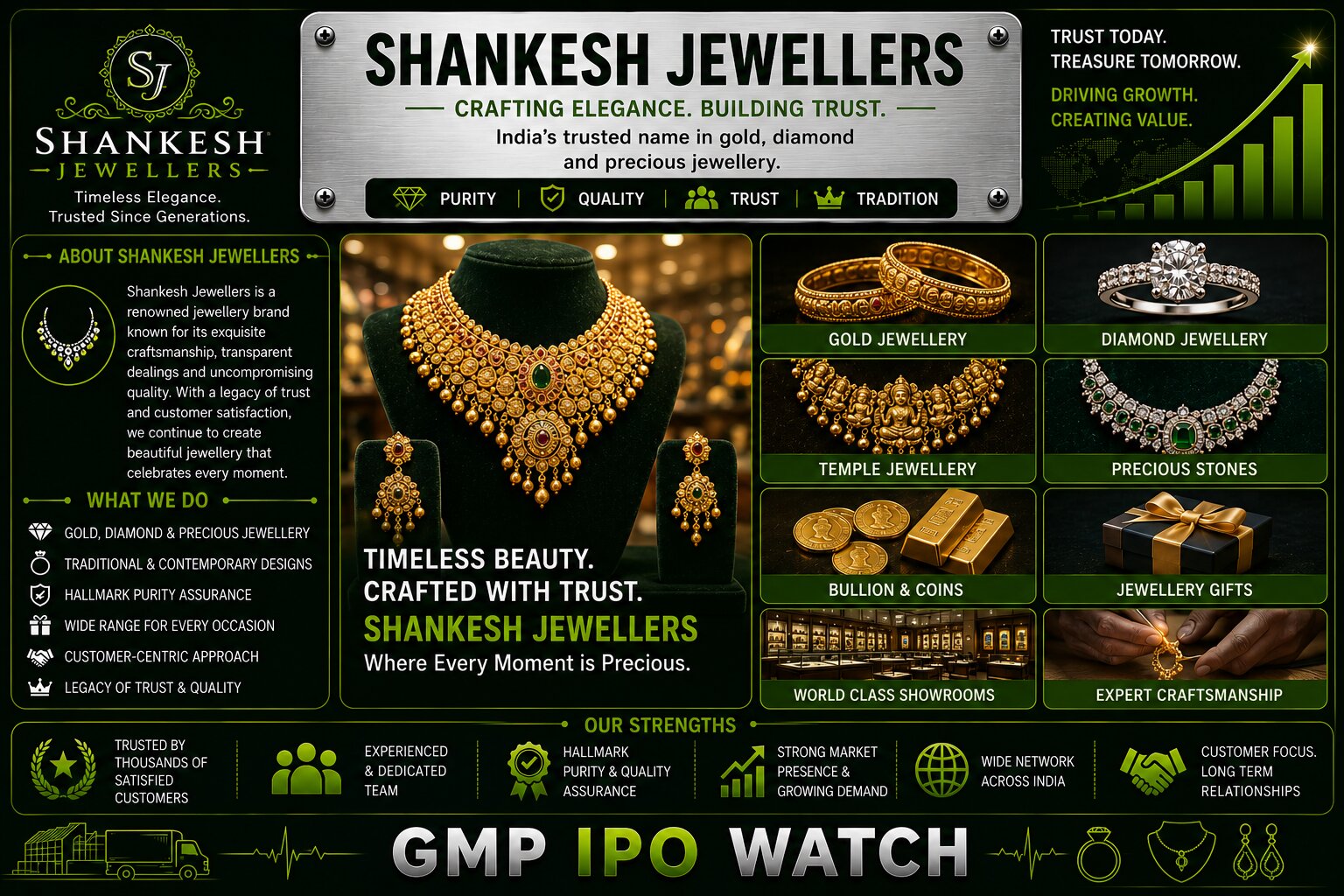
The Mumbai-based jewellery company operates primarily in the B2B handcrafted gold jewellery market, manufacturing customised jewellery rather than relying mainly on a large consumer-facing retail-store network.
That makes Shankesh different from many familiar listed jewellery businesses.
Its IPO story revolves around:
gold jewellery manufacturing + B2B relationships + working capital + debt reduction + improving profitability.
The company has delivered particularly strong earnings growth in FY2026, with PAT increasing substantially faster than revenue. The key question after listing will be whether this profitability can be maintained.
Shankesh Jewellers IPO Details
| Particular | Details |
|---|---|
| IPO Type | Mainboard IPO |
| Issue Size | ₹367.18 Crore |
| Fresh Issue | ₹274.18 Crore |
| Offer for Sale | ₹93.00 Crore |
| Price Band | ₹88 – ₹93 |
| Face Value | ₹5 |
| Lot Size | 160 Shares |
| Minimum Investment | ₹14,880 |
| IPO Open Date | August 18, 2026 |
| IPO Close Date | August 20, 2026 |
| Allotment Date | August 21, 2026 |
| Refund / Demat | August 24, 2026 |
| Listing Date | August 25, 2026 |
| Listing | BSE & NSE |
| Business | Gold Jewellery |
| Registrar | KFin Technologies |
At the upper price of ₹93, one retail lot of 160 shares requires ₹14,880. The offer consists of approximately 2.95 crore fresh shares and 1 crore shares through OFS.
Shankesh Jewellers IPO GMP Today
Grey-market sentiment is currently modest rather than exceptionally strong.
On the final bidding day, the latest report indicates that Shankesh Jewellers shares are trading at roughly a 3% grey-market premium.
| GMP Particular | Current Status |
|---|---|
| Upper Price Band | ₹93 |
| Latest GMP | ~3% |
| Indicative Price | ~₹96 |
| Market Sentiment | Modestly Positive |
The GMP had reportedly risen to approximately 5% on Day 2, before moderating on the final day.
GMP is unofficial and unregulated. It can change quickly and should not be considered a guaranteed listing return.
Investor Demand Has Been Building Gradually
The IPO saw a relatively measured start.
Day 1 overall subscription was approximately 0.36×. Available Day 2 data showed demand improving, with retail participation stronger than institutional participation during the earlier part of the session.
Since today is the final bidding day, the eventual QIB and NII numbers will be particularly important.
Institutional investors often place substantial bids late in the IPO process.
What Does Shankesh Jewellers Do?
Shankesh Jewellers was originally incorporated in 2005 as H. K. Gold Private Limited.
The company specialises in manufacturing and supplying customised handcrafted gold jewellery.
Its product positioning includes jewellery made primarily using:
22-karat and 18-karat gold.
Rather than focusing exclusively on direct retail customers, its B2B model allows it to manufacture jewellery that can be supplied through other jewellery businesses and distribution relationships.
Customisation Is Important in the Jewellery Business
Indian jewellery demand varies significantly between regions.
Customers in one market may prefer:
traditional designs
while another market may demand:
lightweight + contemporary + modern jewellery.
For a B2B manufacturer, the ability to produce customised designs for different buyers can therefore become an important competitive capability.
Shankesh's handcrafted manufacturing model allows it to serve varying design requirements instead of depending only on standardised products.
FY2026 Was a Breakout Year for Profit
The company's financial performance has improved sharply over the past three years.
| Financial Year | Total Income | PAT |
|---|---|---|
| FY2024 | ₹1,061.91 Cr | ₹12.82 Cr |
| FY2025 | ₹1,403.94 Cr | ₹40.31 Cr |
| FY2026 | ₹1,630.93 Cr | ₹106.68 Cr |
The most striking number is PAT.
Profit increased from approximately:
₹12.82 crore in FY2024
to:
₹40.31 crore in FY2025
and then to:
₹106.68 crore in FY2026.
That means FY2026 PAT grew by approximately 165% year-on-year, even though total income increased by roughly 16%.
EBITDA Has Also Expanded Rapidly
EBITDA increased from:
₹28.60 crore in FY2024
to:
₹65.35 crore in FY2025
and:
₹157.90 crore in FY2026.
This indicates substantial operating-margin improvement.
The numbers suggest Shankesh has not simply increased jewellery sales—it has generated considerably more operating profit from its revenue base.
The key post-IPO question becomes:
Is this margin improvement sustainable?
That is more important than simply extrapolating FY2026 profit growth into future years.
Gold Jewellery Is a High-Value, Working-Capital-Intensive Business
Gold creates a unique financial challenge.
Unlike many manufacturers, Shankesh's principal raw material is extremely valuable.
The business cycle can look like:
purchase/source gold → manufacture jewellery → maintain inventory → supply customers → collect receivables.
Significant capital can remain tied up throughout this process.
As the company grows, working-capital requirements can increase even if profitability remains strong.
This explains why part of the IPO proceeds is specifically earmarked for working capital.
₹158 Crore Will Go Toward Debt Repayment
One of the most important features of the IPO is the use of fresh capital.
Shankesh proposes to deploy approximately:
₹158 crore toward repayment or prepayment of borrowings.
Another:
₹38 crore
is intended for working-capital requirements.
Use of IPO Proceeds
| Purpose | Approx. Amount |
|---|---|
| Debt Repayment | ₹158 Crore |
| Working Capital | ₹38 Crore |
| General Corporate Purposes | Balance |
| Main Focus | Deleveraging + Growth |
Debt reduction is therefore the largest identified use of the fresh issue.
Debt Reduction Could Improve Future Earnings Quality
Shankesh reported total borrowings of approximately:
₹109.81 crore in FY2024
₹145.63 crore in FY2025
and:
₹167.30 crore in FY2026.
That upward trend is important.
Growth has required additional capital, and borrowings have increased alongside the business.
Using ₹158 crore of IPO proceeds toward debt repayment could materially change the balance sheet.
The potential equation is:
lower debt → lower interest costs → stronger cash flow → greater financial flexibility.
For a working-capital-intensive jewellery business, that can be valuable.
₹38 Crore Working-Capital Infusion Can Support Scale
The second major allocation is approximately ₹38 crore for working capital.
This capital can support the operating cycle as the company expands.
For example, additional working capital can allow Shankesh to:
source more gold → manufacture more jewellery → fulfil larger orders → support more customers.
The important issue is whether the resulting sales generate sufficient margins and cash returns.
Working-capital growth without adequate profitability would simply tie up additional shareholder capital.
B2B Model Has Different Economics From Retail Jewellery
A large jewellery retailer invests heavily in:
stores + interiors + consumer advertising + prime locations + retail employees.
Shankesh's B2B-oriented model can avoid part of that cost structure.
Instead, its capital requirements are concentrated more heavily around:
gold inventory + manufacturing + receivables + customer relationships.
That can make the operating model relatively asset-light from a retail-infrastructure perspective.
However, lower retail infrastructure does not mean the business itself is capital-light because gold inventory can absorb significant funds.
Customer Relationships Matter
B2B jewellery buyers need manufacturers capable of consistently delivering:
design quality + purity + finishing + pricing + delivery reliability.
Once a manufacturer becomes an established supplier, repeat business can become valuable.
Shankesh's ability to retain and expand customer relationships will therefore be an important long-term growth driver.
A wider customer network can also reduce dependence on individual buyers.
Gold Prices Can Help Revenue but Complicate Analysis
When gold prices rise, the rupee value of jewellery sales can increase even without equivalent growth in physical volume.
This means investors should not look only at headline revenue.
For example:
higher gold price + unchanged jewellery volume = potentially higher reported revenue.
But that does not automatically mean the underlying business has expanded proportionately.
Investors should therefore evaluate margins, volumes, inventory efficiency and cash flows alongside revenue.
Gold Price Volatility Is Also a Risk
Rapid movements in gold prices can affect:
- Inventory valuation
- Customer demand
- Working-capital requirements
- Jewellery affordability
- Purchasing behaviour
- Hedging requirements
When gold becomes expensive, customers may shift toward lighter-weight jewellery.
Manufacturers therefore need to adapt designs and inventory accordingly.
Jewellery Demand Has Strong Cultural Support in India
India remains one of the world's major gold-jewellery markets.
Demand is supported by:
weddings + festivals + gifting + savings behaviour + cultural traditions.
This provides a large underlying market for jewellery manufacturers.
But demand is not constant throughout the year.
Wedding and festival seasons can produce stronger periods, while high gold prices can temporarily affect purchasing volumes.
Handcrafted Jewellery Can Create Differentiation
Jewellery is not purchased purely based on the quantity of gold.
Design and craftsmanship influence value.
A manufacturer that can produce:
complex designs + consistent finishing + customised products + attractive lightweight jewellery
may be able to differentiate itself from commodity-style competitors.
For Shankesh, maintaining this manufacturing capability becomes important as volumes increase.
Rapid Growth Creates Its Own Risks
Shankesh's profit growth has been exceptionally strong.
But rapid expansion can put pressure on:
inventory + receivables + working capital + quality control + customer concentration + management systems.
This means investors should not judge the business solely on its FY2026 PAT.
The more important question is whether Shankesh can sustain profitability while maintaining balance-sheet discipline.
Net Worth Has More Than Tripled in Two Years
The company's net worth increased from approximately:
₹60.29 crore in FY2024
to:
₹100.60 crore in FY2025
and:
₹209.43 crore in FY2026.
The RHP reports FY2026 NAV at ₹17.82 per share.
The improvement reflects the company's rapidly increasing retained earnings and capital base.
Post-IPO debt reduction could further strengthen the financial structure.
Most of the IPO Is Fresh Capital
The total offer size is:
₹367.18 crore.
Of this:
₹274.18 crore is fresh issue
while:
₹93 crore is OFS.
That means approximately 75% of the IPO is fresh capital.
This is meaningful because the majority of funds raised through the offer are intended to strengthen the company rather than solely provide an exit to existing shareholders.
Promoters Retain Significant Ownership
Before the IPO, promoter holding was approximately 95.48%.
The public issue will increase outside ownership, but promoters will continue to retain a substantial interest in the company.
The named promoters include Kantilal Kheemraj Jain, Mahavir Kantilal Jain and Manoj Kantilal Jain.
Key Strengths of Shankesh Jewellers
The company enters the IPO with several positives.
Its income has grown from approximately ₹1,062 crore in FY2024 to ₹1,631 crore in FY2026, while PAT increased dramatically from ₹12.82 crore to ₹106.68 crore over the same period.
The business also benefits from an established presence in customised handcrafted gold jewellery and a B2B-focused operating model.
Most importantly, around three-quarters of the IPO is fresh capital, with ₹158 crore earmarked for debt repayment and ₹38 crore for working capital.
If deployed effectively, this could leave Shankesh with a significantly stronger balance sheet after listing.
Major Risks
The biggest issue investors should examine is whether the recent surge in profitability is sustainable.
Other important risks include:
- Gold-price volatility
- High working-capital requirements
- Inventory management
- Customer concentration
- Receivable collection
- Competition from organised jewellery companies
- Dependence on skilled artisans
- Changes in consumer preferences
- Gold sourcing and regulatory requirements
- Margin volatility
The company's borrowings had also increased to ₹167.30 crore by FY2026, although the IPO proposes substantial deleveraging.
What Investors Should Track After Listing
| Metric | Why It Matters |
|---|---|
| Revenue Growth | Business expansion |
| PAT Margin | Profit sustainability |
| EBITDA Margin | Operating performance |
| Gold Volume | Underlying sales |
| Inventory Days | Capital efficiency |
| Receivable Days | Collection quality |
| Operating Cash Flow | Earnings quality |
| Borrowings | IPO debt reduction |
| Finance Cost | Deleveraging benefit |
| Customer Growth | B2B expansion |
| ROCE | Capital productivity |
| ROE | Shareholder returns |
For Shankesh, the most important post-listing test will be:
whether FY2026's sharp profit improvement translates into sustainable cash flow.
Final View on Shankesh Jewellers IPO 2026
The Shankesh Jewellers IPO closes today, August 20, 2026, at a price band of ₹88–₹93 per share. The ₹367.18 crore mainboard issue comprises approximately ₹274.18 crore of fresh shares and ₹93 crore OFS, with listing scheduled for August 25.
Current grey-market sentiment is relatively moderate, with today's report indicating approximately a 3% premium, lower than the roughly 5% reported during Day 2.
Fundamentally, the strongest part of the story is the company's recent earnings trajectory. Total income reached approximately ₹1,630.93 crore in FY2026, while PAT jumped to ₹106.68 crore, compared with ₹40.31 crore in FY2025 and ₹12.82 crore in FY2024.
The IPO could also materially reshape the balance sheet. Around ₹158 crore is intended for debt repayment and ₹38 crore for working capital, potentially reducing finance costs while providing additional capital to support B2B jewellery orders.