GMP IPO Watch
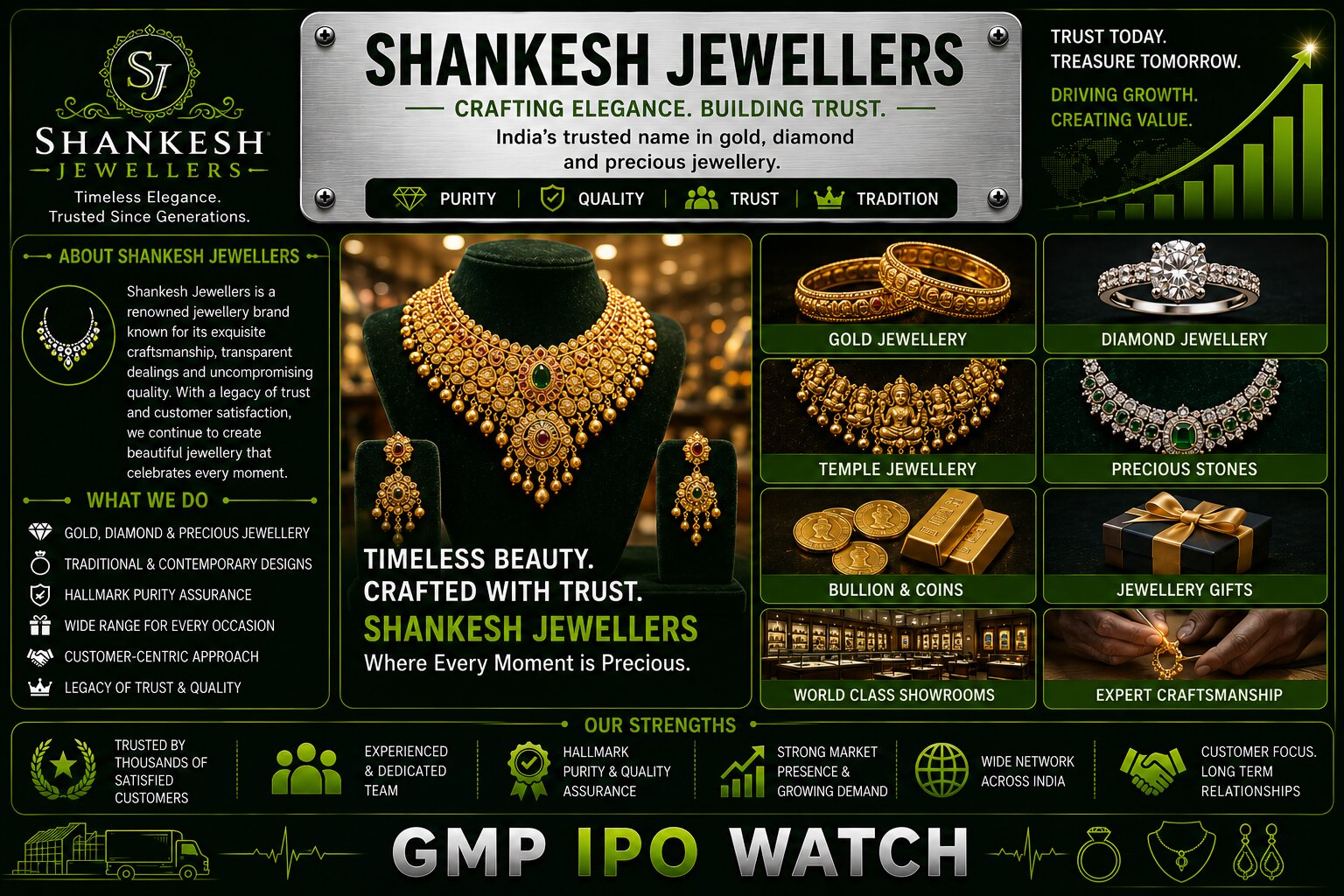
Shankesh Jewellers IPO 2026 – Can Strong Profit Growth Continue After Debt Reduction?
Shankesh Jewellers Limited has entered the primary market with a ₹367.18 crore mainboard IPO, and today, August 19, is the second day of bidding.
Unlike large jewellery retailers that primarily sell directly to consumers through showrooms, Shankesh operates mainly as a B2B jewellery company.
Its business focuses on manufacturing and supplying customised handcrafted gold jewellery to jewellery retailers and other business customers.
That makes its model fundamentally different from a large showroom chain.
The investment story revolves around three major factors:
rapid profit growth + debt reduction + working-capital efficiency.
FY2026 was particularly strong, with total income reaching approximately ₹1,630.93 crore and PAT increasing to ₹106.68 crore.
The key question for investors is whether this improvement represents sustainable business growth or an unusually strong year that will be difficult to repeat.
Shankesh Jewellers IPO Details
| Particular | Details |
|---|---|
| Company | Shankesh Jewellers Ltd. |
| IPO Type | Book Built Mainboard IPO |
| Listing | BSE & NSE |
| Issue Size | ₹367.18 Crore |
| Fresh Issue | ₹274.18 Crore |
| Offer for Sale | ₹93 Crore |
| Price Band | ₹88 – ₹93 |
| Face Value | ₹5 Per Share |
| Lot Size | 159 Shares |
| Minimum Investment | ₹14,787 |
| IPO Open Date | August 18, 2026 |
| IPO Close Date | August 20, 2026 |
| Allotment Date | August 21, 2026 |
| Refund / Share Credit | August 24, 2026 |
| Listing Date | August 25, 2026 |
| Business | B2B Gold Jewellery |
| Listing Platform | Mainboard |
Current offer details show a total issue size of ₹367.18 crore, consisting of approximately ₹274.18 crore fresh issue and ₹93 crore OFS. The price band is ₹88–₹93 per share.
Shankesh Jewellers IPO GMP Today
Grey-market sentiment remains positive but relatively modest.
As of August 19, 2026, the latest reported GMP is approximately:
₹5 per share.
At the ₹93 upper price:
₹93 + ₹5 = ₹98
This indicates an unofficial premium of approximately:
5.38%.
| GMP Particular | Current Status |
|---|---|
| Upper IPO Price | ₹93 |
| Latest GMP | ₹5 |
| Indicative Price | ₹98 |
| Indicative Gain | ~5.38% |
The GMP has been volatile. It moved from ₹0 on August 11 to as high as ₹8 on August 13 before settling around ₹5 on August 19.
This suggests positive but cautious grey-market sentiment rather than expectations of exceptionally high listing gains.
GMP is unofficial and unregulated, so actual listing performance can differ significantly.
IPO Demand Is Building on Day 2
Shankesh Jewellers opened for subscription on August 18 and was approximately 0.36× subscribed on Day 1.
The IPO remains open until August 20, meaning investors still have the remainder of Day 2 and the final bidding day.
Institutional participation is particularly important to monitor because QIB bids frequently arrive closer to the closing session.
Short-term investors may focus on subscription and GMP, but long-term investors should pay more attention to the company's financial performance and capital requirements.
What Does Shankesh Jewellers Do?
Shankesh Jewellers was incorporated in 2005 and is engaged in manufacturing and supplying customised handcrafted gold jewellery.
Its products are primarily supplied to B2B customers rather than relying on a large consumer-facing retail network.
The company's jewellery portfolio includes customised designs intended to meet varying regional and customer preferences.
This gives Shankesh an important advantage:
it does not need to build an expensive nationwide showroom network to grow sales.
Instead, it can use relationships with existing jewellery retailers to reach end customers.
Asset-Light Model Is an Important Strength
Shankesh's business is relatively asset-light because it relies substantially on third-party artisans for jewellery manufacturing.
This can reduce the need to maintain a huge permanent manufacturing workforce.
The model can be simplified as:
design + gold procurement + artisan network + quality control + B2B distribution.
That creates scalability.
If demand increases, the company can potentially expand production through its artisan ecosystem without making proportionately large investments in factories.
However, this structure also creates dependence on third-party artisans.
B2B Distribution Reduces Showroom Capex
Large retail jewellery companies need significant capital for:
- Stores
- Interiors
- Employees
- Security
- Marketing
- Store-level inventory
Shankesh avoids part of this expenditure because its customers handle the retail side.
This means capital can remain focused on:
gold inventory + working capital + customer relationships + design development.
But the model has its own disadvantage.
Shankesh does not control the final customer relationship as directly as a consumer-facing jewellery brand.
FY2026 Financial Performance Was Exceptionally Strong
Shankesh has reported substantial improvement in its financial performance.
| Financial Year | Total Income | PAT |
|---|---|---|
| FY2024 | ₹1,061.91 Cr | ₹12.82 Cr |
| FY2025 | ₹1,403.94 Cr | ₹40.31 Cr |
| FY2026 | ₹1,630.93 Cr | ₹106.68 Cr |
The numbers show two different trends.
Revenue has grown steadily.
But profits have grown dramatically faster.
From FY2024 to FY2026, PAT increased from approximately:
₹12.82 crore → ₹106.68 crore.
That represents more than an eight-fold increase in two years.
FY2026 PAT Increased Around 165%
PAT increased from:
₹40.31 crore in FY2025
to:
₹106.68 crore in FY2026.
That is growth of approximately 165%.
Total income, meanwhile, increased around 16%.
This indicates significant margin expansion.
For IPO investors, this is encouraging—but it also creates an important question:
Can the FY2026 margin level be sustained?
If margins normalise after listing, earnings growth could slow even if revenue continues increasing.
EBITDA Has Also Expanded Rapidly
EBITDA increased from approximately:
₹28.60 crore in FY2024
to:
₹65.35 crore in FY2025
and then:
₹157.90 crore in FY2026.
This suggests the improvement is visible at the operating level rather than only at PAT.
The business appears to have achieved considerably stronger operating economics over the past two years.
Balance Sheet Has Expanded Alongside the Business
Shankesh's total assets increased from approximately:
₹177.07 crore in FY2024
to:
₹249.56 crore in FY2025
and:
₹403.76 crore in FY2026.
Net worth also increased substantially:
| Financial Year | Net Worth |
|---|---|
| FY2024 | ₹60.29 Cr |
| FY2025 | ₹100.60 Cr |
| FY2026 | ₹209.43 Cr |
The growing equity base gives the company greater financial capacity.
But borrowings remain meaningful.
Debt Repayment Is the Biggest IPO Objective
Shankesh plans to use approximately:
₹158 crore
from the fresh issue to repay or prepay borrowings.
That's approximately 57.6% of the fresh issue proceeds.
The expected benefit is straightforward:
lower debt → lower interest expense → stronger cash flow → better balance sheet.
IPO Proceeds Utilisation
| Purpose | Amount |
|---|---|
| Debt Repayment | ₹158 Cr |
| Working Capital | ₹38 Cr |
| General Corporate Purposes | ₹78.18 Cr |
| Total Fresh Issue | ₹274.18 Cr |
This is a meaningful use of fresh capital because the company is strengthening its balance sheet rather than using the entire IPO only for expansion.
Borrowings Reached ₹167.30 Crore in FY2026
Total borrowings increased from:
₹109.81 crore in FY2024
to:
₹145.63 crore in FY2025
and:
₹167.30 crore in FY2026.
Therefore, the planned ₹158 crore debt repayment is substantial relative to current borrowings.
If executed as planned, Shankesh could emerge from the IPO with a considerably lighter debt burden.
That can improve future profitability even without extraordinary revenue growth.
Jewellery Is a Working-Capital-Heavy Business
Although Shankesh's operating model is asset-light, it is not necessarily capital-light.
Gold itself is expensive.
The company needs money for:
gold purchases → production → inventory → customer credit → receivables.
There can be a significant time gap between purchasing raw material and collecting money from customers.
This explains why the company is allocating another:
₹38 crore
toward working-capital requirements.
Gold Price Volatility Is a Major Risk
Gold prices can move sharply.
That affects Shankesh in several ways.
Higher gold prices increase:
- Raw material cost
- Inventory value
- Working-capital requirements
- Customer ticket size
They can also reduce consumer affordability.
Because Shankesh's B2B customers ultimately sell jewellery to consumers, weak end-customer demand can eventually affect wholesale orders.
Current IPO disclosures specifically identify gold-price volatility as an important business risk.
B2B Customers Create Both Scale and Dependence
The B2B model allows Shankesh to reach customers across India without opening hundreds of stores.
But the company ultimately depends on its retail partners.
If those jewellers experience:
- Lower consumer demand
- Financial difficulties
- Inventory reduction
- Competitive pressure
their orders from Shankesh may decline.
Therefore, Shankesh's business success remains partly dependent on its customers' ability to sell jewellery to final consumers.
Pan-India Customer Relationships Are Valuable
Shankesh has developed a diversified B2B customer base across India, supported by decades of promoter experience in the jewellery industry.
This network can become a significant competitive advantage.
Jewellery wholesaling is heavily relationship-driven.
Retailers need confidence that suppliers can consistently deliver:
quality + purity + designs + pricing + delivery timelines.
Once strong supplier relationships are established, they can be difficult for new competitors to replicate quickly.
Handcrafted Jewellery Creates Product Differentiation
Shankesh focuses on customised handcrafted jewellery rather than only standardised mass-market products.
That allows it to serve different regional tastes.
India does not have one uniform jewellery market.
Design preferences can vary significantly across:
- Maharashtra
- Gujarat
- Rajasthan
- South India
- North India
A wide design catalogue can help the company serve multiple customer groups without relying on a single style.
Third-Party Artisans Create Scalability
Using third-party artisans allows Shankesh to expand production without owning every manufacturing facility.
This can improve capital efficiency.
But it also creates operational risks involving:
quality control + delivery schedules + artisan availability + confidentiality of designs.
The company therefore needs strong quality-control systems.
If jewellery quality fails, the damage can extend beyond one order because reputation is critical in the industry.
Competition Remains Intense
India's jewellery market contains:
- Large organised brands
- Regional jewellery chains
- Wholesalers
- Manufacturers
- Thousands of local jewellers
Shankesh therefore operates in a highly competitive environment.
Its B2B model reduces direct competition with some retail brands, but retailers still have many suppliers to choose from.
Maintaining customer relationships and product differentiation is essential.
The IPO Is Mostly Fresh Capital
Of the total ₹367.18 crore issue:
₹274.18 crore is fresh issue
and:
₹93 crore is OFS.
This means approximately 75% of the IPO is fresh capital going into the company.
That's structurally useful because the majority of funds can strengthen Shankesh's business and balance sheet.
The ₹93 crore OFS, by contrast, goes to selling shareholders.
Key Strengths
Shankesh Jewellers enters the IPO with several notable positives:
Strong revenue scale: FY2026 total income reached approximately ₹1,630.93 crore.
Rapid profit growth: PAT increased from ₹12.82 crore in FY2024 to ₹106.68 crore in FY2026.
Improving EBITDA: EBITDA reached approximately ₹157.90 crore in FY2026.
Established industry experience: Promoters have more than three decades of jewellery-industry experience.
Asset-light production: Third-party artisan relationships provide manufacturing scalability.
Diversified B2B customer base: Existing relationships support pan-India distribution.
Debt reduction: ₹158 crore of IPO proceeds is intended for borrowings repayment.
Fresh-issue-heavy structure: Around ₹274 crore of the ₹367 crore IPO goes directly to the company.
Major Risks
The most important risk is gold-price volatility.
The second is the company's working-capital-intensive business model.
The third is dependence on third-party artisans for manufacturing.
The fourth is dependence on B2B customers successfully selling jewellery to end consumers.
The fifth is intense competition across India's organised and unorganised jewellery industry.
Finally, investors should monitor whether the exceptional FY2026 profit growth and margin expansion can be sustained.
What Investors Should Track After Listing
| Metric | Why It Matters |
|---|---|
| Revenue Growth | B2B demand |
| EBITDA Margin | Operating efficiency |
| PAT Margin | Profit sustainability |
| Borrowings | IPO debt reduction |
| Finance Cost | Deleveraging benefit |
| Inventory | Working-capital control |
| Receivables | Customer collection |
| Operating Cash Flow | Earnings quality |
| Gold Price Exposure | Commodity risk |
| Customer Concentration | B2B dependency |
| ROCE | Capital efficiency |
| PAT Growth | FY2026 sustainability |
The most important post-IPO combination will be:
debt + cash flow + margins.
If debt declines while operating cash flow remains healthy and margins stay strong, the IPO capital will have materially strengthened the business.
Final View on Shankesh Jewellers IPO 2026
The Shankesh Jewellers IPO is open from August 18 to August 20, 2026, with a price band of ₹88–₹93 per share. The ₹367.18 crore mainboard issue consists of approximately ₹274.18 crore fresh issue and ₹93 crore OFS, with listing expected on August 25.
Current grey-market sentiment is moderately positive. As of August 19, the latest reported GMP is approximately ₹5, indicating an unofficial estimated price around ₹98 compared with the ₹93 upper issue price.
Fundamentally, the financial improvement is more interesting than the GMP.
Total income increased from approximately ₹1,061.91 crore in FY2024 to ₹1,630.93 crore in FY2026, while PAT surged from ₹12.82 crore to ₹106.68 crore over the same period.
The IPO can also materially change the balance sheet because ₹158 crore is earmarked for debt repayment and ₹38 crore for working capital.
For long-term investors, the main question is therefore not whether the current ₹5 GMP becomes ₹8 or ₹10.
It is whether Shankesh can preserve its FY2026 profitability while managing gold-price volatility, working capital, B2B customer relationships and third-party manufacturing.