GMP IPO Watch
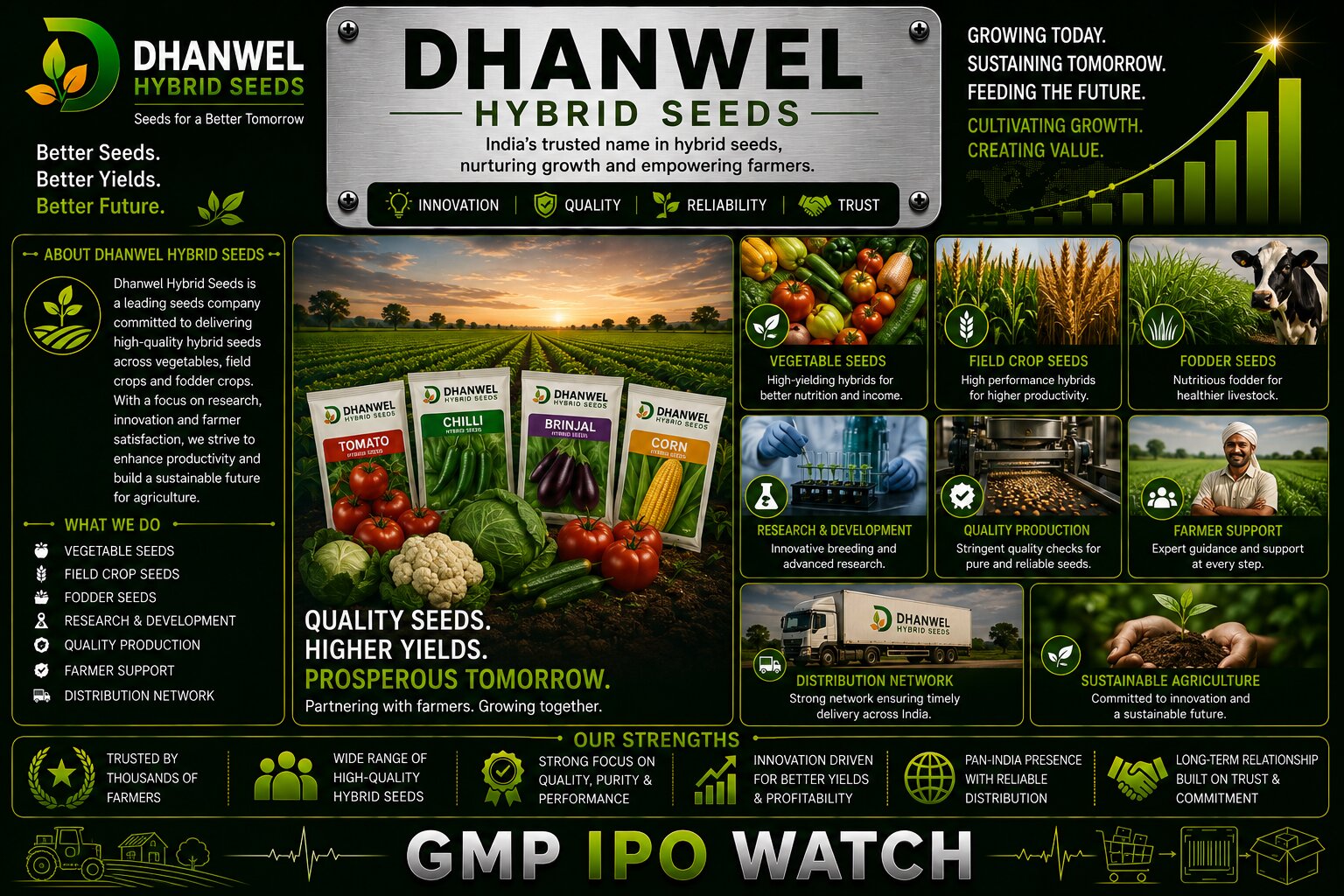
Dhanwel Hybrid Seeds IPO – Understanding the Business Beyond the Issue
Dhanwel Hybrid Seeds Limited operates in a business that sits at the beginning of India's agricultural value chain.
Before farmers can produce wheat, groundnut, soybean, pulses or vegetables, they need reliable seeds. The quality of those seeds can directly influence crop productivity, disease resistance and overall farm economics.
Dhanwel is engaged in the development, multiplication, processing and supply of seeds for field crops and vegetables. Its production process uses improved genetic seed material procured from recognised agricultural institutions and other approved sources.
The company completed its SME IPO earlier in 2026. Despite some recently published pages incorrectly presenting the issue as an August IPO, the company's June 15 RHP and established market records show that the issue actually opened on June 24, 2026, closed on June 29 and was scheduled for listing on July 2.
Dhanwel Hybrid Seeds IPO Details
| Particular | Details |
|---|---|
| IPO Type | BSE SME IPO |
| Issue Size | ₹26.73 Crore |
| Fresh Issue | ₹26.73 Crore |
| OFS | Nil |
| Price Band | ₹95 – ₹99 |
| Face Value | ₹10 |
| Lot Size | 1,200 Shares |
| Retail Minimum | 2,400 Shares |
| Minimum Investment | ₹2,37,600 |
| IPO Open | June 24, 2026 |
| IPO Close | June 29, 2026 |
| Allotment | June 30, 2026 |
| Share Credit | July 1, 2026 |
| Listing Date | July 2, 2026 |
| Exchange | BSE SME |
| Final Issue Price | ₹99 |
The IPO was entirely a fresh issue of 27 lakh equity shares, meaning there was no Offer for Sale component.
This structure is worth noting because the money raised was intended for the company's requirements rather than providing an exit to existing shareholders.
What Does Dhanwel Hybrid Seeds Do?
Dhanwel operates across the seed manufacturing and distribution chain.
Its activities broadly involve:
genetic seed sourcing → multiplication → farming network → processing → quality control → packaging → distribution.
The company deals in seeds for several agricultural crops, including varieties associated with groundnut, soybean, gram, sesame, wheat, green gram, black gram, fenugreek and cumin.
This provides some crop diversification instead of making the business dependent on a single agricultural product.
FY2026 Revenue Jumped to ₹74.59 Crore
One of the strongest points in Dhanwel's IPO story was its recent financial growth.
According to the restated financial statements in its RHP:
| Financial Year | Revenue | PAT |
|---|---|---|
| FY2024 | ₹35.49 Cr | ₹1.91 Cr |
| FY2025 | ₹44.13 Cr | ₹2.16 Cr |
| FY2026 | ₹74.59 Cr | ₹6.12 Cr |
Revenue increased approximately 69% in FY2026, rising from ₹44.13 crore to ₹74.59 crore.
PAT expanded even faster, from approximately ₹2.16 crore to ₹6.12 crore.
This means FY2026 was not simply a higher-sales year—the company also achieved significantly stronger profitability.
Profit Growth Outpaced Revenue Growth
The improvement becomes clearer when looking across FY2024 to FY2026.
Revenue increased from roughly:
₹35.49 crore → ₹74.59 crore
while PAT moved from:
₹1.91 crore → ₹6.12 crore.
Revenue more than doubled over this period, while profit increased by more than three times.
That combination is attractive, but investors should monitor whether these margins remain sustainable as the company scales.
IPO Capital Was Focused on the Balance Sheet and Working Capital
Dhanwel identified three principal uses for the fresh IPO proceeds:
repayment or prepayment of borrowings, funding working-capital requirements and general corporate purposes.
This fits the economics of the seed industry.
Seed businesses can require significant working capital because money may be tied up across:
- Seed procurement
- Contract farming
- Processing
- Inventory
- Packaging
- Distribution
- Receivables
The company may spend money well before the final seed packet is sold and payment is collected.
Why Working Capital Matters
Imagine Dhanwel expects strong demand for groundnut seeds before the planting season.
It cannot wait until farmers start purchasing seeds to begin production.
The company needs to arrange seed multiplication and processing well in advance.
That means cash becomes tied up before revenue is realised.
As the business grows from ₹35 crore revenue toward ₹75 crore and potentially beyond, working-capital requirements can increase substantially.
The IPO therefore provides additional financial capacity to support a larger operating cycle.
Agriculture Creates a Large Long-Term Market
India's agricultural economy provides a substantial addressable market for seed companies.
Farmers increasingly look for improved seed varieties that can potentially offer better:
yield + germination + crop quality + disease tolerance + productivity.
The organised seed industry can benefit as farmers gradually move toward commercially produced and quality-controlled seeds.
For Dhanwel, this creates room for expansion if it can build farmer and distributor trust.
Seed Quality Is the Company's Most Important Product
A farmer purchasing seed cannot fully evaluate its quality by looking at the packet.
The real test occurs after sowing.
Farmers care about:
- Germination rate
- Genetic purity
- Crop uniformity
- Yield
- Disease resistance
This makes reputation extremely important.
If a seed variety performs well, farmers and distributors may purchase it again in the following season.
If performance is poor, rebuilding trust can be difficult.
Weather Is a Major Business Risk
Dhanwel cannot control rainfall.
A weak monsoon or unusual weather conditions can affect:
acreage planted + farmer purchasing power + crop choices + seed demand.
Even if the company produces high-quality seeds, agricultural demand can change because of external conditions.
This makes the business more seasonal and weather-sensitive than many conventional consumer businesses.
Crop Prices Can Also Influence Seed Demand
Farmers respond to economics.
If soybean prices are attractive, farmers may plant more soybean.
If another crop offers better returns, acreage can shift.
Therefore, Dhanwel needs a diversified seed portfolio capable of responding to changing crop preferences.
Its presence across multiple field crops can help reduce dependence on any one commodity.
Seed Production Has Its Own Agricultural Risk
Dhanwel is not exposed only to its customers' farming risk.
Seed multiplication itself depends on agriculture.
Poor weather during seed production can affect:
- Seed availability
- Quality
- Yield
- Procurement cost
So weather can influence both the company's supply side and the farmers who ultimately create demand.
Distribution Will Determine Future Scale
A seed company can have excellent products but still struggle if farmers cannot easily buy them.
Distribution is therefore critical.
Growth requires relationships across:
distributors → dealers → agricultural retailers → farmers.
As Dhanwel expands geographically, strengthening this network could become one of its biggest growth drivers.
Smaller Scale Creates Opportunity and Risk
Dhanwel remains relatively small compared with India's major agricultural-input companies.
That creates upside because a smaller revenue base can potentially grow quickly.
But it also creates disadvantages.
Larger competitors may have:
- Bigger R&D budgets
- Wider dealer networks
- Stronger farmer recognition
- More crop varieties
- Larger marketing budgets
Dhanwel therefore needs to grow without sacrificing seed quality or working-capital discipline.
Key Strengths
The company's biggest positive is its recent financial momentum. FY2026 revenue reached approximately ₹74.59 crore while PAT increased to around ₹6.12 crore.
Its diversified seed portfolio provides exposure to multiple crops rather than one narrow agricultural category.
The IPO was also 100% fresh issue, meaning the capital was raised directly for the company's requirements.
The business operates in an essential sector where better seed quality can contribute directly to agricultural productivity.
Major Risks
Dhanwel's performance can be affected by monsoon conditions, changing crop acreage and agricultural commodity prices.
Seed quality is another major risk because poor germination or product performance can damage farmer confidence.
The business also requires working capital well before seasonal sales are realised.
Competition from larger seed companies, dependence on farmers and production partners, regulatory requirements and geographic expansion execution should also be monitored.
Finally, because Dhanwel is an SME-listed company, investors should consider the typically lower liquidity and potentially higher share-price volatility associated with SME stocks.
What Investors Should Track After the IPO
| Metric | Why It Matters |
|---|---|
| Revenue Growth | Business expansion |
| PAT Margin | Profit sustainability |
| Seed Volumes | Underlying demand |
| Crop Mix | Diversification |
| Inventory | Working-capital control |
| Receivables | Cash collection |
| Borrowings | Balance-sheet strength |
| Operating Cash Flow | Earnings quality |
| Dealer Network | Distribution growth |
| New Seed Varieties | Product expansion |
| Geographic Reach | Market penetration |
| ROCE | Capital efficiency |
The most important post-IPO combination is likely to be:
revenue growth + operating cash flow + working-capital efficiency.
Rapid sales growth is valuable only when the company can convert those sales into sustainable cash generation.
Final View on Dhanwel Hybrid Seeds
Dhanwel Hybrid Seeds completed a ₹26.73 crore BSE SME IPO, entirely through a fresh issue of 27 lakh shares. The price band was ₹95–₹99, with the issue opening on June 24 and closing on June 29, 2026. The final issue price was ₹99, with listing scheduled for July 2.
The strongest part of the company's story is its financial acceleration.
FY2026 revenue increased to approximately ₹74.59 crore from ₹44.13 crore in FY2025, while PAT jumped to about ₹6.12 crore from ₹2.16 crore.
The IPO capital was aimed at strengthening the balance sheet, supporting working capital and funding general corporate requirements—important areas for a growing seed company.
Going forward, the business case is straightforward:
better seed portfolio → wider distribution → more farmers → higher sales → stronger scale and profitability.
But agriculture remains unpredictable. Weather conditions, seed quality, crop prices and working-capital requirements can materially influence performance.