GMP IPO Watch
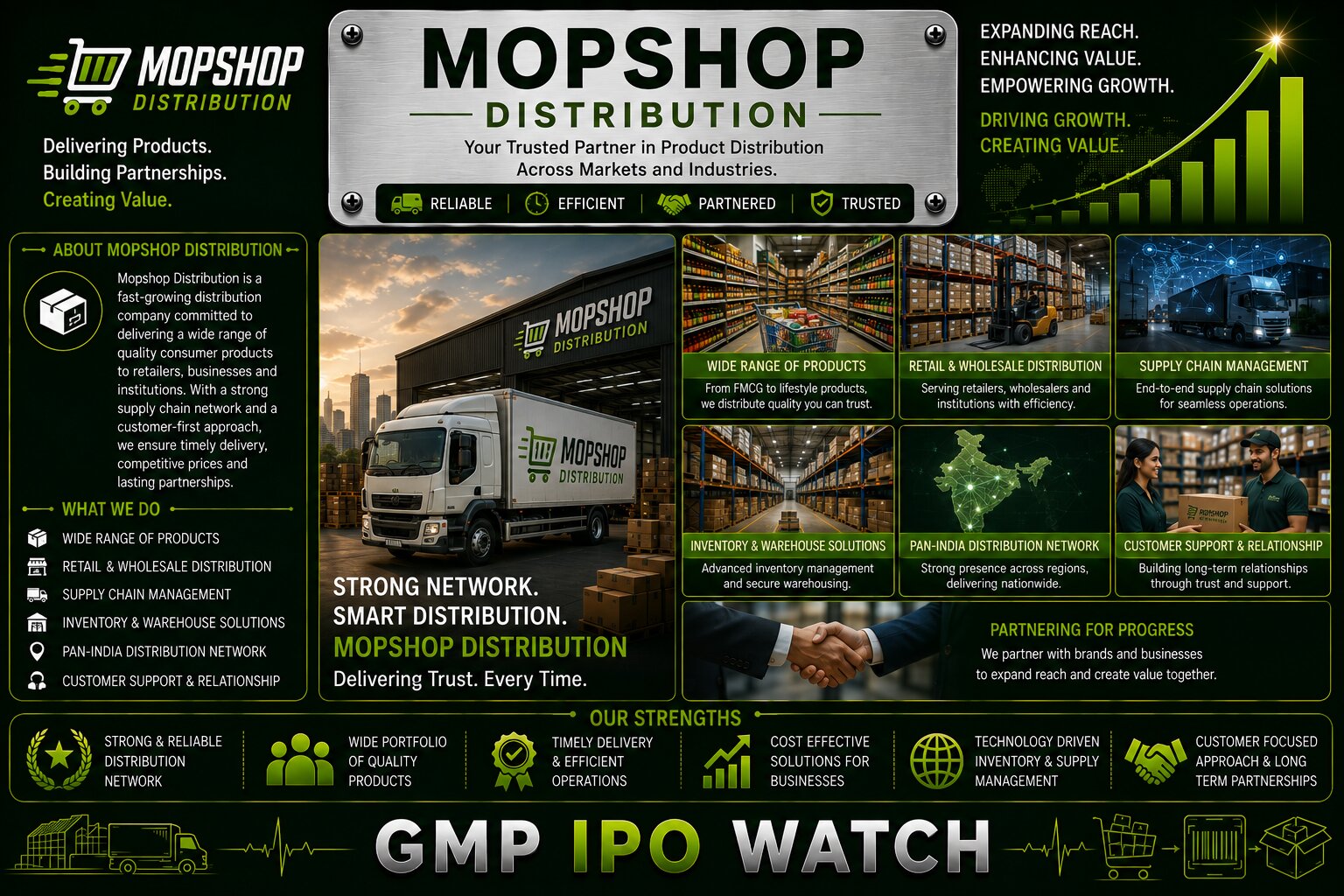
Mopshop Distribution IPO 2026 – Can B2B Facility Supplies Become a Scalable Distribution Business?
Mopshop Distribution Limited is currently in Day 2 of its SME IPO, which opened on August 19 and closes on August 21, 2026.
The company operates in a business that may look simple but serves an essential requirement for large organisations:
cleaning + hygiene + housekeeping + facility-management supplies.
Mopshop follows a primarily B2B distribution model, supplying products to corporate customers across industries such as banking and financial services, construction, real estate, healthcare and facility management.
Its growth story is therefore based on:
more corporate customers → higher order frequency → stronger distribution → efficient logistics → repeat B2B revenue.
Mopshop Distribution IPO Details
| Particular | Details |
|---|---|
| Company | Mopshop Distribution Ltd. |
| IPO Type | SME IPO |
| Issue Type | Fixed Price |
| Listing | BSE SME |
| Issue Size | ₹27.26 Crore |
| Fresh Issue | ₹22.08 Crore |
| Offer for Sale | ₹5.18 Crore |
| Issue Price | ₹138 |
| Face Value | ₹10 |
| Lot Size | 1,000 Shares |
| Minimum Retail Application | 2,000 Shares |
| Minimum Retail Investment | ₹2,76,000 |
| IPO Open Date | August 19, 2026 |
| IPO Close Date | August 21, 2026 |
| Allotment Date | August 24, 2026 |
| Refund Date | August 25, 2026 |
| Demat Credit | August 25, 2026 |
| Listing Date | August 26, 2026 |
| Business | Facility Management Supplies |
The total issue comprises approximately ₹22.08 crore of fresh capital and ₹5.18 crore through Offer for Sale.
Mopshop Distribution IPO GMP Today
Grey-market estimates currently vary between trackers, which is common for smaller SME IPOs.
One recent tracker shows an expected GMP of around ₹18, while another reported ₹12. Because these figures are unofficial and can change quickly, they should be treated only as market sentiment indicators rather than expected listing returns.
| GMP Particular | Details |
|---|---|
| IPO Price | ₹138 |
| Reported GMP Range | ₹12 – ₹18 |
| Indicative Premium | ~8.7% – 13.0% |
| GMP Nature | Unofficial |
| IPO Status | Open |
The final listing price will depend on actual market demand and conditions on the listing day.
What Does Mopshop Distribution Do?
Mopshop supplies facility-management and housekeeping products to businesses.
Its portfolio includes products such as:
- Microfiber cloths
- Cleaning tools
- Surface disinfectants
- Hygiene consumables
- Sensor-based dispensers
- Biodegradable garbage bags
- Vacuum cleaners
- Housekeeping supplies
- Maintenance products
The company has built a customer base of more than 300 corporate clients across India.
This means Mopshop is not primarily trying to sell individual cleaning products directly to households.
Its focus is bulk procurement for businesses.
Why the B2B Model Matters
Consider a large corporate office, hospital, bank or commercial property.
These facilities continuously require:
cleaning products + garbage bags + hygiene consumables + housekeeping tools + maintenance supplies.
These are recurring operational requirements.
Once Mopshop becomes an approved supplier, the customer may place repeat orders instead of finding a new vendor every time supplies run low.
That creates an attractive business cycle:
corporate client acquisition → regular orders → repeat procurement → long-term relationship.
Proprietary Online Ordering Platform Is an Important Part of the Model
Mopshop operates a proprietary B2B online order-management platform that helps customers manage procurement.
This is important because corporate purchasing is very different from normal online shopping.
A corporate customer may require:
bulk quantities + approved products + specific pricing + multiple delivery locations + recurring orders.
A digital ordering system can make this process easier.
Instead of customers repeatedly placing manual orders, Mopshop can increasingly automate procurement relationships.
More Than 300 Corporate Clients Provide a Base for Growth
Mopshop currently serves over 300 corporate clients across India.
Its customer industries include:
BFSI + construction + real estate + healthcare + facility-management companies.
Diversification across industries is useful.
For example, slower demand from commercial real estate may potentially be offset by stronger demand from hospitals or financial institutions.
However, the quality of these relationships matters more than the headline customer count.
The company needs customers that place orders frequently and pay on time.
Revenue Has Been Growing
Mopshop's reported financials show steady expansion in total income.
| Financial Year | Total Income | PAT |
|---|---|---|
| FY2023 | ₹30.02 Cr | ₹0.81 Cr |
| FY2024 | ₹37.86 Cr | ₹1.42 Cr |
| FY2025 | ₹42.00 Cr | ₹3.48 Cr |
The most noticeable development is profitability.
PAT increased from approximately ₹1.42 crore in FY2024 to ₹3.48 crore in FY2025, representing growth of roughly 145%.
That is considerably faster than revenue growth.
FY2025 Profitability Improved Sharply
FY2025 income increased by approximately 11%, but PAT rose around 146%.
Reported FY2025 ratios include:
| KPI | Value |
|---|---|
| ROE | 51.56% |
| ROCE | 59.70% |
| EBITDA Margin | 14.64% |
| PAT Margin | 8.28% |
The key question for investors is whether this improvement represents a sustainable change in business economics or an unusually strong year.
Future financial results will provide the answer.
IPO Money Is Mainly Going Toward Debt Repayment
The largest specific use of Mopshop's fresh IPO proceeds is debt reduction.
Approximately:
₹11.50 crore
is earmarked for repayment of outstanding borrowings.
Use of IPO Proceeds
| Purpose | Amount |
|---|---|
| Debt Repayment | ₹11.50 Cr |
| Commercial Vehicles | ₹2.21 Cr |
| Rooftop Solar Plant | ₹1.05 Cr |
| General Corporate Purposes | ₹7.32 Cr |
| Fresh Issue | ₹22.08 Cr |
Debt repayment accounts for approximately 52% of the fresh issue proceeds.
That could materially change the company's financial position.
Lower Debt Could Improve Cash Flow
Mopshop's borrowings stood at approximately:
₹3.92 crore in FY2023
₹6.59 crore in FY2024
and:
₹5.14 crore in FY2025.
The planned ₹11.50 crore allocation toward repayment includes outstanding borrowings covered by the issue's stated objects and could substantially reduce financing pressure.
The desired outcome is:
lower debt → lower interest cost → stronger cash generation → more capital available for growth.
For a distribution company, this can be important because inventory and customer receivables already consume working capital.
Commercial Vehicles Could Improve Logistics
Mopshop plans to spend approximately ₹2.21 crore on commercial vehicles for transportation and logistics.
This is strategically relevant.
Distribution businesses depend heavily on:
inventory availability + delivery speed + transportation cost + order accuracy.
Owning additional commercial vehicles could provide greater control over deliveries.
It may also reduce dependence on third-party logistics providers for certain routes.
Logistics Is Also One of the Biggest Risks
The same issue works in reverse.
Mopshop's profitability depends on managing transportation expenses effectively. Its IPO risk disclosures highlight high logistical and transportation costs as a potential pressure on profitability.
Imagine a customer ordering:
₹50,000 worth of cleaning products
but requiring deliveries across multiple locations.
If delivery costs are too high, the revenue may look attractive while the actual profit remains small.
This makes gross margin per order and logistics cost per delivery important operating metrics.
Rooftop Solar Is a Small but Interesting Investment
Another approximately ₹1.05 crore is planned for setting up a rooftop grid solar power plant at the company's Vasai warehouse.
The amount is relatively small compared with the total IPO.
However, solar generation could potentially reduce electricity expenses over time.
For a warehouse-based distribution operation, lowering recurring operating expenses can support margins.
Vasai Warehouse Is Central to Operations
Mopshop's primary warehousing operations are based in Vasai, Maharashtra.
The warehouse plays an important role in the business model:
suppliers → Mopshop warehouse → inventory management → corporate orders → logistics → customers.
This creates efficiency because multiple products can be consolidated before being supplied to customers.
But it also creates concentration risk.
A disruption affecting the warehouse could temporarily interfere with fulfilment.
Geographic Concentration Is a Risk
Mopshop currently generates significant revenue from areas around its warehouse locations, according to its IPO risk disclosures.
That creates an interesting challenge.
The company has customers across India, but logistics economics are generally better when customers are located relatively close to distribution hubs.
To expand nationally, Mopshop may eventually need:
additional warehouses + regional distribution partners + stronger logistics infrastructure.
That could increase future capital requirements.
Product Concentration Also Needs Attention
A substantial portion of Mopshop's revenue comes from cleaning tools and hygiene consumables.
This means its product portfolio may appear broad while revenue remains concentrated in a smaller group of categories.
The long-term opportunity is to sell more products to existing customers.
For example:
existing cleaning-products customer
↓
hygiene products
↓
dispensers
↓
garbage bags
↓
equipment
↓
maintenance supplies
This increases revenue per customer without requiring Mopshop to acquire a completely new account.
Cross-Selling Could Be a Major Growth Driver
The more products a corporate customer purchases through Mopshop, the stronger the relationship can become.
Suppose a corporate office currently purchases only garbage bags.
Mopshop could potentially add:
microfiber cloths + dispensers + cleaning chemicals + vacuum equipment + hygiene consumables.
This increases wallet share.
It also makes the procurement platform more useful because the customer can source several categories through one supplier.
Corporate Procurement Is Moving Digital
Many businesses are gradually replacing manual procurement processes with digital systems.
This trend can support Mopshop's online order-management platform.
Corporate buyers increasingly value:
centralised purchasing + transparent pricing + order tracking + repeat ordering + procurement records.
If Mopshop continues improving its technology, the platform could become more than simply an ordering website.
It could become part of the customer's procurement workflow.
That would increase customer stickiness.
But Technology Creates Operational Dependence
The IPO disclosures also identify dependence on the continuous functioning of the company's online ordering system as a risk.
If the platform experiences:
downtime + technical failures + cybersecurity problems + ordering errors,
customer procurement could be disrupted.
As the company scales, technology reliability will therefore become increasingly important.
Facility Management Demand Can Be Recurring
One attractive characteristic of Mopshop's market is that many products are consumable.
A company may purchase office furniture once every several years.
But products such as:
garbage bags + disinfectants + cleaning cloths + hygiene consumables
need continuous replacement.
This can create repeat-order potential.
The ideal Mopshop customer is therefore not one that places a large one-time order.
It is a customer that places consistent recurring orders for years.
Competition Is Still Significant
The facility-supplies industry has relatively low entry barriers in basic product categories.
Mopshop competes not only with organised distributors but also with:
- Local suppliers
- Regional wholesalers
- Online marketplaces
- Product manufacturers
- Facility-management vendors
Price competition can therefore be intense.
The company's differentiation needs to come from:
product availability + corporate relationships + technology + reliable delivery + competitive pricing.
Scale Can Improve Distribution Economics
Distribution businesses can become more efficient as volume increases.
For example, if one delivery vehicle serves only one customer, transportation costs may be high.
If the same route serves ten corporate customers:
delivery cost per order can decline.
Similarly, higher procurement volumes may help Mopshop negotiate better terms with suppliers.
This creates the potential equation:
higher sales volume → better purchasing economics + better logistics utilisation → improved margins.
But achieving that scale requires disciplined execution.
Key Strengths of Mopshop Distribution
Mopshop enters the IPO with several positives.
Established B2B customer base: The company serves more than 300 corporate clients across India.
Diversified end industries: Customers span BFSI, construction, real estate, healthcare and facility management.
Recurring products: Many cleaning and hygiene products require regular replenishment.
Digital ordering: A proprietary B2B platform helps streamline customer procurement.
Improving profitability: PAT increased from ₹1.42 crore in FY2024 to ₹3.48 crore in FY2025.
Fresh capital: Approximately ₹22.08 crore of the ₹27.26 crore IPO goes to the company.
Debt reduction: ₹11.50 crore is allocated toward repayment of outstanding borrowings.
Major Risks
The biggest risks investors should monitor include:
- High logistics and transportation costs
- Product-category concentration
- Geographic concentration
- Dependence on corporate customers
- Customer order-frequency fluctuations
- Technology-platform disruptions
- Inventory management
- Working-capital requirements
- Competition from local distributors
- Pressure on distribution margins
The SME nature of the listing also means investors should consider potentially lower trading liquidity and higher share-price volatility compared with larger mainboard companies.
What Investors Should Track After Listing
| Metric | Why It Matters |
|---|---|
| Revenue Growth | Business scale |
| PAT Margin | Profit sustainability |
| Corporate Clients | Customer expansion |
| Revenue per Client | Cross-selling success |
| Repeat Orders | Customer retention |
| Logistics Cost | Distribution efficiency |
| Inventory Days | Working-capital control |
| Receivable Days | Collection efficiency |
| Operating Cash Flow | Earnings quality |
| Borrowings | IPO deleveraging |
| Geographic Expansion | Future growth |
| ROCE | Capital efficiency |
For Mopshop, one of the most useful indicators could be:
revenue growth per corporate customer.
If the company can sell more categories to existing customers, growth may become more efficient because customer-acquisition costs do not need to increase at the same pace.
Final View on Mopshop Distribution IPO
The Mopshop Distribution IPO is open from August 19 to August 21, 2026, at a fixed issue price of ₹138 per share. The ₹27.26 crore BSE SME issue comprises approximately ₹22.08 crore of fresh shares and ₹5.18 crore OFS, with listing scheduled for August 26.
Financially, the company has shown encouraging recent improvement. Total income increased from approximately ₹30.02 crore in FY2023 to ₹42 crore in FY2025, while PAT increased from ₹0.81 crore to ₹3.48 crore.
The IPO could also strengthen the business structurally. Mopshop plans to allocate ₹11.50 crore toward debt repayment, ₹2.21 crore toward commercial vehicles and ₹1.05 crore toward a rooftop solar project at its Vasai warehouse.
The company's longer-term opportunity lies in converting its 300-plus corporate relationships into recurring, multi-product procurement accounts.