 GMP IPO Watch
Technocrats Plasma Systems IPO 2026 – Can Industrial Automation Turn a Specialist Engineering Company Into a Larger Manufacturing Platform?
Cutting a thick piece of steel with extreme precision is very different from cutting ordinary material.
The equipment needs to create enormous heat, control the cutting path precisely and repeatedly deliver the same quality across thousands of components.
That is where plasma cutting technology becomes important.
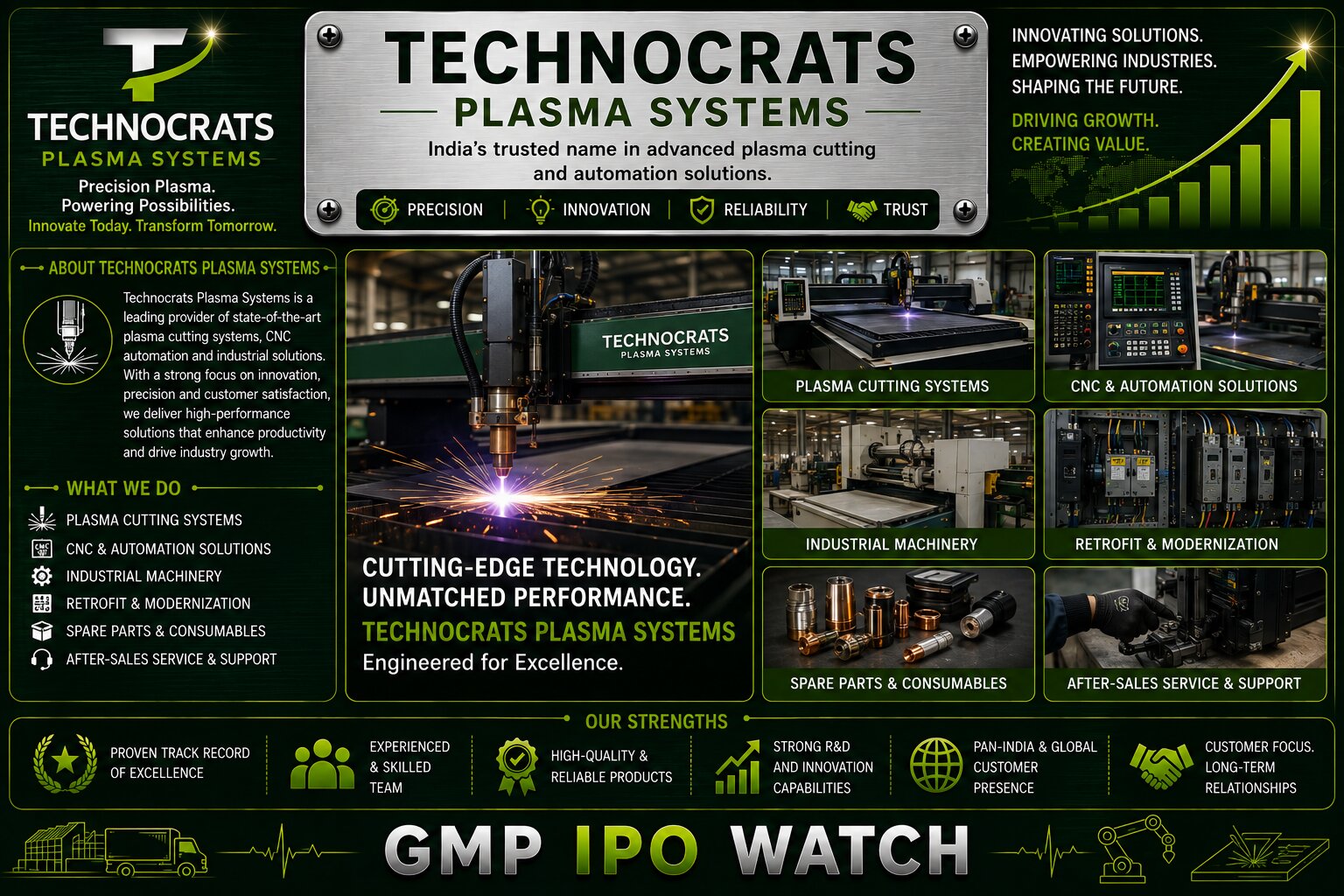
Technocrats Plasma Systems Limited operates in this specialised industrial engineering segment.
The company designs and manufactures:
- Plasma cutting machines
- Welding equipment
- Automated cutting systems
- Customised automation solutions
- Related industrial machinery
Technocrats says it was founded in 1990 and has built its business around plasma cutting, welding and automation technologies supported by in-house research and development.
The company is now preparing to enter the public market through an approximately ₹60.98 crore BSE SME IPO.
The offer opens on August 14, 2026, closes on August 18, and carries a price band of ₹125 to ₹132 per equity share. The entire issue consists of fresh shares, meaning IPO proceeds are intended to enter the company rather than fund an Offer for Sale by existing shareholders.
For investors, the key question is not simply:
Can Technocrats sell more plasma machines?
The more important question is:
Can it use its technology, manufacturing expertise and IPO capital to capture India's broader shift toward automated metal fabrication?
Technocrats Plasma Systems IPO Details
| Particular | Details |
|---|---|
| Company | Technocrats Plasma Systems Limited |
| IPO Type | Book Built SME IPO |
| Listing Platform | BSE SME |
| Total Issue Size | Approx. ₹60.98 Crore |
| Fresh Issue | 46.20 Lakh Shares |
| Offer for Sale | Nil |
| Price Band | ₹125 – ₹132 Per Share |
| Face Value | ₹10 Per Share |
| IPO Opening Date | August 14, 2026 |
| IPO Closing Date | August 18, 2026 |
| Expected Allotment | August 19, 2026 |
| Expected Listing | August 21, 2026 |
| Lead Manager | Rarever Financial Advisors Pvt. Ltd. |
| Registrar | Maashitla Securities Pvt. Ltd. |
The Economic Times IPO page confirms an August 14 opening, August 18 closing and August 21 proposed listing, while current issue information shows approximately 46.20 lakh shares offered entirely through fresh issuance.
What Does Technocrats Plasma Systems Actually Do?
Technocrats operates in industrial machinery and engineering automation.
At a basic level, its systems help manufacturers:
cut metal + weld metal + automate fabrication processes.
Its products can be useful wherever businesses work with metal sheets, plates and fabricated structures.
Potential end-user industries can include:
- General engineering
- Heavy fabrication
- Infrastructure equipment
- Railways
- Automotive components
- Construction equipment
- Industrial machinery
- Defence manufacturing
- Metal processing
The company's own positioning describes it as a manufacturer of advanced plasma cutting, welding and automation solutions.
That makes Technocrats less like a conventional machine trader and more like an engineering-technology manufacturer.
What Is Plasma Cutting?
Plasma cutting uses an electrically conductive gas heated to an extremely high temperature.
The plasma stream cuts through conductive metals such as:
- Mild steel
- Stainless steel
- Aluminium
The advantage is speed and precision.
For industrial manufacturers, a cutting machine is not simply another factory tool.
Its performance can directly affect:
- Production speed
- Material wastage
- Dimensional accuracy
- Labour productivity
- Finished-product quality
A faster and more accurate machine can therefore create significant economic value for the customer.
Why Cutting Accuracy Matters
Imagine a factory cutting 10,000 metal components every month.
If poor machine accuracy causes 3% material rejection, that means 300 components may need to be:
- Scrapped
- Reworked
- Recut
The company loses:
- Raw material
- Labour
- Machine time
- Electricity
If better plasma technology reduces rejection to 1%, the customer can save meaningful amounts every year.
This is why industrial machinery can command value based on productivity rather than only purchase price.
The Bigger Opportunity Is Automation
The strongest long-term opportunity for Technocrats may not be basic plasma machines.
It may be customised automation.
Factories increasingly want systems that can perform repetitive manufacturing processes with:
- Higher speed
- Better precision
- Lower human intervention
- More predictable output
Automation can therefore reduce the cost per manufactured unit.
Technocrats' business already includes customised automation systems alongside plasma cutting and welding equipment.
That gives the company exposure to India's broader manufacturing-modernisation cycle.
Why Indian Manufacturers Are Automating
Labour remains important in Indian manufacturing.
But manufacturers increasingly compete on:
- Quality
- Speed
- Export standards
- Production consistency
Manual processes can create variation.
Automation can help improve:
repeatability + productivity + quality.
For example, instead of an operator manually cutting dozens of complex shapes, a CNC-controlled plasma system can execute programmed designs repeatedly.
That can be particularly valuable for companies producing large batches.
Automation Can Increase Revenue Per Customer
Consider two customers.
Customer A
Purchases only one plasma cutting machine.
Customer B
Purchases:
- Plasma cutting system
- Welding equipment
- Automated handling
- Custom control system
The second customer generates a much larger order.
This means Technocrats can potentially grow not only by winning more customers but by supplying more engineering content to each customer.
That can be a powerful growth strategy.
Customised Automation Can Create Higher Entry Barriers
Standard machines are easier to compare.
If five suppliers offer nearly identical equipment, customers may negotiate mainly on price.
Customised automation is different.
A manufacturer may require a system designed around:
- Specific factory layout
- Particular component dimensions
- Production speed
- Existing machinery
- Safety requirements
Engineering such a solution requires customer-specific knowledge.
That can create deeper relationships and make switching suppliers more difficult.
R&D Is an Important Part of the Business
Technocrats positions itself as an engineering company backed by research and development.
For industrial equipment companies, R&D can improve:
- Cutting speed
- Machine accuracy
- Energy efficiency
- Automation controls
- Product reliability
That matters because machinery technology does not remain static.
Customers continuously demand better production economics.
A manufacturer that stops improving its machines can gradually lose competitiveness.
IPO Capital Will Support Additional Manufacturing Equipment
One of the stated IPO objectives is the purchase and installation of plant and machinery to support manufacturing of plasma cutting machines, welding equipment and customised automation systems at the company's existing premises.
This creates a direct link between the IPO and operating capacity.
The intended cycle is:
fresh capital → new machinery → larger manufacturing capacity → more customer orders → higher revenue.
That is easier to evaluate than an IPO where proceeds are mostly being used for a shareholder exit.
The Entire IPO Is Fresh Issue
Technocrats Plasma Systems is offering approximately 46.20 lakh new shares, with no OFS.
That means the approximately ₹60.98 crore being raised is entering the company.
This is an important structural point.
The IPO is primarily intended to finance the next phase of the business rather than allowing promoters or financial investors to significantly cash out.
Why Fresh Capital Matters for an Engineering SME
A growing engineering company needs capital for several areas:
- Machinery
- Raw materials
- Inventory
- Customer projects
- R&D
- Working capital
Without sufficient capital, the company may win a large order but struggle to execute it quickly.
IPO funding can potentially remove some of these constraints.
The real test will be the return generated on that capital.
FY2026 Revenue Reached Approximately ₹131 Crore
Current IPO financial data indicates Technocrats Plasma Systems reported approximately ₹131.31 crore revenue and around ₹14.94 crore PAT on the latest FY2026 basis.
Those numbers represent meaningful scale for an SME industrial machinery company.
Even more important is the level of profitability.
Technocrats Plasma Systems FY2026 Key Metrics
| KPI | FY2026 |
|---|---|
| Revenue | Approx. ₹131.31 Cr |
| PAT | Approx. ₹14.94 Cr |
| EPS | ₹11.63 |
| ROE | 56.10% |
| ROCE | 48.55% |
| Debt / Equity | 0.38 |
| PAT Margin | 11.37% |
| EBITDA Margin | 20.02% |
| NAV | ₹30.28 |
Current IPO analytics report these performance indicators for the latest annual period.
For investors, the 20% EBITDA margin and double-digit PAT margin are particularly important.
A 20% EBITDA Margin Is Meaningful for a Machinery Company
Industrial manufacturing includes costs such as:
- Steel and components
- Employees
- Factory expenses
- Electricity
- Engineering
- R&D
An EBITDA margin around 20% suggests Technocrats is not operating merely as a low-value reseller.
Its engineering and manufacturing activities appear capable of producing meaningful value addition on the reported FY2026 numbers.
The key question is whether these margins can remain stable as the company becomes larger.
PAT Margin Is Around 11%
Reported FY2026 PAT margin is approximately 11.37%.
That means for every ₹100 of revenue, the company generated roughly ₹11 of profit after tax on that reported basis.
For an engineering SME, that is a healthy margin.
However, investors should avoid assuming current profitability will automatically continue.
Larger orders can sometimes carry different margins from smaller specialised projects.
ROE and ROCE Are High
The latest IPO metrics indicate:
- ROE: 56.10%
- ROCE: 48.55%.
These are very strong headline return ratios.
But the IPO will significantly increase the company's equity base.
After the fresh capital enters the business, return ratios may temporarily decline unless earnings grow quickly.
This makes post-IPO ROCE an especially important metric.
Why ROCE Matters More After an IPO
Suppose Technocrats currently has ₹50 crore of capital and earns ₹20 crore of operating profit.
The return looks excellent.
Now suppose the IPO adds another ₹60 crore.
The company needs to deploy that new capital productively.
If earnings barely increase, return on capital falls.
If new machinery produces substantial additional orders and profits, strong returns can continue.
Therefore, investors should ask:
How much additional PAT can Technocrats generate from the ₹60.98 crore being raised?
Revenue Growth Has Accelerated Sharply
IPO financial reporting shows a very large increase in revenue in recent periods, with one current analysis showing revenue of approximately ₹131.31 crore on the FY2026 basis.
This rapid expansion is attractive.
But it also requires caution.
Very fast growth can expose a small company to:
- Working-capital pressure
- Customer concentration
- Production bottlenecks
- Quality-control problems
The next phase must be both fast and controlled.
Working Capital Can Become a Constraint
Industrial equipment companies often have long production cycles.
Consider a customised ₹5 crore automation project.
Technocrats may need to spend money on:
- Steel
- Electronics
- Motors
- Components
- Employees
- Fabrication
months before receiving the entire customer payment.
That means cash becomes locked inside unfinished projects.
As revenue increases, working-capital requirements can increase quickly.
Customer Advances Can Improve Economics
Engineering companies sometimes receive advance payments when customers place orders.
If Technocrats can negotiate favourable payment milestones such as:
advance → manufacturing milestone → delivery → commissioning
it can reduce working-capital pressure.
This is much stronger than completing the entire machine and waiting months for payment.
Investors should therefore monitor receivables and cash conversion.
Automation Systems Can Create Service Revenue
Selling an industrial machine may appear like a one-time transaction.
But the customer may later require:
- Maintenance
- Spare parts
- Consumables
- Repairs
- Software or control upgrades
- Technical support
That creates potential recurring revenue.
A larger installed base can therefore generate business years after the original equipment sale.
Installed Base Can Become a Long-Term Asset
Suppose Technocrats installs 100 machines annually.
After ten years, it may have hundreds or thousands of machines operating at customer locations.
That creates a potential service ecosystem.
Customers using Technocrats equipment may return for:
- Spares
- Maintenance
- Upgrades
- Additional machines
The economic value of the installed base can therefore increase over time.
Consumables Can Improve Revenue Quality
Plasma and welding equipment can require consumable components depending on machine type and usage.
Recurring consumable demand can create more predictable revenue than only selling capital equipment.
For investors, increasing the proportion of:
service + spares + consumables
could make Technocrats' revenue less dependent on new-machine orders.
Manufacturing Localisation Is a Structural Opportunity
India continues encouraging domestic manufacturing across sectors.
As manufacturers localise more production, they also need domestic suppliers of industrial machinery.
This creates an opportunity for companies such as Technocrats.
Customers may prefer an Indian machinery partner because of:
- Faster service
- Lower logistics cost
- Easier spare-part availability
- Customisation
- Local engineering support
This can provide an advantage against imported machinery.
Imported Machinery Is Still a Competitive Threat
Technocrats competes in an industry where manufacturers can also purchase equipment from overseas suppliers.
Imported machinery may offer:
- Advanced technology
- Global brand reputation
- Large installed bases
Technocrats therefore needs to compete through:
- Cost
- Local service
- Customisation
- R&D
- Delivery speed
The domestic-service advantage can be valuable, but technology needs to remain competitive.
After-Sales Service Can Become a Moat
When an industrial machine stops operating, the customer loses production.
Therefore, customers value fast service.
A supplier with technicians nearby can potentially restore production faster than an overseas manufacturer dependent on distant support.
Technocrats describes itself as offering nationwide support alongside its plasma and automation products.
A strong service network can therefore influence repeat business.
Customer Downtime Creates Real Economic Cost
Imagine a customer's plasma machine processes ₹10 lakh of production per day.
If it remains down for four days, the customer can lose a significant amount of production.
That makes machine reliability and service response important.
For an industrial machinery company, customer satisfaction is therefore closely tied to uptime.
Small Workforce Means Productivity Is Important
A current IPO information source reports that Technocrats had around 40 employees as of June 30, 2026.
For a company generating more than ₹100 crore of annual revenue, that highlights the importance of engineering productivity and outsourced/vendor ecosystems.
However, a relatively compact employee base can also create dependence on key technical personnel.
Key-Person Risk Should Not Be Ignored
Engineering SMEs can depend heavily on:
- Promoters
- Senior engineers
- Product specialists
- Sales personnel
If key employees leave, the company can lose:
- Technical knowledge
- Customer relationships
- Product-development capability
As Technocrats becomes a listed business, building a broader professional management structure will become increasingly important.
Customer Concentration Needs Monitoring
A specialised machinery company can sometimes win a few very large projects.
That can cause revenue concentration.
For example, one ₹20 crore order is significant for a company with ₹131 crore revenue.
If a major customer delays an order, annual revenue can change materially.
Investors should therefore track:
- Top customer contribution
- Top-five customer contribution
- Repeat customers
after listing.
Order Book Quality Matters
For an industrial machinery company, future revenue visibility comes from its order pipeline.
But not every order has the same economic value.
Consider:
Order A
₹10 crore revenue with 20% margin.
Order B
₹10 crore revenue with 7% margin.
Both add the same amount to the order book.
Their shareholder value is completely different.
Investors should therefore focus on margin quality, not merely order value.
Raw Material Prices Can Affect Margins
Technocrats needs metals and industrial components to manufacture its systems.
Input-cost pressures can come from:
- Steel
- Copper
- Electronics
- Motors
- Imported components
If input costs increase after a customer contract is signed, project margins can decline.
The company's ability to manage procurement and include price protections in contracts therefore matters.
Electronics and Control Systems Create Supply-Chain Risk
Modern automation equipment relies on more than steel.
It can require:
- Controllers
- Drives
- Sensors
- Electrical components
- Software interfaces
Supply shortages can delay machine delivery.
This means Technocrats is partly exposed to global electronics supply chains even though manufacturing takes place in India.
Custom Engineering Creates Execution Risk
A standard machine can be built repeatedly using the same production process.
A customised system may require unique:
- Design
- Programming
- Integration
- Testing
That increases complexity.
If design or commissioning takes longer than expected, costs can rise.
High-margin customisation therefore comes with higher execution responsibility.
Technocrats Plasma Systems IPO GMP Today
As of August 13, 2026, InvestorGain reports a latest GMP of approximately:
₹22 per share.
Against the ₹132 upper price band, this indicates an unofficial estimated price around:
₹154
or approximately:
16.7% premium.
InvestorGain's recent range has moved from roughly ₹12 to as high as ₹29, showing that grey-market sentiment is already volatile.
GMP is unofficial and is not a guaranteed listing return.
Subscription Has Not Started Yet
Today is August 13, 2026.
The public issue opens tomorrow, August 14.
Therefore there is currently no valid public subscription number for:
- Retail
- NII
- QIB
Any subscription analysis should begin only after bidding opens.
The issue remains open through August 18.
Why Opening-Day Demand Will Matter
For an SME engineering IPO, investors should monitor how demand develops across the bidding period.
Particularly useful signals will include:
- Retail participation
- NII demand
- Institutional allocation
But subscription alone should not decide whether the business is attractive.
Strong subscription can reflect:
- GMP
- Small issue size
- Short-term listing expectations
rather than long-term fundamentals.
Valuation at the Upper Price Band
Technocrats reports FY2026 EPS of approximately ₹11.63.
At ₹132, a simple pre-issue historical calculation gives:
₹132 ÷ ₹11.63 ≈ 11.4× earnings.
However, investors should use the final post-issue EPS and diluted share count when making a definitive valuation comparison.
The important point is that Technocrats' valuation needs to be considered alongside its:
- 20% EBITDA margin
- Strong return ratios
- Rapid recent revenue growth
- SME scale
- Customer/project concentration risks
Peer Comparison Requires Context
Current IPO data compares Technocrats with listed companies such as:
- Ador Welding
- ESAB India
- Patil Automation
- Jyoti CNC Automation.
However, these businesses vary significantly in:
- Revenue scale
- Product portfolio
- Customer base
- Profitability
Technocrats is much smaller.
A smaller company can grow faster, but it also carries higher operational and liquidity risk.
Competitive Strengths
Long Operating History
The business traces its roots to 1990 and has decades of experience in plasma technology.
Specialised Engineering Capability
The company operates in plasma cutting, welding and customised automation.
Strong FY2026 Profitability
Current financial data shows approximately ₹14.94 crore PAT on ₹131.31 crore revenue.
Healthy Margins
FY2026 EBITDA margin is reported around 20.02%, with PAT margin around 11.37%.
Strong Return Ratios
ROE and ROCE are currently reported at approximately 56.10% and 48.55%, respectively.
Entirely Fresh IPO
There is no OFS in the 46.20 lakh-share issue.
Productive Use of Funds
IPO proceeds include investment in plant and machinery for plasma cutting, welding and automation manufacturing.
Major Risks
Small Operating Scale
Revenue of around ₹131 crore means large orders can materially influence annual performance.
Customer Concentration
A few major clients could create volatility.
Project Execution
Custom automation can face design and commissioning delays.
Raw-Material Costs
Steel, electronics and industrial components can affect margins.
Technology Competition
Imported and domestic machinery companies can offer competing technologies.
Working Capital
Large customised projects may require cash before customer collection.
Key Technical Personnel
Specialised engineering knowledge can create employee dependence.
SME Liquidity
BSE SME shares can experience wider spreads and sharp price movements after listing.
What Could Drive Technocrats Plasma Systems' Next Growth Phase?
Manufacturing Expansion
IPO-funded equipment can increase output.
Industrial Automation
More Indian factories are adopting automated manufacturing systems.
Customised Solutions
Higher-value projects can increase revenue per customer.
Localisation
Domestic machinery manufacturing can gain from India's industrial growth.
After-Sales Service
A larger installed machine base can create recurring service demand.
Consumables and Spares
Recurring products can improve revenue quality.
Export Opportunity
Industrial equipment can potentially find customers outside India as manufacturing capability expands.
What Investors Should Track After Listing
Order Book
Are new machine and automation orders continuing?
Revenue Growth
Can Technocrats sustain the current ₹131 crore-plus scale?
EBITDA Margin
Does the roughly 20% level remain stable?
Working Capital
Are receivables and inventory under control?
Operating Cash Flow
Does PAT translate into cash?
Capacity Utilisation
Is IPO-funded machinery productive?
ROCE
Does the new equity capital continue generating strong returns?
Service Revenue
Is recurring aftermarket revenue becoming meaningful?
The Most Important Post-IPO Question
Technocrats already knows how to manufacture plasma cutting equipment.
The IPO gives it more capital.
The real test is what happens next.
The attractive scenario is:
IPO capital → additional machinery → more automation projects → higher capacity utilisation → stronger revenue → sustained margins → cash generation.
The weaker scenario is:
IPO capital → excess manufacturing capacity → slow order growth → lower utilisation → weaker ROCE.
Both create a larger balance sheet.
Only the first creates a stronger business.
Should Investors Consider Technocrats Plasma Systems IPO?
The positive investment case includes:
- Specialised industrial technology
- Long operating history
- Strong FY2026 profitability
- Healthy EBITDA margin
- High reported return ratios
- Entirely fresh IPO
- Clear manufacturing-expansion plan
- Industrial automation opportunity
- Positive pre-opening GMP
The caution points include:
- SME-company scale
- Project concentration
- Working-capital requirements
- Technology competition
- Need to sustain unusually strong return ratios
- SME liquidity
Technocrats should therefore be evaluated as a specialised industrial automation and manufacturing-technology company, not simply as a machine fabricator.
Final View on Technocrats Plasma Systems IPO 2026
The Technocrats Plasma Systems IPO 2026 comes to the market at an interesting time for Indian manufacturing.
Factories are becoming more automated, while industries increasingly need better cutting accuracy, productivity and production consistency.
Technocrats operates directly within that transformation.
The company designs and manufactures plasma cutting machines, welding equipment and customised automation systems, backed by decades of operating experience and an R&D-led engineering approach.
Its current FY2026 financial profile is also encouraging.
Latest IPO data reports approximately ₹131.31 crore revenue and ₹14.94 crore PAT, with a 20.02% EBITDA margin, 11.37% PAT margin, 56.10% ROE and 48.55% ROCE.
The IPO itself is approximately ₹60.98 crore, priced at ₹125–₹132, and is entirely a fresh issue of 46.20 lakh shares.
That gives the offering a clear growth purpose.
A portion of the proceeds is intended for new plant and machinery supporting production of plasma systems, welding equipment and customised automation solutions.
The long-term investment opportunity can therefore be summarised as:
industrial automation demand + specialised technology + larger manufacturing capacity + recurring installed-base revenue = potential earnings growth.
The key risk is execution.
Technocrats is still a relatively small company, and customised industrial machinery can produce uneven order flows, working-capital requirements and customer concentration.
As of August 13, 2026, the IPO has not opened, so there is no legitimate subscription figure yet. Public bidding starts August 14. Current GMP is around ₹22, implying roughly a 17% unofficial premium over the ₹132 upper band, but this figure can change rapidly.
Overall, Technocrats Plasma Systems represents a differentiated industrial-engineering SME IPO with strong recent profitability, specialised plasma and automation technology, and an entirely fresh capital raise. Its post-listing success will depend on whether management can turn the new manufacturing capacity into a larger order book while maintaining margins, cash conversion and the high return on capital currently visible in its financials.