 GMP IPO Watch
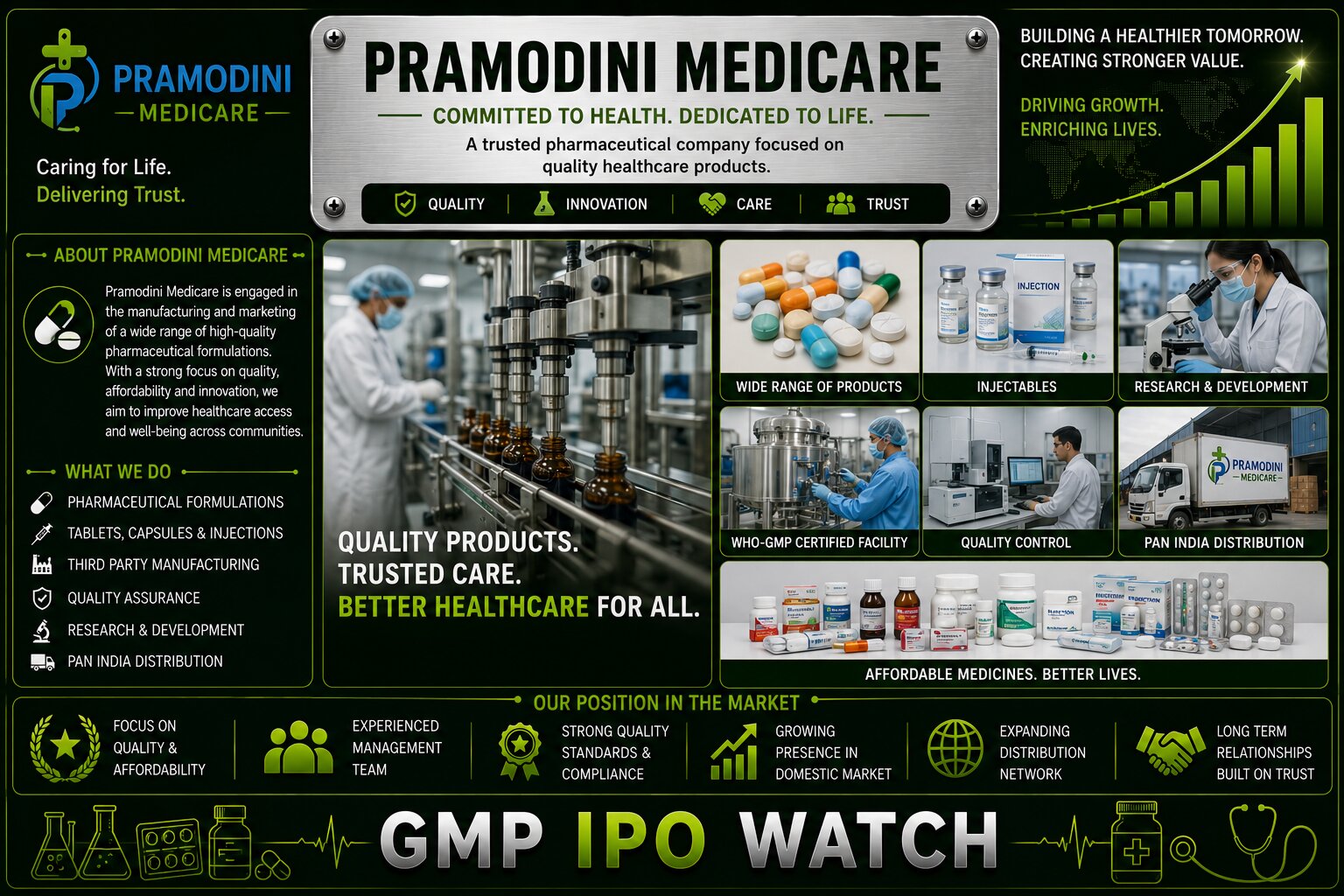
Pramodini Medicare IPO 2026 – The Bigger Question Is Revenue Diversification
Pramodini Medicare Limited reaches the final day of its IPO today, August 14, 2026.
The diagnostic healthcare company is raising approximately ₹69.04 crore through an NSE SME offering priced between ₹110 and ₹118 per share. The issue opened on August 12, closes today, and is expected to list on August 19.
Pramodini has built an attractive healthcare business around radiology, laboratory diagnostics and other specialised diagnostic services.
However, this IPO also brings an important concentration question.
Historically, a large proportion of its business has come from:
- Radiology services
- Government and PPP arrangements
- Andhra Pradesh
- A relatively concentrated customer base
That means Pramodini's future growth is not simply about buying more MRI and CT machines.
The more important question is:
Can the company use IPO capital to diversify its revenue while maintaining the strong profitability already visible in its diagnostic business?
That is the key investment theme.
Pramodini Medicare IPO Details
| Particular | Details |
|---|---|
| Company | Pramodini Medicare Limited |
| IPO Type | Book Built SME IPO |
| Listing Platform | NSE SME |
| Total Issue Size | ₹69.04 Crore |
| Fresh Issue | ₹63.14 Crore |
| Offer for Sale | ₹5.90 Crore |
| Price Band | ₹110 – ₹118 Per Share |
| Face Value | ₹10 Per Share |
| Lot Size | 1,200 Shares |
| Minimum Retail Application | 2,400 Shares |
| Minimum Retail Investment | ₹2,83,200 |
| IPO Opening Date | August 12, 2026 |
| IPO Closing Date | August 14, 2026 |
| Expected Allotment | August 17, 2026 |
| Expected Listing | August 19, 2026 |
| Registrar | Purva Sharegistry (India) Pvt. Ltd. |
| Lead Manager | Smart Horizon Capital Advisors |
The current final offer comprises approximately ₹63.14 crore of fresh shares and ₹5.90 crore of OFS, meaning the overwhelming majority of the issue is fresh capital available to the company.
What Does Pramodini Medicare Actually Do?
Pramodini Medicare is a technology-enabled diagnostic healthcare company.
Its services cover areas including:
- MRI
- CT scans
- X-ray
- Ultrasound
- Mammography
- DEXA scans
- Clinical laboratory testing
- Nuclear medicine
- Teleradiology.
This provides exposure to several areas of modern diagnostic medicine.
But historically, radiology has been overwhelmingly dominant.
That concentration is one of the most important factors investors should understand.
Radiology Generated More Than 96% of FY2025 Revenue
According to current IPO disclosures, radiology services contributed approximately:
₹36.77 crore, or 96.17% of FY2025 revenue from operations.
The corresponding contribution was around:
- 95.82% in FY2024
- 95.13% in FY2023.
That means Pramodini is technically a diversified diagnostic company, but economically it has historically behaved primarily like a radiology business.
This creates both strength and risk.
Why Radiology Can Be an Attractive Business
Advanced radiology requires expensive equipment.
MRI and CT machines can create meaningful entry barriers because operators need:
- Capital
- Skilled technicians
- Radiologists
- Maintenance capability
- Regulatory compliance
Once the infrastructure is established, additional patient volumes can create strong operating leverage.
A scanner already installed at a diagnostic centre can perform more scans without requiring a new machine for every additional patient.
That makes utilisation extremely important.
Radiology Concentration Also Creates Risk
If more than 95% of revenue comes from one service category, problems within that category can have a disproportionate effect.
Risks include:
- Equipment failure
- Higher maintenance costs
- Competition
- Regulatory changes
- Lower scan volumes
- Radiologist shortages
Pramodini's long-term business quality could improve if pathology, nuclear medicine and other diagnostic services become larger contributors.
PPP Contracts Are Another Major Part of the Story
One of the most distinctive aspects of Pramodini Medicare is its exposure to Public Private Partnership arrangements with government authorities.
PPP-related business contributed approximately:
₹27.10 crore, or 70.88% of FY2025 revenue from operations.
The contribution was around:
- 77.22% in FY2024
- 74.33% in FY2023.
This means a substantial majority of historical revenue has been connected to government-linked healthcare arrangements.
Why PPP Healthcare Can Be Attractive
Government hospitals serve large patient populations.
A private diagnostics company can install and operate medical equipment inside or in association with such institutions.
The government benefits because it does not need to build every diagnostic capability internally.
The private operator gains access to:
- Existing patient flow
- Hospital infrastructure
- Doctor referrals
This can support high utilisation of expensive imaging equipment.
But PPP Revenue Creates Contract Risk
Government-linked revenue has different risks from ordinary retail diagnostics.
Potential challenges include:
- Contract renewal
- Changes in tender conditions
- Government policy
- Payment delays
- Pricing pressure
If a major PPP agreement is not renewed, revenue from an individual centre can fall sharply.
This means investors should pay close attention to the duration and renewal profile of Pramodini's major agreements.
B2G Revenue Was About 71% in FY2025
The company's government-related B2G business also contributed approximately 70.88% of FY2025 revenue from operations.
This highlights the same concentration from another angle.
The business has benefited significantly from public healthcare partnerships.
But the next stage of growth could become more resilient if Pramodini increases contributions from:
- Private hospitals
- Standalone patients
- Corporate diagnostics
- Private diagnostic partnerships
Revenue diversification would reduce dependence on government contracts.
Andhra Pradesh Concentration Is Very High
Geographic concentration is another important risk.
Andhra Pradesh contributed approximately:
₹33.54 crore, or 87.71% of FY2025 revenue from operations.
The state contributed around:
- 86.66% in FY2024
- 90.16% in FY2023.
That means Pramodini may operate across multiple states, but its economic base remains heavily concentrated in Andhra Pradesh.
Multi-State Expansion Could Change Business Quality
Pramodini's broader diagnostic network gives it the opportunity to gradually reduce this dependence.
If centres outside Andhra Pradesh grow faster, the company could eventually reach a healthier mix.
For example:
Andhra Pradesh 88% → 70% → 55%
would represent meaningful geographic diversification even if Andhra Pradesh revenue itself continues growing.
This is one of the metrics investors should track closely after listing.
Customer Concentration Is Also Significant
The company's top 10 customers and patients contributed approximately 76.55% of FY2025 revenue from operations.
That percentage was approximately:
- 81.78% in FY2024
- 76.76% in FY2023.
This creates another layer of concentration.
Pramodini therefore historically combines:
high radiology concentration + high government exposure + high Andhra Pradesh exposure + high top-customer concentration.
This is probably the most important risk framework for understanding the IPO.
The Positive Side: Concentration Can Produce Strong Economics
Concentration is not automatically bad.
A company may have a few large, long-standing government hospital contracts that provide:
- High patient volumes
- Predictable demand
- Strong equipment utilisation
That can be economically attractive.
The problem arises if those contracts have weak renewal visibility or poor payment behaviour.
Investors need to distinguish between:
high-quality recurring concentration
and
fragile concentration.
FY2026 Financial Performance Was Strong
Pramodini reported a substantial improvement in FY2026.
| Financial Year | Total Income | PAT |
|---|---|---|
| FY2024 | ₹35.79 Cr | ₹6.87 Cr |
| FY2025 | ₹38.55 Cr | ₹11.00 Cr |
| FY2026 | ₹63.38 Cr | ₹17.38 Cr |
FY2026 total income increased by about 64%, while PAT increased by roughly 58%.
That is a strong pre-IPO growth profile.
Revenue From Operations Reached ₹62.29 Crore
The company's FY2026 sales turnover was approximately ₹62.29 crore, compared with ₹38.24 crore in FY2025.
That represents significant expansion in one year.
For investors, the key question now becomes whether the additional revenue also represents diversification away from the historical concentration profile.
Growth is more valuable when it improves both:
scale and resilience.
PAT Reached ₹17.38 Crore
FY2026 PAT rose from:
₹11.00 crore
to:
₹17.38 crore.
That represents a strong earnings base going into the IPO.
The company also reported operating profit of approximately ₹30.90 crore and EBITDA of around ₹31.99 crore in FY2026.
These numbers indicate strong operating profitability.
Diagnostic Margins Are Attractive
Using FY2026 total income of ₹63.38 crore and PAT of ₹17.38 crore, the company generated a net margin above 27%.
This is unusually strong compared with many conventional service businesses.
The economics partly reflect the operating leverage available when advanced diagnostic equipment reaches strong utilisation.
However, investors should examine whether these margins remain stable after new equipment is commissioned.
Employee Expense Increased Sharply
Personnel expenses increased from approximately:
₹4.69 crore in FY2025
to:
₹11.34 crore in FY2026.
That is a significant increase.
It may reflect business expansion, new centres, additional professionals or operating scale.
As Pramodini grows, management needs to ensure patient volumes grow faster than fixed staffing costs.
Depreciation Will Also Matter More After the IPO
FY2026 depreciation was approximately ₹7.39 crore, up from ₹4.28 crore in FY2025.
This is important because Pramodini plans to purchase significant additional medical equipment.
New MRI, CT and other equipment will generate additional depreciation.
If new machines are highly utilised, the resulting revenue can easily absorb those costs.
If utilisation is weak, higher depreciation can reduce future PAT.
₹45.15 Crore Is Planned for Medical Equipment
The central IPO objective is approximately ₹45.15 crore of capital expenditure for medical equipment at existing and proposed diagnostic centres.
This represents the majority of the fresh issue.
That makes Pramodini fundamentally an asset-expansion IPO.
Management is raising equity to increase diagnostic capacity.
New Equipment Can Expand Existing Centres
An important point is that not every new machine requires a completely new centre.
Pramodini can add equipment to existing facilities.
For example, if a centre currently has one heavily utilised CT scanner, adding a second machine may allow revenue growth while continuing to use the same:
- Building
- Administration
- Patient network
This can produce stronger incremental economics than opening a completely new location.
New Centres Can Diversify Geography
The equipment programme also applies to proposed centres.
If management directs more new equipment toward markets outside Andhra Pradesh, the IPO can do more than increase revenue.
It can reduce geographic concentration.
That could materially improve long-term business quality.
The IPO Could Reduce Radiology Concentration Too
Pramodini's service portfolio extends beyond conventional imaging into laboratory and nuclear medicine services.
Future capital allocation can potentially broaden this mix.
If new investment expands non-radiology services faster than existing imaging revenue, dependence on one diagnostic category could fall.
This would create a more balanced healthcare platform.
Nuclear Medicine Adds a Specialised Opportunity
Nuclear medicine uses radioactive tracers for certain diagnostic and treatment applications.
It requires specialised:
- Equipment
- Professionals
- Compliance
That creates a higher barrier to entry than ordinary pathology collection.
If Pramodini successfully expands this segment, it could add a differentiated service line.
Teleradiology Can Improve Specialist Productivity
Pramodini also offers 24×7 teleradiology services.
Teleradiology allows medical images produced at one location to be interpreted remotely by radiologists.
For a multi-centre network, this can create several advantages:
- Faster report turnaround
- Better specialist utilisation
- Wider geographic coverage
This is especially valuable when radiologists are scarce in smaller cities.
Teleradiology Can Support Tier-II and Tier-III Expansion
A smaller city may generate enough imaging demand to justify a scanner but not enough to support a full team of specialist radiologists around the clock.
Remote reporting can help solve that problem.
This makes teleradiology potentially important for Pramodini's expansion into Tier-II and Tier-III cities.
It can improve the economics of new centres.
Inorganic Acquisition Is Also Part of the Strategy
Beyond equipment, the company has retained flexibility for general corporate purposes and unidentified inorganic acquisitions.
Healthcare diagnostics is fragmented.
Pramodini could potentially acquire:
- Existing diagnostic centres
- Imaging businesses
- Laboratories
instead of building every location from scratch.
Acquisitions Can Accelerate Diversification
An acquisition could allow Pramodini to enter a new city with:
- Existing patient flow
- Equipment
- Employees
- Customer relationships
This may be faster than greenfield development.
It could also help reduce Andhra Pradesh concentration.
However, acquisitions only create value when purchased at disciplined valuations.
Free Cash Flow Matters More Than PAT Alone
Diagnostic companies can generate strong reported profit while requiring large capital expenditure.
Pramodini's planned ₹45.15 crore equipment programme is a good example.
Investors therefore need to monitor:
PAT – maintenance capex – growth capex = cash economics.
A high PAT margin is attractive.
But sustainable shareholder value depends on how much cash remains after maintaining and replacing diagnostic equipment.
Equipment Replacement Is an Ongoing Requirement
MRI and CT scanners do not last indefinitely.
Over time, equipment may require:
- Repairs
- Upgrades
- Replacement
Technology also improves.
Newer machines can offer:
- Faster scans
- Better image quality
- Lower radiation
- Better patient comfort
Pramodini therefore needs continuous capital investment even after the current IPO-funded expansion.
Maintenance Contracts Can Be Expensive
Advanced diagnostic equipment generally requires professional maintenance.
Unexpected downtime can be costly.
An MRI machine offline for several days means:
no scans + no revenue + possible patient diversion to competitors.
Operational uptime is therefore one of the most important hidden drivers of profitability.
Today's IPO Subscription Has Crossed 1×
As of the latest live InvestorGain reading on August 14, the IPO was around 1.40× subscribed overall.
At 12:02 PM, Economic Times showed:
| Category | Subscription |
|---|---|
| QIB | 1.81× |
| NII | 0.81× |
| Retail | 1.17× |
| Overall | 1.27× |
The difference between 1.27× and 1.40× reflects the later live update.
Bidding remains open today, so final numbers can move materially before closing.
QIB Demand Is Currently Strongest
QIB subscription had already reached approximately 1.81× by midday.
That is stronger than both retail and NII demand at the same timestamp.
Institutional participation can be a useful signal because QIBs generally evaluate:
- Financials
- Valuation
- Business risk
- Growth
However, final subscription should not be treated as a guarantee of post-listing returns.
Pramodini Medicare IPO GMP Today
The latest GMP remains:
₹0 per share.
Against the ₹118 upper band, that implies no unofficial listing premium at present.
InvestorGain's seven-day GMP history also shows ₹0 each day from August 8 through August 14.
That indicates grey-market interest has remained consistently neutral rather than briefly dropping today.
₹0 GMP and Positive Subscription Can Coexist
The IPO has now crossed 1× subscription while GMP remains zero.
That demonstrates why the two measures should not be treated as the same thing.
Subscription reflects actual IPO bids.
GMP reflects unofficial grey-market sentiment.
Long-term investors should care far more about:
- Earnings
- Concentration risk
- Equipment utilisation
- Cash flow
- Valuation
than an unofficial premium.
Competitive Strengths
Pramodini enters the IPO with several clear strengths:
- Established diagnostic healthcare platform
- Advanced radiology services
- Nuclear medicine and teleradiology capabilities
- Strong PPP healthcare experience
- FY2026 total income of ₹63.38 crore
- FY2026 PAT of ₹17.38 crore
- High operating profitability
- Mostly fresh issue
- ₹45.15 crore equipment-expansion plan.
Major Risks Investors Should Understand
Radiology Concentration
Around 96% of FY2025 operating revenue came from radiology.
Government and PPP Dependence
Around 71% of FY2025 revenue came from PPP/B2G activity.
Andhra Pradesh Concentration
Almost 88% of FY2025 operating revenue came from Andhra Pradesh.
Customer Concentration
The top 10 customers/patients contributed more than 76% of FY2025 operating revenue.
Capital Intensity
Advanced diagnostic equipment requires significant investment.
Equipment Downtime
Machine failure can directly affect revenue.
Contract Renewal
PPP arrangements carry government tender and renewal risk.
SME Liquidity
NSE SME shares may have lower liquidity and higher volatility after listing.
What Could Drive Pramodini's Next Growth Phase?
Several routes could materially improve the company's business:
Geographic diversification: More revenue outside Andhra Pradesh.
Private healthcare customers: Lower dependence on B2G contracts.
New equipment: Greater MRI, CT and other diagnostic capacity.
Nuclear medicine: Higher-value specialised diagnostics.
Teleradiology: Better specialist utilisation across smaller cities.
Acquisitions: Faster expansion into new geographies.
Higher centre utilisation: More revenue from existing infrastructure.
What Investors Should Track After Listing
The most important metrics will be:
Andhra Pradesh Revenue Share
Does it fall from the current high level?
PPP/B2G Revenue Share
Is the customer mix becoming more balanced?
Radiology Revenue Share
Do pathology and other services become meaningful?
Revenue Per Centre
Is each diagnostic location becoming more productive?
Scans Per Machine
Are new MRI and CT assets highly utilised?
Operating Cash Flow
Are strong accounting profits converting into cash?
ROCE
Does ₹45.15 crore of equipment capex generate attractive incremental returns?
The Most Important Post-IPO Equation
Pramodini's current business already generates attractive profitability.
The IPO needs to improve quality and diversification, not just size.
The ideal cycle is:
₹45.15 crore equipment capex → new centres and services → lower geographic/customer concentration → higher revenue → strong utilisation → sustainable cash flow.
The weaker outcome would be:
₹45.15 crore equipment capex → more machines → same concentrated customers → low utilisation → weaker ROCE.
The difference will determine the long-term success of the IPO.
Should Investors Consider Pramodini Medicare IPO?
The positive investment case includes:
- Strong FY2026 growth
- High profitability
- Advanced diagnostics
- Mostly fresh capital
- Clear equipment-expansion plan
- Current IPO subscription above 1×
The caution points are significant:
- Very high radiology concentration
- Heavy PPP/B2G dependence
- Andhra Pradesh concentration
- Top-customer concentration
- Capital-intensive expansion
- ₹0 GMP
- SME liquidity
Pramodini should therefore be analysed as a profitable but concentrated diagnostic healthcare platform that is using the IPO to fund its next diversification and expansion phase.
Final View on Pramodini Medicare IPO 2026
The Pramodini Medicare IPO 2026 closes today, August 14, at a price band of ₹110–₹118 per share.
The issue size is approximately ₹69.04 crore, including ₹63.14 crore of fresh capital and ₹5.90 crore of OFS. Most importantly, around ₹45.15 crore is earmarked for purchasing medical equipment for existing and proposed diagnostic centres.
Financially, Pramodini enters the market from a position of strength.
FY2026 total income increased to approximately ₹63.38 crore, while PAT reached ₹17.38 crore, compared with ₹38.55 crore and ₹11 crore respectively in FY2025.
But the risk profile is unusually concentrated.
Historically, approximately 96% of FY2025 operating revenue came from radiology, 71% from PPP/B2G arrangements, 88% from Andhra Pradesh, and more than 76% from the top 10 customers/patients.
That makes the IPO's real opportunity clearer.
Pramodini does not simply need to become bigger.
It needs to become broader.
If new medical equipment, centres, nuclear medicine, teleradiology and potential acquisitions gradually reduce its dependence on a small number of government-linked radiology relationships, the business can become significantly more resilient.
As of the latest afternoon tracking today, the issue is around 1.40× subscribed overall, while GMP remains ₹0.
For long-term investors, the most important post-listing metrics will therefore be geographic diversification, PPP revenue share, radiology concentration, equipment utilisation, operating cash flow and ROCE.
Overall, Pramodini Medicare represents a strongly profitable diagnostic healthcare SME with a clear capital-expenditure strategy, but its long-term investment quality will depend on whether management can use the IPO to diversify a historically concentrated revenue base while preserving the attractive margins already generated by its radiology platform.