 GMP IPO Watch
Skytech Infinite Platform IPO 2026 – Can a Small Automation Company Scale With India’s Manufacturing Growth?
Modern factories cannot operate efficiently using mechanical equipment alone.
Motors need to start and stop at the right time. Pumps need to respond to process conditions. Production lines need to communicate with sensors. Electrical loads need to remain controlled. Operators need a central system to monitor what is happening across the plant.
This is where industrial automation comes in.
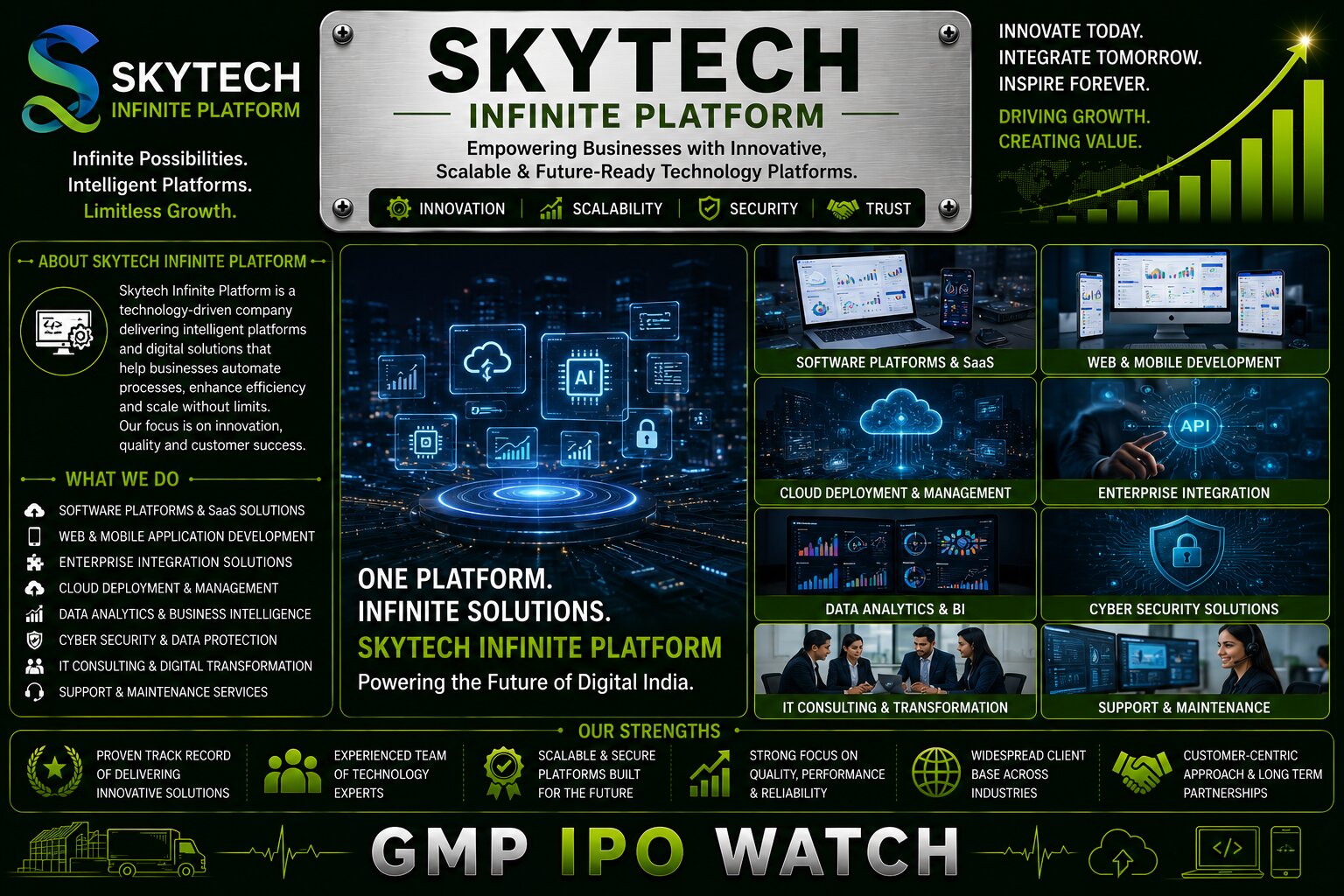
Skytech Infinite Platform Limited provides turnkey industrial automation solutions covering design, engineering, supply, installation, commissioning and maintenance. Its product portfolio includes control panels and automation systems used across sectors such as power, water, infrastructure, food and beverages, chemicals, pharmaceuticals, automotive and HVAC.
The company's NSE SME IPO opened today, August 14, 2026, and closes on August 18. The price band is ₹73 to ₹77 per share, with an overall issue size of approximately ₹22.68 crore.
The entire IPO consists of fresh shares.
For investors, the most important question is therefore not simply whether Skytech can sell more electrical control panels.
It is:
Can Skytech use new working capital to undertake more automation projects simultaneously while maintaining margins and cash discipline?
Skytech Infinite Platform IPO Details
| Particular | Details |
|---|---|
| Company | Skytech Infinite Platform Limited |
| IPO Type | Book Built SME IPO |
| Listing Platform | NSE SME / NSE Emerge |
| Total Issue Size | Approx. ₹22.68 Crore |
| Issue Structure | Entirely Fresh Issue |
| Total Shares | Approx. 29.46 Lakh Shares |
| Price Band | ₹73 – ₹77 Per Share |
| Face Value | ₹10 Per Share |
| Lot Size | 1,600 Shares |
| Minimum Retail Application | 3,200 Shares |
| Minimum Retail Investment | ₹2,46,400 at ₹77 |
| IPO Opening Date | August 14, 2026 |
| IPO Closing Date | August 18, 2026 |
| Expected Allotment | August 19, 2026 |
| Expected Listing | August 21, 2026 |
| Registrar | Integrated Registry Management Services Pvt. Ltd. |
Current IPO data confirms the ₹73–₹77 price band, 1,600-share lot size and ₹22.68 crore issue size.
What Does Skytech Infinite Platform Actually Do?
Skytech provides industrial automation and electrical control solutions.
Its product and service portfolio includes systems such as:
- PCC panels
- MCC panels
- VFD panels
- PLC panels
- APFC panels
- Control desks
- Flameproof panels
- Power distribution boards
- Turnkey automation solutions
- Installation
- Commissioning
- Maintenance.
These systems help factories control machinery, electrical distribution and industrial processes.
That means Skytech does not depend on one single end-use industry.
What Is a Control Panel?
An industrial control panel acts like the electrical control centre of a machine or production process.
It can contain:
- Circuit breakers
- Relays
- Contactors
- Variable-frequency drives
- PLCs
- Electrical protection devices
The panel allows equipment to operate in a controlled and predictable way.
In a large factory, poor control systems can lead to:
- Equipment failure
- Production downtime
- Energy wastage
- Safety issues
That makes automation systems operationally important rather than optional accessories.
PCC and MCC Panels Serve Different Functions
Skytech manufactures PCC and MCC panels among its major products.
PCC stands for Power Control Centre.
It helps distribute and control electrical power within an industrial facility.
MCC stands for Motor Control Centre.
It helps control multiple motors used across industrial processes.
Factories can contain dozens or hundreds of motors.
Centralised motor control improves:
- Safety
- Maintenance
- Monitoring
- Operational efficiency
Demand for these systems tends to increase when new manufacturing facilities are built or older factories modernise.
VFD Systems Can Reduce Energy Consumption
A VFD, or Variable Frequency Drive, controls motor speed.
This can create significant energy savings.
For example, a pump may not need to operate at maximum speed all day.
A VFD allows its speed to adjust according to actual demand.
That can reduce:
- Electricity consumption
- Mechanical wear
- Operating costs
As energy efficiency becomes more important, VFD-based automation can become increasingly valuable to industrial customers.
PLC Automation Is More Software-Driven
PLC stands for Programmable Logic Controller.
A PLC receives signals from sensors and automatically controls machinery according to programmed logic.
For example:
sensor detects condition → PLC evaluates it → motor or valve responds.
This replaces some manual control with automated decision-making.
For Skytech, PLC-based projects can potentially involve more engineering value than simply supplying a standard electrical box.
Turnkey Projects Can Increase Revenue Per Customer
Skytech does not only manufacture panels.
It also provides turnkey services covering:
design → engineering → supply → installation → commissioning → maintenance.
That can substantially increase project value.
Consider two transactions.
Transaction A
Sell one control panel.
Transaction B
Design an entire automation system, manufacture panels, install them, integrate PLC controls and commission the plant.
Transaction B generates much more revenue from the same customer relationship.
This is one of the strongest growth opportunities in the business.
Custom Engineering Can Improve Customer Stickiness
A standard electrical panel can be compared easily across suppliers.
A customised automation system is different.
The supplier may need to understand:
- Factory layout
- Motors
- Sensors
- Process sequence
- Safety requirements
Once an automation company understands a customer's plant deeply, switching suppliers can become more inconvenient.
This creates potential customer stickiness.
Skytech Serves Several Industries
Current IPO descriptions show Skytech serving industries including:
- Power
- Water
- Energy
- Infrastructure
- Food and beverages
- Chemicals
- Pharmaceuticals
- Automotive
- HVAC
- Other process industries.
This diversification is important.
An automation company dependent only on one sector can experience sharp demand volatility.
Serving several sectors can reduce that risk.
Water Infrastructure Can Be an Important Market
Water treatment and pumping systems rely heavily on automation.
A modern treatment plant may require automatic control of:
- Pumps
- Valves
- Chemical dosing
- Water levels
- Pressure
These processes often use PLCs, VFDs and electrical control panels.
Infrastructure spending on water systems can therefore create opportunities for Skytech.
Pharmaceutical Plants Require Reliable Automation
Pharmaceutical manufacturing involves tightly controlled processes.
Systems may need to monitor:
- Temperature
- Pressure
- Mixing
- Production timing
Automation helps manufacturers maintain consistency.
This creates opportunities for engineering companies capable of meeting required industrial standards.
Food and Beverage Plants Also Depend on Automation
Food factories use automation across:
- Mixing
- Filling
- Packaging
- Conveyors
- Pumps
High production volumes require predictable machine control.
As organised food manufacturing expands in India, automation demand can grow alongside it.
FY2026 Revenue Crossed ₹52 Crore
Current IPO financial reporting shows:
| Financial Year | Revenue | PAT |
|---|---|---|
| FY2024 | ₹44.15 Cr | ₹1.35 Cr |
| FY2025 | ₹45.21 Cr | ₹3.71 Cr |
| FY2026 | ₹52.14 Cr | ₹4.20 Cr |
Figures are based on current IPO reporting and are stated in rupee crores after conversion from lakh values.
Revenue increased by around 15% in FY2026, while profit reached roughly ₹4.20 crore.
Profit Has Grown Faster Than Revenue Over Two Years
FY2024 PAT was approximately:
₹1.35 crore.
FY2026 PAT reached approximately:
₹4.20 crore.
That represents more than a three-fold increase in two years.
Revenue increased much more moderately.
This suggests improvement in operating profitability.
For investors, this is one of the more attractive financial trends.
PAT Margin Improved Sharply
IPO metrics show:
- FY2024 PAT margin: 3.06%
- FY2025: 8.23%
- FY2026: 8.14%.
This indicates the margin improvement achieved in FY2025 was largely maintained in FY2026.
That is important.
A single year of high profitability can be temporary.
Two consecutive years around 8% provide stronger evidence that the business economics may have improved structurally.
EBITDA Margin Is Around 13%
Skytech's reported EBITDA margin was approximately:
- 7.00% in FY2024
- 13.57% in FY2025
- 12.87% in FY2026.
Again, profitability improved significantly compared with FY2024.
The slight decline from FY2025 to FY2026 deserves monitoring but does not eliminate the broader margin improvement.
ROCE Remains Healthy
Current IPO KPIs show ROCE around:
- 17.48% in FY2024
- 33.10% in FY2025
- 25.45% in FY2026.
FY2026 ROCE declined from the unusually strong FY2025 level but remains healthy.
This matters because IPO proceeds will increase the company's capital base substantially.
Management now needs to prove it can deploy additional capital without diluting returns too much.
Debt-to-Equity Has Increased Moderately
Debt-to-equity increased from:
- 0.35× in FY2024
- 0.36× in FY2025
- 0.49× in FY2026.
This is not excessive leverage.
But the direction is worth monitoring.
The business is growing and may require more working capital.
The IPO can reduce dependence on additional borrowing by providing equity capital.
₹16.81 Crore Is Planned for Working Capital
This is the most important use of IPO proceeds.
Current IPO reporting states that approximately ₹16.81 crore is earmarked for working-capital requirements.
Compared with the roughly ₹22.68 crore total issue size, that is a very large proportion.
This reveals something important:
Skytech's main growth constraint may be project financing rather than technology or demand alone.
Why Automation Projects Consume Working Capital
Imagine Skytech wins a ₹5 crore turnkey project.
Before the customer pays the full amount, Skytech may need to purchase:
- Electrical components
- PLCs
- VFDs
- Enclosures
- Switchgear
- Cables
It must also pay:
- Engineers
- Installation teams
- Vendors
Cash leaves the business before all project revenue is collected.
That creates working-capital pressure.
More Working Capital Can Allow More Projects at the Same Time
Without enough capital, a company may need to finish Project A before fully funding Project B.
With stronger working capital, it can execute several projects concurrently.
That can increase annual revenue.
The intended growth cycle becomes:
₹16.81 crore working capital → more concurrent automation projects → higher revenue → stronger customer base.
This is arguably the central IPO investment thesis.
Receivables Could Become the Biggest Risk
Working capital can also create problems.
Suppose Skytech executes a ₹10 crore project but the customer delays payment.
The company may show revenue and profit while cash remains stuck in receivables.
If several customers delay payments simultaneously, liquidity pressure can increase.
Investors should therefore track:
receivable days + operating cash flow.
These numbers may be more important than headline revenue growth.
Customer Advances Can Improve Cash Flow
Automation companies can reduce working-capital stress by structuring project payments.
For example:
- 20% advance
- 40% after manufacturing
- 30% after installation
- 10% after commissioning
This is far healthier than receiving nearly all payment after completion.
Future disclosures around payment terms can help investors evaluate cash quality.
Installation and Commissioning Can Create Additional Margin
A company manufacturing only panels earns mainly from hardware.
Skytech also performs installation and commissioning.
These services involve engineering expertise rather than large material costs.
That can potentially improve project margins.
The stronger Skytech becomes at selling full turnkey solutions, the more its economics may shift from pure manufacturing toward engineering services.
Maintenance Can Create Recurring Revenue
Industrial automation systems require periodic support.
Customers may need:
- Troubleshooting
- Panel modifications
- PLC programming
- Replacement components
- Maintenance
This can create recurring revenue after the original project.
A large installed base becomes increasingly valuable over time.
Installed Systems Can Lead to Repeat Orders
Suppose Skytech automates one production line successfully.
The same customer may later ask Skytech to automate:
- Another line
- Another plant
- Another process
This reduces customer-acquisition effort.
Repeat business can therefore become an important growth lever.
Industrial Automation Is Supported by Manufacturing Modernisation
India's manufacturers increasingly focus on:
- Productivity
- Energy efficiency
- Quality
- Export competitiveness
Automation supports all four.
A business that previously depended on manual controls may move toward:
- PLC-based automation
- VFD systems
- Centralised control panels
This provides Skytech with a structural demand opportunity.
Smaller Manufacturers Are Also Automating
Automation is no longer limited to the largest factories.
Smaller companies are adopting:
- VFDs
- PLCs
- Automated controls
as equipment costs decline and labour/productivity pressures increase.
This broadens the potential customer base.
Competition Is Still Intense
Industrial electrical and automation markets contain:
- Large multinational companies
- Indian electrical-equipment manufacturers
- Regional panel builders
- System integrators
Skytech must therefore compete on more than price.
Potential differentiators include:
- Engineering capability
- Customisation
- Delivery speed
- After-sales support
- Project execution
Component Dependence Creates Supply-Chain Risk
Skytech may rely on components supplied by larger electrical and automation brands.
These can include:
- PLCs
- Drives
- Switchgear
- Electrical protection equipment
Supply shortages can delay projects.
This means Skytech's ability to manage procurement and vendor relationships matters significantly.
Customer Concentration Needs Close Monitoring
For a company with roughly ₹52 crore annual revenue, one ₹5–₹10 crore project can materially change annual results.
That makes customer concentration important.
Investors should monitor:
- Largest customer share
- Top-five customers
- Repeat business
A diversified project pipeline will make revenue more predictable.
Order Book Quality Matters More Than Size
A ₹50 crore order book can look attractive.
But margins vary by project.
A ₹10 crore control-panel order with strong engineering margins may create more value than a ₹15 crore low-margin supply contract.
Investors should therefore focus on:
order-book profitability, not only order-book value.
Skytech Infinite Platform IPO Day-1 Subscription
As of approximately 1:30 PM on August 14, 2026, Groww reported:
- QIB: 0.00×
- NII: 0.11×
- Retail: 0.38×
- Overall: 0.24×.
Because this is only Day 1 and the issue remains open until August 18, these figures are preliminary.
SME IPO subscriptions can change sharply on the final day.
Retail Is Leading Early Demand
Retail subscription is currently around 0.38×, compared with roughly 0.11× for NII.
The low QIB number is not particularly meaningful this early.
The closing-day category mix will provide a better indication of investor demand.
Skytech Infinite Platform IPO GMP Today
Current GMP data is inconsistent.
StockGro reported ₹0 GMP based on its latest stated reading, implying neutral grey-market sentiment.
However, another live tracker currently shows approximately ₹13 GMP.
At ₹13 against the ₹77 upper price band, that would imply an unofficial premium of about 16.9% and an indicated price near ₹90.
Because the trackers disagree materially, investors should treat GMP as unstable rather than rely on a single number.
GMP Does Not Affect Business Fundamentals
A changing GMP does not change:
- Revenue
- PAT
- Working capital
- ROCE
- Customer orders
For long-term investors, these business indicators matter more.
Grey-market premium is unofficial and unregulated.
IPO Valuation Needs to Consider SME Risk
At the ₹77 upper band, investors should compare Skytech's valuation against:
- FY2026 PAT
- ROE/RoNW
- ROCE
- Debt
- Cash-flow quality
The company's reported FY2026 PAT is approximately ₹4.20 crore.
Because Skytech is a relatively small SME, investors should also demand a risk discount for:
- Customer concentration
- Lower liquidity
- Project volatility
A strong growth rate alone does not justify any valuation.
Competitive Strengths
Skytech enters the IPO with several positives:
- Turnkey industrial automation capability
- Diversified panel product portfolio
- Multiple end-user industries
- FY2026 revenue above ₹52 crore
- PAT above ₹4 crore
- PAT margin above 8%
- Healthy FY2026 ROCE of about 25%
- Entirely fresh issue
- Large working-capital allocation.
Major Risks
Small Scale
Revenue remains just above ₹50 crore.
Working-Capital Intensity
₹16.81 crore of proceeds being earmarked for working capital highlights the importance of liquidity.
Receivable Risk
Delayed customer payments can weaken cash flow.
Customer Concentration
Large projects may materially affect annual results.
Component Dependence
Control systems require third-party electrical components.
Project Execution
Installation and commissioning delays can affect margins.
Competition
The industrial automation market includes much larger competitors.
SME Liquidity
NSE SME shares may experience lower trading liquidity and greater volatility.
What Could Drive Skytech's Next Growth Phase?
More Working Capital
Can enable a larger project pipeline.
Turnkey Automation
Higher-value contracts can increase revenue per customer.
Energy Efficiency
VFD-based automation can benefit from industrial energy-saving demand.
Manufacturing Modernisation
More factories are moving toward PLC and automated control.
Water and Infrastructure Projects
These can create additional automation demand.
Repeat Customers
Existing installations can lead to new projects.
Maintenance Services
Can add recurring revenue.
What Investors Should Track After Listing
Revenue Growth
Can Skytech move materially beyond the current ₹52 crore base?
PAT Margin
Can it maintain the 8% range?
Receivable Days
Are customers paying efficiently?
Operating Cash Flow
Does profit translate into cash?
Order Book
Is project demand expanding?
Repeat Customers
Are relationships becoming sticky?
ROCE
Does IPO capital generate attractive incremental returns?
The Most Important Post-IPO Equation
Skytech is raising a relatively small IPO.
But relative to the company's present size, the capital is meaningful.
The ideal growth cycle is:
₹16.81 crore working capital → more projects → higher revenue → better operating scale → higher profit and cash flow.
The weaker outcome would be:
₹16.81 crore working capital → more receivables → delayed collections → weak cash conversion.
This is why working-capital discipline may determine whether the IPO creates shareholder value.
Should Investors Consider Skytech Infinite Platform IPO?
The positive investment case includes:
- Industrial automation exposure
- Turnkey engineering capabilities
- Multi-industry customer opportunity
- Improved margins
- Strong PAT growth since FY2024
- Entirely fresh issue
- Clear working-capital requirement
The caution points include:
- Small revenue base
- Customer/project concentration
- Receivables risk
- Rising debt-to-equity
- SME liquidity
- Unstable GMP
Skytech should therefore be evaluated as a small project-driven industrial automation company, not simply as an electrical-panel manufacturer.
Final View on Skytech Infinite Platform IPO 2026
The Skytech Infinite Platform IPO 2026 opened today, August 14, at a price band of ₹73–₹77 per share, with an approximately ₹22.68 crore entirely fresh issue scheduled to close on August 18.
The business operates across industrial control panels and turnkey automation, supplying systems such as PCC, MCC, VFD, PLC and other panels while also providing installation, commissioning and maintenance.
Financially, the company has improved meaningfully.
Revenue rose from approximately ₹44.15 crore in FY2024 to ₹52.14 crore in FY2026, while PAT increased from around ₹1.35 crore to ₹4.20 crore. PAT margin improved from about 3.06% to 8.14% over the same period.
The most important IPO detail is the planned use of approximately ₹16.81 crore for working capital.
That indicates the company sees an opportunity to execute more automation projects but needs additional cash to fund the project cycle.
As of around 1:30 PM today, the IPO was subscribed about 0.24× overall, led by roughly 0.38× retail demand.
GMP signals are currently inconsistent, ranging from roughly ₹0 to ₹13 across current trackers, so short-term grey-market sentiment should be considered unsettled.
For long-term investors, the key question is much clearer:
Can Skytech convert additional working capital into a larger, profitable automation project pipeline without allowing receivables to consume the resulting cash flow?
Overall, Skytech Infinite Platform represents a small but improving industrial automation SME with diversified end-market exposure, stronger recent margins and a fully fresh IPO. Its post-listing success will depend on project execution, customer collections, order growth and the return generated on the substantial working-capital infusion relative to its current business size.