 GMP IPO Watch
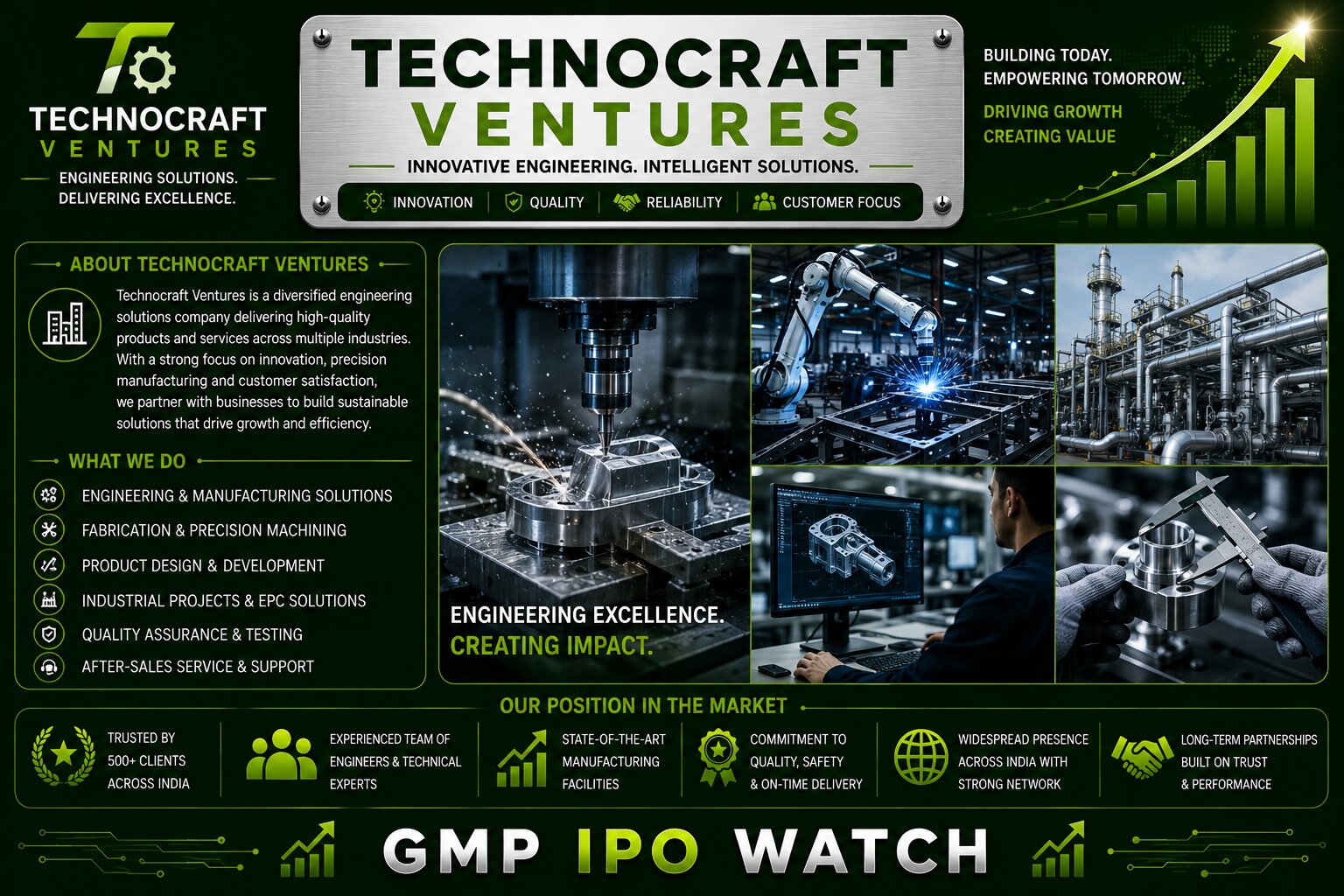
Technocraft Ventures IPO 2026 – The Order Book Is Only Half the Story
Infrastructure companies are often judged by one headline number: order book.
A large order book looks attractive because it represents work already secured for future execution. But an order book doesn't automatically become revenue, and revenue doesn't automatically become cash.
Between winning a contract and collecting the final payment, an infrastructure company must purchase materials, mobilise workers, arrange equipment, manage construction sites, complete milestones and wait for customer certification.
That makes working capital and execution efficiency particularly important when analysing Technocraft Ventures Limited.
Technocraft Ventures is an infrastructure development and EPC company involved in civil infrastructure projects. Its activities include water and wastewater projects along with other infrastructure development work.
The company's mainboard IPO opened on August 7, 2026 and closes on August 11, 2026, with a price band of ₹200 to ₹212 per share.
The total issue is approximately ₹251.88 crore, including a fresh issue of approximately ₹201.51 crore and an Offer for Sale of approximately ₹50.37 crore.
The IPO therefore isn't simply a capital-market event. It is effectively a working-capital raise designed to help Technocraft convert a growing project pipeline into future revenue.
Technocraft Ventures IPO Details
| Particular | Details |
|---|---|
| Company | Technocraft Ventures Limited |
| IPO Type | Mainboard Book Built Issue |
| Issue Size | Approx. ₹251.88 Crore |
| Fresh Issue | Approx. ₹201.51 Crore |
| Offer for Sale | Approx. ₹50.37 Crore |
| Price Band | ₹200 – ₹212 |
| Face Value | ₹10 Per Share |
| Lot Size | 70 Shares |
| Minimum Retail Investment at Upper Band | ₹14,840 |
| IPO Opens | August 7, 2026 |
| IPO Closes | August 11, 2026 |
| Expected Allotment | August 12, 2026 |
| Expected Listing | August 14, 2026 |
| Listing | BSE & NSE |
The IPO structure is particularly relevant because most of the issue consists of fresh capital rather than shareholder exits.
What Does Technocraft Ventures Actually Do?
Technocraft Ventures operates in infrastructure development and EPC execution.
Its project capabilities cover areas such as:
- Water infrastructure
- Wastewater projects
- Civil construction
- Pipeline infrastructure
- Roads and related infrastructure
- Power-sector civil works
- Other infrastructure development activities
The company does not simply manufacture a product and sell it.
It takes responsibility for executing infrastructure projects across different stages.
That makes project management one of its most important capabilities.
How an EPC Contract Becomes Revenue
Consider a ₹100 crore infrastructure contract.
Winning that contract doesn't mean the company immediately receives ₹100 crore.
Instead, execution may happen over multiple stages.
Stage 1 – Mobilisation
Employees, equipment and subcontractors are moved to the project site.
Stage 2 – Procurement
Materials such as pipes, cement, steel and equipment are purchased.
Stage 3 – Construction
Physical project execution begins.
Stage 4 – Milestone Completion
Specific portions of the project are completed.
Stage 5 – Customer Certification
The customer verifies completed work.
Stage 6 – Payment
The company receives payment according to contractual terms.
This entire process can take months or years.
That explains why infrastructure companies require substantial working capital even when they already have confirmed orders.
The ₹768.81 Crore Order Book Is Important
Technocraft Ventures' disclosed order book increased from approximately:
₹752.89 crore in FY2024
to
₹768.81 crore in FY2025.
For a company of Technocraft's revenue scale, this provides meaningful future business visibility.
But investors should avoid making the simple assumption:
₹768 crore order book = ₹768 crore guaranteed future revenue.
Projects can experience:
- Execution delays
- Design changes
- Customer approvals
- Land-related issues
- Payment delays
- Cost escalation
The quality and execution speed of the order book therefore matter as much as its headline size.
Inventory Has Increased Along With the Order Book
One particularly interesting disclosure is the increase in inventory.
Inventory increased from approximately:
₹47.26 crore in FY2023
to
₹55.75 crore in FY2024
and then to approximately:
₹88.93 crore in FY2025.
Why?
Because larger infrastructure projects require more materials.
Technocraft has explained that increasing project activity and the larger order book require higher inventory levels to prevent supply-chain disruptions.
This is a critical part of understanding the IPO.
More projects create more revenue opportunity.
But more projects also require more money before that revenue can be collected.
Inventory Holding Period Is Relatively Long
Technocraft's historical inventory holding period has generally been around 90 to 120 days.
That means capital can remain locked in materials for several months.
The company estimated inventory holding days of approximately:
- FY2026: 81 days
- FY2027: 93 days
For an infrastructure contractor, maintaining sufficient inventory can reduce the risk of project disruption.
But it also increases working-capital requirements.
This is one of the reasons why the company is raising substantial fresh capital through the IPO.
Why ₹201.51 Crore of Fresh Capital Matters
Out of the total ₹251.88 crore issue, approximately ₹201.51 crore represents fresh issue proceeds.
This means roughly 80% of the IPO size represents new capital being raised by the company.
The primary objective is to fund working-capital requirements, along with general corporate purposes.
That distinguishes Technocraft from IPOs where most proceeds are simply an exit for existing shareholders.
The real test will be how effectively management converts this fresh working capital into additional profitable project execution.
Working Capital Can Accelerate Growth
Imagine Technocraft has enough orders to execute ₹400 crore of work but only sufficient liquidity to execute ₹300 crore efficiently.
Additional working capital could potentially allow it to:
- Purchase more materials
- Mobilise additional projects
- Pay subcontractors
- Increase execution speed
- Bid for larger projects
Faster execution can translate into faster revenue recognition.
Therefore, IPO capital could potentially create a multiplier effect if deployed efficiently.
But Working Capital Can Also Become a Risk
There is another side.
Suppose Technocraft purchases large quantities of materials but a project is delayed.
Cash becomes locked in inventory.
Similarly, if completed work is certified but customers delay payment, cash becomes locked in receivables.
This creates a common infrastructure problem:
Accounting profit can increase while cash flow remains weak.
For this reason, investors should closely monitor operating cash flow after the IPO.
Technocraft Ventures Financial Growth
The company's recent financial trajectory has been encouraging.
| Financial Year | Revenue | Profit After Tax |
| FY2024 | Approx. ₹227.3 Crore | Approx. ₹19.0 Crore |
| FY2025 | Approx. ₹281 Crore | Approx. ₹28.2 Crore |
| FY2026 | Approx. ₹347 Crore | Approx. ₹43.3 Crore |
The important point is that profit has grown faster than revenue.
From FY2024 to FY2026:
- Revenue increased by roughly 53%.
- PAT more than doubled.
That suggests improving operating economics during the period.
Profit Growth Deserves Attention
PAT increased from approximately:
₹19 crore → ₹28.2 crore → ₹43.3 crore
over FY2024–FY2026.
That is a meaningful trend.
However, infrastructure investors should always ask a second question:
How much cash was generated alongside that profit?
A business generating ₹43 crore of accounting profit but continuously requiring significantly more working capital may not be as financially attractive as the headline PAT suggests.
Revenue Growth Needs to Be Compared With Capital Employed
Infrastructure growth requires capital.
Technocraft must continuously finance:
- Inventory
- Trade receivables
- Security deposits
- Project mobilisation
- Equipment
- Employee expenses
- Subcontractors
Therefore, investors should not evaluate the company solely based on revenue CAGR.
The more useful combination is:
Revenue growth + PAT growth + operating cash flow + return on capital.
Remote Project Locations Create Operational Complexity
Technocraft has disclosed that many projects are located in remote regions.
This creates additional logistics challenges.
The company may need to move:
- Construction materials
- Machinery
- Employees
- Fuel
- Equipment
- Subcontractors
across significant distances.
Maintaining higher inventory at or near project locations can protect execution schedules but increases the amount of capital tied up in operations.
Why Project Execution Speed Matters
Suppose two contractors each have a ₹500 crore order book.
Contractor A executes ₹300 crore annually.
Contractor B executes only ₹150 crore.
Even though both companies have the same order book, Contractor A converts orders into revenue twice as quickly.
Execution speed therefore affects:
- Revenue growth
- Cash flow
- Working-capital efficiency
- Customer relationships
- Ability to bid for new work
For Technocraft, future order-book growth should therefore be analysed alongside execution velocity.
Water Infrastructure Provides Structural Opportunity
One important part of Technocraft's business is water and wastewater infrastructure.
India requires substantial investment in:
- Drinking-water systems
- Water pipelines
- Sewage networks
- Wastewater treatment
- Industrial water systems
- Urban infrastructure
These aren't discretionary luxury projects.
Water infrastructure is essential for cities, industries and communities.
This creates a potentially long-duration opportunity for specialised EPC contractors.
Government Infrastructure Spending Can Support Growth
Infrastructure spending continues to be an important part of India's economic development.
Projects across:
- Water
- Roads
- Power
- Urban development
- Environmental infrastructure
can create tender opportunities for EPC companies.
Companies with sufficient working capital and execution history may be better positioned to participate in larger projects.
But Government Projects Have Their Own Risks
Government and public-sector infrastructure contracts can offer scale, but they can also involve:
- Lengthy approvals
- Tender competition
- Payment delays
- Retention money
- Project modifications
- Administrative delays
This means customer quality and payment terms are important when analysing an EPC order book.
Competitive Tendering Can Pressure Margins
Many infrastructure contracts are awarded through competitive bidding.
Contractors compete on:
- Price
- Technical qualification
- Previous experience
- Financial capability
- Execution history
Winning contracts aggressively at low prices can increase revenue but damage profitability.
Therefore, investors should monitor whether Technocraft maintains discipline while expanding its order book.
Raw-Material Inflation Is Another Important Variable
Infrastructure execution requires materials such as:
- Steel
- Cement
- Pipes
- Electrical equipment
- Pumps
- Construction materials
If prices increase after a contract is awarded, project margins can be affected.
Some contracts include escalation clauses.
Others may not provide full protection.
The company's ability to procure materials efficiently therefore has a direct impact on project profitability.
Competitive Strengths of Technocraft Ventures
Several factors support the investment case.
Strong Order Visibility
The disclosed order book provides future execution opportunities.
Growing Financial Performance
Revenue and PAT have shown consistent growth.
Infrastructure Experience
The company has experience executing complex civil and infrastructure projects.
Water-Sector Exposure
Water and wastewater infrastructure offer long-term structural demand.
Large Fresh Issue Component
Most IPO proceeds are being raised directly by the company.
Working-Capital Expansion
Additional liquidity could allow faster project execution.
Major Risks Investors Should Consider
Working-Capital Intensity
Large amounts of cash can remain locked in inventory and receivables.
Project Delays
Construction schedules may be affected by approvals, weather or site conditions.
Order-Book Conversion
Winning contracts doesn't guarantee timely revenue.
Customer Payments
Delayed payments can increase borrowing requirements.
Raw-Material Prices
Cost inflation may pressure project margins.
Competitive Bidding
Aggressive bidding can reduce profitability.
Execution Complexity
Managing multiple geographically dispersed projects increases operational risk.
Technocraft Ventures IPO Subscription – August 10 Update
As of the latest available update on the second day of bidding, the IPO had received approximately 2.59 times subscription.
This indicates healthy early investor participation ahead of the final bidding day.
However, IPO subscription can change substantially during the final hours because institutional and non-institutional investors often submit large bids near closing.
Investors should therefore treat Day 2 subscription as an interim indicator rather than the final demand picture.
Technocraft Ventures IPO GMP Today
The latest unofficial grey-market indications suggest a premium of approximately 11% over the upper issue price.
At the ₹212 upper price band, that indicates positive short-term market sentiment.
However, GMP is:
- Unofficial
- Unregulated
- Highly volatile
- Not guaranteed
It should never replace fundamental analysis.
What Investors Should Track After Listing
Five indicators will be particularly important.
1. Order Book
Is the company continuously replacing completed projects with new contracts?
2. Order Execution
How quickly does the order book convert into revenue?
3. Inventory Days
Does the IPO-funded working capital improve inventory efficiency?
4. Operating Cash Flow
Are reported profits actually converting into cash?
5. Return on Capital
Does the company generate attractive returns from the additional IPO capital?
Together, these numbers can reveal whether the IPO genuinely strengthens the business.
A Simple Way to Understand the Investment Case
Technocraft's growth cycle can be viewed like this:
More orders → Higher inventory requirement → More project execution → Higher revenue → Customer certification → Cash collection → Capital available for new projects
The IPO injects capital near the beginning of this cycle.
If management executes projects efficiently, that capital can support additional revenue.
If projects or collections are delayed, however, capital can remain trapped in working assets.
That is the central opportunity—and the central risk—of Technocraft Ventures.
Should Investors Consider Technocraft Ventures IPO?
The positive side includes:
- ₹768 crore-plus disclosed order book
- Consistent revenue growth
- Strong PAT growth
- Exposure to essential infrastructure
- Significant fresh issue component
- IPO funds directed toward business requirements
- Positive current IPO demand
Areas requiring careful monitoring include:
- Working-capital intensity
- Inventory levels
- Receivables
- Project execution
- Customer payment cycles
- Raw-material costs
- Valuation
Investors interested only in listing gains may focus on GMP and subscription.
Long-term investors should focus much more closely on cash-flow conversion.
Final View on Technocraft Ventures IPO 2026
The Technocraft Ventures IPO 2026 is fundamentally a story about converting infrastructure orders into profitable cash-generating projects.
The company enters the IPO with a sizeable order book, rising revenue and improving profitability. Revenue increased from approximately ₹227.3 crore in FY2024 to around ₹347 crore in FY2026, while PAT increased from roughly ₹19 crore to ₹43.3 crore during the same period.
Its disclosed order book of approximately ₹768.81 crore in FY2025 provides future revenue visibility, but the simultaneous increase in inventory to approximately ₹88.93 crore highlights why additional working capital is important.
That makes the ₹201.51 crore fresh issue particularly relevant.
If Technocraft uses the capital to accelerate execution, manage inventory efficiently, maintain margins and collect receivables on time, the IPO could strengthen its ability to take on a larger infrastructure pipeline.
If working-capital requirements continue rising faster than operating cash generation, however, headline revenue and profit growth may not translate into equally strong shareholder returns.
Therefore, the most important post-IPO question isn't simply "How large is Technocraft's order book?"
It is:
"How efficiently can Technocraft convert that order book into cash?"
Overall, Technocraft Ventures represents a growing mainboard infrastructure company with meaningful order visibility and exposure to India's water and civil infrastructure opportunity, while its long-term investment case depends heavily on execution discipline, working-capital efficiency and cash-flow generation.