 GMP IPO Watch
Shiprocket IPO 2026 – The Bigger Story Is No Longer Just Shipping
A few years ago, Shiprocket could have been described mainly as a shipping aggregator.
A seller received an online order, selected a courier through Shiprocket, generated the shipping label and dispatched the parcel.
That description is now incomplete.
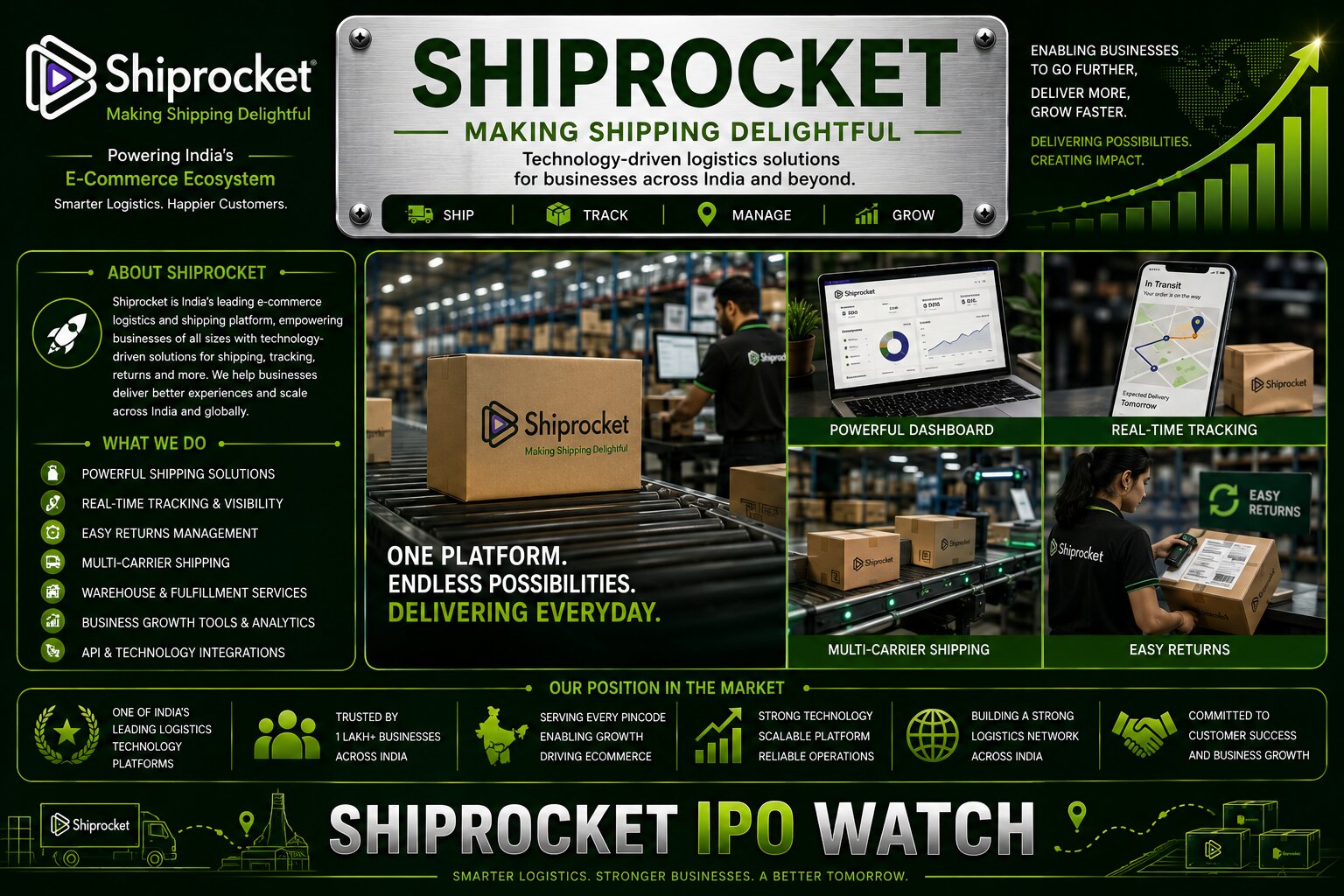
Shiprocket has expanded into a much broader e-commerce enablement platform spanning domestic logistics, fulfilment, international shipping, checkout technology, hyperlocal delivery, marketing tools and merchant-focused services. Its own platform currently highlights more than 4 lakh businesses and sellers, 19,000+ unique Indian pin codes, 220+ countries and territories, 42+ courier partners and 250+ ecosystem integrations.
That expansion creates the central investment question around the Shiprocket IPO 2026:
Can Shiprocket increase the amount of revenue it earns from every merchant while turning its rapidly growing newer businesses profitable?
The answer matters much more than the number of parcels moving through the platform.
Shiprocket IPO Details
| Particular | Details |
|---|---|
| Company | Shiprocket Limited |
| IPO Type | Mainboard Book Built IPO |
| Total Issue Size | ₹1,617.59 Crore |
| Fresh Issue | ₹885.60 Crore |
| Offer for Sale | ₹731.98 Crore |
| Price Band | ₹92 – ₹97 Per Share |
| Face Value | ₹10 Per Share |
| Lot Size | 154 Shares |
| Minimum Retail Investment | ₹14,938 at ₹97 |
| IPO Opening Date | August 12, 2026 |
| IPO Closing Date | August 14, 2026 |
| Expected Allotment | August 17, 2026 |
| Expected Listing | August 19, 2026 |
| Listing | BSE & NSE |
| Registrar | KFin Technologies Limited |
| Lead Manager | Axis Capital |
The offer consists of approximately 9.13 crore fresh shares worth ₹885.60 crore and around 7.55 crore shares through the OFS worth ₹731.98 crore.
What Does Shiprocket Actually Do?
Shiprocket provides technology and services that help merchants manage different stages of online commerce.
Its current offering includes:
- Domestic shipping
- Fulfilment
- Cross-border shipping
- Checkout technology
- Hyperlocal delivery
- Marketing tools
- Merchant services
- Cargo and heavy logistics
- Omnichannel commerce
- Customer-experience tools
Shiprocket's website describes domestic shipping across more than 19,000 Indian pin codes, international coverage across more than 220 countries and territories, and fulfilment through 35 strategically placed warehouses.
This makes Shiprocket much more than a courier-comparison platform.
Shiprocket Does Not Need to Own Every Delivery Vehicle
One of the more attractive aspects of Shiprocket's model is that it aggregates multiple logistics providers rather than building the entire delivery network itself.
The platform currently works with more than 42 courier partners.
For merchants, that creates choice.
For Shiprocket, it can create a more scalable model than owning every truck, aircraft and last-mile delivery network directly.
The company can potentially grow shipment volume by expanding software, merchant relationships and logistics integrations rather than matching every rupee of revenue growth with physical logistics capex.
Merchant Scale Is the Real Platform Asset
Shiprocket states that its ecosystem supports more than 4 lakh businesses and sellers.
However, IPO reporting provides another useful measure: as of the six months ended September 30, 2025, the company had more than 145,000 active merchants, processed more than 97 million transactions, reached more than 42 million customers, and recorded a repeat-customer rate of 64.56%. It also served more than 8,500 higher-volume “Power Merchants.”
For investors, active merchants and merchant activity are more important than simple registration counts.
Why Merchant Retention Matters
Imagine Shiprocket acquires 10,000 sellers.
If half stop using the platform within a year, the company must continuously spend on marketing simply to replace lost merchants.
If merchants remain active and adopt additional Shiprocket services, customer economics improve.
That creates a more attractive cycle:
merchant acquisition → shipping usage → checkout/fulfilment/cross-border adoption → higher revenue per merchant → stronger retention.
This is the platform model investors should watch.
The Core Business Is Already Profitable
Shiprocket divides its operations broadly into core and emerging businesses.
The core platform includes shipping and associated applications, while emerging operations include areas such as heavy cargo, cross-border shipments, marketing and other merchant solutions.
The distinction is important because the core business is already profitable, while the emerging businesses remain in investment mode.
That means Shiprocket is not simply a loss-making startup with no profitable foundation.
Instead, it has a profitable core funding the expansion of newer growth categories.
Emerging Businesses Are Growing Much Faster
Between FY2024 and FY2026, Shiprocket's emerging-business contribution to revenue increased from approximately 17.6% to 26.6%, while its share of merchant additions increased from 6.2% to 21%.
During the same period, emerging-business revenue grew at approximately 52.6% CAGR, compared with roughly 17% CAGR for the core business.
This tells investors where management expects the next phase of growth to come from.
Why Emerging Businesses Matter
Consider a merchant already using Shiprocket for domestic shipping.
That merchant could later use:
- International shipping
- Fulfilment
- Checkout tools
- Hyperlocal delivery
- Marketing solutions
Shiprocket therefore does not always need to acquire a completely new seller to generate additional revenue.
It can increase its wallet share from merchants already on the platform.
This is one of the most important growth opportunities in the business.
Cross-Border Commerce Could Become a Major Growth Engine
Shiprocket currently offers cross-border solutions through services including ShipX, CargoX and LaunchX, with international reach across more than 220 countries and territories.
For Indian D2C brands, international expansion can be operationally difficult because they must deal with:
- International shipping
- Customs
- Documentation
- Delivery tracking
A platform simplifying those steps can create substantial value.
If more Indian sellers begin exporting directly to global customers, Shiprocket's cross-border business could grow faster than domestic shipping.
Fulfilment Adds Another Layer of Revenue
Shiprocket also operates fulfilment services across 35 strategically placed warehouses, according to the company's current platform information.
Fulfilment lets merchants store products closer to customers.
That can potentially reduce:
- Delivery times
- Shipping costs
- Return-to-origin rates
For Shiprocket, fulfilment can deepen the merchant relationship because the company becomes involved before the parcel is even handed to the courier.
Checkout Technology Pushes Shiprocket Closer to the Sale
Shipping happens after a customer places an order.
Checkout happens before the order is completed.
Shiprocket's fastrr Checkout is designed to reduce checkout friction and improve conversion. The company markets it as a one-click checkout solution that can reduce checkout time to under 40 seconds.
This is strategically interesting.
Shiprocket is moving from:
“help the merchant ship the order”
toward:
“help the merchant generate, convert, fulfil and deliver the order.”
That significantly expands the potential revenue opportunity per merchant.
FY2026 Revenue Reached ₹2,024 Crore
Shiprocket's revenue increased at approximately 24% CAGR between FY2024 and FY2026, reaching around ₹2,024 crore in FY2026.
That scale makes Shiprocket one of India's largest e-commerce enablement platforms by revenue.
The growth demonstrates that the company has already moved well beyond startup-scale operations.
But Shiprocket Is Still Loss Making
Despite strong revenue growth, Shiprocket reported a net loss of approximately ₹79.2 crore in FY2026.
This is one of the biggest risks in the IPO.
Investors are not buying an established, consistently profitable technology business.
They are buying a company where the core operation is profitable but newer segments are still consuming investment.
That makes future margin improvement critical.
Operating Cash Flow Has Improved Sharply
One encouraging financial development is cash flow.
Shiprocket's total operating cash flow improved from an approximately ₹216 crore outflow in FY2024 to a positive ₹52.6 crore in FY2026.
This matters because a company can report improving EBITDA while still consuming large amounts of cash.
Moving into positive operating cash flow suggests the economics are improving.
However, current brokerage analysis also notes that FY2026 cash flow benefited partly from share-based-payment expenses and favourable working-capital movements, so investors should watch whether positive cash generation continues.
Core Operating Profit Is Growing Fast
Shiprocket's core business operating profit grew at approximately 60% CAGR to ₹186.6 crore between FY2024 and FY2026.
That is a major positive.
It suggests the mature portion of Shiprocket's platform is generating meaningful operating leverage.
The long-term path to consolidated profitability may therefore depend largely on how quickly emerging segments narrow their losses.
₹211 Crore Is Planned for Technology
Shiprocket intends to deploy around ₹211 crore of fresh IPO proceeds toward enhancing technology infrastructure and capabilities across both core and emerging businesses.
This investment can support:
- Platform scalability
- Merchant tools
- Automation
- AI-related capabilities
- Data infrastructure
- Product development
For a technology-led platform, continued investment is necessary.
The key is generating sufficient incremental merchant revenue from that spending.
₹294 Crore Will Go Toward Marketing and Brand Building
The company has earmarked approximately ₹294 crore for marketing and brand-building initiatives.
That is a significant amount.
It highlights how competitive merchant acquisition has become.
Shiprocket competes not only against logistics companies but also against:
- Commerce software platforms
- Courier aggregators
- Fulfilment providers
- Cross-border platforms
Investors should monitor whether higher marketing spend improves:
active merchants + transactions + merchant revenue
rather than simply registrations.
₹210 Crore Is Planned for Debt Repayment
Around ₹210 crore is expected to be used for repayment or prepayment of borrowings and related accrued interest.
Debt reduction can potentially:
- Lower finance costs
- Strengthen cash flow
- Improve the path toward profitability
The remaining fresh issue proceeds can also be used for potential inorganic opportunities and general corporate purposes.
The IPO Is Not Entirely Fresh Capital
The ₹1,617.59 crore issue consists of:
₹885.60 crore fresh issue
and
₹731.98 crore OFS.
That means roughly 55% of the IPO is new company capital, while the balance provides liquidity to existing shareholders.
Selling shareholders include institutional and individual investors, while co-founders Saahil Goel and Gautam Kapoor are also participating in the OFS.
Shiprocket Has No Identified Promoter
One unusual governance feature is that Shiprocket has not identified a promoter. Bertelsmann Nederland BV was the largest shareholder with approximately 21.3% ownership before the IPO, according to current IPO analysis.
Co-founders Saahil Goel and Gautam Kapoor continue to run operations, but their stakes are expected to decline after the offering.
For investors, this makes management quality and board governance particularly important.
Anchor Demand Was Strong
Ahead of the public issue, Shiprocket raised approximately ₹727.41 crore from anchor investors at ₹97 per share.
Of that allocation, about 66.76% was taken by 13 domestic mutual funds through 31 schemes.
That indicates substantial institutional interest before public bidding began.
However, anchor participation does not guarantee listing or long-term returns.
Day-2 Subscription Is Improving
As of the latest August 13 intraday update, Shiprocket IPO was subscribed approximately:
| Category | Subscription |
|---|---|
| Retail | 5.76× |
| NII | 2.31× |
| QIB | 0.02× |
| Overall | 1.72× |
Retail demand is currently the strongest, while QIB bidding remains low at this stage.
Institutional investors frequently place large orders on the final day, so the final August 14 QIB figure will be more meaningful than today's intraday level.
Shiprocket IPO GMP Today
The latest reported grey-market premium is approximately:
₹34 per share.
Against the ₹97 upper price band, that implies an unofficial estimated price of around:
₹131
or approximately:
35% premium.
GMP is unofficial, unregulated and can change rapidly before listing.
It should not determine a long-term investment decision.
Price-to-Sales Is More Useful Than P/E
Because Shiprocket remains loss making, a traditional P/E ratio is not particularly useful.
Current analysis values the offering at roughly 3.5–3.6× FY2026 sales based on the implied post-issue valuation.
This valuation needs to be judged against:
- Revenue growth
- Core profitability
- Emerging-business growth
- Cash-flow improvement
- Future path to consolidated profitability
The biggest risk is paying for growth before the company proves those newer businesses can generate profits.
The Asset-Light Model Is a Strength
Shiprocket's platform-heavy structure can allow revenue to scale faster than physical assets.
It connects merchants with courier, fulfilment and commerce infrastructure rather than needing to own every element itself.
This can support:
- Faster expansion
- Lower capital intensity
- Wider geographic coverage
Current brokerage coverage has also highlighted the company's asset-light, technology-driven model as a key strength.
Competition Is Still Intense
Shiprocket operates across several highly competitive markets.
These include:
- Domestic shipping
- Fulfilment
- Cross-border logistics
- Checkout
- Marketing technology
Large courier companies, technology firms and specialised startups can compete in individual segments.
Shiprocket's advantage depends on maintaining the value of its integrated ecosystem rather than winning every standalone product category.
The Ecosystem May Be the Real Moat
A merchant using only Shiprocket shipping can potentially switch relatively easily.
A merchant using:
shipping + fulfilment + checkout + international commerce + marketing
is more deeply integrated.
That can increase switching friction.
Therefore, one of the most important long-term metrics is likely to be:
number of Shiprocket products used per active merchant.
Higher product adoption can improve both retention and monetisation.
D2C Growth Is a Structural Tailwind
Shiprocket serves SMB online retailers, D2C brands, social sellers and larger omnichannel businesses.
As more Indian brands sell directly through:
- Their own websites
- Social media
- Marketplaces
- Offline stores
they need technology to connect these different sales and logistics channels.
That creates a long-duration opportunity for commerce-enablement platforms.
Cross-Border Growth Could Reduce Domestic Dependence
International commerce provides another strategic benefit.
If Indian brands increasingly export through direct online channels, Shiprocket can earn revenue from a market far larger than domestic parcel shipping alone.
Its current global network already extends across more than 220 countries and territories.
The challenge is maintaining competitive economics against global shipping and logistics providers.
Major Strengths
Shiprocket's key strengths include:
- ₹2,024 crore FY2026 revenue
- Profitable core business
- Rapidly growing emerging businesses
- 4 lakh+ seller ecosystem
- 42+ courier partners
- 19,000+ pin-code coverage
- 220+ countries and territories
- Positive FY2026 operating cash flow
- Strong anchor participation
- Multiple merchant monetisation opportunities.
Major Risks
The major risks investors should consider include:
- Consolidated net losses
- Emerging businesses still loss making
- High marketing requirements
- Strong competition
- Execution risk across multiple new services
- OFS component
- Need to maintain merchant retention
- Dependence on third-party courier ecosystems
- Risk that current cash-flow improvement is not fully sustainable.
What Investors Should Track After Listing
The most useful post-listing metrics may be:
Active merchants: Is the merchant base continuing to expand?
Revenue per merchant: Is Shiprocket monetising existing customers better?
Emerging-business share: Does it continue increasing beyond 26.6%?
Emerging-business losses: Are newer segments moving toward breakeven?
Core operating profit: Does the profitable core continue compounding?
Operating cash flow: Does positive cash generation continue?
Marketing efficiency: Is ₹294 crore of planned marketing spend producing quality merchant growth?
Product adoption: Are merchants using multiple Shiprocket solutions?
The Most Important Post-IPO Equation
Shiprocket has already proved that it can build scale.
The company now needs to prove that scale can become durable consolidated profitability.
The ideal equation is:
more merchants → more products per merchant → higher revenue → stronger core profits → emerging businesses mature → consolidated profit.
The riskier alternative is:
more merchants → more marketing expense → more emerging-business investment → continued losses.
The difference between these two outcomes will determine the quality of Shiprocket as a listed company.
Should Investors Consider Shiprocket IPO?
The positive investment case includes:
- Large e-commerce enablement platform
- Strong merchant ecosystem
- ₹2,024 crore FY2026 revenue
- Profitable core operations
- Fast-growing emerging businesses
- Improved operating cash flow
- ₹727 crore-plus anchor allocation
- Strong current retail demand
- Positive GMP
The caution points include:
- Consolidated losses
- Emerging businesses still unprofitable
- Significant marketing investment
- Competitive markets
- Need to prove sustainable positive cash generation
- Meaningful OFS component
Shiprocket should therefore be evaluated as a commerce infrastructure and software platform, not simply as a logistics aggregator.
Final View on Shiprocket IPO 2026
The Shiprocket IPO 2026 arrives at an important transition point for the company.
Shiprocket began by simplifying shipping for online merchants. It now operates across domestic logistics, fulfilment, international commerce, checkout, marketing and other merchant solutions, while its current ecosystem spans more than 4 lakh businesses and sellers, 42+ courier partners, 19,000+ Indian pin codes and 220+ countries and territories.
Financially, FY2026 revenue reached approximately ₹2,024 crore, representing roughly 24% annual growth from FY2024. The core business is already profitable, with operating profit reaching approximately ₹186.6 crore, while emerging businesses are expanding much faster but remain loss making.
The company still reported an approximately ₹79.2 crore net loss in FY2026, but operating cash flow improved dramatically to a positive ₹52.6 crore, compared with a ₹216 crore outflow in FY2024.
The IPO will provide roughly ₹885.60 crore in fresh capital, with planned spending including about ₹294 crore for marketing, ₹211 crore for technology and ₹210 crore for debt repayment.
That creates the long-term investment thesis:
profitable core business + higher merchant monetisation + fast-growing emerging services + better cash generation = potential path to consolidated profitability.
But investors should not ignore the key risk.
Shiprocket has significant scale but has not yet demonstrated sustained net profitability at the consolidated level. The emerging businesses that provide its most exciting growth opportunities are also the businesses currently consuming investment.
As of August 13, the IPO is subscribed around 1.72× overall, retail demand is about 5.76×, and current GMP of roughly ₹34 suggests around a 35% unofficial premium over the ₹97 upper band.
For long-term investors, however, the more important numbers after listing will be active merchants, revenue per merchant, emerging-business profitability, operating cash flow and consolidated PAT.
Overall, Shiprocket represents a differentiated Indian digital-commerce infrastructure IPO with large scale, a profitable core engine and multiple future monetisation opportunities. Its long-term success will depend on whether management can turn its rapidly expanding commerce ecosystem into sustainable consolidated profits without allowing marketing and emerging-business investments to consume the benefits of scale.