 GMP IPO Watch
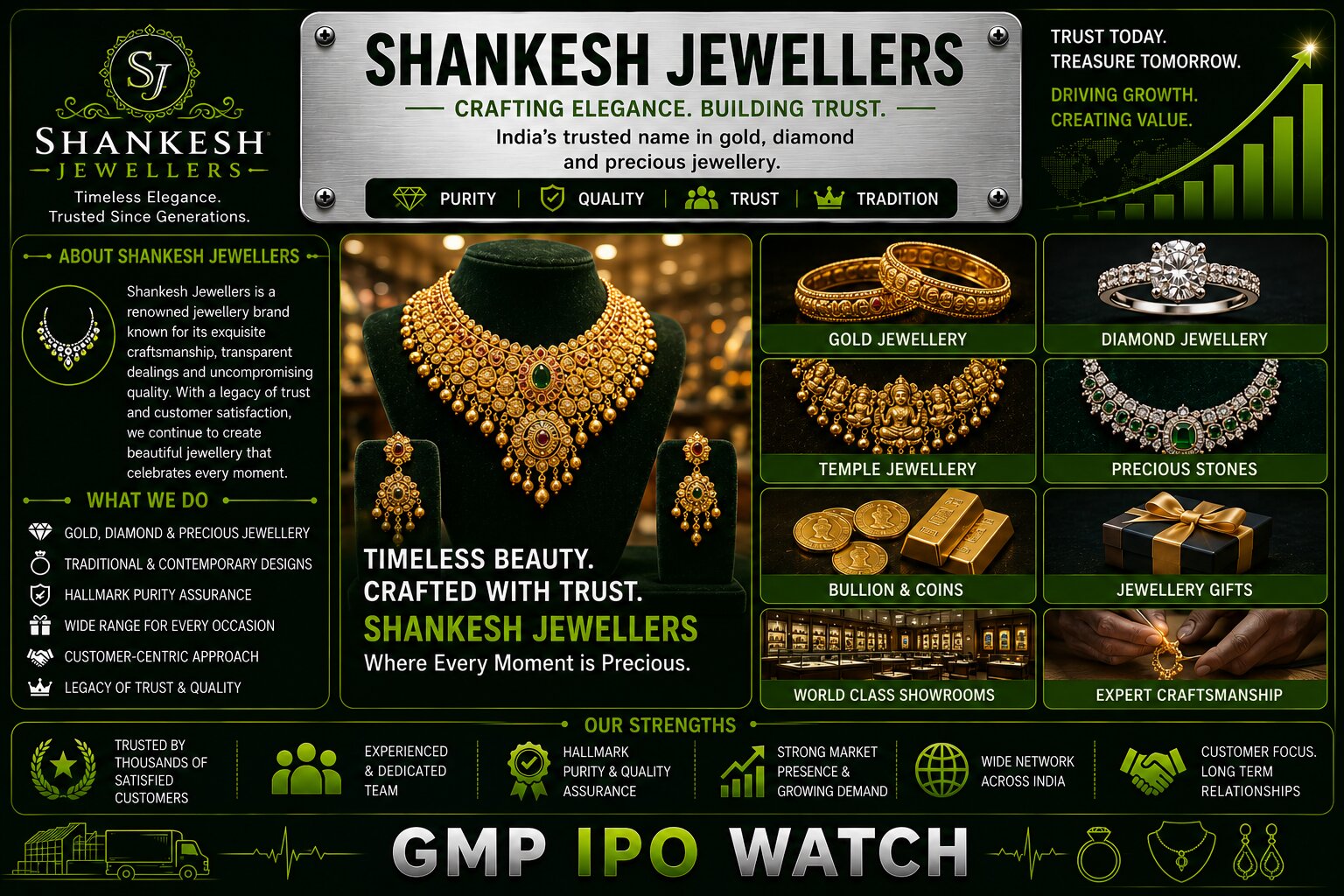
Shankesh Jewellers IPO 2026 – A Jewellery Business Built Behind the Retail Counter
When consumers think about jewellery companies, they usually think about showrooms.
Shankesh Jewellers operates differently.
Its core business is much more B2B-focused, involving the manufacture and supply of handcrafted gold jewellery to jewellery retailers and other trade customers.
That distinction changes the economics of the business.
A retail jewellery chain earns from:
- Store traffic
- Consumer branding
- Making charges
- Retail margins
A B2B jewellery manufacturer must instead focus on:
- Design
- Manufacturing quality
- Gold inventory
- Customer orders
- Working capital
- Production efficiency
Shankesh Jewellers Limited is now preparing to enter the public market through an approximately ₹367.18 crore mainboard IPO.
The issue opens on August 18, 2026, closes on August 20, and has a price band of ₹88 to ₹93 per share. It comprises approximately ₹274.18 crore of fresh issue and ₹93 crore through an Offer for Sale.
For investors, the real question is not simply whether gold jewellery demand will remain strong.
It is:
Can Shankesh convert its high-volume B2B jewellery model into sustainable profit growth while reducing leverage and improving cash efficiency?
Shankesh Jewellers IPO Details
| Particular | Details |
|---|---|
| Company | Shankesh Jewellers Limited |
| IPO Type | Mainboard Book Built IPO |
| Total Issue Size | Approx. ₹367.18 Crore |
| Fresh Issue | Approx. ₹274.18 Crore |
| Offer for Sale | Approx. ₹93 Crore |
| Price Band | ₹88 – ₹93 Per Share |
| Face Value | ₹5 Per Share |
| Lot Size | 160 Shares |
| Minimum Retail Investment | ₹14,880 at ₹93 |
| IPO Opening Date | August 18, 2026 |
| IPO Closing Date | August 20, 2026 |
| Expected Allotment | August 21, 2026 |
| Expected Listing | August 25, 2026 |
| Listing | BSE & NSE |
| Registrar | KFin Technologies Limited |
| Lead Managers | Aryaman Financial Services and Smart Horizon Capital Advisors |
The issue structure is relatively fresh-issue heavy, with roughly three-fourths of the IPO proceeds coming through newly issued shares.
About Shankesh Jewellers
Shankesh Jewellers is a Mumbai-based jewellery manufacturer with a long operating presence in the industry.
The business focuses on handcrafted jewellery, particularly:
- 18-karat gold jewellery
- 22-karat gold jewellery
- Antique designs
- Rhodium-finished jewellery
- Plain gold jewellery
- Customised jewellery
- Job-work services
The company operates primarily as a manufacturer and supplier rather than as a large consumer-facing retail chain.
That makes its business model more closely tied to relationships with jewellery retailers and trade customers.
Why B2B Jewellery Is Different From Retail Jewellery
Suppose a jewellery retailer wants 5,000 pieces across multiple designs.
It may not want to manufacture all of those products internally.
Instead, it can place orders with a specialist manufacturer such as Shankesh.
The manufacturer then handles:
Design → Gold procurement → Manufacturing → Finishing → Quality control → Delivery
The retailer receives finished products ready for sale.
This allows retailers to expand design variety without building equivalent manufacturing infrastructure.
For Shankesh, repeat relationships with retailers can create recurring order flow.
18K and 22K Gold Jewellery Serve Different Customers
Shankesh manufactures both 18-karat and 22-karat products.
22K Gold
Often preferred for traditional Indian gold jewellery because of its higher gold purity.
18K Gold
Contains a lower gold percentage but can offer additional hardness and design flexibility.
It is often used for:
- Contemporary jewellery
- Stone-set designs
- Lightweight products
Operating across both categories gives Shankesh flexibility in serving different customer segments.
Design Capability Can Be a Competitive Advantage
Jewellery demand is not based only on gold weight.
Customers also care about:
- Design
- Finish
- Craftsmanship
- Fashion trends
- Regional preferences
A B2B manufacturer capable of launching attractive collections may win repeat orders from multiple retail clients.
That means design teams can be an important intangible asset.
Unlike a commodity gold trader, Shankesh can potentially earn additional value through craftsmanship and product differentiation.
Customisation Helps Strengthen Customer Relationships
Retailers may request jewellery designed for:
- Specific regional markets
- Wedding collections
- Festival demand
- Price points
- Weight ranges
Manufacturers able to respond quickly can become strategically important suppliers.
This creates a more embedded customer relationship than simply selling standardised gold products.
FY2025 Revenue Reached ₹1,403.83 Crore
Shankesh reported approximately ₹1,403.83 crore of FY2025 revenue, compared with about ₹1,061.78 crore in FY2024 and roughly ₹909.19 crore in FY2023.
That represents substantial top-line expansion.
The company therefore enters the IPO with meaningful operating scale rather than as an early-stage jewellery manufacturer.
Shankesh Jewellers Financial Performance
| Financial Year | Revenue | Profit After Tax |
| FY2023 | ₹909.19 Cr | ₹10.44 Cr |
| FY2024 | ₹1,061.78 Cr | ₹12.82 Cr |
| FY2025 | ₹1,403.83 Cr | ₹40.31 Cr |
The standout number is FY2025 PAT.
Profit increased from around ₹12.82 crore to ₹40.31 crore in one year.
That is more than a three-fold increase.
The PAT Jump Is the Biggest Financial Question
Revenue increased by roughly 32% from FY2024 to FY2025.
PAT increased by more than 200%.
That is a major improvement in profit conversion.
Possible drivers may include:
- Better product mix
- Higher manufacturing utilisation
- Lower finance costs
- Improved operating efficiency
- Stronger making-charge realisations
But investors should not assume that FY2025 profit growth will automatically repeat.
The key question is whether the margin improvement is structural.
Jewellery Manufacturing Is a Low-Margin, High-Volume Business
FY2025 PAT of ₹40.31 crore against revenue above ₹1,400 crore implies a net margin below 3%.
That may appear low.
But B2B jewellery manufacturers frequently operate on high turnover with relatively modest margins.
Because the underlying gold value flows through revenue, even a small margin can generate meaningful absolute profit when sales volume is large.
This makes inventory turnover and working-capital efficiency particularly important.
A Small Margin Change Can Have a Big Impact
Suppose annual revenue is ₹1,400 crore.
At a 2% net margin:
PAT = ₹28 crore
At a 3% net margin:
PAT = ₹42 crore
Only one percentage point separates the two outcomes.
This explains why investors should pay close attention to:
- Gross margin
- EBITDA margin
- Finance costs
- Gold pricing
Current Profitability Ratios Are Strong
IPO valuation data indicates metrics including:
- ROE around 40.07%
- ROA around 16.15%
- EBITDA margin around 4.66%.
Current pricing analyses also show EPS around ₹7.26, with the upper issue price of ₹93 implying a P/E close to 12.8× on the cited basis.
These ratios make the valuation worth examining closely.
Working Capital Is the Core Constraint
Gold jewellery manufacturing requires enormous working capital relative to the company's net margin.
Imagine Shankesh receives a ₹50 crore customer order.
It may need significant capital immediately to purchase gold and begin production.
The customer may pay only after delivery.
So cash is temporarily locked in:
- Gold inventory
- Work-in-progress
- Finished jewellery
- Receivables
Fast revenue growth can therefore create more working-capital pressure rather than less.
₹38 Crore Is Planned for Working Capital
Current IPO disclosures indicate approximately ₹38 crore of fresh issue proceeds is intended to meet working-capital requirements.
That can support higher order volumes without requiring the company to finance every incremental order through additional borrowing.
For a high-volume jewellery manufacturer, this can be particularly valuable.
₹158 Crore Is Planned for Debt Repayment
A much larger portion of the fresh issue, approximately ₹158 crore, is intended for repayment or prepayment of borrowings.
This is one of the most important IPO objectives.
As of FY2025, total borrowings were approximately ₹145.63 crore according to earlier filing-based financial reporting.
Reducing debt can directly improve earnings quality.
Why Debt Reduction Matters So Much
Suppose Shankesh pays ₹15 crore annually in finance costs.
If IPO proceeds substantially reduce borrowings, future interest expense could decline.
That can improve:
- PAT
- Cash flow
- Interest coverage
- Balance-sheet strength
In a low-margin business, lower finance costs can have an outsized impact.
A ₹5 crore reduction in interest expense is meaningful when annual PAT is ₹40 crore.
Fresh Issue Is Larger Than the OFS
The IPO includes:
- Fresh issue: ₹274.18 crore
- OFS: ₹93 crore.
This means around 75% of the total issue is fresh capital.
That is constructive from a capital-allocation perspective because most of the money raised is intended to strengthen the company.
Who Is the Typical Shankesh Customer?
The company primarily serves jewellery businesses rather than individual consumers.
Its customer base includes:
- Jewellery retailers
- Wholesalers
- Trade customers
In FY2025, Shankesh reportedly served 457 customers.
A large B2B customer base provides diversification.
But revenue concentration among the largest customers still needs careful evaluation.
B2B Customers Have Significant Bargaining Power
A large jewellery retailer may place very large orders.
That gives the customer negotiating power over:
- Making charges
- Payment terms
- Design specifications
- Delivery timing
The manufacturer must therefore maintain excellent production efficiency to protect margins.
High revenue does not automatically translate into high pricing power.
Customer Retention Can Create Recurring Revenue
Once a retailer trusts a jewellery manufacturer's:
- Purity
- Design quality
- Delivery
- Craftsmanship
it may place repeat orders across many seasons.
This can create recurring demand.
The relationship can become particularly strong when Shankesh develops customer-specific designs.
Gold Prices Can Distort Revenue Growth
Suppose Shankesh sells exactly the same quantity of jewellery in two years.
If gold prices rise 20%, reported rupee revenue could also rise sharply.
That does not necessarily mean physical jewellery volume increased.
Therefore, investors should ideally look beyond headline revenue to metrics such as:
- Jewellery volume
- Number of customers
- Order count
- Making-charge income
Gold inflation can otherwise make revenue growth look stronger than underlying operational growth.
Rising Gold Prices Can Also Pressure Demand
Higher gold prices raise the final cost of jewellery.
Retail customers may respond by purchasing:
- Lighter jewellery
- Lower quantities
- 18K instead of 22K products
- Alternative designs
This eventually affects orders placed by retailers with manufacturers such as Shankesh.
Gold-price volatility is therefore both an accounting and demand risk.
Inventory Risk Is Significant
Gold inventory has very high monetary value.
Poor inventory management can create large capital requirements.
Management needs to maintain enough stock to:
- Fulfil customer orders
- Maintain design availability
- Manage production
without allowing excessive capital to sit idle.
This makes inventory turnover one of the most important post-listing metrics.
Manufacturing Quality Is Non-Negotiable
Jewellery customers expect:
- Correct purity
- Correct weight
- Reliable finishing
- Design accuracy
A quality failure can result in:
- Customer returns
- Lost orders
- Reputation damage
Because B2B relationships often involve repeat transactions, reliability matters greatly.
Zaveri Bazaar Provides Ecosystem Benefits
Shankesh is associated with Mumbai's jewellery ecosystem, including the Zaveri Bazaar market.
Operating within a major jewellery hub provides access to:
- Skilled artisans
- Gold suppliers
- Traders
- Customers
- Industry networks
This can support faster sourcing and product development.
However, it also means the company competes within one of India's most intense jewellery manufacturing clusters.
Jewellery Craftsmanship Remains Labour Intensive
Many handcrafted jewellery products require skilled workers.
That means the business depends on:
- Artisans
- Designers
- Manufacturing staff
- Quality-control employees
Labour availability and craftsmanship quality can directly affect production.
If skilled labour costs increase sharply, margins may come under pressure.
Technology Can Still Improve a Traditional Craft Business
Even handcrafted jewellery manufacturers can use technology for:
- CAD design
- Inventory management
- ERP systems
- Customer ordering
- Production planning
Digital tools can improve efficiency without removing craftsmanship from the final product.
For a company growing past ₹1,400 crore in revenue, strong internal systems become increasingly important.
Export Opportunity Adds Another Growth Route
Shankesh describes itself as a manufacturer-exporter with international customers.
Export markets can provide:
- Additional customer diversification
- Access to Indian diaspora demand
- Foreign currency revenue
But exports also create:
- Currency risk
- International compliance
- Logistics complexity
The long-term value depends on whether export margins justify the additional operating requirements.
Valuation at ₹93
Latest IPO valuation tracking indicates:
- EPS: about ₹7.26
- P/E: about 12.81×
- RoNW: about 50.94%
- Indicative post-issue market capitalisation: about ₹1,367 crore.
A P/E near 13× does not immediately look aggressive compared with many consumer-jewellery businesses.
However, Shankesh is a B2B manufacturer rather than a high-margin branded retail chain.
Its appropriate valuation should therefore reflect:
- Lower margins
- Working-capital intensity
- Customer bargaining power
- Gold-price exposure
Peer Comparisons Need Care
Listed jewellery companies may include retail chains with substantially different economics.
A retailer can earn:
- Brand premium
- Retail making charges
- Store-level margins
Shankesh operates further back in the value chain.
Therefore, comparing its P/E directly with a major retail jeweller can be misleading.
The closest peers are businesses with similar manufacturing and wholesale exposure.
Shankesh Jewellers IPO GMP Today
As of August 13, 2026, grey-market trackers are showing GMP of approximately:
₹6–₹7 per share.
Against the upper issue price of ₹93, that implies an unofficial indicated listing range of approximately:
₹99–₹100
or roughly:
6%–8% premium.
GMP remains unofficial and can change materially before the August 25 listing.
There Is No Subscription Data Yet
The IPO opens on August 18, 2026.
Therefore, there is currently no genuine:
- QIB subscription
- NII subscription
- Retail subscription
as of August 13.
Any subscription figure appearing before the public issue opens should not be treated as valid public bidding data.
What Could Drive Shankesh's Next Growth Phase?
Lower Finance Costs
₹158 crore debt repayment could improve earnings.
More Working Capital
₹38 crore funding can support larger customer orders.
Customer Growth
Adding additional retailers and wholesalers can diversify revenue.
More Premium Designs
Higher-value jewellery may improve making-charge economics.
Export Expansion
International customers can increase the addressable market.
Better Inventory Turnover
Faster movement of gold stock can improve return on capital.
Competitive Strengths
₹1,400 Crore+ Revenue Scale
Shankesh already operates at meaningful scale.
Strong FY2025 PAT Growth
PAT increased from ₹12.82 crore to ₹40.31 crore.
High ROE
FY2025 ROE is reported around 40%.
B2B Jewellery Expertise
The company specialises in handcrafted 18K and 22K jewellery.
Diversified Customer Base
It served 457 customers in FY2025.
Mostly Fresh IPO
Around ₹274 crore of the ₹367 crore issue goes into the company.
Debt-Reduction Plan
A substantial portion of fresh proceeds is planned for deleveraging.
Major Risks
Low Net Margins
Small changes in operating costs can materially affect PAT.
Working-Capital Intensity
Gold inventory requires substantial financing.
Gold Price Volatility
Higher prices can influence both revenue and underlying demand.
Customer Bargaining Power
Large jewellery retailers can pressure manufacturing margins.
Customer Concentration
A few large clients may represent meaningful revenue.
Skilled Labour Dependence
Handcrafted jewellery requires experienced artisans.
Inventory Risk
Slow-moving designs can lock significant capital.
OFS Component
₹93 crore of the issue goes to selling shareholders rather than the company.
What Investors Should Track After Listing
PAT Margin
Can the FY2025 margin improvement continue?
Interest Expense
Does debt repayment materially boost profitability?
Inventory Turnover
Is gold capital moving efficiently?
Operating Cash Flow
Does PAT convert into real cash?
Customer Concentration
Is the business becoming more diversified?
ROCE
Does the larger equity base continue generating strong returns?
Export Contribution
Is international business becoming meaningful?
The Most Important Post-IPO Question
The IPO is giving Shankesh substantially more equity capital.
A large part will be used to reduce debt.
That means the first stage of value creation may come from improving the balance sheet.
The next stage needs to come from operating growth.
The ideal cycle looks like:
Lower debt → lower finance costs → more working capital → larger orders → higher PAT → stronger cash flow.
If that cycle works, the IPO can improve both growth and earnings quality.
Should Investors Consider Shankesh Jewellers IPO?
The positive investment case includes:
- Large revenue base
- Strong recent PAT growth
- High reported ROE
- B2B jewellery manufacturing expertise
- Reasonable headline P/E
- Debt-repayment plan
- Mostly fresh issue
- Positive current GMP
The caution points include:
- Thin margins
- Gold-price risk
- Working-capital intensity
- Customer bargaining power
- Need to prove FY2025 profit sustainability
This makes Shankesh more suitable for investors comfortable analysing a high-turnover manufacturing and wholesale jewellery model rather than a branded retail jewellery story.
Final View on Shankesh Jewellers IPO 2026
The Shankesh Jewellers IPO 2026 gives investors exposure to a jewellery business that operates behind the retail showroom rather than primarily inside it.
The company manufactures handcrafted 18K and 22K gold jewellery and provides customisation and job-work services to jewellery businesses.
Its recent growth has been significant.
Revenue increased from approximately ₹909.19 crore in FY2023 to ₹1,403.83 crore in FY2025, while PAT increased from around ₹10.44 crore to ₹40.31 crore.
The IPO structure is also important.
Out of the approximately ₹367.18 crore issue, around ₹274.18 crore is fresh capital, while ₹93 crore represents OFS.
Management intends to use approximately ₹158 crore for debt repayment and ₹38 crore for working capital.
That creates a relatively clear investment thesis:
less debt + stronger working capital + established B2B customer base = potential improvement in earnings quality and growth capacity.
The biggest question is whether FY2025's sharp profitability improvement is sustainable.
Shankesh operates in a business where margins are thin, gold inventory is expensive and large customers can have substantial bargaining power.
For long-term investors, the most useful post-listing metrics will therefore be:
PAT margin, interest cost, inventory turnover, operating cash flow and customer concentration.
Overall, Shankesh Jewellers represents a profitable, fast-growing B2B jewellery manufacturing IPO with a relatively modest headline valuation and a meaningful debt-reduction plan. Its long-term success will depend less on short-term gold prices and more on disciplined working-capital management, customer diversification and the sustainability of its recent profit expansion.