 GMP IPO Watch
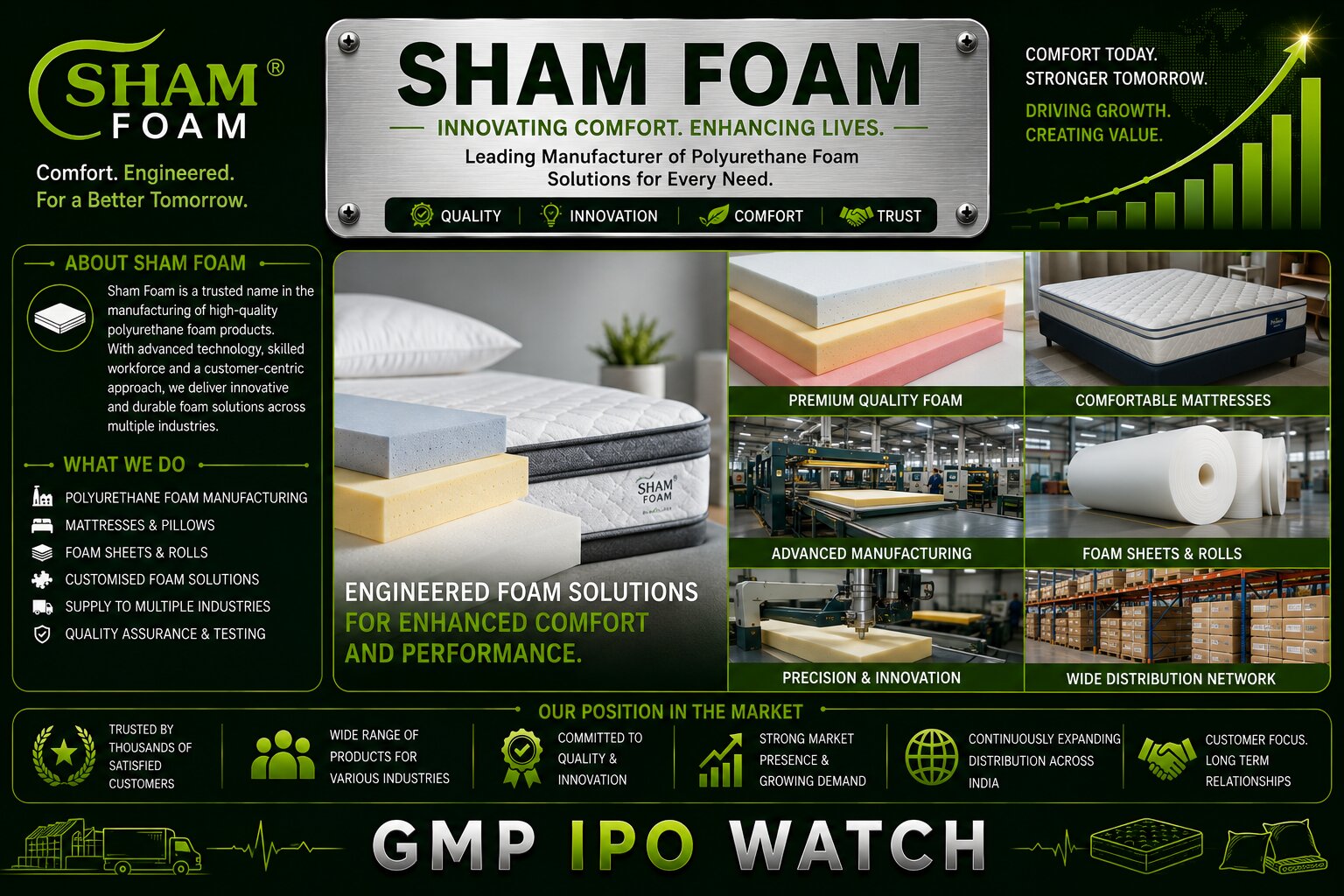
Sham Foam IPO 2026 – More Than Just a Mattress Business
A mattress is the final product that consumers see.
But the real economics often begin much earlier—with the foam inside it.
Polyurethane or PU foam is used not only in mattresses and pillows but also across furniture, automotive seating, garments, sports products and several industrial applications.
That places Sham Foam Limited in an interesting position.
The company operates across both sides of the market.
On one side, it manufactures PU foam used as an industrial input.
On the other, it converts foam into consumer-facing products such as mattresses, pillows and cushions under brands including Featherfresh and Restivia.
This gives Sham Foam two potential growth engines:
industrial foam volume + branded consumer products.
The company's BSE SME IPO opened on August 11, 2026 and closes on August 13, 2026 at a fixed issue price of ₹130 per share.
The entire approximately ₹40.48 crore issue is a fresh issue, meaning the money raised is intended to go into the business rather than primarily providing an exit to existing shareholders.
For investors, the key question is whether Sham Foam can use that capital to expand production while gradually increasing the contribution from higher-value branded products.
Sham Foam IPO Details
| Particular | Details |
|---|---|
| Company | Sham Foam Limited |
| IPO Type | Fixed Price SME IPO |
| Exchange | BSE SME |
| Total Issue Size | Approx. ₹40.48 Crore |
| Fresh Issue | Approx. 31.14 Lakh Shares |
| Offer for Sale | Nil |
| Issue Price | ₹130 Per Share |
| Face Value | ₹10 Per Share |
| Base Lot | 1,000 Shares |
| Minimum Retail Application | 2,000 Shares |
| Minimum Retail Investment | ₹2,60,000 |
| IPO Opening Date | August 11, 2026 |
| IPO Closing Date | August 13, 2026 |
| Expected Allotment | August 14, 2026 |
| Expected Listing | August 18, 2026 |
| Listing Platform | BSE SME |
Under the current SME application structure, the minimum retail application is 2,000 shares, requiring approximately ₹2.60 lakh at the fixed ₹130 price.
About Sham Foam Limited
Sham Foam Limited was incorporated in 2020 and is based in Ambala, Haryana.
The company manufactures, markets and sells:
- Polyurethane foam
- Mattresses
- Pillows
- Cushions
- Furniture cushioning
- PU foam cores
- Other home-comfort products
It also supplies industrial-grade PU foam for use across sectors such as:
- Furniture
- Automotive
- Apparel
- Sports goods
This combination gives the company exposure to both B2B manufacturing and consumer retail demand.
Understanding the PU Foam Business
PU foam is a lightweight cellular material made using chemical inputs.
Its characteristics can be changed according to:
- Density
- Firmness
- Thickness
- Resilience
- Support level
That allows manufacturers to produce foam suited for different applications.
For example:
Soft foam → pillows and comfort products
Medium-density foam → mattresses and furniture
Specialised foam → industrial and automotive applications
This means Sham Foam is not dependent entirely on one finished-product category.
PU Foam Is Used Far Beyond Beds
Many investors may associate foam entirely with mattresses.
In reality, applications are much broader.
PU foam can be used in:
Furniture
Sofas, chairs and upholstered furniture require cushioning.
Automotive
Vehicle seating and interior comfort systems use foam materials.
Apparel
Certain padding and support applications use foam.
Sports Products
Protective and cushioning products can require specialised foam.
Home Furnishing
Mattresses, pillows and cushions form the most visible consumer segment.
This diversified end-use exposure can help reduce dependence on one market.
Why Vertical Integration Matters
Sham Foam describes itself as an integrated operator spanning product design, manufacturing, distribution and customer engagement.
This can provide an important economic advantage.
A non-integrated mattress company may need to purchase finished foam from an outside manufacturer.
Sham Foam can produce its own foam and then convert part of that production into finished mattresses.
That can potentially provide:
- Better raw-material control
- Faster product development
- Improved quality consistency
- Lower dependency on outside foam suppliers
- Better margin opportunity
However, vertical integration also requires more capital and operating expertise.
Production Capacity Is Already Meaningful
According to Sham Foam's own corporate disclosures, the company has annual PU foam manufacturing capacity of approximately 15,000 tonnes.
Capacity is important, but utilisation matters even more.
A plant capable of producing 15,000 tonnes creates strong economics only when customer demand keeps machinery productively occupied.
Investors should therefore monitor:
installed capacity → actual output → revenue → EBITDA → cash flow
after the IPO.
Why Capacity Utilisation Matters
Imagine a foam plant has capacity for 15,000 tonnes.
Scenario A
Production: 6,000 tonnes
Fixed factory costs are spread over fewer units.
Scenario B
Production: 12,000 tonnes
The same factory infrastructure produces much more saleable output.
That can improve:
- Fixed-cost absorption
- Employee productivity
- EBITDA margins
- Return on capital
Sham Foam's ability to increase utilisation without excessive additional fixed expenditure could therefore support profitability.
Consumer Brands Can Improve Business Quality
Sham Foam sells mattresses under brands including:
- Featherfresh
- Restivia
Its pillows and cushions are also marketed primarily under Featherfresh.
This matters because branded consumer products can have different economics from selling bulk foam.
When selling commodity-like foam, pricing may be heavily influenced by:
- Raw-material costs
- Competitor pricing
- Customer bargaining power
A recognised mattress brand can potentially earn additional value from:
- Product design
- Retail positioning
- Distribution
- Customer loyalty
- Brand perception
That creates the possibility of gradually improving product mix.
Featherfresh Is Central to the Consumer Strategy
Featherfresh is positioned across mattresses and related comfort products.
Sham Foam offers mattresses with different:
- Foam structures
- Firmness levels
- Comfort profiles
- Hybrid configurations
The company's strategy is therefore not limited to selling standard foam blocks.
It is attempting to turn manufacturing capability into consumer-facing sleep products.
If successful, this could help the company capture more value from each kilogram of foam manufactured.
Restivia Adds Brand Diversification
Restivia provides another mattress brand within Sham Foam's portfolio.
Multiple brands can potentially allow a company to target different:
- Price points
- Customer segments
- Retail channels
However, additional brands also require spending on:
- Distribution
- Advertising
- Dealer relationships
- Inventory
The value comes only when brand expansion creates incremental profitable sales.
Sham Foam Financial Performance
Historical financial disclosures show a meaningful improvement in profitability.
| Period | Total Income | Profit After Tax | EBITDA |
| FY2023 | ₹80.53 Cr | ₹0.70 Cr | ₹1.34 Cr |
| FY2024 | ₹73.89 Cr | ₹2.97 Cr | ₹4.43 Cr |
| FY2025 | ₹81.62 Cr | ₹3.58 Cr | ₹4.69 Cr |
| 6M FY2026 | ₹37.97 Cr | ₹3.19 Cr | ₹4.07 Cr |
The company also reported net worth of approximately ₹15.66 crore and borrowings of around ₹7.12 crore as of September 2025.
Recent IPO platforms also report stronger annualised FY2026 numbers, though investors should rely on the final RHP when comparing full-year figures.
Profitability Has Improved Faster Than Revenue
One notable feature of the historical numbers is that revenue has not increased dramatically every year, but PAT has improved significantly compared with FY2023.
Profit moved from:
₹0.70 crore in FY2023
to:
₹2.97 crore in FY2024
and:
₹3.58 crore in FY2025.
This may suggest improvement in:
- Product mix
- Factory efficiency
- Cost controls
- Finance costs
- Capacity utilisation
The six-month FY2026 PAT of ₹3.19 crore suggests continued improvement.
Borrowings Have Reduced
Another encouraging historical trend is debt.
Reported total borrowings declined from approximately:
- ₹18.40 crore in FY2023
- ₹10.11 crore in FY2024
- ₹9.22 crore in FY2025
- ₹7.12 crore by September 2025
A declining debt profile can support:
- Lower interest expenses
- Stronger cash flow
- Better financial flexibility
- Reduced balance-sheet risk
However, the IPO's expansion programme could create new working-capital requirements, so post-issue debt should continue to be monitored.
IPO Proceeds Will Fund Expansion
Sham Foam intends to use IPO proceeds for purposes including:
- Civil construction at the existing manufacturing facility
- Purchase of machinery and equipment
- Working-capital requirements
- General corporate purposes
This makes the IPO largely a growth-capital transaction.
The company is raising money to increase operational capacity rather than simply allowing promoters to sell shares.
Why New Machinery Matters
Additional machinery could help Sham Foam:
- Increase output
- Improve automation
- Produce new foam specifications
- Improve quality consistency
- Reduce production bottlenecks
- Support more mattress manufacturing
The economic value will depend on demand.
Buying equipment before sufficient customer orders exist can lower returns on capital.
Working Capital Is Important in Foam Manufacturing
Foam manufacturing requires purchasing chemical raw materials before finished products are sold.
Cash can become tied up in:
- Chemical inputs
- Work-in-progress
- Finished foam
- Mattresses
- Dealer receivables
As sales expand, working-capital requirements often expand as well.
That means revenue growth needs to be compared with:
operating cash flow + inventory days + receivable days.
Raw Materials Are One of the Biggest Risks
PU foam is produced using petrochemical-linked inputs.
That creates sensitivity to raw-material prices.
If input prices increase quickly, the company has three options:
- Raise product prices.
- Accept lower margins.
- Improve efficiency elsewhere.
The ability to pass costs to customers may differ between industrial foam and branded mattresses.
This makes raw-material volatility one of Sham Foam's most important operational risks.
Consumer Products Can Offer Better Pricing Flexibility
An industrial customer buying large quantities of foam may negotiate aggressively on price.
A mattress customer generally compares:
- Comfort
- Brand
- Features
- Warranty
- Price
rather than calculating the underlying foam input cost.
That creates an opportunity for branded finished products to reduce pure commodity-price exposure.
However, success requires brand investment and distribution.
Distribution Is Critical in the Mattress Business
A good mattress cannot generate revenue if customers cannot find it.
Distribution therefore matters significantly.
Sham Foam has developed a presence across multiple states and cities in India.
Future growth may depend on expanding:
- Dealers
- Furniture outlets
- Mattress retailers
- Institutional channels
- Online sales
Distribution expansion can improve brand visibility but may also increase receivables and marketing costs.
Institutional Customers Provide Another Opportunity
Sham Foam states that its products serve customers including families, hotels and healthcare centres.
Institutional customers can create bulk demand from:
- Hotels
- Hospitals
- Hostels
- Residential projects
- Furniture manufacturers
This creates another sales channel beyond individual retail buyers.
The Mattress Industry Is Highly Competitive
Sham Foam competes with:
- Large national mattress brands
- Regional manufacturers
- Local foam suppliers
- Unorganised mattress companies
- Online-first sleep brands
Competition can occur across:
- Price
- Comfort technology
- Dealer incentives
- Warranty
- Advertising
- Product availability
This means manufacturing capability alone does not guarantee strong branded-market share.
Sham Foam IPO Valuation
One current IPO analysis estimates a post-issue P/E of around 17×, while another platform using different annualised assumptions shows a higher multiple.
The variation illustrates why investors should verify:
- final EPS
- post-issue share count
- annualised vs audited earnings
before relying on a single P/E figure.
The ₹130 issue price should ultimately be judged against sustainable earnings rather than short-period annualisation.
Return Ratios Have Improved
Current IPO analytics report strong return indicators, including ROE and ROCE improvement as profitability and debt levels have improved.
These metrics are encouraging but need to be assessed after the IPO because the equity base will increase substantially.
When fresh equity capital enters the company, ROE may temporarily decline unless profits increase fast enough.
Sham Foam IPO GMP Today
As of August 11, 2026, the latest available GMP reading is approximately:
₹0.
That implies no unofficial premium over the ₹130 issue price at this stage.
The issue has only just opened, so grey-market activity can change during the subscription period.
GMP is unofficial and should never be treated as a guarantee of listing performance.
Day-1 Subscription Is Just Starting
The Sham Foam IPO opened today.
Early subscription data remained near zero in the initial update because bidding had only just begun.
Final demand on August 13 will provide a much more useful picture.
SME IPO subscription can change substantially during the final bidding day.
Competitive Strengths
Integrated PU Foam Manufacturing
The company manufactures foam as well as finished consumer comfort products.
15,000-Tonne Capacity
Existing production capability provides a meaningful manufacturing base.
Consumer Brands
Featherfresh and Restivia provide exposure to higher-value retail products.
Multiple End-Use Markets
PU foam serves furniture, automotive, apparel and sports applications in addition to bedding.
Improving Profitability
Historical PAT has increased significantly from FY2023 levels.
Declining Borrowings
Debt has reduced materially over recent periods.
100% Fresh Issue
IPO funds are directed toward company requirements rather than an OFS.
Major Risks
Raw-Material Volatility
Petrochemical-linked inputs can affect foam manufacturing margins.
Brand Competition
Established mattress companies have stronger national recognition and marketing budgets.
Working-Capital Requirement
Inventory and dealer receivables can absorb cash.
Capacity Utilisation
New machinery must generate enough incremental orders.
Small Business Scale
Sham Foam remains relatively small compared with national consumer-durable businesses.
Consumer Demand
Mattress demand can be influenced by housing, discretionary spending and replacement cycles.
SME Liquidity
BSE SME shares can experience limited liquidity and higher volatility after listing.
What Could Drive Sham Foam's Next Growth Phase?
Higher PU Foam Utilisation
Increasing production from the existing manufacturing base can improve operating leverage.
More Branded Mattress Sales
A larger consumer-business contribution could improve product mix.
Geographic Distribution Expansion
Entering additional states and retail networks could increase market reach.
Industrial Customer Growth
Furniture and automotive markets provide B2B opportunities.
New Product Categories
Pillows, cushions and specialised comfort products can increase revenue per customer.
Production Expansion
IPO-funded machinery can support higher volumes and additional foam specifications.
What Investors Should Track After Listing
Long-term investors should monitor:
Capacity Utilisation
Is the expanded plant actually producing more saleable output?
Consumer Brand Revenue
Are Featherfresh and Restivia becoming more important?
EBITDA Margin
Can Sham Foam manage raw-material volatility?
Operating Cash Flow
Are rising profits converting into cash?
Inventory
Is expansion causing excessive stock buildup?
Debt
Does the company maintain its improved leverage profile?
ROCE
Are new machinery and civil investments generating adequate returns?
Should Investors Consider Sham Foam IPO?
The positive investment case includes:
- Entirely fresh issue
- Expanding manufacturing capacity
- Integrated foam-to-mattress model
- Multiple end-use applications
- Consumer brand opportunity
- Improving profitability
- Falling borrowings
Areas requiring caution include:
- Raw-material price exposure
- Competitive mattress industry
- Working-capital requirements
- SME liquidity
- Execution of new capex
- Limited current GMP activity
The business has growth potential, but investors should focus more on post-IPO execution than short-term market sentiment.
Final View on Sham Foam IPO 2026
The Sham Foam IPO 2026 gives investors exposure to a relatively young manufacturing company operating across both industrial PU foam and branded home-comfort products.
The company's biggest advantage is its integrated structure.
It can manufacture the underlying PU foam and then sell it either as an industrial input or convert it into higher-value products such as mattresses, pillows and cushions.
Its existing manufacturing capacity of approximately 15,000 tonnes per year, Featherfresh and Restivia brands, improving profitability and declining borrowings provide a foundation for the next phase of growth.
The approximately ₹40.48 crore IPO is entirely a fresh issue, with capital intended for civil construction, machinery, working capital and general corporate requirements.
That means the central investment thesis is straightforward:
IPO capital → higher capacity and efficiency → larger foam production → greater branded-product sales → stronger earnings.
Whether that cycle actually works will depend on demand, capacity utilisation, raw-material costs and the company's ability to compete against larger mattress brands.
Current grey-market sentiment is neutral, with GMP around ₹0 on opening day.
Overall, Sham Foam represents a growth-oriented SME manufacturing IPO combining PU foam production with an emerging branded mattress business. Its long-term opportunity is meaningful, but investors should carefully evaluate raw-material exposure, cash-flow conversion, brand execution and the returns generated from its IPO-funded expansion.