 GMP IPO Watch
Sham Foam IPO 2026 – Can Better Capacity Utilisation Turn a Small Foam Manufacturer Into a Stronger Consumer Business?
Sham Foam Limited reaches the final day of its IPO today, August 13, 2026.
The company is raising approximately ₹40.48 crore through a completely fresh BSE SME issue at a fixed price of ₹130 per share. The offer opened on August 11, allotment is scheduled for August 14, and listing is expected on August 18.
What makes Sham Foam interesting is not simply that it manufactures foam.
Its business sits at the intersection of two very different markets:
industrial polyurethane foam and consumer home-comfort products.
That means the company can sell foam as a manufacturing input while also converting some of that foam into finished products such as mattresses, cushions and pillows.
For investors, the key question is therefore:
Can Sham Foam increase manufacturing scale while gradually selling a larger share of higher-value finished products?
That is a more important long-term question than today's GMP.
Sham Foam IPO Details
| Particular | Details |
|---|---|
| Company | Sham Foam Limited |
| IPO Type | Fixed Price SME IPO |
| Exchange | BSE SME |
| Issue Size | ₹40.48 Crore |
| Fresh Issue | ₹40.48 Crore |
| OFS | Nil |
| Shares Offered | 31.14 Lakh |
| Issue Price | ₹130 Per Share |
| Face Value | ₹10 Per Share |
| Lot Size | 1,000 Shares |
| IPO Opening Date | August 11, 2026 |
| IPO Closing Date | August 13, 2026 |
| Allotment Date | August 14, 2026 |
| Listing Date | August 18, 2026 |
The issue consists of 31,14,000 new shares, so the capital raised goes into Sham Foam rather than to selling shareholders.
What Does Sham Foam Actually Do?
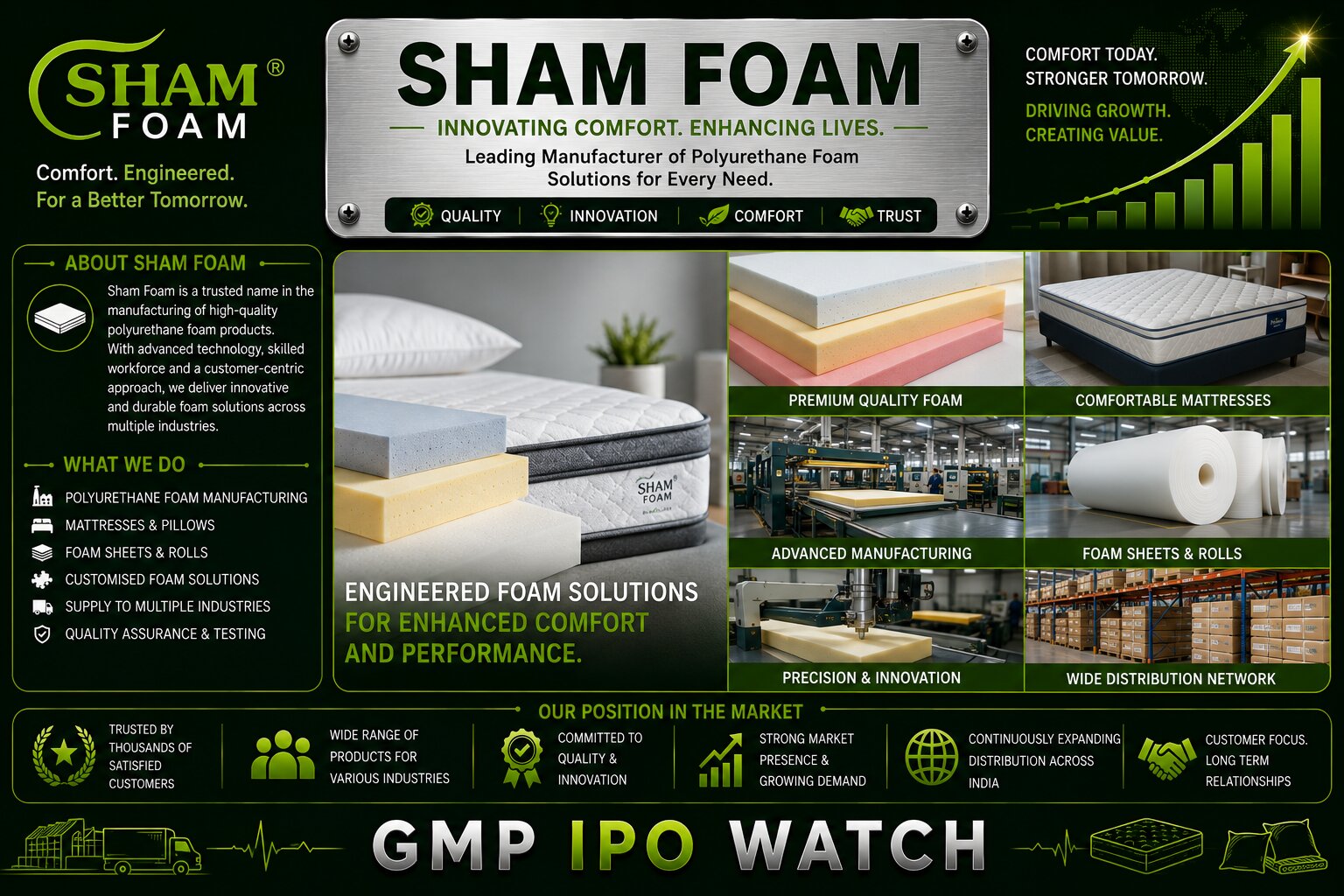
Sham Foam manufactures and sells polyurethane foam, commonly known as PU foam, together with finished home-comfort products.
Its product ecosystem includes:
- PU foam
- Mattresses
- Pillows
- Cushions
- Furniture cushioning
- Foam-based comfort products
Its foam can also serve industrial applications beyond household bedding.
This means Sham Foam is not dependent entirely on mattress consumers.
The business has exposure to both:
B2B foam demand and B2C branded comfort products.
Why PU Foam Is a Versatile Product
PU foam can be manufactured in different:
- Densities
- Thicknesses
- Firmness levels
- Comfort profiles
That makes it useful across multiple industries.
For example:
Furniture
Sofas, chairs and upholstered products need cushioning.
Mattresses
Foam forms the comfort and support layers.
Automotive
Vehicle seats and interior cushioning can use specialised foam.
Apparel and Sports
Padding and protective products can also require foam materials.
This broad end-use base gives Sham Foam multiple sources of potential demand.
The Bigger Opportunity Is Moving Up the Value Chain
There are two ways Sham Foam can sell the same underlying material.
Route 1
Manufacture foam and sell it in bulk.
Route 2
Manufacture foam, convert it into a finished mattress, package it and sell it under a consumer brand.
The second route adds more stages of value creation.
That can potentially increase:
- Revenue per unit of foam
- Gross margin
- Brand recognition
This is why the company's mattress and home-comfort business could become increasingly important over time.
Vertical Integration Can Improve Margin Control
A mattress company that buys all of its foam externally depends heavily on suppliers.
Sham Foam can manufacture the underlying foam itself.
That can potentially provide:
- Better quality control
- Faster product development
- Lower supplier dependence
- Better margin visibility
However, vertical integration also means the company carries both manufacturing and retail-product execution risk.
It needs to be good at both.
FY2026 Was a Strong Financial Year
Sham Foam's financial performance improved sharply in FY2026.
| Period | Revenue | PAT | Net Worth | Borrowings |
|---|---|---|---|---|
| FY2024 | ₹73.89 Cr | ₹2.97 Cr | ₹8.88 Cr | ₹10.11 Cr |
| FY2025 | ₹81.62 Cr | ₹3.58 Cr | ₹12.46 Cr | ₹9.22 Cr |
| FY2026 | ₹92.39 Cr | ₹8.65 Cr | ₹21.11 Cr | ₹3.99 Cr |
FY2026 revenue reached approximately ₹92.39 crore, while PAT increased to roughly ₹8.65 crore. Borrowings declined to around ₹3.99 crore.
That combination is notable:
higher revenue + much higher profit + lower debt.
PAT More Than Doubled
Profit after tax increased from approximately:
₹3.58 crore in FY2025
to:
₹8.65 crore in FY2026.
That is growth of roughly 142%.
Revenue increased only around 13%.
This means profit grew far faster than sales.
For investors, this is probably the single most important financial development ahead of the IPO.
Why Profit Grew Faster Than Revenue
Possible structural drivers may include:
- Better capacity utilisation
- Higher-value product mix
- Lower finance costs
- Manufacturing efficiency
- Better operating leverage
The decline in borrowings likely also helped reduce financial pressure.
But investors should now ask:
Can Sham Foam maintain this higher margin after expanding?
One strong year is encouraging.
Several years of sustainable margin improvement would be much more valuable.
Debt Has Fallen Substantially
Borrowings declined from approximately:
₹10.11 crore in FY2024
to:
₹9.22 crore in FY2025
and then:
₹3.99 crore in FY2026.
This is an important positive.
A lower-debt balance sheet can provide:
- Lower finance cost
- Greater resilience
- More room for future expansion
For a smaller manufacturing company, financial discipline matters considerably.
Net Worth Has Also Increased Sharply
Net worth increased from approximately:
₹8.88 crore in FY2024
to:
₹21.11 crore in FY2026.
That provides a stronger equity base going into the IPO.
After the fresh issue, the company's net worth will increase further.
The important question is whether profits can grow fast enough to maintain attractive return ratios on the larger equity base.
IPO Capital Can Accelerate Manufacturing Expansion
The entire ₹40.48 crore issue is fresh capital.
Sham Foam intends to use IPO proceeds toward business purposes including:
- Manufacturing expansion
- Machinery
- Civil work
- Working capital
- General corporate requirements
This means the IPO is primarily a growth-capital transaction rather than a shareholder-exit event.
For investors, that makes capital deployment especially important.
New Machinery Must Produce More Than Just Capacity
Suppose Sham Foam spends ₹10 crore on machinery.
That investment creates shareholder value only if it eventually generates:
- More production
- Better quality
- Lower wastage
- Higher margin
- Greater cash flow
A machine that sits underutilised still creates:
- Depreciation
- Maintenance
- Operating costs
Therefore, post-IPO capacity utilisation becomes one of the most important metrics.
Capacity Utilisation Can Create Operating Leverage
Consider a factory with fixed expenses of ₹10 crore.
Scenario A
Revenue = ₹60 crore.
Scenario B
Revenue = ₹100 crore.
If much of the same infrastructure supports both levels, fixed cost becomes a smaller percentage of revenue in Scenario B.
That can improve margins.
Sham Foam's FY2026 profit acceleration may already indicate that this kind of operating leverage is beginning to appear.
But Expansion Can Also Create Overcapacity
The opposite scenario is possible.
If Sham Foam increases machinery capacity rapidly but demand does not keep pace, it could face:
- Idle equipment
- Higher depreciation
- Lower ROCE
This is why manufacturing growth should always be evaluated alongside customer demand.
More capacity is not automatically better.
Raw-Material Prices Remain a Major Risk
PU foam production depends on chemical inputs linked partly to petrochemical markets.
Raw-material costs can therefore fluctuate.
If costs rise sharply, Sham Foam may need to:
- Increase selling prices
- Reduce margins
- Improve production efficiency
Passing price increases to industrial customers may be difficult when competition is strong.
This makes procurement discipline crucial.
Branded Mattresses Can Reduce Pure Commodity Exposure
The company's consumer-product strategy offers one potential defence against raw-material volatility.
An industrial buyer may compare foam primarily on:
- Price
- Density
- Specification
A mattress consumer may also value:
- Comfort
- Brand
- Warranty
- Design
That creates more room for product differentiation.
If Sham Foam can grow the branded-product contribution, it may become less dependent on commodity-style foam pricing.
Distribution Is Critical for Mattress Growth
Manufacturing a good mattress is not enough.
The product must reach:
- Dealers
- Furniture stores
- Online customers
- Institutional buyers
Distribution expansion can therefore become a major growth lever.
But it can also create:
- Higher inventory
- Dealer credit
- Marketing costs
Sham Foam will need to grow distribution without allowing receivables and working capital to expand too quickly.
Institutional Customers Provide Another Opportunity
Mattresses, foam and cushioning products can also be sold to:
- Hotels
- Hospitals
- Hostels
- Furniture manufacturers
Institutional orders can provide larger volumes than individual household sales.
This can improve factory utilisation.
However, institutional buyers typically negotiate aggressively on price.
Product Mix Will Determine Margin Quality
Suppose Sham Foam sells ₹100 crore of products.
If most revenue comes from low-margin bulk foam, profitability may remain limited.
If branded mattresses and specialty foam grow faster, the same ₹100 crore of revenue could produce better earnings.
Therefore, investors should monitor:
revenue growth by product category, not just total sales.
Working Capital Still Matters
Manufacturing requires cash before customers pay.
Sham Foam must buy:
- Chemicals
- Packaging
- Other materials
then manufacture products and potentially hold inventory.
Cash becomes tied up in:
raw material → production → finished goods → receivables.
Rapid expansion can therefore consume cash even when PAT is rising.
Operating cash flow should remain an important post-listing metric.
FY2026 Margin Improvement Needs to Be Tested
FY2026 PAT of ₹8.65 crore on ₹92.39 crore revenue implies a net margin of roughly 9.4%.
That is substantially stronger than FY2025.
The central financial question is whether this level can persist after:
- Higher capacity
- New machinery
- Distribution expansion
If margins remain strong while revenue increases, the business quality improves considerably.
Sham Foam IPO Final-Day Subscription
Today, August 13, is the third and final bidding day.
The Economic Times IPO page showed the issue at approximately 0.76× overall subscription at 12:24 PM, including:
- NII: 0.74×
- Retail: 0.79×.
The same ET page also surfaced a later headline indicating the issue had reached approximately 4.73× subscription during Day 3.
This illustrates how quickly final-day SME subscription can move.
The final exchange-confirmed closing figure should be treated as the authoritative number once bidding ends.
Why Final-Day SME Demand Can Jump Quickly
SME IPOs often receive a substantial portion of applications during the closing hours.
Investors may wait to observe:
- GMP
- Day-1 demand
- Day-2 demand
before deciding.
Therefore, a weak morning subscription figure does not necessarily mean the final issue will be undersubscribed.
Sham Foam appears to be showing exactly this final-day acceleration.
Sham Foam IPO GMP Today
GMP readings are currently inconsistent across trackers.
One current market tracker showed Sham Foam GMP around ₹9 per share, equivalent to about 6.9% above the ₹130 issue price.
Meanwhile, the Economic Times IPO page surfaced a Day-3 headline referring to GMP climbing to around a 14% premium.
Because unofficial GMP sources are currently showing different readings, it is better to treat the grey market only as a broad positive-sentiment signal rather than state one figure as definitive.
GMP Does Not Change the Business
Whether GMP is:
- ₹5
- ₹10
- ₹20
Sham Foam's factory does not become more productive.
Its FY2026 PAT does not change.
Its debt does not change.
GMP is useful for understanding short-term sentiment, but long-term investors should give far more weight to:
- Revenue
- Margin
- Debt
- Cash flow
- Capacity utilisation
Valuation Needs to Consider the FY2026 Profit Jump
Current IPO analysis shows approximately:
- FY2026 revenue: ₹92 crore
- PAT: roughly ₹9 crore
- EPS: about ₹10.3
- Indicative P/E: roughly 12.6×.
A P/E around 12–13× does not appear particularly high in isolation.
But investors must decide whether FY2026 earnings are sustainable.
If profit falls back toward FY2025 levels, the effective valuation would become much higher.
Competitive Strengths
Sham Foam's positive investment factors include:
- Integrated PU foam and mattress business
- ₹92 crore-plus FY2026 revenue
- ₹8.65 crore FY2026 PAT
- Strong profit growth
- Borrowings reduced to about ₹3.99 crore
- Entirely fresh IPO
- Manufacturing expansion opportunity
- Exposure to both B2B and consumer markets.
Major Risks
Raw-Material Volatility
Petrochemical-linked inputs can affect foam margins.
FY2026 Profit Sustainability
PAT more than doubled, so maintaining the new margin level is important.
Capacity Utilisation
IPO-funded machinery needs sufficient demand.
Brand Competition
The mattress segment includes larger national and regional players.
Working-Capital Requirements
Inventory and dealer receivables can consume cash.
Small Scale
Sham Foam remains much smaller than large listed consumer-product manufacturers.
SME Liquidity
BSE SME stocks can experience lower liquidity and higher volatility.
What Could Drive Sham Foam's Next Growth Phase?
Better Factory Utilisation
Higher output can improve fixed-cost absorption.
New Machinery
Can increase capacity and reduce production inefficiencies.
More Branded Products
Mattresses and home-comfort products can improve product mix.
Institutional Customers
Hotels, hospitals and furniture businesses can provide larger orders.
Dealer Expansion
Can improve retail reach.
Lower Debt
Reduced borrowings can support stronger earnings quality.
What Investors Should Track After Listing
Revenue Growth
Does the company move meaningfully beyond the ₹92 crore FY2026 base?
PAT Margin
Can the roughly 9% FY2026 margin be maintained?
Capacity Utilisation
Are new machines productive?
Branded Product Contribution
Are mattresses and finished products becoming more important?
Inventory Days
Is expansion creating excess stock?
Operating Cash Flow
Is accounting profit translating into cash?
ROCE
Does IPO-funded capex generate attractive returns?
The Most Important Post-IPO Equation
Sham Foam's next phase can be summarised as:
fresh IPO capital → better machinery → higher utilisation → greater finished-product sales → stronger revenue and cash flow.
That is the attractive outcome.
The weaker version would be:
fresh IPO capital → excess capacity → higher inventory → weak utilisation → lower returns.
The difference will come down to management execution.
Should Investors Consider Sham Foam IPO?
The positive investment case includes:
- Entirely fresh issue
- Strong FY2026 earnings growth
- Lower borrowings
- Integrated manufacturing
- Consumer-brand opportunity
- Reasonable headline valuation
- Improving final-day IPO demand
The caution points include:
- Small operating scale
- Raw-material volatility
- Need to sustain FY2026 margins
- Expansion execution
- SME liquidity
Sham Foam should therefore be evaluated as a small manufacturing company moving gradually from commodity foam toward higher-value home-comfort products, rather than only as a mattress IPO.
Final View on Sham Foam IPO 2026
The Sham Foam IPO 2026 reaches its final subscription day with a much stronger underlying financial profile than the company had two years earlier.
Revenue increased from approximately ₹73.89 crore in FY2024 to ₹92.39 crore in FY2026, while PAT rose from around ₹2.97 crore to ₹8.65 crore. At the same time, borrowings declined from approximately ₹10.11 crore to ₹3.99 crore.
That combination—higher revenue, substantially higher profit and lower debt—is the strongest part of the IPO story.
The ₹40.48 crore issue is also entirely fresh capital, giving Sham Foam additional funds to strengthen manufacturing capacity, machinery and working capital rather than primarily financing a shareholder exit.
Today's subscription data has moved quickly. The ET tracker showed around 0.76× at 12:24 PM, while a later Day-3 headline on the same IPO page indicated approximately 4.73× subscription, highlighting strong closing-day acceleration.
Grey-market sentiment is also positive, although trackers currently disagree on the exact premium, with readings ranging from around 7% to roughly 14%.
For long-term investors, however, those numbers are secondary.
The real test after listing will be whether Sham Foam can turn IPO capital into:
higher manufacturing utilisation, more branded mattress sales, stable margins and stronger operating cash flow.
Overall, Sham Foam represents a relatively small but rapidly improving PU foam and home-comfort manufacturing IPO, with strong FY2026 profit growth, falling debt and a fully fresh issue. Its long-term success will depend on sustaining recent profitability while deploying new manufacturing capacity without creating excess inventory or weak returns on capital.