 GMP IPO Watch
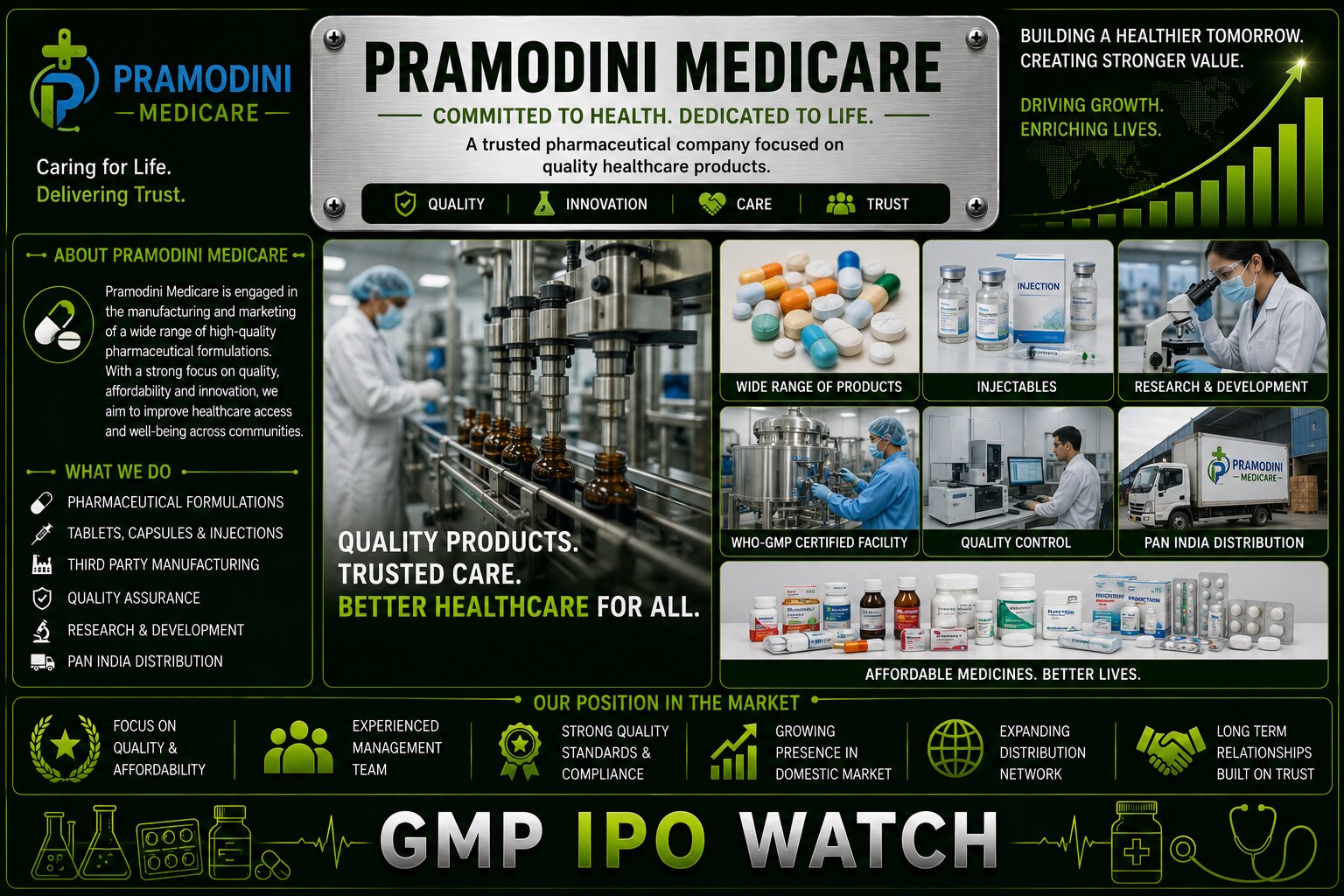
Pramodini Medicare IPO 2026 – Can a Regional Diagnostic Network Become a Larger Healthcare Platform?
A diagnostic centre can look deceptively simple.
A patient enters, receives an MRI, CT scan, X-ray, ultrasound or laboratory test, collects the report and leaves.
But behind that single test sits a capital-intensive healthcare business.
The company must invest in:
- Medical imaging equipment
- Laboratories
- Qualified technicians
- Radiologists
- Maintenance
- Healthcare compliance
- Patient acquisition
- Hospital relationships
That is the business Pramodini Medicare Limited has been building.
Pramodini Medicare is an Andhra Pradesh-based diagnostics company that has expanded from a single centre to a network of 15 diagnostic centres across multiple Indian states. Its operations span advanced radiology and laboratory diagnostics, including MRI, CT, X-ray, ultrasound and other services.
The company's NSE SME IPO is currently open for subscription from August 12 to August 14, 2026, with a price band of ₹110–₹118 per equity share. The issue size is approximately ₹69.04 crore.
The investment case is not simply about adding more diagnostic centres.
The more important question is:
Can Pramodini improve revenue and profitability per centre while deploying IPO capital into high-value diagnostic equipment?
Pramodini Medicare IPO Details
| Particular | Details |
|---|---|
| Company | Pramodini Medicare Limited |
| IPO Type | NSE SME Book Built IPO |
| Total Issue Size | Approx. ₹69.04 Crore |
| Fresh Issue | Approx. ₹63.14 Crore |
| Offer for Sale | Approx. ₹6 Crore |
| Price Band | ₹110 – ₹118 Per Share |
| Face Value | ₹10 Per Share |
| Lot Size | 1,200 Shares |
| IPO Opening Date | August 12, 2026 |
| IPO Closing Date | August 14, 2026 |
| Expected Allotment | August 17, 2026 |
| Expected Listing | August 19, 2026 |
| Listing Platform | NSE SME |
| Lead Manager | Smart Horizon Capital Advisors |
| Registrar | Purva Sharegistry (India) Pvt. Ltd. |
The offer consists of approximately 53.5 lakh fresh shares and about 5 lakh shares through an Offer for Sale, according to the company's IPO filing structure.
What Does Pramodini Medicare Actually Do?
Pramodini Medicare operates diagnostic centres that provide services across radiology and pathology.
Its broader diagnostic offering includes areas such as:
- MRI
- CT Scan
- X-ray
- Ultrasound
- Colour Doppler
- Mammography
- DEXA Scan
- Laboratory testing
- Other diagnostic imaging services
The company has expanded its operations through a network model rather than remaining dependent on one flagship centre.
That gives Pramodini a potentially scalable healthcare platform.
Why Diagnostic Centres Can Produce Strong Operating Leverage
Diagnostic businesses require large upfront investment.
Consider an MRI machine.
Whether it performs five scans or twenty scans in a day, many costs remain similar:
- Equipment depreciation
- Radiologist cost
- Technician salaries
- Rent
- Maintenance
That means profitability can improve sharply when patient volumes increase.
The economics are straightforward:
Same machine + more scans = higher revenue without proportionately higher fixed costs.
This is one of the biggest reasons utilisation matters.
Revenue Per Centre Could Become a Key Metric
Pramodini already operates 15 diagnostic centres.
For investors, simply increasing that number to 20 or 25 centres would not automatically indicate better economics.
A better metric is:
Revenue per centre.
Suppose 15 centres generate ₹60 crore.
Average revenue per centre = ₹4 crore.
If the company later operates 20 centres and generates ₹100 crore:
Average revenue per centre = ₹5 crore.
That would indicate both network expansion and improving productivity.
This is a more powerful growth model than simply opening additional locations.
Equipment Utilisation Is More Important Than Equipment Count
A company can announce that it has purchased:
- 3 MRI machines
- 5 CT scanners
- 10 ultrasound systems
But that does not tell investors whether those assets are productive.
The critical number is:
How many tests does each machine perform every day?
A heavily utilised scanner can generate attractive returns.
An underutilised scanner can become a costly asset that generates depreciation but little revenue.
For Pramodini, this makes machine-level productivity an important post-IPO consideration.
IPO Proceeds Are Primarily Growth Capital
One of the strongest structural features of Pramodini Medicare's IPO is that most of the issue is fresh capital.
Approximately ₹63.14 crore of the ₹69.04 crore offer is fresh issue, while only around ₹6 crore represents an OFS.
That means the majority of IPO funds can potentially be deployed directly into business expansion.
This is different from an OFS-heavy IPO where most proceeds go to selling shareholders.
Medical Equipment Is Central to the IPO Strategy
Pramodini's original IPO filing stated that it was raising funds primarily for capital expenditure.
For a diagnostics company, this can include high-value equipment such as:
- MRI systems
- CT scanners
- Advanced X-ray equipment
- Ultrasound systems
- Laboratory machines
This directly links IPO capital to future testing capacity.
The investment thesis therefore becomes:
IPO capital → equipment → additional diagnostic capacity → patient volume → revenue → profit.
Why New Equipment Can Create Growth Without a New Centre
Pramodini does not necessarily need to open a new location every time it wants to grow.
Suppose an existing centre currently has one CT scanner operating near full utilisation.
Adding another scanner can potentially increase revenue while using the same:
- Building
- Administrative team
- Customer base
- Hospital relationship
This can create stronger operating leverage than opening an entirely new facility.
Existing-centre expansion may therefore be one of the most capital-efficient growth strategies.
15 Diagnostic Centres Give Pramodini an Existing Base
Pramodini operates through 15 centres across six states, according to its DRHP-era disclosures.
This matters because the IPO is not funding a company that still needs to prove whether it can operate diagnostic centres.
The company already has an operating network.
The new question is whether that network can be scaled efficiently.
Multi-State Presence Reduces Single-City Risk
A diagnostic company dependent entirely on one city can be affected by:
- Local competition
- Hospital relationships
- Pricing pressure
- Regulatory developments
A multi-state network provides geographic diversification.
If one market experiences slower growth, another region may still perform strongly.
However, geographic expansion also creates management complexity.
Pramodini needs to maintain consistent:
- Service quality
- Clinical standards
- Reporting
- Equipment maintenance
across every location.
Hospital Partnerships Can Support Patient Volumes
Diagnostic centres located within or alongside hospitals can benefit from existing patient traffic.
Doctors already prescribe:
- MRI
- CT
- Ultrasound
- Blood tests
If the diagnostic service is available at the same healthcare location, the patient has less reason to travel elsewhere.
This can increase testing volumes.
That means hospital partnerships can reduce some of the customer acquisition costs associated with standalone diagnostic centres.
Hospital Relationships Can Become Sticky
Once a hospital and diagnostic provider integrate operationally, replacing the provider may require:
- Contract renegotiation
- Equipment movement
- New workflows
- Patient-process changes
This can create switching friction.
However, hospital partnerships also create concentration risk if a small number of major institutions contribute a large share of revenue.
Investors should therefore monitor partner concentration after listing.
Diagnostic Demand Has Structural Growth Drivers
India's diagnostics sector benefits from several long-term trends:
- Higher healthcare awareness
- Growing preventive health testing
- Rising chronic diseases
- Increasing hospital infrastructure
- Greater insurance penetration
- More advanced imaging
Healthcare testing is moving beyond diagnosis after illness toward screening and preventive care.
That increases recurring demand.
Preventive Healthcare Can Increase Test Frequency
Traditionally, many patients underwent diagnostic tests only when they were unwell.
Today, preventive packages increasingly include:
- Blood sugar
- Cholesterol
- Liver function
- Kidney function
- Thyroid testing
- Imaging when required
This can increase diagnostic utilisation without an equivalent increase in hospital admissions.
For diagnostic companies, higher testing frequency per patient can become a powerful growth driver.
Advanced Imaging Has High Entry Barriers
MRI and CT services require substantial capital and skilled professionals.
A new competitor must invest in:
- Equipment
- Facility preparation
- Radiologists
- Technicians
- Compliance
- Maintenance contracts
This creates a meaningful barrier compared with simpler healthcare businesses.
Pramodini's existing network and experience therefore provide some operating advantage.
Skilled Medical Professionals Are Critical
An MRI machine may create images, but a qualified radiologist must interpret them.
Similarly, laboratories need trained professionals and technicians.
Diagnostic companies therefore compete not only for patients but also for medical talent.
If Pramodini expands rapidly, it will need access to:
- Radiologists
- Pathologists
- Technicians
- Operations staff
Workforce availability can influence expansion speed.
Centralised Reporting Can Improve Scale
Digital diagnostics can allow radiology images to be shared electronically.
This can potentially enable a radiologist at one location to interpret studies produced elsewhere, subject to medical and regulatory requirements.
A multi-centre platform can therefore centralise certain specialist functions.
This can improve:
- Turnaround time
- Specialist utilisation
- Reporting availability
Technology can therefore help Pramodini scale beyond purely physical centre expansion.
Maintenance Cost Is an Important Hidden Expense
Diagnostic equipment is expensive to maintain.
MRI and CT machines require:
- Preventive maintenance
- Calibration
- Replacement parts
- Service contracts
Machine downtime directly reduces revenue.
If a scanner is offline for one week, it is not merely a repair problem.
It is lost patient capacity.
Investors should therefore monitor operating margins after the IPO to ensure equipment maintenance costs remain controlled.
FY2026 Growth Provides Momentum
Current IPO-market data shows Pramodini Medicare entered the issue after a period of strong financial expansion, with recent reported revenue and PAT materially higher than FY2025 levels. Current IPO valuation platforms also reflect an issue size of approximately ₹69.04 crore at an upper price of ₹118.
The challenge is determining whether this recent growth is sustainable once new IPO-funded capacity comes online.
Profit Growth Must Be Compared With Capex
Diagnostics is a business where PAT alone does not tell the complete story.
Suppose a company earns ₹20 crore but needs to spend ₹30 crore every year replacing and expanding equipment.
The underlying free cash flow may be far lower than PAT.
Therefore, investors should track:
PAT + operating cash flow + capital expenditure.
This gives a much clearer view of economic profitability.
Return on Equipment Is the Real Test
Pramodini is raising capital to increase medical infrastructure.
That means future ROCE becomes particularly important.
Suppose the company invests ₹40 crore in additional equipment.
Scenario A
Incremental annual operating profit = ₹12 crore.
Scenario B
Incremental annual operating profit = ₹3 crore.
Both scenarios create revenue growth.
But the first produces significantly better shareholder economics.
The success of the IPO therefore depends on returns generated by the new equipment.
Acquisition Could Provide Another Route to Growth
Pramodini's expansion need not come entirely through greenfield centres.
The diagnostics market remains fragmented.
The company could potentially acquire:
- Existing imaging centres
- Diagnostic laboratories
- Regional healthcare businesses
Acquisitions can provide instant:
- Patient volumes
- Equipment
- Employees
- Local market presence
But they also carry risks involving valuation and integration.
Buying a Centre Can Be Faster Than Building One
A new diagnostic centre may require:
- Location selection
- Construction
- Equipment installation
- Hiring
- Brand building
Acquiring an existing operating centre can compress that timeline.
But investors should ensure management does not overpay simply to show faster revenue growth.
Disciplined acquisition pricing is essential.
Diagnostics Can Become a Consolidation Story
India has thousands of local diagnostic operators.
Smaller centres may struggle with:
- Technology investment
- Branding
- Capital
- Quality systems
Larger organised platforms can potentially acquire or partner with these operators.
If Pramodini becomes an effective consolidator, its addressable growth opportunity could extend beyond organic centre openings.
SME Listing Creates Additional Risk
Pramodini is listing on NSE SME rather than the mainboard.
SME shares can experience:
- Lower trading liquidity
- Wider bid-ask spreads
- Greater price volatility
This means the investment decision needs to consider both:
business fundamentals
and:
post-listing liquidity risk.
Pramodini Medicare IPO GMP Today
As of August 13, 2026, current GMP trackers continue to show approximately:
₹0 GMP
for Pramodini Medicare.
Against the ₹118 upper price band, that means there is currently no established unofficial listing premium.
This is only a sentiment indicator.
GMP is unofficial and can change before listing.
Why ₹0 GMP Does Not Automatically Mean a Weak IPO
Grey-market activity can sometimes remain limited for SME issues.
A ₹0 GMP does not automatically mean:
- Poor fundamentals
- Negative listing
- Weak long-term prospects
It simply means grey-market participants are not currently quoting a meaningful premium.
Investors should give far more weight to:
- Financials
- Valuation
- Business model
- Use of proceeds
- Subscription quality
Day-2 Subscription Is More Important Than Day-1
The IPO opened on August 12 and closes August 14.
Today is Day 2.
SME IPO demand can change significantly on the final day, especially from non-institutional investors.
Therefore, the final August 14 subscription numbers will provide a more useful signal than early bidding levels.
Valuation Should Focus on Sustainable Earnings
At ₹118 per share, investors should not simply value Pramodini based on its latest growth rate.
Diagnostics can be volatile when:
- New centres open
- New equipment is commissioned
- Large hospital contracts begin
Investors should ask whether current PAT represents a sustainable base rather than a temporary growth period.
Competitive Strengths
Existing 15-Centre Network
Pramodini already operates at meaningful regional scale.
Multi-State Presence
Operations across six states reduce single-market dependence.
Advanced Diagnostic Services
MRI, CT and related imaging create higher entry barriers than simple collection-centre models.
Mostly Fresh IPO
Approximately ₹63.14 crore of the ₹69.04 crore issue is fresh capital.
Capex-Focused Fundraise
The IPO is intended primarily to support diagnostic equipment and expansion.
Structural Healthcare Demand
Preventive diagnostics and advanced imaging provide long-term industry growth opportunities.
Major Risks
High Equipment Costs
MRI and CT systems require substantial investment.
Utilisation Risk
Low patient volumes can weaken returns.
Equipment Obsolescence
Medical technology changes over time.
Skilled Workforce Dependence
Radiologists and technicians are essential.
Hospital Partnership Risk
Changes in institutional contracts can affect individual centres.
Cash-Flow Pressure
High capex can reduce free cash flow despite accounting profits.
Acquisition Risk
Expansion through acquisitions can destroy value if management overpays.
SME Liquidity
Post-listing trading may be volatile.
What Could Drive Pramodini's Next Growth Phase?
Higher Existing-Centre Utilisation
The cheapest growth may come from doing more tests at current locations.
New Diagnostic Equipment
IPO-funded machinery can expand capacity.
Additional Centres
New locations can broaden geographic reach.
Hospital Partnerships
More institutional tie-ups can provide patient volumes.
Preventive Healthcare
Higher screening demand can increase test frequency.
Acquisitions
Buying regional centres can accelerate expansion.
Digital Reporting
Technology can improve specialist productivity.
What Investors Should Track After Listing
Revenue Per Centre
Is each centre generating more business?
Scans Per Machine
Are MRI and CT assets being used efficiently?
EBITDA Margin
Is operating leverage improving?
Operating Cash Flow
Are profits becoming cash?
Capex
How much investment is required to maintain growth?
ROCE
Are new machines earning adequate returns?
Customer Concentration
Is the company dependent on a few hospital partners?
The Most Important Growth Equation
For Pramodini Medicare, the ideal post-IPO cycle looks like:
Fresh capital → new diagnostic equipment → higher capacity → more patients → higher revenue → operating leverage → stronger cash flow.
But there is another possible outcome:
Fresh capital → expensive machines → low utilisation → higher depreciation → weaker returns.
The difference comes down to execution.
That is why equipment utilisation should be one of the most important investor metrics after listing.
Should Investors Consider Pramodini Medicare IPO?
The positive investment case includes:
- Established diagnostic operating history
- 15-centre network
- Multi-state presence
- Advanced radiology capabilities
- Mostly fresh issue
- Capex-led growth strategy
- Long-term healthcare demand
- Potential operating leverage
The caution points include:
- Capital intensity
- SME liquidity
- Equipment utilisation
- Medical talent dependence
- Need to prove cash-flow quality
- Current ₹0 GMP
Pramodini should therefore be evaluated as an asset-intensive healthcare diagnostics platform, not simply as a fast-growing SME.
Final View on Pramodini Medicare IPO 2026
The Pramodini Medicare IPO 2026 offers investors exposure to a regional diagnostic healthcare company that is attempting to move into a larger expansion phase.
The company has already built a network of 15 diagnostic centres across six states, giving it an operating base from which to deploy additional equipment and expand capacity.
The IPO itself is approximately ₹69.04 crore, including around ₹63.14 crore fresh issue and roughly ₹6 crore OFS, with bidding open from August 12 to August 14 at ₹110–₹118 per share.
The strongest part of the investment story is the use of fresh capital for healthcare infrastructure.
Instead of relying mainly on an OFS, Pramodini is raising substantial new equity to support medical equipment and future expansion.
The long-term opportunity can be summarised as:
15-centre network + additional MRI/CT capacity + higher utilisation + healthcare demand = potential earnings growth.
But diagnostics is capital intensive.
The number of machines installed is less important than the amount of profitable testing each machine generates.
Therefore, the most important post-listing metrics will be:
revenue per centre, scans per machine, operating cash flow, EBITDA margin and return on capital employed.
Current GMP remains around ₹0, so short-term grey-market sentiment is neutral at present.
Overall, Pramodini Medicare represents a healthcare SME IPO with an established multi-state diagnostic network and a clear equipment-led expansion strategy. Its long-term success will depend on management's ability to turn fresh IPO capital into highly utilised diagnostic assets rather than simply a larger number of centres and machines.