 GMP IPO Watch
Pramodini Medicare IPO 2026 – Can Medical Equipment Become a Scalable Healthcare Network?
A diagnostic centre is an unusual business.
Much of the investment is made before the first patient walks through the door.
The operator must purchase expensive equipment such as MRI and CT scanners, install the machines, recruit trained technicians and radiologists, and meet healthcare compliance requirements.
After that, the economics depend heavily on one factor:
How effectively can those machines be utilised?
That question sits at the centre of the Pramodini Medicare Limited IPO 2026.
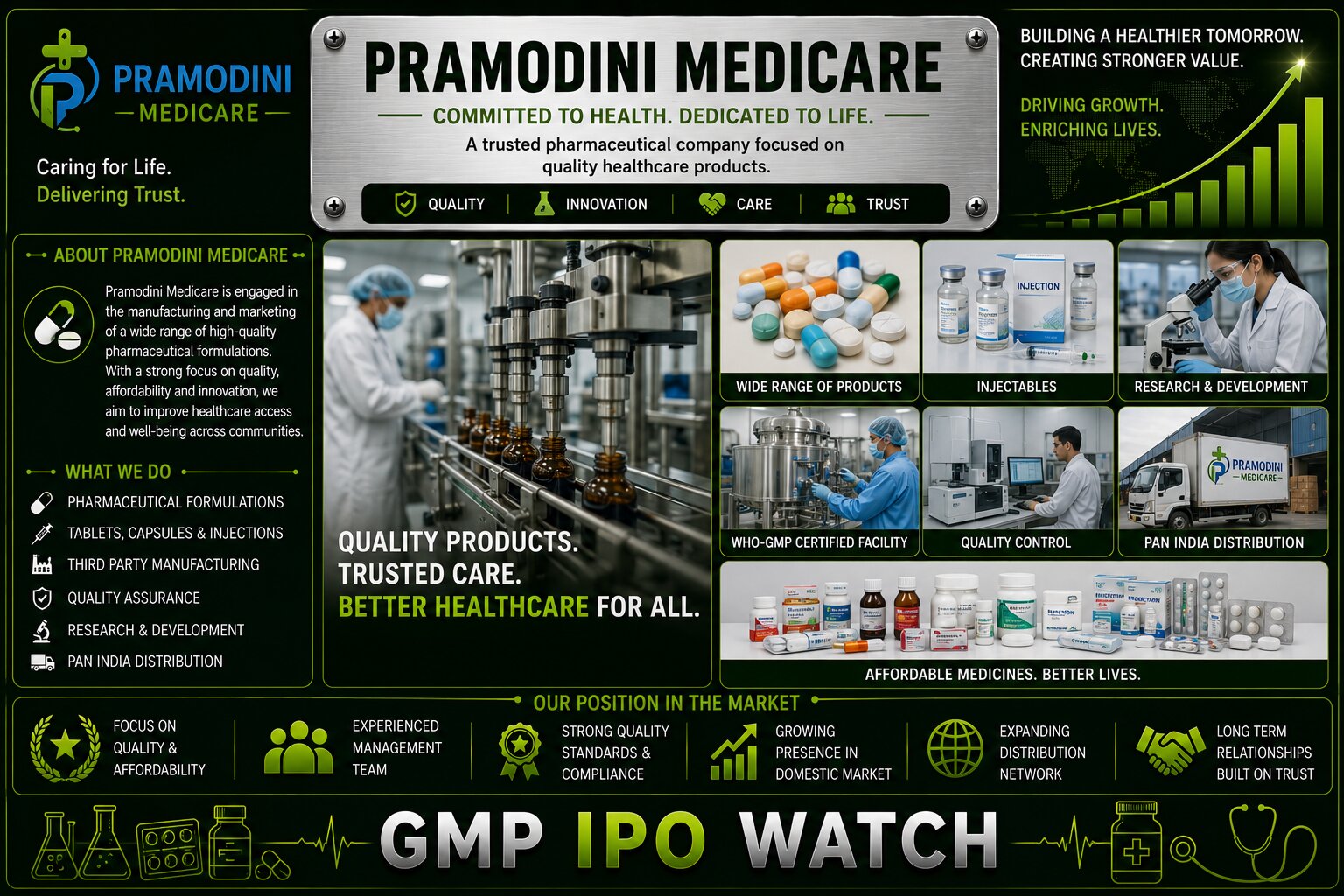
Pramodini Medicare is an Andhra Pradesh-based diagnostic healthcare company operating across radiology and clinical laboratory services. The company has expanded from a single diagnostic centre in FY2015 to 15 diagnostic centres as of FY2026, with a presence across 13 cities and six states.
Its NSE SME IPO opened on August 12, 2026 and closes on August 14, 2026. The issue has a price band of ₹110 to ₹118 per share and an overall size of approximately ₹69.04 crore.
Rather than using most of the fresh capital for debt repayment, Pramodini plans a substantial investment in new medical diagnostic equipment for existing and proposed centres.
This creates a straightforward investment thesis:
More diagnostic equipment → more testing capacity → higher utilisation → more revenue and potentially stronger earnings.
Whether the company can execute that cycle efficiently will determine the long-term value created from the IPO.
Pramodini Medicare IPO Details
| Particular | Details |
|---|---|
| Company | Pramodini Medicare Limited |
| IPO Type | Book Built SME IPO |
| Listing Platform | NSE Emerge |
| Total Issue Size | Approx. ₹69.04 Crore |
| Fresh Issue | Approx. ₹63.14 Crore |
| Offer for Sale | Approx. ₹5.90 Crore |
| Price Band | ₹110 – ₹118 Per Share |
| Face Value | ₹10 Per Share |
| Base Lot Size | 1,200 Shares |
| Minimum Retail Application | 2,400 Shares |
| Minimum Retail Investment | ₹2,83,200 at ₹118 |
| IPO Opening Date | August 12, 2026 |
| IPO Closing Date | August 14, 2026 |
| Expected Allotment | August 17, 2026 |
| Expected Listing | August 19, 2026 |
| Registrar | Purva Sharegistry (India) Pvt. Ltd. |
| Lead Manager | Smart Horizon Capital Advisors Pvt. Ltd. |
The IPO comprises up to 53,50,800 fresh shares and up to 5,00,400 shares through an Offer for Sale.
Most of the issue therefore represents fresh capital entering the company rather than promoter exits.
About Pramodini Medicare Limited
Pramodini Medicare was incorporated in September 2000.
The company operates in the diagnostic healthcare sector, with services spanning radiology and clinical laboratory testing.
Its diagnostic network has grown substantially over time.
As of December 31, 2025, the company operated 15 diagnostic centres across 13 cities, with locations across:
- Uttar Pradesh
- Andhra Pradesh
- Karnataka
- West Bengal
- Haryana / Delhi NCR
- Kerala, where operations at the stated location were yet to commence
The company also operates a processing unit-cum-laboratory in Vijayawada.
This geographic network gives Pramodini exposure to multiple regional healthcare markets instead of depending entirely on one city.
What Services Does Pramodini Medicare Provide?
Pramodini's diagnostic capabilities cover both imaging and laboratory testing.
Its radiology portfolio includes:
- MRI
- CT Scan
- X-ray
- Ultrasound with Colour Doppler
- Mammography
- DEXA Scan
- Interventional Radiology
Its clinical laboratory services include areas such as haematology and related pathology testing.
This combination is strategically useful because imaging and laboratory testing have different economics and patient-use cases.
Why Radiology Is an Attractive Diagnostic Business
Consider an MRI scanner.
The machine requires substantial upfront investment.
But once installed, each additional scan does not require another multimillion-rupee machine.
The economics can therefore improve as utilisation rises.
For example:
Low Utilisation
5 scans each day.
Large equipment investment is spread across relatively few patients.
High Utilisation
20 scans each day.
The same machine is generating substantially more revenue.
This makes machine utilisation one of the most important economics drivers in diagnostic imaging.
High Equipment Utilisation Can Create Operating Leverage
A diagnostic centre has several fixed or semi-fixed expenses:
- Equipment depreciation
- Facility rent
- Radiologists
- Technicians
- Electricity
- Maintenance contracts
- Administrative employees
These expenses do not rise proportionately with every additional patient.
Once the centre reaches a sufficient patient volume, additional scans and tests can potentially generate attractive incremental margins.
This is one reason successful diagnostic centres can produce strong EBITDA margins.
Pramodini reported an EBITDA margin of approximately 54.8% for FY2025, based on its prospectus KPI disclosures.
Hospital Partnerships Can Reduce Expansion Risk
One interesting part of Pramodini's operating model is its use of partnerships with healthcare institutions.
The company enters arrangements to establish and operate onsite diagnostic centres within existing healthcare facilities.
This can be strategically attractive.
Instead of creating every diagnostic centre as a completely independent retail destination, Pramodini can potentially benefit from an existing hospital's:
- Patient flow
- Doctor network
- Location
- Healthcare infrastructure
This can reduce some of the customer-acquisition challenge associated with building an independent centre from scratch.
Why an Onsite Hospital Centre Can Be Powerful
Imagine a hospital already handles hundreds of patients every day.
Doctors regularly prescribe:
- MRI
- CT
- X-ray
- Ultrasound
- Blood tests
If Pramodini operates the diagnostic facility inside that hospital, it gains immediate access to a healthcare ecosystem.
The patient does not need to leave the hospital and search for another diagnostic provider.
This convenience can support higher equipment utilisation.
But Hospital Partnerships Create Another Dependency
The model also creates risks.
If Pramodini depends heavily on a partner hospital, it may be exposed to:
- Contract renewal risk
- Revenue-sharing terms
- Hospital patient volumes
- Changes in management
- Competitive bidding
A profitable diagnostic centre can become less attractive if commercial terms with the host institution change.
Investors should therefore understand the duration and economics of major partnership agreements.
Pramodini Has Expanded From 1 Centre to 15
The growth of the diagnostic network is noteworthy.
The company disclosed that the number of centres increased from:
1 diagnostic centre in FY2015
to:
15 diagnostic centres by FY2026.
This shows management has experience opening and operating diagnostic locations across multiple regions.
The IPO is intended to accelerate that process through additional equipment investment.
₹45.15 Crore Planned for Medical Equipment
The company's DRHP identifies approximately ₹45.1485 crore for purchasing medical equipment for existing and proposed diagnostic centres during FY2026-27.
This represents one of the most important details of the IPO.
A substantial portion of the fresh capital is therefore going toward productive assets.
The company is effectively asking investors to fund the next expansion of its diagnostic capacity.
What Could ₹45 Crore of Equipment Achieve?
Depending on the specific machines purchased, the investment could potentially support:
- New MRI capacity
- CT scanners
- Ultrasound systems
- X-ray equipment
- Mammography equipment
- Laboratory systems
The exact revenue potential will depend on:
- Equipment type
- Location
- Patient volume
- Pricing
- Utilisation
Simply buying a machine does not guarantee strong returns.
Where the machine is installed can be just as important as the machine itself.
Location Selection Is Critical
Suppose two identical MRI machines cost the same amount.
Machine A
Installed in a hospital with high patient traffic.
Machine B
Installed in an area with limited referrals.
Machine A may produce dramatically higher returns.
This means Pramodini's post-IPO success will depend heavily on management's ability to select the right healthcare locations.
FY2026 Financial Growth Is Strong
Current IPO-market financial data shows Pramodini Medicare reported approximately:
₹63.38 crore revenue in FY2026
compared with:
₹38.55 crore in FY2025.
Profit increased from approximately:
₹11.14 crore
to:
₹17.38 crore.
This represents a significant increase in both revenue and earnings.
Pramodini Medicare Financial Performance
| Financial Year | Revenue | Profit After Tax |
| FY2025 | ₹38.55 Cr | ₹11.14 Cr |
| FY2026 | ₹63.38 Cr | ₹17.38 Cr |
Revenue increased by approximately 64%.
PAT increased by roughly 56%.
That is a strong pre-IPO growth rate for a diagnostic SME.
Earlier Financials Also Show Margin Strength
The official DRHP reported FY2025 revenue from operations of approximately ₹38.24 crore and EBITDA of around ₹20.97 crore.
The company therefore entered FY2026 from an already profitable operating base.
The key question after listing is whether expansion maintains these economics.
Rapid centre growth can temporarily affect margins because new locations often take time to reach full utilisation.
New Centres May Initially Lower Margins
Imagine Pramodini opens three diagnostic centres.
From the first month, it may incur:
- Rent
- Salaries
- Maintenance
- Depreciation
But patient volumes may take time to build.
This can temporarily reduce margins.
As volumes increase, profitability can improve.
Investors should therefore avoid judging new-centre expansion solely on the first few quarters.
Radiology Has High Barriers to Entry
Opening a basic pathology collection point can be relatively inexpensive.
Operating advanced imaging services is different.
MRI and CT services require:
- Expensive equipment
- Qualified professionals
- Regulatory compliance
- Maintenance
- Technical expertise
- Suitable facilities
This creates a higher capital barrier.
Pramodini's existing imaging infrastructure and experience can therefore be an advantage.
Equipment Technology Also Creates Risk
Medical imaging technology keeps improving.
New machines may offer:
- Faster scans
- Better image quality
- Lower radiation
- Advanced software
Older equipment can gradually become less competitive.
This means Pramodini must continuously invest in technology.
The IPO's capital expenditure programme partly addresses this requirement.
Maintenance Is a Hidden but Important Cost
Advanced medical equipment cannot simply be installed and forgotten.
MRI and CT machines require:
- Preventive maintenance
- Calibration
- Replacement components
- Service contracts
Unexpected equipment downtime is particularly costly.
A machine that is not operating cannot generate scan revenue.
This makes uptime and maintenance discipline important operational metrics.
Radiologists Are Equally Important
Equipment produces medical images.
A qualified specialist still needs to interpret those images correctly.
Diagnostic businesses therefore depend on:
- Radiologists
- Pathologists
- Technicians
- Other skilled medical professionals
Competition for experienced professionals can increase employee and consultant costs.
Pramodini's expansion therefore requires not only capital but also access to medical talent.
Technology Can Improve Radiologist Productivity
Digital imaging allows scans to be transmitted electronically.
This can make it possible for a radiologist in one location to report cases originating from another centre, subject to applicable clinical and regulatory requirements.
For a multi-centre diagnostic network, centralised reporting can potentially improve:
- Specialist utilisation
- Turnaround time
- Coverage
As Pramodini expands geographically, digital workflow can become increasingly important.
The Business Has Exposure to Multiple States
Geographic diversification provides several benefits.
Healthcare demand can vary by:
- City
- Local competition
- Hospital partnerships
- Pricing
Operating across multiple states reduces complete dependence on a single local market.
At the same time, multi-state operations increase complexity involving:
- Hiring
- Management
- Compliance
- Equipment servicing
The company must therefore prove that expansion does not weaken operational control.
The IPO Is Mostly Fresh Capital
The issue comprises approximately:
₹63.14 crore fresh issue
and:
₹5.90 crore Offer for Sale.
This means more than 90% of the IPO is fresh capital.
That is an important structural positive.
Most of the funds are being raised for the company's expansion rather than simply providing an exit to shareholders.
Who Is Selling Through the OFS?
The original offer documents identify promoter selling shareholders including:
- Dr. Chalasani Kuldeep Kumar
- Dr. Chalasani Kavitha
- Sri Ram Medicare Private Limited
Together, the OFS covers up to 5,00,400 equity shares.
The OFS component is relatively small compared with the overall fresh issue.
General Corporate Purposes and Acquisition Opportunity
Besides diagnostic equipment, the company has also identified general corporate purposes and unidentified inorganic acquisition as possible uses of fresh proceeds, subject to regulatory limits.
The acquisition component is particularly interesting.
Diagnostics can be a scalable consolidation business.
Instead of opening every centre organically, Pramodini could potentially acquire:
- Existing diagnostic centres
- Imaging facilities
- Laboratory operations
This may accelerate expansion.
However, acquisitions can also create integration and valuation risk.
Diagnostics Can Benefit From Industry Consolidation
India's diagnostic sector remains fragmented.
There are:
- National chains
- Regional networks
- Hospital laboratories
- Standalone imaging centres
- Small pathology laboratories
Larger organised operators can potentially gain share because of:
- Quality standards
- Branding
- Technology
- Multi-centre purchasing power
This creates a long-term consolidation opportunity for companies that can deploy capital efficiently.
Pramodini's Debt Requires Monitoring
Earlier DRHP KPI data showed a debt-to-equity ratio of approximately 1.29× for FY2023, indicating the historically capital-intensive nature of the business.
As additional IPO equity enters the company, leverage metrics could improve.
However, diagnostic equipment expansion can require further financing over time.
Investors should therefore continue monitoring:
- Borrowings
- Finance costs
- Operating cash flow
rather than assuming the IPO permanently removes capital requirements.
Operating Cash Flow Is More Important Than PAT Alone
Diagnostic companies can report profit while spending heavily on equipment.
For shareholders, it is important to distinguish:
Accounting profit
from:
Cash remaining after capital expenditure.
Pramodini may generate attractive EBITDA but still need substantial cash for MRI, CT and other machines.
Investors should therefore examine free cash flow alongside reported earnings after listing.
What Could Drive the Next Phase of Growth?
Additional Diagnostic Centres
Expanding beyond the existing 15 centres can increase geographic reach.
New Medical Equipment
₹45 crore-plus planned capex can increase testing capacity.
Higher Existing-Centre Utilisation
Increasing patient volumes can improve margins without opening another location.
Hospital Partnerships
Additional onsite centres can provide patient access.
Inorganic Acquisitions
Buying established centres can accelerate expansion.
Broader Test Portfolio
Adding diagnostic capabilities can increase revenue per patient.
Competitive Strengths
25+ Years of Operating History
Pramodini was incorporated in 2000.
15-Centre Diagnostic Network
Provides an existing operating platform across multiple regions.
13-City Presence
Reduces dependence on one local market.
Advanced Radiology Services
MRI, CT, mammography and other imaging provide higher entry barriers.
Strong FY2026 Growth
Revenue and PAT increased significantly year-on-year.
Mostly Fresh IPO
Around ₹63.14 crore of the ₹69.04 crore issue is fresh capital.
Expansion-Focused Proceeds
Approximately ₹45.15 crore is earmarked for medical equipment in the DRHP.
Major Risk Factors
Capital-Intensive Equipment
MRI and CT equipment requires substantial investment.
Utilisation Risk
Low patient volumes can weaken returns on expensive machines.
Hospital Partnership Dependence
Changes in institutional relationships can affect individual centres.
Medical Talent
Radiologists and technicians are critical to service delivery.
Equipment Downtime
Machine failure directly affects revenue generation.
Technology Obsolescence
Medical imaging equipment requires periodic upgrading.
Geographic Expansion Risk
Managing centres across multiple states increases complexity.
SME Liquidity
NSE Emerge shares can experience lower liquidity and greater price volatility than established mainboard stocks.
Pramodini Medicare IPO GMP Today
As of August 12, 2026, InvestorGain reports:
GMP: ₹0
with no established grey-market premium so far.
At the ₹118 upper issue price, this implies an unofficial estimated price of approximately ₹118 based on the current GMP reading.
The IPO only opened today, so this can change before listing.
GMP remains unofficial and should not be treated as guaranteed market performance.
Day-1 Subscription Update
The latest intraday tracking shows Pramodini Medicare IPO subscribed approximately:
0.04× overall
with retail around:
0.09×.
These are early Day-1 figures.
SME subscriptions can change substantially over the remaining bidding period, particularly on the final day.
The final August 14 demand will be much more informative than today's early numbers.
What Investors Should Track After Listing
Number of Centres
Can Pramodini expand beyond 15 without weakening centre economics?
Equipment Utilisation
Are new MRI and CT machines producing sufficient patient volumes?
Revenue Per Centre
Is each location becoming more productive?
EBITDA Margin
Can the company maintain its historically strong operating margins?
PAT Growth
Is earnings expansion keeping pace with revenue?
Operating Cash Flow
Are profits translating into cash?
ROCE
Does the ₹45 crore-plus equipment investment generate attractive returns?
The Most Important Metric May Be Revenue Per Machine
For Pramodini, simply announcing that another MRI machine has been installed is not enough.
The important question is:
How much revenue is that machine generating?
If equipment utilisation rises, the company can potentially create substantial operating leverage.
If utilisation remains weak, large capital expenditure can reduce returns.
That is why investors should focus on asset productivity after the IPO.
Should Investors Consider Pramodini Medicare IPO?
The positive investment case includes:
- Established healthcare operating history
- 15-centre network
- Multi-state presence
- Advanced imaging capabilities
- Strong recent revenue growth
- High historical operating margins
- Mostly fresh issue
- Clear equipment-expansion plan
- Long-term diagnostics demand
The caution points include:
- High equipment capital requirements
- Centre utilisation risk
- Skilled-medical-professional dependence
- Hospital-contract risk
- Expansion execution
- SME liquidity
- No meaningful GMP currently
This makes Pramodini Medicare more suitable for investors evaluating the long-term healthcare expansion story rather than focusing only on immediate listing sentiment.
Final View on Pramodini Medicare IPO 2026
The Pramodini Medicare IPO 2026 provides investors with exposure to a growing regional diagnostic healthcare platform.
The company has expanded from one diagnostic centre in FY2015 to 15 centres across 13 cities and six states by FY2026, while maintaining capabilities across advanced radiology and laboratory diagnostics.
Current IPO data shows FY2026 revenue of approximately ₹63.38 crore, compared with ₹38.55 crore in FY2025, while PAT increased from approximately ₹11.14 crore to ₹17.38 crore.
The ₹69.04 crore IPO is particularly interesting because approximately ₹63.14 crore represents fresh capital, and the original offer documents earmark about ₹45.15 crore toward purchasing medical equipment for existing and proposed diagnostic centres.
That creates a clear post-IPO growth equation:
new machines + new centres + hospital partnerships + higher utilisation = potential revenue and profit expansion.
But healthcare equipment is expensive.
If new machines remain underutilised, return on capital can decline quickly.
For that reason, Pramodini Medicare's long-term success will depend less on how many scanners it purchases and more on how many profitable scans and tests those machines perform every day.
Overall, Pramodini Medicare represents a healthcare SME IPO with strong recent growth, established diagnostic capabilities and a clearly defined equipment-expansion strategy. The major variables to monitor after listing will be centre utilisation, cash-flow generation, return on equipment investment and management's ability to scale from a regional diagnostic network into a broader multi-state healthcare platform.