 GMP IPO Watch
Optimystix Entertainment India IPO 2026 – Why Making More Content Requires More Capital
A television programme may run for only 30 or 60 minutes on screen.
Producing those minutes can require weeks of work.
Before a broadcaster or digital platform receives a finished episode, a production company may already have spent money on writers, actors, technicians, sets, equipment, locations, editing and post-production.
This gap between spending money and receiving money is one of the most important factors behind the Optimystix Entertainment India IPO.
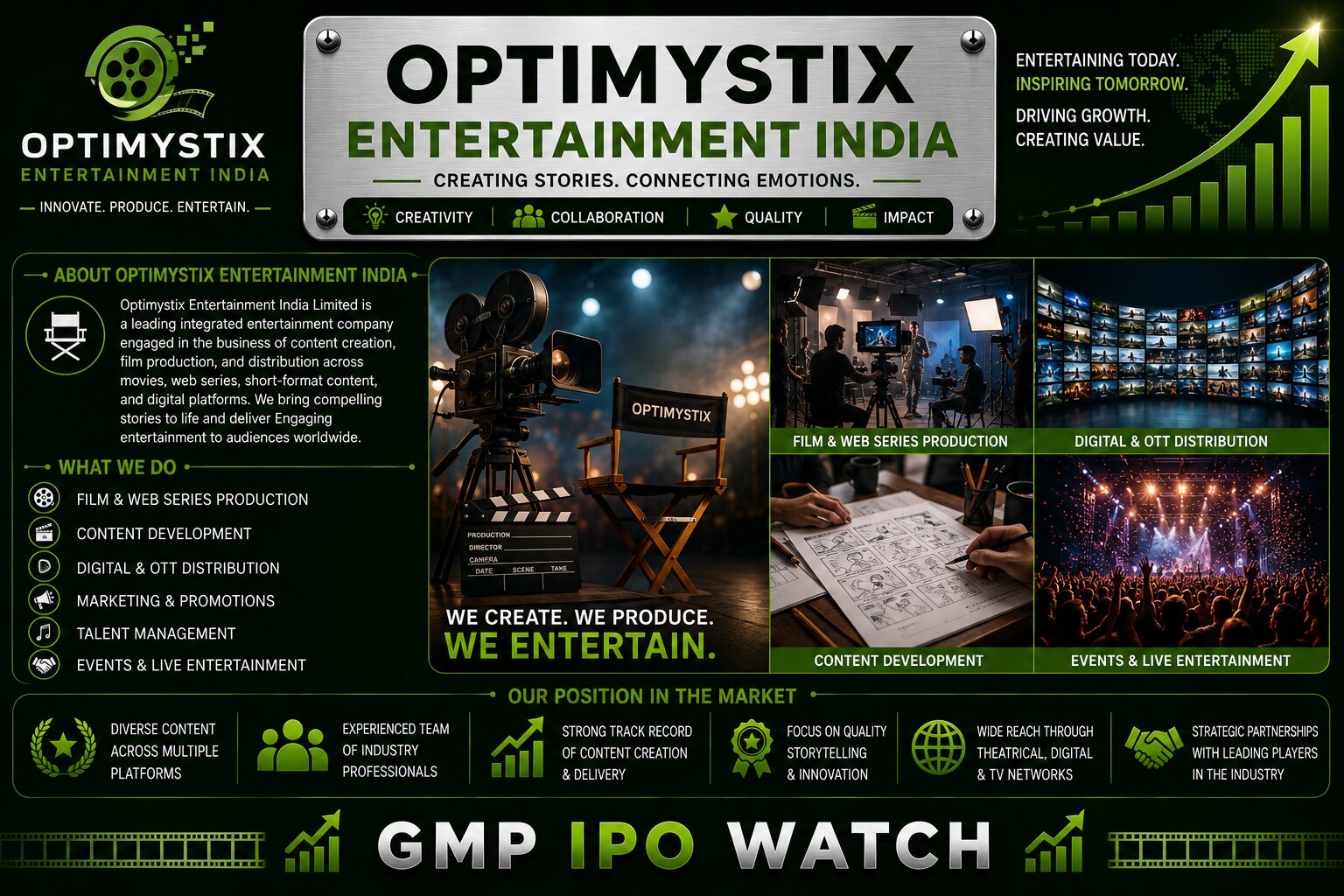
Optimystix Entertainment India Limited is an established content production company operating across television, films, web series and other entertainment formats.
Its NSE SME IPO opened on August 7, 2026 and reaches its final subscription day on August 11, 2026.
The price band has been fixed at ₹166 to ₹175 per share, with the overall issue valued at approximately ₹108.5 crore at the upper end.
But instead of looking at Optimystix purely as an entertainment company, investors should also understand it as a project-execution business where creative talent and working capital must operate together.
Optimystix Entertainment India IPO Details
| Particular | Details |
|---|---|
| Company | Optimystix Entertainment India Limited |
| IPO Type | Book Built SME IPO |
| Exchange | NSE SME |
| Issue Size | Approx. ₹108.5 Crore |
| Price Band | ₹166 – ₹175 Per Share |
| IPO Opening Date | August 7, 2026 |
| IPO Closing Date | August 11, 2026 |
| Business | Entertainment Content Production |
| Key Segments | TV, Films, Web Series & Digital Content |
The company is using the IPO to strengthen its financial capacity as it seeks to execute a larger content pipeline.
What Does Optimystix Entertainment India Do?
Optimystix creates entertainment content for broadcasters and digital platforms.
Its capabilities extend across formats including:
- Television programmes
- Reality shows
- Comedy programming
- Fiction
- Non-fiction
- Web series
- Digital entertainment
- Films
- Production services
- Content development
The company has operated in the Indian entertainment industry for more than two decades.
That experience matters because successful content production depends heavily on relationships with broadcasters, platforms, writers, actors, directors and technical teams.
The Production Cycle Explains the IPO Story
Suppose Optimystix receives an order to produce a new web series.
The platform doesn't necessarily hand over the entire project value on day one.
Optimystix first needs to begin production.
That can involve:
Concept → Script → Casting → Pre-production → Shooting → Editing → Post-production → Delivery → Billing → Collection
Money is being spent throughout this process.
This creates a working-capital requirement.
And as the number and scale of projects increase, the amount of capital required can also increase.
₹55.88 Crore Is Planned for Working Capital
One of the most important details in Optimystix's IPO documents is the proposed deployment of approximately:
₹55.88 crore toward working-capital requirements.
This provides an important clue about management's strategy.
The IPO isn't simply intended to increase cash sitting on the balance sheet.
A significant portion is designed to support actual content production.
If deployed effectively, additional working capital could allow Optimystix to execute more projects simultaneously.
Why Entertainment Production Needs Working Capital
Consider a hypothetical ₹20 crore production.
Optimystix may need to pay:
- ₹4 crore for actors and creative talent
- ₹3 crore for production crews
- ₹2 crore for sets and locations
- ₹3 crore for equipment
- ₹4 crore for shooting
- ₹2 crore for editing and post-production
- ₹1 crore for logistics
- ₹1 crore for other expenses
Those aren't actual Optimystix figures—they simply illustrate the economics.
Much of the money must be spent before the project is completely delivered.
If the customer pays after milestones or final delivery, Optimystix has to finance the gap.
More Working Capital Could Mean More Simultaneous Projects
Imagine Optimystix currently has enough capital to comfortably manage five large productions at once.
If its customer pipeline supports eight productions, financial capacity can become a growth constraint.
Additional working capital could potentially allow:
5 projects → 6 projects → 8 projects
without waiting for cash from an earlier project before starting the next one.
This can accelerate revenue growth.
But only if new projects remain profitable.
Revenue Growth Has Already Been Significant
Optimystix's recent financial performance demonstrates a substantial expansion in business scale.
Revenue from operations increased from approximately:
₹31.10 crore in FY2023
to
₹54.76 crore in FY2024
and then to approximately:
₹124.39 crore in FY2025.
That means revenue approximately quadrupled within two financial years.
For a content-production company, that is a major change in operating scale.
The Bigger Story Is the Profit Turnaround
Revenue growth is impressive, but the profitability transition is even more important.
The company moved from a loss of approximately:
₹8.28 crore in FY2023
to a profit of approximately:
₹6.65 crore in FY2024
and approximately:
₹17.22 crore in FY2025.
The business therefore moved from loss-making operations to meaningful profitability within two years.
Optimystix Financial Performance
| Financial Metric | FY2023 | FY2024 | FY2025 |
| Revenue from Operations | ₹31.10 Cr | ₹54.76 Cr | ₹124.39 Cr |
| PAT | ₹(8.28) Cr | ₹6.65 Cr | ₹17.22 Cr |
| EBITDA | Negative | ₹4.48 Cr | ₹23.93 Cr |
| EBITDA Margin | Negative | 8.19% | 19.23% |
| PAT Margin | Negative | 12.14% | 13.84% |
| ROE | Negative | 11.12% | 17.69% |
| ROCE | Negative | 6.66% | 24.38% |
The FY2025 performance therefore represents a considerable improvement in both scale and operating efficiency.
Operating Leverage Has Started Appearing
One of the strongest changes is EBITDA margin.
It increased from approximately:
8.19% in FY2024
to:
19.23% in FY2025.
This indicates that expenses did not increase at the same pace as revenue.
A larger production company can sometimes spread corporate costs across more projects.
For example, functions such as:
- Finance
- Administration
- Legal
- Business development
- Production management
do not necessarily need to double when revenue doubles.
That can create operating leverage.
But Entertainment Margins Can Change Quickly
Investors should not assume that a 19% EBITDA margin automatically becomes permanent.
Different content projects can carry very different economics.
One television production may generate strong margins.
Another film may require substantial expenditure.
A large web series may experience:
- Shooting delays
- Talent cost increases
- Location problems
- Reshoots
- Post-production overruns
Therefore, project mix can significantly influence annual margins.
Film and Web-Series Revenue Have Become Important
FY2025 shows an interesting shift in Optimystix's business.
Revenue from film production, distribution and associated rights became a significant contributor.
Web-series production and associated rights also generated substantial revenue.
This means the company is no longer dependent solely on traditional television production.
Its opportunity is expanding toward:
TV + OTT + Films + Digital Content
That diversification is important because Indian audiences increasingly consume entertainment across multiple platforms.
OTT Has Changed the Production Market
Earlier, a production house might depend heavily on a limited group of television broadcasters.
Today, content buyers include:
- Television channels
- Streaming platforms
- Digital media companies
- Film distributors
- Online entertainment platforms
This creates more opportunities for established production companies.
However, it also means more competition.
Digital platforms can source content from independent producers, studios and creators across India.
Content Demand Is Growing, But Quality Still Wins
Streaming platforms need fresh programming to retain subscribers.
Television channels need shows to maintain ratings.
Advertisers need audiences.
That creates ongoing demand for content.
But more demand does not mean every production succeeds.
Entertainment remains a business where audience preferences can change quickly.
A format that performs strongly today may lose popularity tomorrow.
Optimystix therefore needs to combine production scale with creative relevance.
A Production Company's Reputation Is an Economic Asset
A factory owns machines.
A production company owns something less visible:
execution credibility.
Broadcasters and platforms need confidence that a producer can:
- Deliver episodes on time
- Control budgets
- Manage talent
- Maintain production quality
- Handle large teams
- Meet technical requirements
A company with decades of production experience can therefore possess a competitive advantage that does not appear directly on the balance sheet.
Long-Term Industry Relationships Matter
Entertainment is highly relationship-driven.
Producing a successful project can strengthen relationships with:
- Broadcasters
- OTT platforms
- Actors
- Directors
- Writers
- Production crews
- Distributors
These relationships can increase the probability of winning future projects.
That creates a potential repeat-business cycle:
Successful project → stronger reputation → more opportunities → larger pipeline → higher revenue
Intellectual Property Can Add Another Layer of Value
Not every production arrangement gives Optimystix ownership of intellectual property.
But where the company owns or retains rights, successful content can potentially create additional monetisation opportunities.
These may include:
- Streaming rights
- Syndication
- Licensing
- International distribution
- Remakes
- Regional adaptations
- Format rights
Owned intellectual property can be more valuable than one-time production revenue because it may generate income beyond the original project.
Investors should therefore monitor the proportion of future content where Optimystix retains meaningful rights.
Why Rights Ownership Matters
Consider two projects.
Project A
Optimystix produces content for ₹10 crore and transfers all rights to the broadcaster.
Once payment is received, the commercial relationship with that project largely ends.
Project B
Optimystix produces successful content and retains certain rights.
That content may potentially generate revenue through multiple channels later.
The second model can create more long-term value.
This makes the company's future IP strategy important.
Near-Zero Debt Is a Useful Strength
Optimystix enters the IPO with very low financial leverage.
Its debt-equity ratio declined from approximately:
0.02 in FY2023
to:
0.01 in FY2024
and effectively:
0.00 in FY2025.
That provides financial flexibility.
Instead of raising IPO capital primarily to repair a heavily leveraged balance sheet, the company can direct a substantial portion toward operational requirements.
Low Debt Doesn't Mean Low Financial Risk
Even a debt-free entertainment company can experience cash-flow pressure.
Suppose Optimystix simultaneously begins several large productions.
It must spend significant capital.
If customers delay milestone payments, working capital can become stretched.
Therefore, investors should monitor:
Cash balance + receivables + working capital + operating cash flow
rather than looking only at debt.
Receivable Management Has Improved
The company's receivable cycle improved over the recent period.
Receivable days declined from approximately:
71 days in FY2023
to:
65 days in FY2024
and around:
55 days in FY2025.
This is encouraging.
Faster collections mean money invested in production returns to the company more quickly.
That capital can then be recycled into the next project.
The Cash Cycle Can Drive Growth
The economics can be simplified as:
Cash → Production → Content Delivery → Invoice → Collection → New Production
If this cycle takes 150 days, capital turns slowly.
If Optimystix reduces it to 90 days, the same amount of capital can potentially support more annual business.
This is why working-capital efficiency can become a growth driver rather than simply an accounting metric.
What Could Drive the Next Phase of Optimystix?
Several opportunities could support growth.
Larger Web-Series Projects
OTT platforms continue demanding differentiated programming.
Film Production
Feature films provide another route to larger project values.
Original Content
Owning more intellectual property could create longer-duration revenue.
Regional Entertainment
India's language diversity creates substantial demand for regional content.
International Distribution
Indian entertainment increasingly reaches global audiences.
Branded Content
Companies are spending more on entertainment-led marketing.
Digital-First Programming
YouTube and other online platforms continue expanding the creator economy.
Regional Content Could Become Particularly Important
India is not one entertainment market.
It is many markets.
Audiences consume content in:
- Hindi
- Tamil
- Telugu
- Marathi
- Bengali
- Gujarati
- Malayalam
- Kannada
- Punjabi
- Other languages
Streaming has made regional programming easier to distribute nationally and internationally.
A production company capable of adapting formats across languages could potentially expand its addressable market considerably.
Talent Costs Remain an Important Risk
Actors, writers and directors can become expensive when demand increases.
Popular talent can command substantial fees.
This creates a challenge.
Platforms want premium-quality programming, but producers still need to maintain margins.
Optimystix must therefore balance:
Creative quality + Talent cost + Production budget + Customer pricing
Poor cost discipline can quickly reduce project profitability.
Project Delays Can Hurt Economics
Suppose a 60-day shoot becomes a 90-day shoot.
Additional costs may include:
- Equipment rental
- Crew salaries
- Location expenses
- Accommodation
- Production management
If the customer does not compensate for these overruns, Optimystix absorbs the cost.
Execution discipline therefore directly affects margins.
Customer Concentration Needs Monitoring
Large broadcasters and streaming platforms can represent significant individual customers.
This creates negotiating power for buyers.
A major customer can potentially demand:
- Lower production pricing
- Longer payment terms
- More content rights
- Higher production quality
Diversifying the customer base can therefore strengthen Optimystix's long-term economics.
SME Listing Adds Another Risk Dimension
Optimystix is listing on the NSE SME platform rather than the mainboard.
SME stocks can experience:
- Lower liquidity
- Larger bid-ask spreads
- Higher volatility
- Sharp price movements
Investors should therefore consider both the business risk and the trading-liquidity risk.
Optimystix Entertainment IPO GMP
Recent unofficial grey-market indications have been around a modest 3% premium to the ₹175 upper price band.
That suggests relatively cautious short-term grey-market sentiment compared with some other current IPOs.
However, GMP is unofficial.
It can change rapidly and should not be used as the primary basis for an investment decision.
What Should Investors Track After Listing?
Long-term investors should watch six areas.
1. Revenue Pipeline
Is Optimystix continuously winning new productions?
2. Working-Capital Deployment
Does the ₹55.88 crore allocation translate into additional projects?
3. EBITDA Margin
Can the company sustain healthy profitability as revenue grows?
4. Receivable Days
Do customers continue paying within a controlled period?
5. Operating Cash Flow
Are reported profits becoming real cash?
6. IP Ownership
Is Optimystix building content assets capable of generating repeat monetisation?
These factors will reveal whether the company can become a scalable entertainment platform.
Strengths of Optimystix Entertainment India
The investment case includes several positive factors:
- More than two decades of industry experience
- Strong FY2025 revenue growth
- Significant profitability turnaround
- EBITDA margin expansion
- Near-zero financial debt
- Improving receivable cycle
- Television and digital production capabilities
- Film and web-series diversification
- IPO capital available for working-capital expansion
These provide a foundation for future growth.
Key Risks
Investors should also understand the risks.
Project-Based Revenue
Annual revenue can fluctuate depending on project timing.
Content Uncertainty
Audience preferences are difficult to predict.
Production Cost Overruns
Delays can significantly affect margins.
Customer Concentration
Large platforms can possess strong negotiating power.
Talent Costs
Popular actors and creative professionals can increase budgets.
Working-Capital Requirement
Large productions require upfront spending.
IP Ownership
Not all produced content necessarily generates long-term rights revenue.
SME Liquidity
Trading after listing may be more volatile than mainboard stocks.
Should Investors Consider Optimystix Entertainment IPO?
The company enters the IPO after an impressive financial turnaround.
Revenue increased from approximately ₹31 crore in FY2023 to ₹124 crore in FY2025.
PAT moved from an ₹8.28 crore loss to approximately ₹17.22 crore profit.
EBITDA margin expanded to approximately 19.23%.
Financial leverage remains extremely low.
These are meaningful positives.
But the next phase is different.
Optimystix now needs to prove that the FY2025 improvement was not simply the result of a few unusually large projects.
It needs to demonstrate repeatability.
That means:
New projects → profitable production → timely delivery → fast collections → reinvestment into additional projects.
If this cycle works consistently, the business can scale.
Final View on Optimystix Entertainment India IPO 2026
The Optimystix Entertainment India IPO 2026 reaches its final subscription day after a major transformation in the underlying business.
Revenue from operations increased from approximately ₹31.10 crore in FY2023 to ₹124.39 crore in FY2025, while the company moved from an approximately ₹8.28 crore loss to ₹17.22 crore profit.
Its EBITDA margin improved to approximately 19.23%, ROCE reached around 24.38%, and financial leverage declined to negligible levels.
The IPO now gives Optimystix additional financial capacity for the next stage of expansion.
Approximately ₹55.88 crore is proposed for working-capital requirements, which is particularly important because entertainment production requires significant expenditure before customers make final payments.
The investment opportunity therefore depends on what happens to this capital after listing.
If Optimystix can use it to execute more projects simultaneously, maintain margins, shorten collection cycles and build a larger portfolio of valuable content, the business could benefit from India's growing television, OTT, film and digital entertainment ecosystem.
The primary risk is that entertainment remains inherently unpredictable.
A large production budget does not guarantee a successful project, and rapid revenue growth does not guarantee sustainable margins.
For long-term investors, the most important question is therefore not:
"Can Optimystix produce more content?"
It is:
"Can Optimystix repeatedly turn its creative pipeline and working capital into profitable, cash-generating content?"
Overall, Optimystix Entertainment India offers exposure to India's expanding content economy through an established production company with strong recent growth, low leverage and improving profitability. Its post-IPO performance will depend on project execution, working-capital efficiency, customer diversification and the sustainability of its recent earnings turnaround.