 GMP IPO Watch
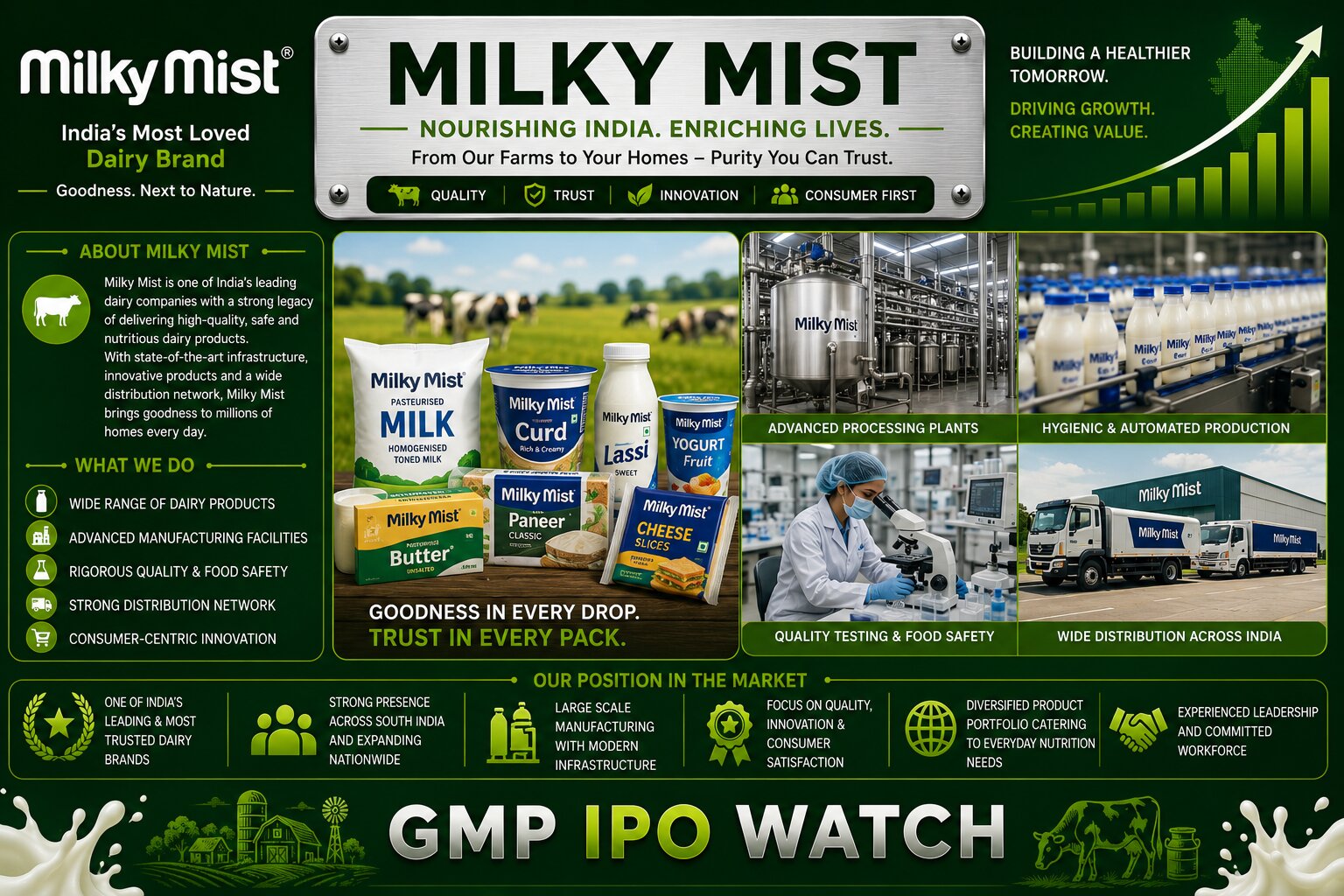
Milky Mist IPO 2026 – The Real Story Is Value-Added Dairy, Not Milk
When investors think about dairy companies, the first product that usually comes to mind is packaged milk.
Milky Mist Dairy Food Limited has built a very different business.
Its core strength is not ordinary liquid milk.
It is value-added dairy.
The company manufactures products such as:
- Paneer
- Cheese
- Curd
- Yogurt
- Greek yogurt
- Butter
- Ghee
- Ice cream
- Other packaged dairy foods
This product mix matters because value-added dairy products can generate very different economics from commoditised liquid milk.
Milky Mist's IPO opened on August 11, 2026 and closes on August 13, 2026, with a price band of ₹133 to ₹140 per equity share.
The total IPO size is approximately ₹1,553 crore, consisting of a ₹1,428 crore fresh issue and an Offer for Sale of approximately ₹125 crore.
For investors, the key question is whether Milky Mist can use its strong positions in paneer, cheese and yogurt to build a much broader national consumer-food business.
Milky Mist IPO Details
| Particular | Details |
|---|---|
| Company | Milky Mist Dairy Food Limited |
| IPO Type | Mainboard Book Built IPO |
| Total Issue Size | ₹1,553 Crore |
| Fresh Issue | ₹1,428 Crore |
| Offer for Sale | ₹125 Crore |
| Price Band | ₹133 – ₹140 Per Share |
| Face Value | ₹2 Per Share |
| Lot Size | 107 Shares |
| Minimum Retail Investment | ₹14,980 at ₹140 |
| IPO Opening Date | August 11, 2026 |
| IPO Closing Date | August 13, 2026 |
| Expected Allotment | August 14, 2026 |
| Expected Listing | August 18, 2026 |
| Listing | BSE & NSE |
At the upper price band, one lot of 107 shares requires approximately ₹14,980.
What Makes Milky Mist Different From a Conventional Dairy Company?
A conventional dairy business may generate a large share of revenue from:
- Packaged milk
- Bulk milk
- Commodity dairy products
Milky Mist has positioned itself more toward products where branding, convenience, quality and processing create additional value.
This includes:
Milk → processing → paneer / cheese / yogurt / butter / ghee → branded retail product
The further the company moves along that value chain, the greater the opportunity to differentiate through:
- Brand
- Product quality
- Packaging
- Distribution
- Innovation
rather than competing only on raw milk prices.
Paneer Is a Major Competitive Strength
Milky Mist was the largest private packaged paneer brand in India's organised market in FY2026, with an estimated market share of approximately 19% by value.
That is strategically important.
Paneer is widely consumed across:
- Households
- Restaurants
- Hotels
- Caterers
- Quick-service restaurants
Unlike highly discretionary premium foods, paneer has become a relatively mainstream protein source for vegetarian consumers.
This gives the category a potentially large long-term demand base.
Why Packaged Paneer Can Grow Faster Than Loose Paneer
A significant portion of paneer in India has historically been sold through local dairies or unorganised channels.
Organised packaged paneer can offer:
- Standardised quality
- Better hygiene
- Branded trust
- Consistent weight
- Shelf-life management
- Cold-chain traceability
As consumers shift from loose products toward organised packaged food, brands such as Milky Mist can potentially gain share even if total paneer consumption grows more slowly.
Cheese Is Another Important Category
Milky Mist is also the largest private packaged cheese brand in South India, with around 12% market share, and ranks among the leading private organised cheese players nationally with approximately 5% share.
Cheese demand is supported by:
- Pizza consumption
- Burgers
- Sandwiches
- Cafés
- Quick-service restaurants
- Home cooking
This gives Milky Mist exposure to both retail and institutional food-service demand.
Greek Yogurt Provides a Premium Growth Segment
Milky Mist also has a strong position in organised Greek yogurt.
Current IPO-related reporting places its share at approximately 35%–40% of the organised Greek yogurt market in FY2026.
Greek yogurt is particularly interesting because it sits at the intersection of:
- Health
- Protein consumption
- Convenience
- Premium snacking
Consumers are increasingly looking for higher-protein food options.
This creates an opportunity for Milky Mist to participate in a faster-growing premium dairy niche rather than depending only on traditional dairy categories.
Product Mix Is the Core Investment Thesis
The company can potentially grow in two ways.
Volume Growth
Sell more paneer, cheese and curd.
Mix Improvement
Sell a larger proportion of premium products such as:
- Greek yogurt
- Cheese
- Specialty dairy
- Branded convenience foods
The second route can be particularly important because premium products may support stronger realisations and brand economics.
FY2026 Was a Major Financial Step-Up
Milky Mist reported revenue of approximately ₹3,145.01 crore in FY2026, compared with about ₹2,354.79 crore in FY2025.
Profit after tax increased from approximately ₹46.07 crore in FY2025 to ₹127.01 crore in FY2026.
That translates into:
- Revenue growth of roughly 34%
- PAT growth of roughly 176%
The sharp increase in profitability is one of the most important developments ahead of the IPO.
Milky Mist Financial Performance
| Financial Year | Revenue | Profit After Tax |
| FY2025 | ₹2,354.79 Cr | ₹46.07 Cr |
| FY2026 | ₹3,145.01 Cr | ₹127.01 Cr |
The difference between revenue and profit growth deserves attention.
Revenue increased by about one-third.
Profit increased by almost three times.
That suggests significant margin improvement.
Why PAT Grew Faster Than Revenue
Possible reasons can include:
- Higher capacity utilisation
- Better product mix
- Scale benefits
- Lower relative overheads
- Improved pricing
- Stronger premium product contribution
For investors, however, the key issue is sustainability.
A one-year margin expansion is valuable only if the business can protect those margins through future milk-price cycles.
Raw Milk Is the Most Important Input
Every dairy product begins with milk.
This means Milky Mist's profitability is influenced heavily by raw milk procurement costs.
Milk prices can change because of:
- Feed costs
- Weather
- Seasonal supply
- Farmer economics
- Competing dairy demand
When procurement prices rise, Milky Mist may need to increase retail prices.
But price increases can affect consumer demand.
This creates a constant balancing act between:
input cost + retail pricing + volume + margin.
Value-Added Products Can Provide Better Cost Pass-Through
A litre of ordinary milk is easy for consumers to compare across brands.
A premium Greek yogurt or speciality cheese product is harder to compare directly.
Branding and differentiation can therefore provide more pricing flexibility.
This is one reason Milky Mist's value-added strategy is important.
The stronger the brand becomes, the less the company may need to compete solely on price.
The IPO Is Primarily Fresh Capital
The ₹1,553 crore IPO includes:
- ₹1,428 crore fresh issue
- ₹125 crore OFS.
This is noteworthy.
More than 90% of the IPO is fresh capital.
That means most of the money being raised will go into Milky Mist rather than to selling shareholders.
From a business-development perspective, this gives the IPO a very different character from OFS-heavy issues.
Debt Repayment Is a Major Use of Proceeds
Milky Mist intends to use a portion of fresh issue proceeds toward repayment or prepayment of debt.
Current IPO analysis indicates approximately ₹496.86 crore is earmarked toward debt repayment.
Reducing debt could help:
- Lower finance costs
- Improve PAT
- Strengthen cash flow
- Reduce leverage
- Increase capacity for future investment
This is especially important for a company operating expensive manufacturing and cold-chain infrastructure.
Capacity Expansion Is Also Important
The fresh IPO proceeds are also intended to support plant and production expansion.
Dairy manufacturing requires substantial investment in:
- Processing equipment
- Cheese production
- Fermentation
- Packaging
- Refrigeration
- Storage
- Cold-chain logistics
Additional capacity can support growth only when demand grows fast enough to utilise it.
Therefore, post-IPO capacity utilisation will be an important metric.
Distribution Infrastructure Can Become a Moat
Dairy products are not like biscuits or packaged snacks that can remain at room temperature for long periods.
Many Milky Mist products require refrigeration.
That means the company must manage:
- Cold storage
- Refrigerated transportation
- Distributor refrigeration
- Retail refrigeration
- Temperature control
Building this system requires significant investment.
Once established, however, it can become difficult for smaller competitors to replicate.
Cold Chain Can Limit National Expansion
The same infrastructure that creates a competitive advantage also creates a challenge.
Expanding from South India into North, West and East India requires more than advertising.
Milky Mist needs:
- Warehouses
- Refrigerated vehicles
- Distributors
- Retail refrigeration
- Reliable delivery schedules
This means national expansion can be capital intensive.
South India Concentration Is One of the Biggest Risks
Approximately 70% of Milky Mist's revenue comes from South India.
This is important.
The brand has a strong regional position, but geographic concentration exposes the company to:
- Regional competition
- Supply disruptions
- Consumer trends
- Distribution issues
A successful expansion into other parts of India could materially reduce this risk.
Geographic Expansion Could Be the Next Big Growth Driver
Imagine Milky Mist currently generates the majority of its revenue from southern states.
If it builds meaningful market share in:
- Maharashtra
- Gujarat
- Delhi NCR
- Uttar Pradesh
- Rajasthan
- Eastern India
the addressable market expands dramatically.
National distribution could therefore become one of the company's biggest long-term growth opportunities.
But Building a National Brand Is Expensive
The company may need to invest heavily in:
- Advertising
- Sales teams
- Distributor margins
- Retail visibility
- Cold-chain infrastructure
- Sampling
- Promotions
These expenses can temporarily reduce margins.
Investors should therefore not expect every rupee of geographic expansion revenue to immediately create the same profitability as established South Indian operations.
Anchor Book Shows Institutional Demand
Ahead of the public issue, Milky Mist raised approximately ₹465.29 crore from 19 anchor investors at ₹140 per share.
Anchor participation provides a useful indication of institutional interest in the IPO.
However, it does not guarantee:
- Listing gains
- Long-term returns
- Sustainable valuation
Investors still need to evaluate the business independently.
Promoter Holding Will Remain High
Following the IPO, promoter-group ownership is expected to decline from approximately 93% to around 79.5%.
That means promoters will continue to own a substantial majority after listing.
High promoter ownership can preserve long-term alignment, although public-market investors should also monitor governance and related-party disclosures.
Market Leadership Is a Strong Positive
Milky Mist holds leading or significant positions across several organised dairy categories.
These include:
- No. 1 private packaged paneer brand nationally
- No. 1 private packaged cheese brand in South India
- Leading private yogurt position
- Strong organised Greek yogurt share.
This multi-category strength is important.
It means the company isn't entering the IPO with only one successful product.
Competition Is Still Intense
The dairy market includes:
- Large cooperatives
- National dairy brands
- Regional companies
- Local dairies
- Private food companies
Competition can occur across:
- Price
- Product quality
- Distribution
- Brand trust
- Retail availability
Milky Mist must continue investing to defend its positions.
Product Concentration Is Another Risk
A meaningful portion of revenue is linked to major categories such as:
- Paneer
- Cheese
- Curd.
If demand weakens in these categories or competition intensifies, growth could be affected.
Expanding categories such as yogurt, desserts, ice cream and other value-added foods can reduce this concentration.
Food Safety Is Non-Negotiable
For a dairy business, quality control is critical.
Any major issue involving:
- Contamination
- Product spoilage
- Cold-chain failure
- Food safety
can damage consumer trust quickly.
A strong dairy brand takes years to build and can be harmed rapidly by a quality incident.
This makes manufacturing and cold-chain control fundamental to the investment case.
Milky Mist IPO GMP Today
The latest reported GMP on August 11 is approximately ₹21 per share.
Against the ₹140 upper price band, that implies an unofficial indicated price of roughly ₹161, or around a 15% premium.
The GMP was higher at around ₹26 before opening, so sentiment has moderated somewhat.
Grey Market Premium is unofficial and can change before listing.
Opening-Day Subscription
The IPO opened today, so subscription figures remain intraday and can change substantially through August 13.
Early tracking has shown investor bidding beginning across categories.
For a large mainboard IPO, the final QIB subscription on the closing day will be particularly useful in assessing institutional demand.
What Could Drive Milky Mist's Next Growth Phase?
Paneer Market Formalisation
A shift from unorganised to branded packaged paneer can expand the addressable market.
Cheese Consumption
QSR, home cooking and food-service demand can support growth.
High-Protein Foods
Greek yogurt and other protein-led products can benefit from health trends.
Geographic Expansion
Entering additional Indian markets can reduce South India concentration.
Capacity Expansion
IPO-funded infrastructure can support larger volumes.
Debt Reduction
Lower finance costs can improve earnings quality.
New Product Launches
Additional premium dairy categories can increase revenue per customer.
Competitive Strengths
Milky Mist enters the IPO with several clear advantages.
Strong Organised Paneer Position
Approximately 19% national organised packaged paneer share.
Cheese Leadership in South India
Around 12% share in the regional organised packaged cheese market.
Greek Yogurt Position
Approximately 35%–40% organised market share.
Strong FY2026 Growth
Revenue increased about 34% while PAT increased around 176%.
Mostly Fresh Issue
₹1,428 crore of the ₹1,553 crore IPO goes toward fresh shares.
Anchor Participation
₹465 crore-plus was raised from institutions before the IPO.
Major Risks
South India Concentration
Nearly 70% of revenue comes from the region.
Milk Price Volatility
Higher procurement prices can reduce margins.
Cold-Chain Costs
Expansion requires significant distribution infrastructure.
Product Concentration
Paneer, cheese and curd remain major contributors.
Competition
Large dairy companies possess strong distribution and brands.
Expansion Risk
New capacity must achieve sufficient utilisation.
Debt
Despite planned repayment, leverage remains an important consideration before the IPO.
What Investors Should Track After Listing
Long-term investors should monitor:
Revenue Outside South India
Is geographic diversification improving?
Paneer and Cheese Market Share
Is Milky Mist maintaining category leadership?
PAT Margin
Can FY2026 profitability be sustained?
Milk Procurement Cost
Is raw-material inflation being managed?
Debt
Does the IPO produce meaningful deleveraging?
Capacity Utilisation
Are new facilities generating adequate sales?
Operating Cash Flow
Are reported profits translating into cash?
Should Investors Consider Milky Mist IPO?
The positive investment case includes:
- Strong consumer brand
- Leadership in organised paneer
- Large cheese business
- Premium Greek yogurt exposure
- ₹3,000 crore-plus FY2026 revenue
- Sharp PAT growth
- Mostly fresh IPO proceeds
- Debt-repayment plan
- Long-term organised dairy opportunity
The caution points include:
- Geographic concentration
- Milk-price volatility
- Cold-chain capex
- Competition
- Sustainability of FY2026 margins
- Execution of national expansion
This makes Milky Mist more interesting as a long-term branded-food story than as simply a dairy commodity company.
Final View on Milky Mist IPO 2026
The Milky Mist Dairy Food IPO 2026 gives public-market investors access to one of India's important value-added dairy businesses.
Its investment case is built on category leadership rather than commodity milk volumes.
The company holds roughly 19% of India's organised packaged paneer market by value, leads the private organised cheese market in South India and has a strong position in Greek yogurt.
Financial performance improved sharply in FY2026, with revenue increasing from approximately ₹2,354.79 crore to ₹3,145.01 crore, while PAT rose from around ₹46.07 crore to ₹127.01 crore.
The ₹1,553 crore IPO is also overwhelmingly fresh capital, with ₹1,428 crore intended to support company-level objectives including debt repayment and expansion.
The opportunity is clear:
strong regional brand + organised dairy growth + premium product mix + national expansion.
The biggest challenge is equally clear:
Milky Mist must prove it can reproduce its South Indian success across the rest of India without sacrificing margins.
If the company can expand distribution, maintain its paneer and cheese leadership, grow premium products such as Greek yogurt and reduce debt, its business can become substantially larger over time.
If expansion costs rise too quickly, milk procurement prices remain elevated or national distribution proves difficult, returns may be weaker than the recent financial growth suggests.
Overall, Milky Mist represents a differentiated branded-food IPO with strong value-added dairy positioning, impressive FY2026 momentum and meaningful national expansion potential. Its long-term investment case will depend on geographic diversification, margin sustainability, debt reduction and disciplined deployment of the ₹1,428 crore fresh issue.