 GMP IPO Watch
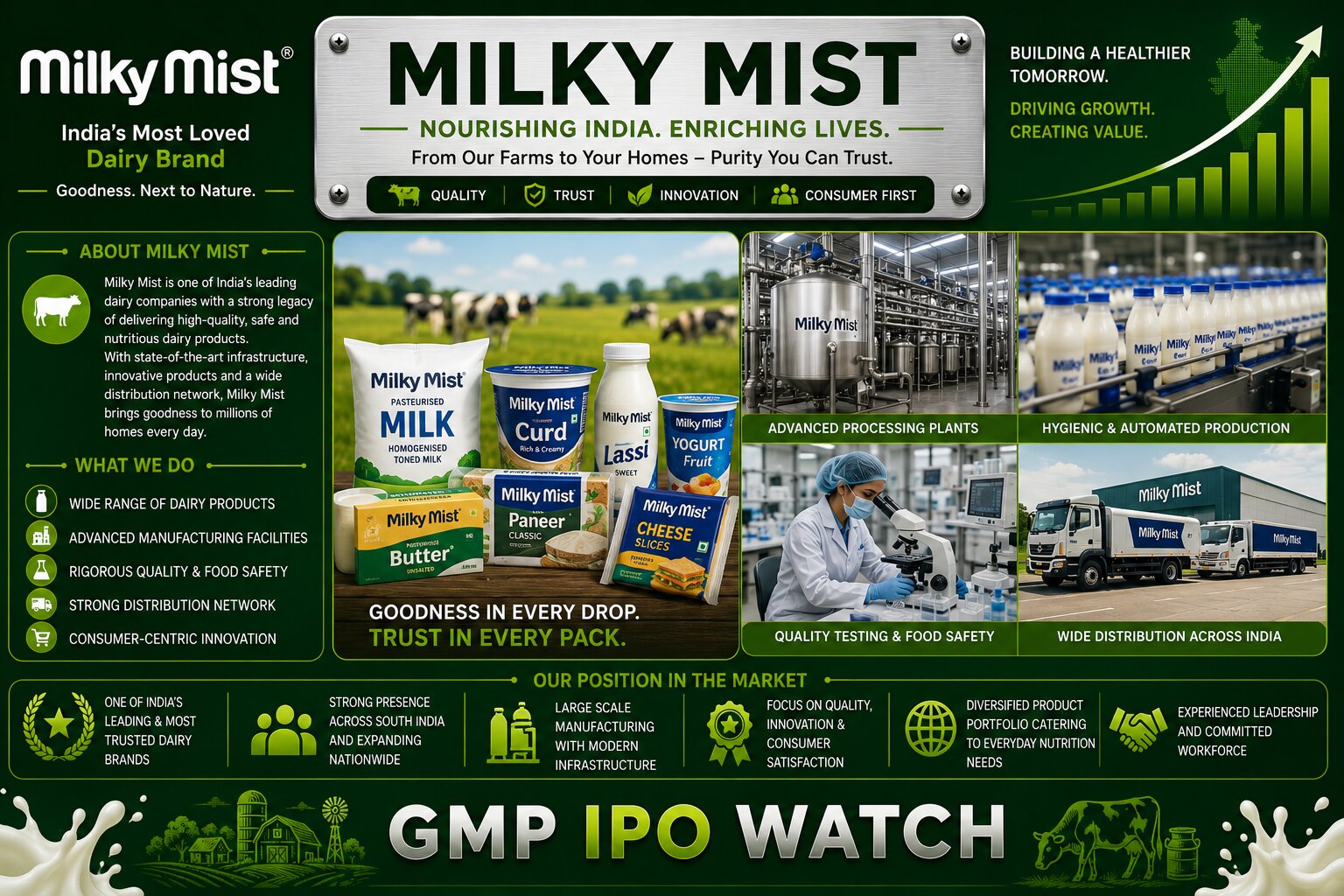
Milky Mist IPO 2026 – The Real Moat May Begin Before the Product Reaches the Factory
When consumers buy paneer, cheese, curd or yogurt, they usually evaluate the finished product.
They see the brand, packaging, price and taste.
But for a large dairy company, the business begins much earlier.
Before Milky Mist can sell a packet of paneer, it must reliably source milk, test its quality, transport it under controlled conditions, process it efficiently, manufacture multiple products, keep them refrigerated and deliver them to thousands of retail points before shelf life becomes a problem.
That makes Milky Mist Dairy Food Limited much more than a branded-food company.
It is also a large procurement, manufacturing and cold-chain operation.
That distinction becomes important as the company's ₹1,553 crore IPO reaches its final subscription day on August 13, 2026. The price band is ₹133–₹140 per share, with a lot size of 107 shares and a minimum retail investment of ₹14,980 at the upper band.
Investor demand has accelerated sharply today. By around 3:36 PM, the IPO was subscribed approximately 57.45 times overall, driven by very strong institutional demand.
The bigger investment question, however, is not whether the IPO is oversubscribed.
It is:
Can Milky Mist use its manufacturing scale, milk sourcing network and IPO capital to become a national value-added dairy company without weakening margins or return on capital?
Milky Mist IPO Details
| Particular | Details |
|---|---|
| Company | Milky Mist Dairy Food Limited |
| IPO Type | Mainboard Book Built IPO |
| Total Issue Size | ₹1,553 Crore |
| Fresh Issue | ₹1,428 Crore |
| Offer for Sale | ₹125 Crore |
| Price Band | ₹133 – ₹140 Per Share |
| Face Value | ₹2 Per Share |
| Lot Size | 107 Shares |
| Minimum Retail Investment | ₹14,980 |
| IPO Opening Date | August 11, 2026 |
| IPO Closing Date | August 13, 2026 |
| Expected Allotment | August 14, 2026 |
| Expected Listing | August 18, 2026 |
| Listing | NSE & BSE |
The final issue is materially smaller than the earlier DRHP proposal. At the current terms, Milky Mist is raising ₹1,428 crore through fresh equity and ₹125 crore through an OFS.
That means more than 90% of the issue is fresh capital going into the company.
Milky Mist Is Fundamentally a Value-Added Dairy Company
Milky Mist's investment case differs from a dairy company heavily dependent on ordinary packaged milk.
Its portfolio is centred around value-added products such as:
- Paneer
- Cheese
- Curd
- Yogurt
- Greek yogurt
- Butter
- Ghee
- Ice cream
- Other dairy foods
This distinction matters because value-added products provide more room for differentiation through:
- Brand
- Taste
- Convenience
- Packaging
- Quality
- Product innovation
Milky Mist also has leadership positions in organised packaged paneer and private packaged cheese in South India, while its organised Greek yogurt share was estimated at roughly 35–40% by value in FY2026.
The Business Starts With Milk Procurement
A dairy factory cannot function without a predictable supply of raw milk.
That creates a major operational challenge.
Milk supply can change because of:
- Seasonality
- Animal productivity
- Farmer economics
- Feed costs
- Weather
- Competing dairy buyers
Milky Mist therefore needs a procurement system capable of continuously supplying enough high-quality milk to its manufacturing facilities.
This is especially important because value-added dairy plants require consistent utilisation.
A factory may have expensive processing and refrigeration equipment, but without sufficient raw milk it cannot operate efficiently.
Why Procurement Scale Can Become a Competitive Advantage
Suppose a small dairy company wants to double production.
It cannot simply press a button and produce twice as much paneer.
It first needs access to twice as much suitable milk.
Building a procurement network requires:
- Farmer relationships
- Collection infrastructure
- Milk-testing systems
- Chilling capacity
- Transportation
These capabilities take time to build.
For established dairy businesses, procurement infrastructure can therefore become a less-visible competitive moat.
Milk Quality Directly Affects Finished Products
Milk used for paneer or cheese cannot be treated as a generic raw material.
Quality affects:
- Yield
- Taste
- Texture
- Shelf life
- Product consistency
Poor-quality raw milk can reduce the amount of finished product generated from every litre.
That means procurement quality has direct economic consequences.
Improving yield by even a small amount can meaningfully affect margins when processing volumes are large.
Dairy Economics Are Also About Yield
Consider two factories using the same amount of milk.
Factory A
Produces 18 kilograms of finished product from a given milk quantity.
Factory B
Produces 20 kilograms.
That difference can come from:
- Milk composition
- Manufacturing technology
- Process control
- Product formulation
Higher yield allows the company to generate more saleable output from the same raw-material input.
For Milky Mist, manufacturing efficiency can therefore be just as important as retail price increases.
Cold Chain Is the Second Major Infrastructure Requirement
After dairy products are manufactured, the logistics challenge begins.
Many products require refrigeration.
That includes categories such as:
- Paneer
- Cheese
- Curd
- Yogurt
- Ice cream
The company must maintain temperature through:
factory → warehouse → vehicle → distributor → retailer.
If this chain breaks, products can spoil.
This means distribution infrastructure is directly linked with brand reputation and profitability.
Why Cold Chain Is a Barrier to National Expansion
Selling biscuits in a new state can be relatively simple.
A company can use conventional warehouses and trucks.
Dairy is different.
To enter another geography at meaningful scale, Milky Mist may need:
- Refrigerated warehouses
- Cold rooms
- Refrigerated trucks
- Distributors with cold infrastructure
- Retail refrigeration
This makes national expansion slower and more capital intensive.
But once the network is built, it also becomes harder for smaller competitors to replicate.
Distribution Density Can Improve Economics
Suppose one refrigerated truck delivers to 15 outlets.
Now suppose it serves 60 outlets along roughly the same route.
The second route can generate more revenue without four times the transportation cost.
This creates a concept similar to logistics route density.
As Milky Mist becomes stronger in a market, distribution economics can improve.
That means expansion should ideally progress from:
new geography → more retailers → higher route density → better logistics efficiency.
South India Is Both Milky Mist's Strength and Its Biggest Concentration Risk
Around 70% of Milky Mist's revenue comes from South India.
This provides several advantages.
The company already has:
- Brand recognition
- Distribution
- Procurement familiarity
- Customer loyalty
But it also creates geographic concentration.
Milky Mist's long-term valuation will depend partly on whether it can replicate its southern success in markets such as western, northern and eastern India.
Expanding Nationally Requires More Than Advertising
A consumer brand can launch television and digital advertising across India quickly.
Physical dairy distribution cannot scale that fast.
Milky Mist must first ensure that products can reliably reach retailers.
That involves:
- Warehouses
- Dealers
- Refrigerated transport
- Inventory planning
- Store-level availability
A national advertising campaign without supporting cold-chain distribution could simply create demand the company cannot fulfil efficiently.
FY2026 Was a Major Earnings Year
Current IPO analysis indicates Milky Mist delivered robust growth through FY2026. Brokerage research on the IPO notes a roughly 31.26% revenue CAGR during FY2024–FY2026, supported by the company's focus on value-added dairy products.
Earlier FY2025 revenue from operations was approximately ₹2,349.50 crore, up from ₹1,821.61 crore in FY2024.
The company entered the IPO after another significant scale-up in FY2026, which is central to the optimistic investment thesis.
Profit Growth Is More Important Than Revenue Growth
A dairy company can increase revenue simply because milk prices rise.
That does not automatically mean economic performance improved.
Investors should therefore watch:
- EBITDA margin
- PAT margin
- Volume growth
- Product mix
- Cash flow
If premium products such as cheese and yogurt become a larger share of sales, earnings can potentially grow faster than milk volumes.
This is a healthier growth model than relying entirely on price inflation.
Premiumisation Can Improve Revenue Per Litre of Milk
Imagine one litre of milk is sold directly.
Now imagine that same raw material becomes:
- Cheese
- Greek yogurt
- Paneer
- Specialty dairy foods
Processing creates more value.
The company can potentially earn higher realisation from each litre of milk procured.
This is one reason value-added dairy is strategically attractive.
Paneer Provides Scale, but Premium Products Can Improve the Mix
Paneer remains one of Milky Mist's strongest categories.
But the next phase of margin improvement may depend increasingly on categories such as:
- Cheese
- Greek yogurt
- Protein-focused products
- Premium dairy snacks
These products can offer:
- Higher selling prices
- More differentiation
- Stronger brand engagement
The ideal business mix combines large-volume categories with higher-margin premium products.
Protein Consumption Is an Important Consumer Trend
Consumer awareness around protein has increased.
This can benefit dairy categories such as:
- Paneer
- Greek yogurt
- Cheese
Milky Mist is already well positioned in these categories.
The opportunity is to move from simply selling dairy toward owning a stronger position in the broader protein and nutrition food market.
That could open space for additional products over time.
Fresh Issue Dominates the IPO
The current ₹1,553 crore IPO includes:
₹1,428 crore fresh issue
and only:
₹125 crore OFS.
This is a meaningful positive from a capital-deployment perspective.
Unlike an IPO dominated by shareholder exits, most of the money is entering Milky Mist.
Investors can therefore evaluate what management intends to do with the capital.
Debt Reduction Is One Important Objective
Fresh proceeds are intended partly for debt repayment.
For a dairy company with significant manufacturing and cold-chain infrastructure, debt reduction can be important.
Lower borrowings can reduce:
- Interest expense
- Financial risk
- Cash-flow pressure
That can allow a larger portion of operating profit to reach the bottom line.
Deleveraging Can Directly Improve PAT
Suppose a company earns ₹300 crore of operating profit.
If it pays ₹100 crore of interest, only ₹200 crore remains before tax and other items.
If debt reduction lowers interest to ₹50 crore, earnings improve even without higher revenue.
This is why the IPO can potentially improve Milky Mist's earnings quality as well as fund growth.
Capex Is the Second Major Capital-Deployment Theme
Milky Mist also plans to deploy capital into expansion.
Dairy manufacturing requires expensive infrastructure.
Potential investments can support:
- Processing
- Cheese production
- Packaging
- Refrigeration
- Storage
- Logistics
The important metric will be whether this new capacity produces sufficient incremental revenue.
Capacity Utilisation Is Critical
Imagine a dairy facility capable of producing ₹1,000 crore worth of products annually.
Scenario A
₹500 crore of output.
Scenario B
₹900 crore of output.
Scenario B can provide substantially better:
- Fixed-cost absorption
- EBITDA margins
- Return on capital
This is why investors should not judge Milky Mist only by headline capacity additions.
They should track how quickly that capacity becomes productive.
Overexpansion Can Hurt Returns
Rapid consumer growth can encourage companies to build capacity aggressively.
But dairy infrastructure is expensive.
If Milky Mist adds processing capacity faster than consumer demand grows, it may face:
- Lower utilisation
- Higher depreciation
- Higher maintenance expense
- Weak return on capital
Management therefore needs to balance optimism with capital discipline.
Anchor Demand Was Strong
Ahead of the public issue, Milky Mist raised approximately ₹465.30 crore from anchor investors, allotting shares at ₹140 each.
This showed meaningful institutional interest even before public bidding began.
But anchor demand became even more relevant after today's final-day QIB bidding accelerated dramatically.
Final-Day Subscription Has Exploded
As of approximately 3:36 PM on August 13, current subscription tracking showed:
| Category | Subscription |
|---|---|
| QIB | 160.43× |
| NII | 36.24× |
| Retail | 7.88× |
| Overall | 57.45× |
This represents a major change from Day 2, when the issue closed around 2.17× overall subscription.
The jump is being driven particularly by institutional investors.
Why QIB Demand Matters
QIB investors include institutions such as:
- Mutual funds
- Insurance companies
- Foreign institutional investors
These investors typically conduct detailed analysis around:
- Valuation
- Financials
- Industry structure
- Management
- Growth
A 160×-plus QIB book is therefore a powerful demand signal.
However, it does not guarantee future share-price performance.
Institutions can be enthusiastic about an IPO and still face valuation or market-cycle risks later.
Retail Demand Is Also Strong
Retail subscription is around 7.88× at the latest update.
That means retail investors have applied for far more shares than allocated to the category.
As a result, allotment probability for a valid retail application is likely to be relatively low.
Final exchange figures can still move before bidding closes.
Milky Mist IPO GMP Today
The latest mainstream reporting places Milky Mist's GMP at roughly 15% above the ₹140 upper issue price.
That implies an unofficial indicated price of approximately:
₹161 per share.
Grey-market sentiment was stronger before opening, at roughly 20%, and has since moderated.
This illustrates that even when subscription rises dramatically, GMP does not necessarily move in the same direction.
GMP remains unofficial and unregulated.
Valuation Is One of the Biggest Questions
Current brokerage analysis values Milky Mist at approximately 84.84× FY2026 post-IPO EPS at the ₹140 upper band.
That is a demanding earnings multiple.
Investors are therefore paying for expectations of:
- Strong future revenue growth
- Market leadership
- Premium dairy expansion
- National distribution
- Margin improvement
A high valuation does not automatically make an IPO unattractive.
But it reduces the room for operational disappointment.
High Growth Is Already Reflected in the Price
If a company trades at a low P/E, modest growth may be enough to generate attractive returns.
At a high multiple, investors expect a lot.
Milky Mist may need to continue delivering:
- Double-digit volume growth
- Geographic expansion
- Higher premium-product contribution
- Margin improvement
If growth falls sharply, the valuation could compress even while the company remains profitable.
Temasek Backing Adds Institutional Credibility
Milky Mist is backed by Singapore investment company Temasek. Reuters reported that the IPO was fully subscribed by the second day, highlighting strong interest in the Temasek-backed dairy company.
Institutional backing can support:
- Governance
- Strategic expansion
- Capital discipline
But it should not replace independent analysis of valuation and operating performance.
India's Organised Dairy Market Still Has Significant Runway
India is one of the world's largest dairy-consuming markets.
However, substantial parts of the industry remain fragmented.
The gradual shift toward organised, branded products can benefit companies offering:
- Consistent quality
- Packaged products
- Food safety
- Reliable cold chain
Milky Mist's strength in value-added categories positions it to participate in this formalisation trend.
Organised Paneer Has a Particularly Large Opportunity
A large amount of paneer is still purchased from local and unorganised sources.
Consumers increasingly place importance on:
- Hygiene
- Standardisation
- Packaging
- Shelf life
This can support continued movement toward branded packaged paneer.
For Milky Mist, category leadership provides a useful starting advantage.
Institutional Food Service Can Also Support Growth
Milky Mist's addressable market is not limited to households.
Dairy products are used extensively by:
- Restaurants
- Hotels
- Caterers
- Cafés
- Quick-service restaurants
Products such as cheese, paneer and butter can generate significant institutional demand.
This provides another growth route beyond retail shelf expansion.
Food-Service Demand Can Improve Production Planning
Large institutional customers can place recurring orders.
That gives the factory more predictable volume.
For example, supplying cheese to a restaurant chain can provide steady demand compared with relying entirely on individual retail consumers.
However, large institutional buyers also negotiate strongly on price.
Milky Mist needs to balance:
volume + margin.
Food Safety Is a Critical Risk
Dairy is especially sensitive to quality failures.
Problems involving:
- Contamination
- Spoilage
- Temperature control
- Packaging
can damage brand trust quickly.
As Milky Mist expands nationally, maintaining consistent quality across a much larger distribution network becomes increasingly important.
Raw Milk Inflation Can Compress Margins
Milk procurement costs can increase even when retail prices cannot be changed immediately.
This creates temporary margin pressure.
The company must decide whether to:
- Increase prices
- Reduce promotions
- Absorb costs
Brand strength can make passing on inflation easier.
But pricing power is never unlimited.
Competition Is Intense
Milky Mist competes with:
- Large dairy cooperatives
- National dairy companies
- Regional private brands
- New premium dairy brands
Competition covers:
- Price
- Distribution
- Brand visibility
- Product quality
- Innovation
The company therefore needs to keep investing rather than assuming current category leadership will remain permanent.
What Could Drive Milky Mist's Next Growth Phase?
Geographic Diversification
Reducing the approximately 70% South India revenue concentration could materially expand the addressable market.
Premium Dairy
Greek yogurt and other premium categories can improve the product mix.
Organised Paneer Growth
Formalisation can support volume growth.
Institutional Food Service
Restaurants and QSRs can provide large recurring orders.
New Capacity
IPO-funded infrastructure can support higher volumes.
Debt Reduction
Lower finance costs can improve earnings quality.
New Product Development
Expanding beyond existing categories can increase wallet share.
Major Strengths of Milky Mist
The investment case includes several clear positives:
- Leadership in organised packaged paneer
- Strong cheese position in South India
- 35–40% organised Greek yogurt share
- Value-added dairy focus
- Strong recent revenue growth
- Large fresh issue component
- Debt-reduction opportunity
- Temasek backing
- Very strong final-day institutional demand.
Major Risks Investors Should Understand
High Valuation
The IPO is priced at roughly 84.84× FY2026 post-IPO EPS based on one current brokerage calculation.
South India Concentration
Around 70% of revenue currently comes from the region.
Raw Milk Prices
Procurement inflation can compress margins.
Cold-Chain Requirement
National expansion requires substantial distribution infrastructure.
Capacity Execution
New plants and equipment need strong utilisation.
Food Safety
Quality failures could materially damage the brand.
Competition
Large established dairy businesses possess strong procurement and distribution networks.
What Investors Should Track After Listing
The most useful metrics may be:
Revenue Outside South India
Is geographic diversification progressing?
Volume Growth
Is revenue expansion coming from more product sold rather than only higher prices?
Premium Product Contribution
Are cheese, Greek yogurt and other higher-value products becoming larger contributors?
EBITDA Margin
Is scale improving manufacturing economics?
Operating Cash Flow
Are profits translating into cash?
Net Debt
Does IPO-funded repayment meaningfully strengthen the balance sheet?
Capacity Utilisation
Are new manufacturing investments earning adequate returns?
The Most Important Post-IPO Equation
Milky Mist already has a strong regional brand.
Its next stage is more difficult.
The ideal post-IPO cycle is:
fresh capital → debt reduction + new capacity → national distribution → higher sales → better utilisation → stronger profit and cash flow.
The riskier outcome is:
fresh capital → expensive expansion → low new-market penetration → underutilised capacity → weaker ROCE.
The difference between those two outcomes will determine whether the IPO creates long-term shareholder value.
Should Investors Consider Milky Mist IPO?
The positive investment case includes:
- Strong category leadership
- Value-added dairy focus
- Rapid financial growth
- Organised dairy opportunity
- Mostly fresh issue
- Very strong QIB demand
- Positive GMP
- National expansion potential
The caution points include:
- High valuation
- Regional concentration
- Raw-material sensitivity
- Cold-chain capital requirements
- Need to sustain recent profitability
Milky Mist should therefore be analysed as a premium value-added food platform with dairy-manufacturing infrastructure, rather than simply as a milk company.
Final View on Milky Mist IPO 2026
The Milky Mist Dairy Food IPO 2026 reaches its final bidding day with exceptionally strong investor demand.
As of around 3:36 PM on August 13, the issue was subscribed approximately 57.45× overall, including more than 160× demand from QIBs, around 36× from NIIs, and nearly 8× from retail investors.
The ₹1,553 crore IPO is priced at ₹133–₹140 per share, with approximately ₹1,428 crore coming through fresh equity and only ₹125 crore through OFS.
That gives Milky Mist significant new capital for its next stage.
Its strongest advantage is not one individual product.
It is the combination of:
milk procurement + manufacturing + paneer and cheese leadership + premium dairy products + cold-chain distribution + brand.
That integrated system is difficult to build quickly.
The opportunity is substantial because organised value-added dairy remains a growing part of India's food market, and Milky Mist has already established strong positions in categories including packaged paneer, cheese and Greek yogurt.
However, today's huge subscription should not distract investors from valuation.
At the upper price band, one current brokerage calculation values the company at around 84.84× FY2026 post-IPO earnings, meaning expectations are already high.
The company therefore needs to execute well after listing.
For long-term investors, the real evidence will come from whether Milky Mist can reduce debt, increase manufacturing utilisation, expand outside South India, grow premium products and convert higher revenue into sustainable operating cash flow.
The current GMP of approximately 15% indicates positive short-term sentiment, but this is far less important than the company's ability to generate attractive returns on the ₹1,428 crore of fresh equity entering the business.
Overall, Milky Mist represents one of the more differentiated branded-food IPOs of 2026, combining strong value-added dairy leadership, a large fresh capital raise and powerful institutional demand. The long-term opportunity is meaningful, but the premium valuation means future execution—particularly national expansion, margin sustainability and return on new capacity—will determine whether the business can justify the expectations currently built into the IPO price.