 GMP IPO Watch
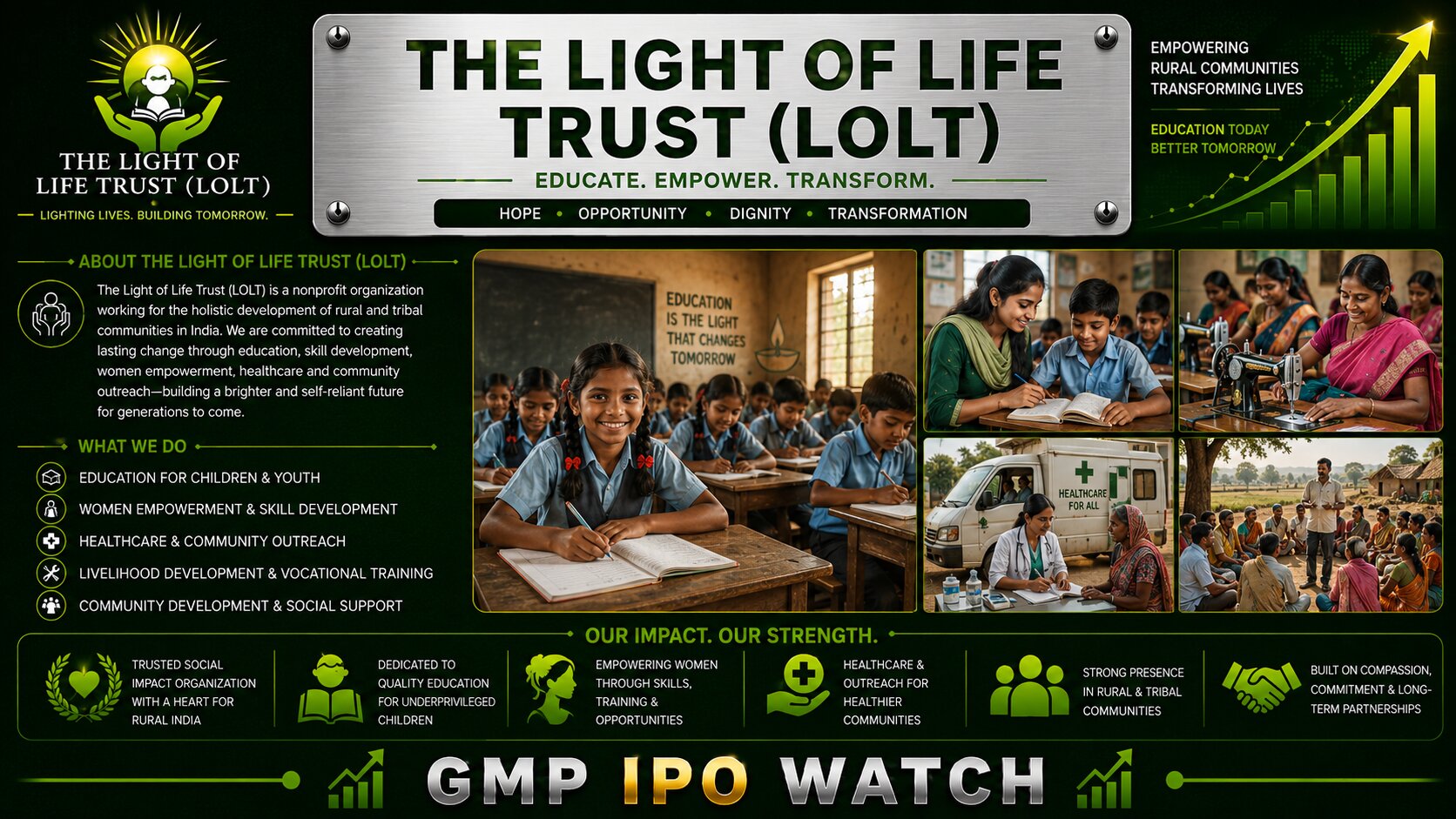
Light of Life Trust Social Stock Exchange Issue 2026 – Investing for Impact, Not Financial Returns
Most public-market issues begin with one question:
How much return can investors make?
The Light of Life Trust (LOLT) issue begins with a completely different question:
How much social change can the contributed capital create?
Light of Life Trust has launched a public issue of Zero Coupon Zero Principal (ZCZP) instruments through the BSE Social Stock Exchange (SSE).
The organisation plans to raise approximately ₹1.27 crore, with the funds intended to support the complete education sponsorship of 420 underserved children in Bihar and Jharkhand over a 24-month period.
The issue opened on August 10, 2026 and is scheduled to close on August 21, 2026.
Unlike shares or conventional bonds, these instruments do not provide investors with interest, dividends or repayment of principal.
The "return" is the measurable social impact created by the capital.
That makes this issue fundamentally different from every conventional IPO.
Light of Life Trust ZCZP Issue Details
| Particular | Details |
|---|---|
| Organisation | Light of Life Trust |
| Platform | BSE Social Stock Exchange |
| Instrument | Zero Coupon Zero Principal |
| Issue Size | ₹1.27 Crore |
| Face Value | ₹1,000 per instrument |
| Minimum Application | ₹1,000 |
| Minimum Instruments | 1 ZCZP |
| Issue Opens | August 10, 2026 |
| Issue Closes | August 21, 2026 |
| Expected Listing | September 2026 |
| Programme Duration | 24 Months |
| Target Beneficiaries | 420 Students |
| Programme Geography | Bihar & Jharkhand |
| BSE SSE Registration | BSESSENPO0042 |
The issue allows eligible participants to contribute from as little as ₹1,000.
This Is Not a Normal IPO
The distinction is extremely important.
In a normal IPO:
Investor pays money → receives shares → becomes shareholder → may earn dividends or capital appreciation.
In this issue:
Contributor pays money → receives ZCZP instrument → funds social programme → receives no financial return or principal repayment.
There is:
- No equity ownership
- No dividend
- No interest
- No principal repayment
- No conventional investment return
The purpose is social impact.
Therefore, this issue should not be analysed using conventional metrics such as P/E ratio, EPS, GMP or listing gains.
What Is a Zero Coupon Zero Principal Instrument?
The name explains the structure.
Zero Coupon
There is no periodic interest payment.
Zero Principal
The amount contributed is not repaid like a conventional bond.
This makes ZCZP instruments fundamentally different from normal debt securities.
The money effectively supports the social programme described in the fundraising documents.
For contributors, the expected outcome is measurable social impact rather than financial profit.
Why Does the Social Stock Exchange Exist?
India's Social Stock Exchange was developed to create a more structured connection between capital providers and organisations working on social problems.
Non-profit organisations traditionally raise money through:
- Donations
- CSR funding
- Grants
- Philanthropic contributions
- Fundraising events
The Social Stock Exchange introduces a regulated market framework through which eligible social enterprises and non-profit organisations can raise funds for clearly defined social objectives.
This can potentially improve:
- Transparency
- Accountability
- Impact reporting
- Donor confidence
- Access to capital
Light of Life Trust is registered as an NPO on the BSE Social Stock Exchange.
Where Will the ₹1.27 Crore Be Used?
The proposed issue is connected to an education programme for 420 underserved children.
The programme will operate across:
Bihar and Jharkhand
for approximately:
24 months.
Instead of raising unrestricted funds for general organisational expenses, the issue connects capital with a defined beneficiary group and social objective.
That makes impact measurement particularly important.
Understanding the Cost Per Beneficiary
The issue aims to raise:
₹1.27 crore
for:
420 students.
On a simple mathematical basis, this represents approximately:
₹30,238 per student
across the overall programme.
Because the programme duration is 24 months, that works out to approximately:
₹15,119 per student per year
before considering the precise allocation of programme and implementation costs.
This simple calculation helps contributors understand the approximate scale of funding being deployed for each beneficiary.
Why Education Sponsorship Matters
For children from financially vulnerable rural families, dropping out of school can create consequences lasting far beyond one academic year.
A child leaving school early may experience:
- Lower employability
- Lower lifetime income
- Greater financial vulnerability
- Early entry into informal labour
- Limited access to higher education
The problem can eventually repeat across generations.
This is why Light of Life Trust's mission focuses on breaking the generational cycle of poverty.
Education becomes the starting point rather than the final objective.
Who Are the 420 Beneficiaries?
The fundraising programme specifically targets underserved children in Bihar and Jharkhand.
These states contain large rural populations where children from economically weaker communities can face challenges involving:
- Household income
- School continuity
- Learning resources
- Academic support
- Career guidance
- Access to opportunities
The programme is designed to provide structured educational support rather than only one-time financial assistance.
Light of Life Trust's Education Philosophy
LOLT's broader model is built around holistic development.
Its education programmes don't focus only on whether a child attends school.
The organisation's approach includes helping beneficiaries become:
Educated → Empowered → Equipped for Employability
This is important because simply completing secondary school does not automatically break poverty.
Students also need confidence, skills, career awareness and pathways toward higher education or employment.
The Organisation Has Been Working for More Than Two Decades
Light of Life Trust traces its origins to 2002, when it was established under the leadership of founder Villy Doctor.
Its work has focused particularly on underprivileged rural communities.
Over the years, its activities have expanded across areas including:
- Secondary education
- Higher education
- Livelihood development
- Skill training
- Healthcare
- Environment conservation
- Performing arts
This means the Social Stock Exchange programme is not the organisation's first education initiative.
It builds on a much longer operating history.
Scale of Light of Life Trust's Existing Impact
According to the organisation's latest published impact information, its programmes have collectively transformed more than:
7.27 lakh lives
across approximately:
1,764 villages.
The organisation reports more than:
- 2.35 lakh secondary-education beneficiaries
- 2.18 lakh skilling and livelihood beneficiaries
- 2.08 lakh primary-healthcare beneficiaries
- 65,000+ environment-conservation beneficiaries
It has also established approximately 72 centres.
These numbers provide context for the organisation's experience in implementing community programmes.
Anando – Education as Long-Term Intervention
One of Light of Life Trust's major initiatives is Anando.
The programme focuses on children who may be vulnerable to dropping out of secondary education.
Instead of treating dropout risk purely as an academic problem, the intervention considers broader factors affecting children.
These can include:
- Family circumstances
- Financial challenges
- Motivation
- Academic difficulties
- Social pressures
Supporting a child through these barriers can improve the likelihood of completing secondary education.
Anando Plus – What Happens After School?
Keeping a child in secondary school solves only part of the problem.
Students then need pathways toward:
- Higher education
- Professional courses
- Vocational training
- Employment
Light of Life Trust's Anando Plus programme supports beneficiaries beyond secondary education.
The organisation reports that thousands of its female beneficiaries are currently pursuing higher education.
That matters because the long-term success of an education intervention should ultimately be judged by what beneficiaries are able to do afterward.
Education Can Affect Social Outcomes Beyond Employment
LOLT's reported impact data also points to broader social changes.
For example, the organisation reports a higher average marriage age among female beneficiaries compared with the age observed in communities before intervention.
Education can influence:
- Employment
- Financial independence
- Decision-making
- Marriage age
- Health awareness
- Family outcomes
This demonstrates why social-impact measurement often needs to extend beyond examination results.
Employability Is the Next Step
The organisation also operates livelihood and skill-development programmes.
Training can help rural youth and women develop capabilities relevant to employment and self-employment.
The broader impact pathway can therefore be understood as:
Education → Skills → Employment → Income → Financial Independence
This is more meaningful than measuring success purely by the number of students enrolled.
Why the 24-Month Programme Period Matters
The ZCZP-funded education project is expected to run for 24 months.
Longer-duration interventions can provide greater continuity than short-term assistance.
Education outcomes often require sustained support.
A student may need:
- Academic assistance
- Learning materials
- Mentorship
- Counselling
- Career guidance
over multiple academic periods.
The two-year programme therefore provides time for more structured intervention and outcome measurement.
What Does a ₹1,000 Contribution Mean?
The minimum application amount is only ₹1,000.
That lowers the financial entry barrier for individuals who want to participate.
Unlike conventional philanthropy where donors may have limited visibility into programme structure, the Social Stock Exchange framework is designed around formal fundraising and impact disclosures.
However, contributors must remember:
₹1,000 invested does not become ₹1,100 or ₹1,500 later.
There is no financial return.
The contribution is intended to generate social impact.
Who Can Participate?
The issue framework provides participation routes for eligible categories including:
- Resident individual investors
- High-net-worth individuals
- Corporates
- Eligible CSR contributors
- Foundations
- Trusts
- Registered societies
- Partnership firms
- LLPs
- Certain financial institutions
- Eligible investment funds
Retail resident individuals can apply through the permitted application mechanism, subject to the governing issue conditions.
CSR Funding Can Be Particularly Relevant
For companies, Social Stock Exchange instruments may provide a structured mechanism for supporting eligible social programmes through CSR expenditure, subject to applicable rules and eligibility.
This creates an interesting bridge between:
Corporate capital + regulated fundraising + measurable social outcomes.
Large companies often want clearer visibility into how CSR funds are deployed.
A programme-specific Social Stock Exchange issue can potentially improve that transparency.
Tax Benefit
Light of Life Trust states that contributions to the issue are 80G eligible, subject to applicable tax provisions and investor eligibility.
For eligible contributors, this may provide a tax deduction under the relevant income-tax rules.
However, tax treatment can depend on the contributor's circumstances, so participants should independently verify their eligibility.
There Is No GMP to Analyse
A normal IPO article might discuss:
- Grey Market Premium
- Expected listing price
- Listing gain
- Subscription return
Those concepts do not apply in the conventional sense here.
A ZCZP issue is designed around social contribution rather than financial return.
Therefore, trying to calculate an expected listing profit would misunderstand the purpose of the instrument.
There Is No P/E Ratio Either
Similarly, investors shouldn't ask:
What is LOLT's EPS?
or
What is its P/E multiple?
Light of Life Trust is a non-profit organisation.
The appropriate analytical framework is completely different.
Instead, contributors should ask:
- What social problem is being addressed?
- How will funds be deployed?
- How many beneficiaries will be reached?
- What outcomes will be measured?
- Does the organisation have implementation experience?
- How transparent is reporting?
These are the equivalent of fundamental-analysis questions for a social-impact issue.
What Contributors Should Evaluate
Programme Clarity
The fundraising objective should be clearly defined.
In this case, the issue targets education support for 420 children.
Cost Efficiency
Contributors should understand how much funding is required per beneficiary.
Organisation Experience
A long implementation history can reduce execution uncertainty.
Measurement
Social outcomes should be tracked rather than only money spent.
Transparency
Financial and impact reports should be available.
Governance
Strong governance is particularly important when capital is contributed without financial repayment.
Transparency Is a Major Part of the SSE Model
Light of Life Trust makes multiple organisational documents available for review, including:
- Draft fundraising documentation
- Annual reports
- Audited financial statements
- Impact reports
- FCRA documents
- Legal registrations
- 80G certification
- Governance documents
- Strategic plans
For a social-impact contributor, access to these documents can help evaluate whether the organisation has adequate governance and reporting practices.
How Should Success Be Measured?
The easiest metric would be:
420 students supported.
But that alone isn't enough.
A stronger impact assessment should examine outcomes such as:
- School attendance
- Dropout reduction
- Academic progression
- Secondary-school completion
- Higher-education participation
- Skills development
- Employment readiness
The ultimate question is whether the intervention changes the beneficiary's long-term life trajectory.
Risks Are Different From a Normal IPO
There is no share-price risk in the conventional investment sense because the contributor isn't seeking financial appreciation.
But execution risks still exist.
Programme Execution Risk
The organisation must successfully deliver support across Bihar and Jharkhand.
Beneficiary Retention
Students may still discontinue education because of family or economic circumstances.
Impact Measurement
Social outcomes can be difficult to quantify.
Funding Efficiency
Capital must be deployed effectively.
Geographic Challenges
Working across underserved regions can create operational complexity.
Long-Term Sustainability
Educational progress must continue beyond the 24-month programme.
These are social-impact risks rather than market-price risks.
Why This Issue Is Important Beyond ₹1.27 Crore
The issue itself is relatively small compared with conventional corporate IPOs.
But the model represents something much larger.
India has thousands of non-profit organisations working across:
- Education
- Healthcare
- Poverty reduction
- Livelihood
- Environment
- Disability
- Rural development
If Social Stock Exchange fundraising becomes more widely adopted, organisations could gain another structured route to capital.
That could potentially bring greater transparency and measurable outcomes to social funding.
Light of Life Trust Issue vs Normal IPO
| Factor | Normal Equity IPO | LOLT ZCZP Issue |
| Purpose | Raise Corporate Capital | Fund Social Programme |
| Investor Receives | Equity Shares | ZCZP Instrument |
| Ownership | Yes | No |
| Interest | No | No |
| Dividend Potential | Yes | No |
| Capital Appreciation | Possible | Not the Objective |
| Principal Repayment | Not Applicable | No |
| Main Return | Financial | Social Impact |
| Key Metric | Profit / EPS / ROE | Beneficiary Outcomes |
| GMP Relevant | Yes, unofficially | No |
Understanding this distinction is essential before participating.
Who Might Consider the Issue?
The Light of Life Trust ZCZP issue may be relevant for:
- Individuals interested in philanthropy
- Social-impact contributors
- CSR-focused companies
- Foundations
- Family offices
- HNIs supporting education
- Institutions seeking measurable social outcomes
It is not designed for someone whose primary objective is earning a financial return.
Final View on Light of Life Trust ZCZP Issue 2026
The Light of Life Trust Social Stock Exchange issue represents a fundamentally different type of public fundraising.
The organisation is seeking ₹1.27 crore through Zero Coupon Zero Principal instruments, with the proceeds intended to support the education of 420 underserved students across Bihar and Jharkhand for 24 months.
The issue opened on August 10, 2026, closes on August 21, 2026, carries a face value of ₹1,000 per instrument, and allows applications starting from one instrument.
But unlike a normal IPO, there is no earnings multiple to debate and no financial listing return to forecast.
The capital is not intended to come back to the contributor.
Instead, the investment thesis is entirely about impact:
Can ₹1.27 crore help 420 vulnerable children remain in education, progress academically and improve their chances of becoming economically independent adults?
Light of Life Trust brings more than two decades of social-sector experience to that objective. Its broader programmes have already reached hundreds of thousands of beneficiaries across education, livelihood development, healthcare and environmental initiatives.
For prospective contributors, the most important factors are therefore not GMP, EPS or P/E.
They are programme execution, governance, transparency, cost per beneficiary and measurable educational outcomes.
Overall, the Light of Life Trust ZCZP Issue 2026 offers a regulated Social Stock Exchange route for individuals and institutions seeking measurable social impact through education, rather than financial investment returns.