 GMP IPO Watch
LAPL Automotive IPO 2026 – Looking Beyond the Headline Numbers
For an automotive component manufacturer, winning new customers is only one part of the growth story. The company must also have sufficient machines, tooling capabilities, production space, quality systems and working capital to convert customer programmes into actual revenue.
That makes the proposed expansion of LAPL Automotive Limited one of the most important aspects of its IPO story.
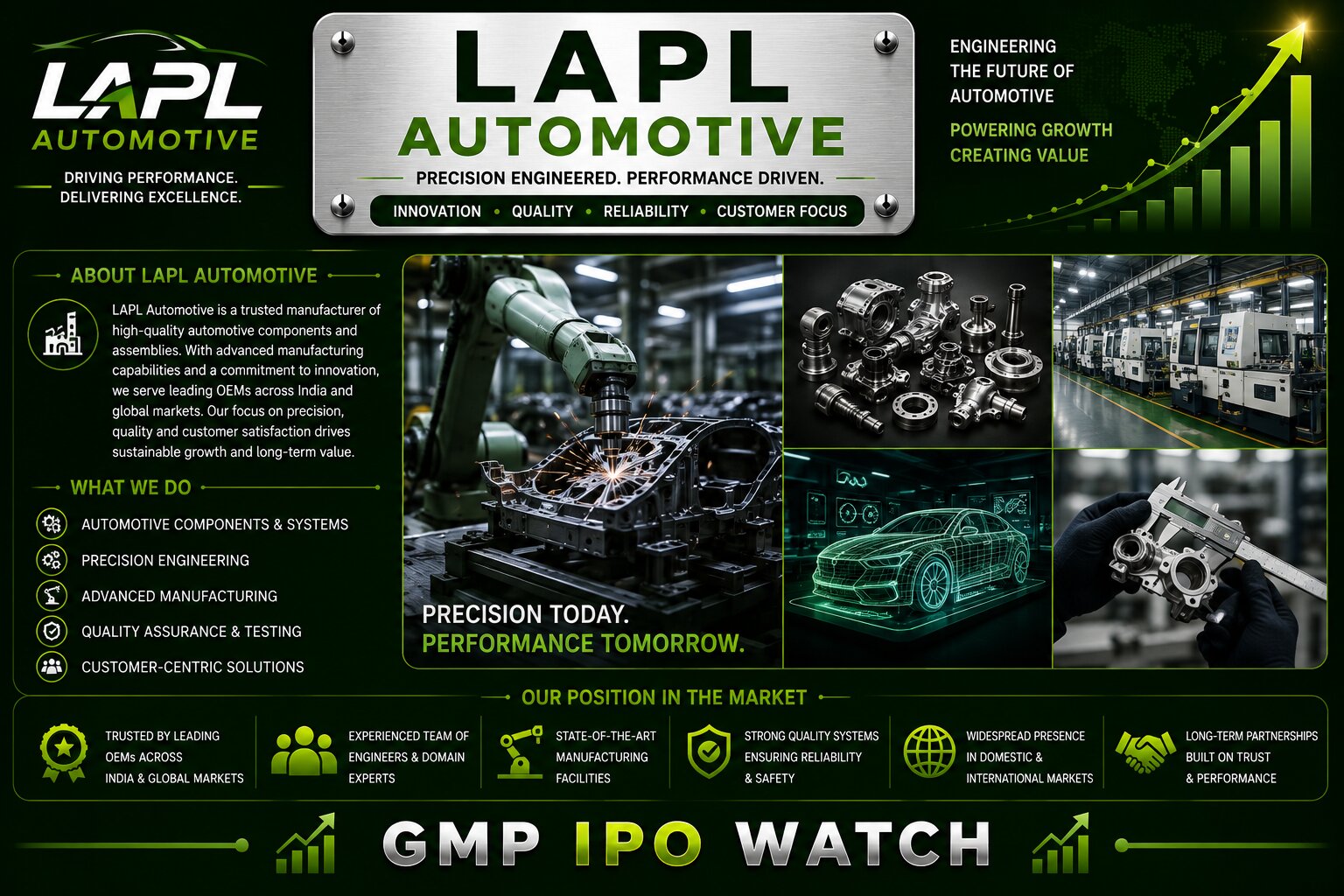
LAPL Automotive is an Aurangabad-based automotive component manufacturer that has approached the capital market through a BSE SME IPO. The public issue comprises 36 lakh fresh equity shares at ₹78 per share, aggregating to approximately ₹28.08 crore.
Unlike an IPO containing a large Offer for Sale, LAPL Automotive's issue is a fresh capital raise. This means the money raised is intended for the company rather than primarily providing an exit to existing shareholders.
A major part of the proposed capital is connected with establishing an additional manufacturing facility at AURIC City, Aurangabad, Maharashtra.
For investors, the central question is therefore not simply whether India's automobile market will grow. The more important question is whether LAPL Automotive can use its new manufacturing capacity to win larger orders while maintaining margins and returns on capital.
LAPL Automotive IPO at a Glance
| Particular | Details |
|---|---|
| Company | LAPL Automotive Limited |
| IPO Platform | BSE SME |
| Issue Type | Fixed Price Issue |
| Issue Price | ₹78 per share |
| Face Value | ₹10 per share |
| Fresh Issue | 36,00,000 shares |
| Approx. Issue Size | ₹28.08 crore |
| Offer for Sale | Nil |
| Merchant Banker | GYR Capital Advisors Private Limited |
| Registrar | Maashitla Securities Private Limited |
| Industry | Automotive Components |
| Registered Location | Aurangabad, Maharashtra |
The IPO is therefore relatively straightforward from a structure perspective: the company is issuing new shares to raise growth capital.
What Does LAPL Automotive Actually Do?
LAPL Automotive operates in the automotive component manufacturing ecosystem.
Its business involves producing components and assemblies required by vehicle manufacturers and other automotive customers.
The company's manufacturing capabilities are associated with areas such as:
- Automotive lighting components
- Plastic moulded parts
- Vehicle component assemblies
- Injection-moulded components
- Automotive accessories
- Customer-specific components
The business is primarily B2B rather than consumer-facing.
That means LAPL's growth depends considerably on relationships with vehicle manufacturers, Tier-1 suppliers and other automotive customers.
Why Automotive Component Suppliers Can Build Sticky Relationships
Automotive manufacturers cannot casually change suppliers for critical components.
Before approving a component, an OEM may evaluate:
- Product design
- Material specifications
- Manufacturing process
- Dimensional accuracy
- Durability
- Quality controls
- Production capacity
- Delivery capability
- Cost competitiveness
Once a supplier successfully completes these processes, the relationship can continue throughout the lifecycle of a vehicle model.
That creates an important advantage.
A successful customer programme may produce repeat orders for several years instead of generating only a one-time sale.
However, this relationship works both ways.
If one major customer contributes a large percentage of revenue, losing that customer or a particular vehicle programme can significantly affect the supplier.
The AURIC City Expansion Is Central to the IPO Story
One of the most important proposed uses of IPO proceeds is funding an additional manufacturing unit at AURIC City in Aurangabad, Maharashtra.
The company has indicated approximately ₹19.56 crore toward this capital expenditure.
This represents a substantial portion of the overall IPO proceeds.
The proposed facility matters because additional capacity could allow LAPL Automotive to:
- Handle larger orders
- Add manufacturing equipment
- Develop new components
- Improve production efficiency
- Serve additional customers
- Reduce capacity constraints
- Participate in new vehicle programmes
The expansion therefore has the potential to become the next stage of the company's growth.
But new capacity creates value only when utilisation increases.
An underutilised plant can instead increase depreciation, employee expenses and fixed operating costs.
Capacity Utilisation Will Be an Important Post-IPO Metric
Investors should closely follow the utilisation of the new manufacturing facility after commissioning.
Suppose a company doubles manufacturing capacity but revenue grows only 20%.
The new facility may initially reduce returns because the company must absorb:
- Depreciation
- Maintenance
- Factory overheads
- Electricity
- Salaries
- Insurance
Conversely, if customer orders fill the new capacity quickly, operating leverage may improve profitability.
For LAPL Automotive, future capacity utilisation may therefore be more important than simply announcing completion of the new plant.
Tooling Is an Important Part of Automotive Manufacturing
Automotive plastic and lighting components often require customised moulds and tools.
When an OEM launches a new component design, the manufacturer may need to develop a specific mould.
This process involves:
- Customer design specifications
- Engineering development
- Prototype creation
- Tool design
- Mould manufacturing
- Trial production
- Customer validation
- Commercial production
Tooling requires both engineering knowledge and capital.
Once approved, however, the same tooling can support large-volume production over the life of the programme.
This makes successful new product development particularly valuable.
Why the Automotive Lighting Market Is Changing
Vehicle lighting has evolved significantly.
Older vehicles depended heavily on traditional halogen systems.
Newer vehicles increasingly use:
- LED lighting
- Daytime running lamps
- Projector systems
- Signature tail lamps
- Sequential indicators
- Decorative lighting
- Integrated electronic controls
Lighting is also becoming part of vehicle design and brand identity.
Automakers therefore increasingly want suppliers that can combine functionality with styling.
For manufacturers such as LAPL Automotive, this creates an opportunity—but it also requires continuous investment in technology and product development.
Electric Vehicles Can Change Component Demand
Electric vehicles do not eliminate the need for lighting and plastic automotive components.
In many cases, EV manufacturers place even greater emphasis on:
- Lightweight components
- Modern exterior design
- LED lighting
- Energy efficiency
- Aerodynamics
- Premium interiors
The growth of electric mobility therefore creates an additional addressable market for component manufacturers.
However, LAPL's ability to benefit will depend on winning actual EV-related programmes rather than simply participating in the broader automotive sector.
LAPL Automotive Financial Performance
Recent IPO-related financial disclosures show a meaningful improvement in the company's operating scale.
For FY2026, annualised figures indicated approximately:
| Financial Metric | FY2026 |
| Revenue | ₹82.35 crore |
| EBITDA | ₹14.00 crore |
| Profit After Tax | ₹7.52 crore |
| EBITDA Margin | 17.00% |
| PAT Margin | 9.13% |
| Net Worth | ₹22.27 crore |
The reported numbers indicate that LAPL has moved beyond being only a small-scale component operation and is generating meaningful profitability from its existing manufacturing base.
What a 17% EBITDA Margin Tells Investors
An EBITDA margin of around 17% deserves attention in an automotive component business.
Margins can be influenced by:
- Product mix
- Customer pricing
- Raw-material costs
- Capacity utilisation
- Employee productivity
- Tooling income
- Manufacturing efficiency
The key question is whether the FY2026 margin represents a sustainable operating level.
Investors should monitor whether margins remain stable as the company moves into its next expansion phase.
Revenue Growth Alone Is Not Enough
Suppose LAPL's revenue increases from ₹82 crore to ₹120 crore after capacity expansion.
That looks attractive.
But investors should also determine how much additional capital was required to generate that revenue.
A better analysis should consider:
Revenue growth + profit growth + operating cash flow + return on capital.
If revenue grows rapidly while receivables and inventory rise even faster, the business may require continuous external funding.
For manufacturing companies, cash conversion is therefore critical.
Working Capital Can Become a Hidden Challenge
Automotive suppliers generally manufacture products before receiving customer payments.
This means money becomes temporarily locked in:
- Raw materials
- Work-in-progress
- Finished inventory
- Trade receivables
At the same time, suppliers must continue paying:
- Employees
- Vendors
- Electricity bills
- Transportation costs
- Factory expenses
Rapid growth can therefore increase working-capital requirements even when the company is profitable.
Investors should track whether LAPL can finance future growth primarily through internal cash generation.
Raw Material Prices Can Influence Margins
Automotive components may use materials including:
- Engineering plastics
- Polycarbonate
- ABS
- Metals
- Electronic components
- LEDs
- Wiring
- Packaging materials
Prices of these materials can fluctuate.
The company's ability to pass increases to customers depends on contractual arrangements.
If input costs rise quickly while selling prices remain fixed, margins can decline.
Customer Concentration Deserves Attention
A relatively small automotive supplier may generate a meaningful portion of revenue from a limited number of customers.
This can be positive when customers provide predictable repeat orders.
But concentration also creates risk.
Revenue could be affected if a major customer:
- Reduces production
- Changes suppliers
- Discontinues a model
- Negotiates lower prices
- Delays payments
- Moves production elsewhere
Investors should therefore study the revenue contribution from LAPL's largest customers instead of looking only at the total customer count.
Why Location Matters
LAPL Automotive's existing operations are based in Aurangabad, Maharashtra, an established industrial and automotive manufacturing region.
The planned AURIC City expansion could offer access to:
- Industrial infrastructure
- Transport connectivity
- Skilled manpower
- Automotive suppliers
- Manufacturing customers
A strategically located manufacturing facility can reduce logistics complexity and improve responsiveness to customers.
Fresh Issue vs Offer for Sale
LAPL Automotive's IPO is particularly interesting because it is a fresh issue rather than an OFS-led offering.
The company is issuing 36 lakh new shares.
From an investor's perspective, fresh capital can be constructive when it is deployed productively.
In this case, a significant portion is intended for manufacturing expansion.
The long-term outcome will depend on whether the additional plant and machinery generate sufficient incremental earnings.
What Could Drive LAPL Automotive's Next Growth Phase?
Several factors could support expansion.
New OEM Programmes
Winning components for newly launched vehicle models can generate multi-year orders.
Higher Production Capacity
The proposed AURIC City facility may remove existing manufacturing constraints.
LED Lighting Adoption
Premium and energy-efficient lighting systems continue gaining share.
Electric Vehicles
New EV platforms create opportunities for automotive component suppliers.
Product Diversification
Adding more plastic and lighting components can increase revenue per customer.
Customer Diversification
Adding OEM and Tier-1 customers would reduce concentration risk.
Competitive Strengths
LAPL Automotive's investment case includes several positive factors:
- More than two decades of operating history
- Existing automotive manufacturing experience
- Established production base in Aurangabad
- Growing revenue and profitability
- Automotive component specialisation
- Fresh IPO funding for expansion
- Proposed additional manufacturing capacity
- Exposure to India's vehicle production growth
The combination of an established business and capacity expansion differentiates the company from an early-stage manufacturer raising capital before developing commercial operations.
Key Risks Investors Should Understand
SME Scale
LAPL remains significantly smaller than major listed automotive component companies.
Customer Dependence
Large customers can have significant negotiating power.
Expansion Execution
The new plant must be commissioned on time and within budget.
Utilisation Risk
New capacity may remain underutilised if orders grow slower than expected.
Raw-Material Volatility
Plastic, electronic and other input costs may affect margins.
Automotive Cyclicality
Vehicle demand can decline during economic slowdowns.
Technology Risk
Lighting and automotive component technologies continue changing rapidly.
Working-Capital Requirements
Faster revenue growth may require additional inventory and receivable funding.
SME Market Liquidity
Shares listed on the BSE SME platform can experience lower liquidity and greater volatility than established mainboard companies.
Questions Investors Should Ask Before Investing
Rather than relying only on IPO demand or grey-market activity, investors should ask:
- How quickly will the AURIC City plant become operational?
- What additional revenue can the new facility support?
- Are customer orders already available for the additional capacity?
- How concentrated is revenue among the largest customers?
- Can the company maintain its FY2026 EBITDA margin?
- How much working capital will expansion require?
- Is operating cash flow keeping pace with PAT?
- What percentage of sales comes from newer-generation products?
- Can LAPL win business from additional OEMs?
- What return can the company generate on the ₹19.56 crore expansion investment?
These questions provide a much clearer picture of the investment case than short-term market sentiment.
LAPL Automotive's Long-Term Opportunity
India's automotive component industry continues to benefit from localisation.
Automakers increasingly source components domestically to:
- Reduce import dependence
- Shorten supply chains
- Control costs
- Improve delivery reliability
At the same time, vehicle manufacturers are introducing more technologically sophisticated models.
That combination creates opportunities for smaller specialised suppliers capable of meeting OEM quality requirements.
LAPL Automotive's future growth will depend on converting this industry opportunity into actual customer programmes.
Who May Find the IPO Interesting?
The IPO may attract investors looking for exposure to:
- Small-cap manufacturing
- Automotive components
- Capacity-expansion stories
- India's domestic manufacturing growth
- Automotive technology upgrades
However, investors should recognise that SME companies generally carry higher business and liquidity risk than larger established listed companies.
Final View on LAPL Automotive IPO
The LAPL Automotive IPO 2026 is fundamentally an expansion story.
The company is raising approximately ₹28.08 crore at ₹78 per share, with a substantial portion of the fresh capital intended to establish an additional manufacturing unit at AURIC City, Aurangabad.
Its FY2026 annualised financials—approximately ₹82.35 crore revenue, ₹14 crore EBITDA and ₹7.52 crore PAT—provide a base from which management plans to expand.
The investment case will ultimately depend on what happens after the IPO.
If LAPL successfully commissions the new plant, wins additional OEM programmes, maintains margins and improves revenue without disproportionately increasing working capital, the expansion could create meaningful operating leverage.
On the other hand, slower order growth, customer concentration, underutilised capacity or margin pressure could reduce returns from the new investment.
Therefore, LAPL Automotive can be viewed as a growth-oriented SME automotive manufacturing IPO where the quality of post-IPO capacity utilisation and customer acquisition will be more important than short-term listing sentiment.
For long-term investors, the most important numbers to track after listing will be revenue from the new facility, EBITDA margin, operating cash flow, customer concentration and return on capital employed.