 GMP IPO Watch
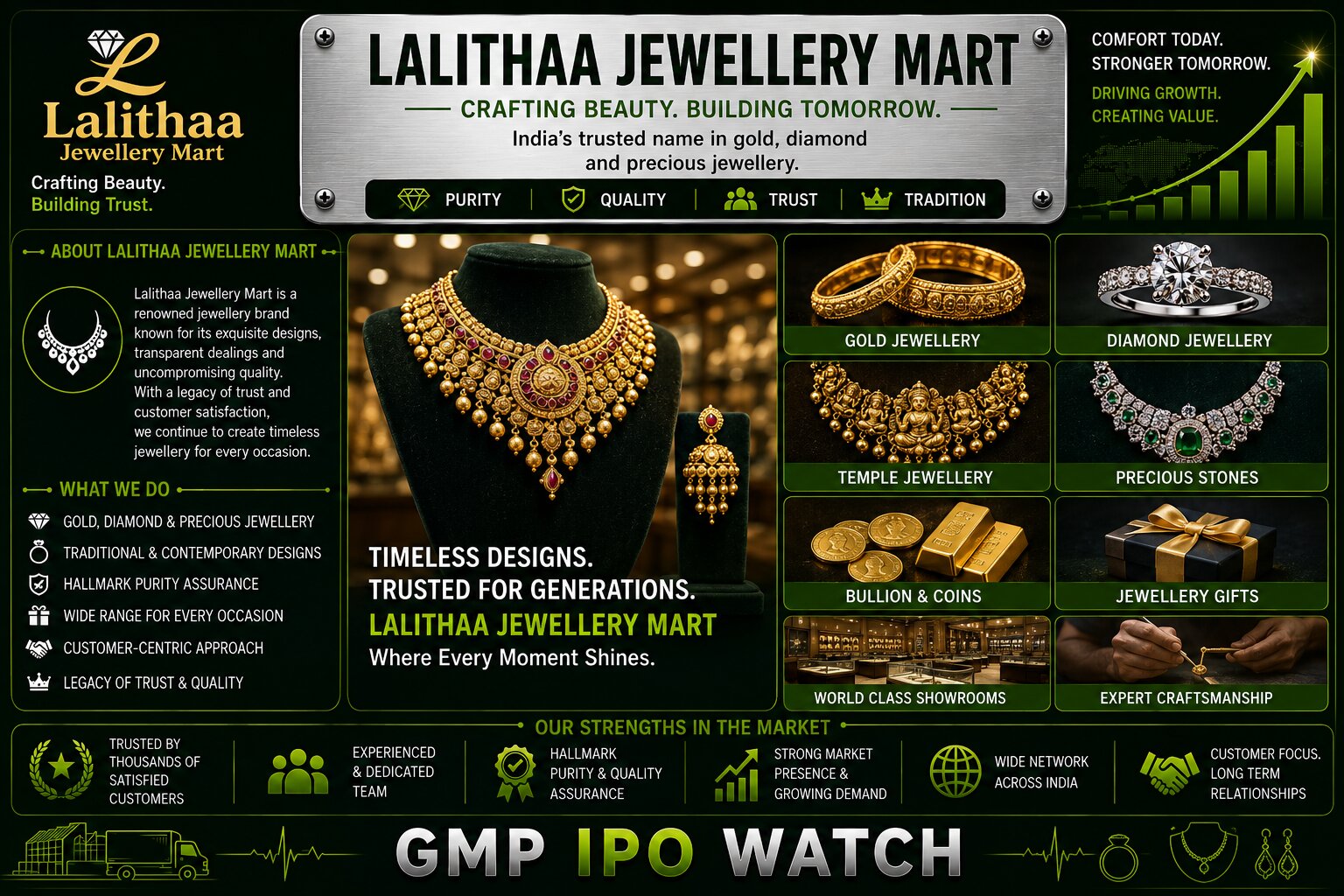
Lalithaa Jewellery Mart IPO 2026 – Why Jewellery Retail Is Really an Inventory and Store-Productivity Business
Jewellery retail looks simple from the customer's side.
A customer enters a showroom, compares designs, checks the gold rate, pays the making charges and leaves with jewellery.
For the retailer, however, the economics are much more complex.
A large jewellery showroom may need crores of rupees worth of inventory sitting inside the store before the first customer arrives.
That capital is tied up in:
- Gold jewellery
- Diamond jewellery
- Silver products
- Precious stones
- Bridal collections
- Daily-wear designs
This makes jewellery retail fundamentally a working-capital and inventory-turnover business.
That is particularly important when analysing Lalithaa Jewellery Mart Limited.
The Chennai-headquartered jewellery retailer is preparing to launch its ₹1,700 crore mainboard IPO on August 17, 2026. The offer consists of a ₹1,200 crore fresh issue and a ₹500 crore Offer for Sale, with a price band of ₹190 to ₹201 per equity share.
The most important use of the fresh issue is not simply advertising or debt repayment.
Lalithaa plans to deploy around ₹998.68 crore toward inventory for new stores and approximately ₹34.55 crore toward capital expenditure for those stores.
That gives investors a very clear growth equation:
more stores + more jewellery inventory + higher store productivity = potential revenue growth.
The real challenge is making sure all that new inventory generates adequate sales and returns.
Lalithaa Jewellery Mart IPO Details
| Particular | Details |
|---|---|
| Company | Lalithaa Jewellery Mart Limited |
| IPO Type | Mainboard Book Built IPO |
| Total Issue Size | ₹1,700 Crore |
| Fresh Issue | ₹1,200 Crore |
| Offer for Sale | ₹500 Crore |
| Price Band | ₹190 – ₹201 Per Share |
| Face Value | ₹5 Per Share |
| Lot Size | 74 Shares |
| Minimum Retail Investment | ₹14,874 at ₹201 |
| IPO Opening Date | August 17, 2026 |
| IPO Closing Date | August 19, 2026 |
| Expected Allotment | August 20, 2026 |
| Expected Listing | August 24, 2026 |
| Listing | BSE & NSE |
| Registrar | MUFG Intime India Pvt. Ltd. |
| Lead Managers | Anand Rathi Advisors and Equirus Capital |
These issue terms are reflected in current exchange-market and broker IPO data.
About Lalithaa Jewellery Mart
Lalithaa Jewellery Mart is a Chennai-based jewellery retailer with a long operating history in South India.
The company's product categories include:
- Gold jewellery
- Diamond jewellery
- Silver jewellery
- Platinum jewellery
- Precious and semi-precious stone jewellery
- Bridal jewellery
- Everyday jewellery
Its business has historically been built around a value-oriented jewellery proposition and large-format retail presence in southern markets.
Jewellery Retail Is Not Just About Gold Prices
It is easy to assume jewellery retailers automatically benefit when gold prices rise.
The reality is more complicated.
Suppose gold increases from ₹70,000 to ₹90,000 per 10 grams.
The value of the retailer's inventory rises.
But the jewellery also becomes more expensive for customers.
That may reduce:
- Purchase volume
- Average weight purchased
- Impulse buying
Customers may shift from:
- 30-gram jewellery
to:
- 20-gram jewellery
to keep the total bill within budget.
So rising gold prices can increase reported revenue without necessarily producing proportional growth in physical volumes or profit.
Store Productivity Matters More Than Store Count
Opening additional stores sounds attractive.
But more stores do not automatically create shareholder value.
Consider two jewellery chains.
Chain A
50 stores generating ₹200 crore of sales each.
Chain B
100 stores generating ₹70 crore each.
The smaller network may be economically stronger.
For Lalithaa Jewellery Mart, investors should therefore focus not only on the number of stores but on:
revenue per store + inventory per store + profit per store.
A recent IPO analysis indicates revenue per store improved meaningfully between FY2024 and FY2026, highlighting stronger store productivity alongside business growth.
The IPO Will Fund 12 New Stores
One of the central objectives of the IPO is the establishment of 12 new jewellery stores.
The company plans to deploy a substantial portion of fresh proceeds toward these outlets. Earlier offer documents identified roughly ₹1,014.50 crore toward the new-store expansion programme, while the final allocation separates most of this between store inventory and capex.
This makes the IPO primarily an expansion issue.
The company is effectively raising equity capital to accelerate its retail footprint.
Why Jewellery Stores Need So Much Inventory Capital
Imagine opening a large jewellery showroom.
Customers expect to see:
- Hundreds of necklace designs
- Multiple bridal collections
- Bangles
- Rings
- Chains
- Earrings
- Diamond jewellery
- Silver products
A showroom cannot simply display ten items and manufacture the rest after customers order.
Jewellery buying is highly visual.
Customers want to:
- See products
- Compare designs
- Try jewellery
- Buy immediately
That means inventory must already be available.
This explains why almost ₹999 crore of IPO proceeds is planned for inventory rather than only store construction.
Inventory Turns Are Critical
Suppose Lalithaa invests ₹100 crore in jewellery inventory.
Scenario A
That inventory generates ₹300 crore of annual sales.
Scenario B
It generates ₹120 crore.
Scenario A produces significantly better capital efficiency.
The key metric is therefore not simply:
How much jewellery does Lalithaa own?
It is:
How much revenue can Lalithaa generate from each rupee invested in inventory?
This becomes especially important after the IPO because the company is making a very large additional inventory investment.
Large Showrooms Can Become Local Destination Stores
Jewellery buying often involves families travelling specifically to a trusted showroom.
Large-format stores can offer:
- More designs
- Wider price ranges
- Better availability
- Bridal collections
- Multiple jewellery categories
That can create a destination-shopping effect.
If successful, larger stores may attract customers from beyond the immediate neighbourhood.
But large showrooms also have higher:
- Rent
- Employees
- Security costs
- Inventory requirements
That makes location selection extremely important.
Location Selection Will Determine Expansion Returns
The new stores must be opened in markets capable of supporting substantial jewellery sales.
A new showroom needs:
- Customer purchasing power
- Brand recognition
- Wedding demand
- Suitable catchment population
- Reliable security infrastructure
A poorly located jewellery store can trap enormous capital in slow-moving inventory.
For Lalithaa, this means the success of the IPO-funded expansion will depend heavily on where the 12 stores are opened and how quickly they mature.
FY2026 Business Scale Is Very Large
Current IPO financial analysis indicates Lalithaa Jewellery Mart's revenue reached approximately ₹25,023.92 crore in FY2026 on the stated annualised/latest reported basis, with PAT around ₹1,009.81 crore.
Earlier DRHP-era disclosures showed FY2024 revenue of approximately ₹16,788 crore and PAT of roughly ₹359.8 crore, demonstrating how large the operating platform had already become before the latest growth phase.
The scale places Lalithaa among India's major jewellery retail businesses.
Profitability Has Improved Significantly
Jewellery retailers often operate on relatively thin margins because gold represents a very large percentage of revenue.
The real profitability comes from:
- Making charges
- Product mix
- Diamond jewellery
- Inventory management
- Operational efficiency
Recent FY2026 KPI data indicates:
- ROE: about 41.6%
- ROCE: about 42.6%
- RoNW: about 39.9%
- PAT margin: about 4.04%.
A roughly 4% net margin may look small compared with some consumer businesses.
For a jewellery retailer generating tens of thousands of crores of revenue, however, small changes in margins can have a substantial effect on PAT.
Why a 1% Margin Change Matters
Suppose annual revenue is ₹25,000 crore.
At a 4% PAT margin:
PAT = ₹1,000 crore
At a 3% margin:
PAT = ₹750 crore
A one-percentage-point change creates approximately ₹250 crore difference in profit.
This illustrates why jewellery investors should watch margins very carefully.
Gold Inventory Creates a Large Balance Sheet
The latest reported FY2026 balance-sheet data shows assets of approximately ₹10,945 crore, with total debt around ₹1,604 crore and net worth around ₹3,033 crore on the reported basis.
A large portion of assets in jewellery retail is naturally linked to:
- Inventory
- Receivables
- Store infrastructure
That means balance-sheet growth can occur rapidly when the company expands.
Debt Needs Context
Jewellery businesses often use borrowings to fund inventory.
That is different from borrowing to cover operating losses.
If inventory turns quickly and generates healthy margins, borrowing can support profitable expansion.
But excessive leverage becomes dangerous when:
- Sales slow
- Gold prices move sharply
- Inventory ages
- Store expansion underperforms
Investors should therefore compare debt with:
- Inventory turnover
- Operating cash flow
- EBITDA
- Interest coverage
rather than looking at debt in isolation.
The Fresh Issue Reduces Reliance on Debt-Funded Expansion
Lalithaa is raising ₹1,200 crore through new shares.
A large portion of that money will fund store inventory.
This is important because the company could theoretically have financed expansion through additional borrowing.
Using equity reduces the need to fund the entire expansion through debt.
That can make the growth strategy more resilient.
The OFS Is ₹500 Crore
The IPO also includes approximately ₹500 crore through an Offer for Sale by promoter M. Kiran Kumar Jain.
This means:
- ₹1,200 crore goes to the company.
- ₹500 crore goes to the selling shareholder.
Around 71% of the issue is therefore fresh capital, while approximately 29% is OFS.
That is a healthier fresh-issue proportion than many recent IPOs dominated by shareholder exits.
South India Is the Core Brand Strength
Lalithaa Jewellery has built strong brand recognition in South India.
Jewellery buying is often highly regional.
Consumer preferences differ across:
- Tamil Nadu
- Andhra Pradesh
- Telangana
- Karnataka
- Kerala
Design preferences, wedding traditions and purchasing behaviour can vary meaningfully.
A retailer with deep regional understanding can have an advantage over a generic national chain.
But Regional Strength Can Also Become Concentration Risk
A company that is dominant in one region may still face risk if expansion outside its strongest markets proves difficult.
National jewellery chains already compete aggressively for:
- Prime retail locations
- Bridal customers
- Digital customers
- Gold savings customers
Lalithaa will need to balance growth with brand consistency.
The company should avoid expanding faster than consumer recognition can support.
Jewellery Savings Schemes Can Strengthen Customer Retention
Lalithaa Jewellery operates jewellery pre-booking and savings-related schemes through dedicated platforms.
These programmes can help:
- Build recurring customer relationships
- Encourage future jewellery purchases
- Improve purchase planning
They can be especially relevant for customers saving toward:
- Weddings
- Festivals
- Major family purchases
However, such schemes require strict compliance and careful management of customer funds.
Wedding Demand Is a Structural Tailwind
India's jewellery industry receives strong demand from weddings.
Wedding jewellery can involve:
- Gold necklaces
- Bangles
- Earrings
- Chains
- Diamond jewellery
This creates large transaction values.
The wedding market also provides a degree of cultural resilience because jewellery purchases may continue even when discretionary fashion spending slows.
However, customers may reduce jewellery weight when gold prices rise sharply.
Organised Jewellery Retail Is Gaining Share
The jewellery industry has historically included thousands of independent local jewellers.
Consumers are gradually shifting toward organised chains because of:
- Hallmarking
- Billing transparency
- Buyback policies
- Brand trust
- Wider designs
Large organised players can benefit from this formalisation trend.
Lalithaa Jewellery is already positioned within this organised market.
Hallmarking and Trust Are Major Competitive Factors
Gold jewellery purchases involve high transaction values.
Customers care about:
- Purity
- Weight
- Making charges
- Buyback terms
A recognised brand can reduce uncertainty.
This creates a trust-based moat that may be more important in jewellery than in many ordinary retail categories.
Diamond Jewellery Could Improve Product Mix
Gold jewellery generates large revenue because of the underlying metal value.
Diamond jewellery can offer different margin characteristics.
If Lalithaa successfully increases the proportion of:
- Diamond jewellery
- Premium designs
- Value-added products
it may improve overall profitability.
However, diamond inventory can also carry higher fashion and design risk than plain gold jewellery.
Competition Is Extremely Strong
Lalithaa operates in a market containing major national and regional players.
Competition includes companies such as:
- Titan's Tanishq
- Kalyan Jewellers
- Senco Gold
- P N Gadgil Jewellers
- Thangamayil Jewellery
- Regional jewellery chains
- Thousands of independent jewellers
Competition affects:
- Making charges
- Advertising
- Store locations
- Employee costs
- Customer acquisition
This means Lalithaa must maintain its value positioning even as the industry becomes more organised.
Making Charges Can Influence Customer Decisions
Two jewellers may sell gold at almost the same underlying market price.
But their final bill can differ because of:
- Making charges
- Wastage
- Design costs
- Stone charges
Lalithaa has historically positioned itself around value and competitive pricing.
That can attract price-conscious consumers.
But very low making charges may also limit margins.
Management therefore needs to balance:
customer value + sustainable profitability.
Advertising Is Important in Jewellery Retail
Jewellery companies invest heavily in advertising because customer trust and brand recall influence purchase decisions.
Advertising becomes even more important when entering a new city.
New stores may require substantial promotional expenditure before reaching mature sales levels.
Investors should therefore expect expansion to bring not only inventory and store capex but also marketing requirements.
New Stores Can Take Time to Mature
A mature store may already have:
- Repeat customers
- Wedding referrals
- Established local reputation
A new store starts without those advantages.
Sales may need several quarters or years to reach mature levels.
That means Lalithaa's expansion should be judged over a multi-year period rather than only the first few quarters after IPO.
Revenue Per Store Will Be a Key Post-IPO Metric
For investors, one of the most useful numbers after listing may be:
Revenue per store.
If total stores increase rapidly but revenue per store falls significantly, expansion quality may be weak.
If the company adds stores while maintaining or increasing revenue per store, that would indicate strong demand execution.
Inventory Days Will Be Equally Important
Lalithaa is allocating close to ₹1,000 crore to inventory.
That makes inventory efficiency critical.
Investors should monitor:
- Inventory days
- Inventory turnover
- Same-store sales
- Gross margin
If new-store inventory sits unsold for too long, returns on equity can decline.
Same-Store Sales Growth Can Reveal Brand Health
Total revenue can increase simply because more stores are added.
Same-store sales growth tells investors whether existing stores are still improving.
For example:
Total sales growth: 25%
but
same-store growth: 2%
would indicate most growth came from adding stores.
By contrast:
same-store growth: 15%
would suggest strong underlying customer demand.
This metric will be particularly important after Lalithaa begins its 12-store expansion.
Gold Price Volatility Can Distort Revenue Comparisons
Suppose gold prices rise 20%.
Even if Lalithaa sells exactly the same grams of gold, reported rupee revenue can increase significantly.
This means investors should ideally examine:
- Volume growth
- Same-store sales
- Transaction count
- Average ticket size
alongside headline revenue.
Otherwise, gold-price inflation can make growth appear stronger than actual customer-volume growth.
Current IPO GMP – August 13
As of the afternoon of August 13, 2026, multiple trackers showed Lalithaa Jewellery Mart grey-market premium around ₹20–₹25 per share. One current tracker reported ₹25, equivalent to roughly 12% above the ₹201 upper band and an unofficial indicated price around ₹226.
The GMP has been volatile.
Reported readings moved from roughly:
- ₹17 on August 11
- ₹41 on August 12
- around ₹20–₹25 on August 13.
This volatility is precisely why GMP should be treated only as an unofficial sentiment indicator.
There Is No Subscription Data Yet
The public issue does not open until August 17.
Therefore, there is no valid retail, NII or QIB subscription data as of August 13. Current platforms correctly show the issue as upcoming.
Subscription should only be analysed after bidding begins.
The most important figure will likely be final QIB demand on August 19.
Valuation Needs to Be Viewed Against Scale
At the ₹201 upper price band, investors should evaluate Lalithaa against other listed jewellery retailers using metrics such as:
- P/E
- EV/EBITDA
- ROE
- ROCE
- PAT margin
- Same-store growth
But comparisons need context.
A jewellery company with:
- Higher margins
- Faster store productivity
- Lower debt
- Better inventory turns
may deserve a higher multiple.
Therefore, valuation should never be interpreted solely through headline revenue scale.
Competitive Strengths
Established South Indian Brand
Lalithaa has decades of jewellery retail experience and strong regional recognition.
Very Large Revenue Base
Latest reported FY2026 revenue exceeds ₹25,000 crore on the stated reported basis.
Strong Return Ratios
FY2026 metrics indicate ROE above 40% and ROCE above 42%.
Mostly Fresh IPO
₹1,200 crore of the ₹1,700 crore offer goes to the company.
Clear Expansion Plan
12 new stores provide a visible route for growth.
Large Inventory Allocation
Nearly ₹999 crore is earmarked for new-store jewellery stock.
Organised Jewellery Tailwind
Formalisation and branded jewellery adoption support long-term industry growth.
Major Risks
Gold Price Volatility
Higher gold prices can reduce jewellery volumes even while reported revenue rises.
Inventory Risk
Almost ₹1,000 crore of IPO capital will be deployed into jewellery stock.
New-Store Execution
Poor location selection can generate weak returns.
Regional Concentration
The company's strongest brand position remains in southern India.
Competition
Large listed and regional jewellery chains compete aggressively.
Thin Net Margins
Even small changes in margins can materially affect PAT.
Debt and Working Capital
Jewellery retail requires large amounts of inventory financing.
Promoter OFS
₹500 crore of the IPO goes to the selling shareholder rather than into the company.
What Could Drive Lalithaa Jewellery's Next Growth Phase?
12 New Stores
This is the most direct near-term growth driver.
Higher Same-Store Sales
Growth from existing locations would improve capital efficiency.
Organised Jewellery Adoption
Consumers continue shifting toward branded retailers.
Diamond Jewellery
Higher-value product mix can support margins.
Geographic Expansion
New markets can reduce regional concentration.
Inventory Productivity
Faster inventory turnover can improve return on capital.
Wedding Demand
India's large wedding economy provides long-duration structural demand.
What Investors Should Track After Listing
Revenue Per Store
Are new stores generating healthy sales?
Same-Store Sales Growth
Are mature stores continuing to grow?
Inventory Turnover
Is the ₹999 crore inventory investment being used efficiently?
PAT Margin
Can Lalithaa maintain around 4% profitability?
Debt
Does equity-funded expansion prevent leverage from rising significantly?
ROCE
Are new stores generating attractive returns?
Product Mix
Is diamond and other value-added jewellery contribution increasing?
The Most Important Post-IPO Question
Lalithaa is raising ₹1,200 crore of fresh capital.
Most of that money will go toward growth.
That means investors need to measure what happens to every new rupee.
The key equation is:
₹1,200 crore fresh capital → 12 stores + inventory → incremental revenue → incremental PAT → ROCE
If returns remain high, the IPO-funded expansion can create significant shareholder value.
If new stores generate weak sales, the additional equity capital could dilute return ratios.
Should Investors Consider Lalithaa Jewellery Mart IPO?
The positive investment case includes:
- Established jewellery brand
- ₹25,000 crore-plus latest reported revenue scale
- Strong return ratios
- Large organised jewellery market
- 12-store expansion
- Mostly fresh IPO proceeds
- Clear inventory-funding strategy
- Positive current GMP
The caution points include:
- Inventory intensity
- Gold-price sensitivity
- Store-expansion execution
- Strong competition
- Thin net margins
- Regional concentration
Lalithaa should therefore be evaluated as a high-turnover retail and inventory-management business, not simply as a play on rising gold prices.
Final View on Lalithaa Jewellery Mart IPO 2026
The Lalithaa Jewellery Mart IPO 2026 brings one of South India's major jewellery retail businesses to the public market.
The ₹1,700 crore offer consists of ₹1,200 crore fresh issue and ₹500 crore OFS, with the public bidding scheduled for August 17–19 at ₹190–₹201 per share.
The most compelling part of the IPO is its highly visible capital deployment strategy.
Approximately ₹998.68 crore will fund jewellery inventory for new stores, while another ₹34.55 crore is planned for store-related capex.
That creates a direct path for growth.
The company is not simply raising cash with vague expansion objectives.
It is effectively using public-market capital to build a larger store network.
Financially, Lalithaa already operates at substantial scale, with the latest reported FY2026 numbers showing revenue above ₹25,000 crore, PAT above ₹1,000 crore, and strong reported return ratios.
The opportunity can be summarised as:
strong South India brand + organised jewellery growth + 12 new stores + ₹1,000 crore inventory investment = potential multi-year expansion.
The risk is equally straightforward:
jewellery inventory is extremely capital intensive.
If the new stores generate strong sales, the IPO capital can create meaningful growth.
If inventory turns slowly or new markets fail to achieve mature-store economics, returns on capital could decline.
For long-term investors, therefore, the most important metrics will not simply be gold prices or headline revenue.
They will be:
same-store growth, revenue per store, inventory turnover, PAT margin and ROCE.
Overall, Lalithaa Jewellery Mart represents a large-scale consumer jewellery IPO with strong regional brand equity, high reported return ratios and a clearly defined expansion strategy. Its post-listing success will depend on whether management can convert nearly ₹1,000 crore of new-store inventory into fast-moving, profitable jewellery sales without weakening capital efficiency.