GMP IPO Watch
Horizon Industrial Parks IPO 2026 – Can Deleveraging Turn a Large Warehouse Platform Into a Profitable Infrastructure Business?
A warehouse may appear to be a simple building.
But modern logistics infrastructure is much more complicated.
Large customers want:
strategic location + highway connectivity + efficient truck movement + high floor loading + fire protection + reliable power + employee facilities + sustainability infrastructure.
This is the business Horizon Industrial Parks has built at scale.
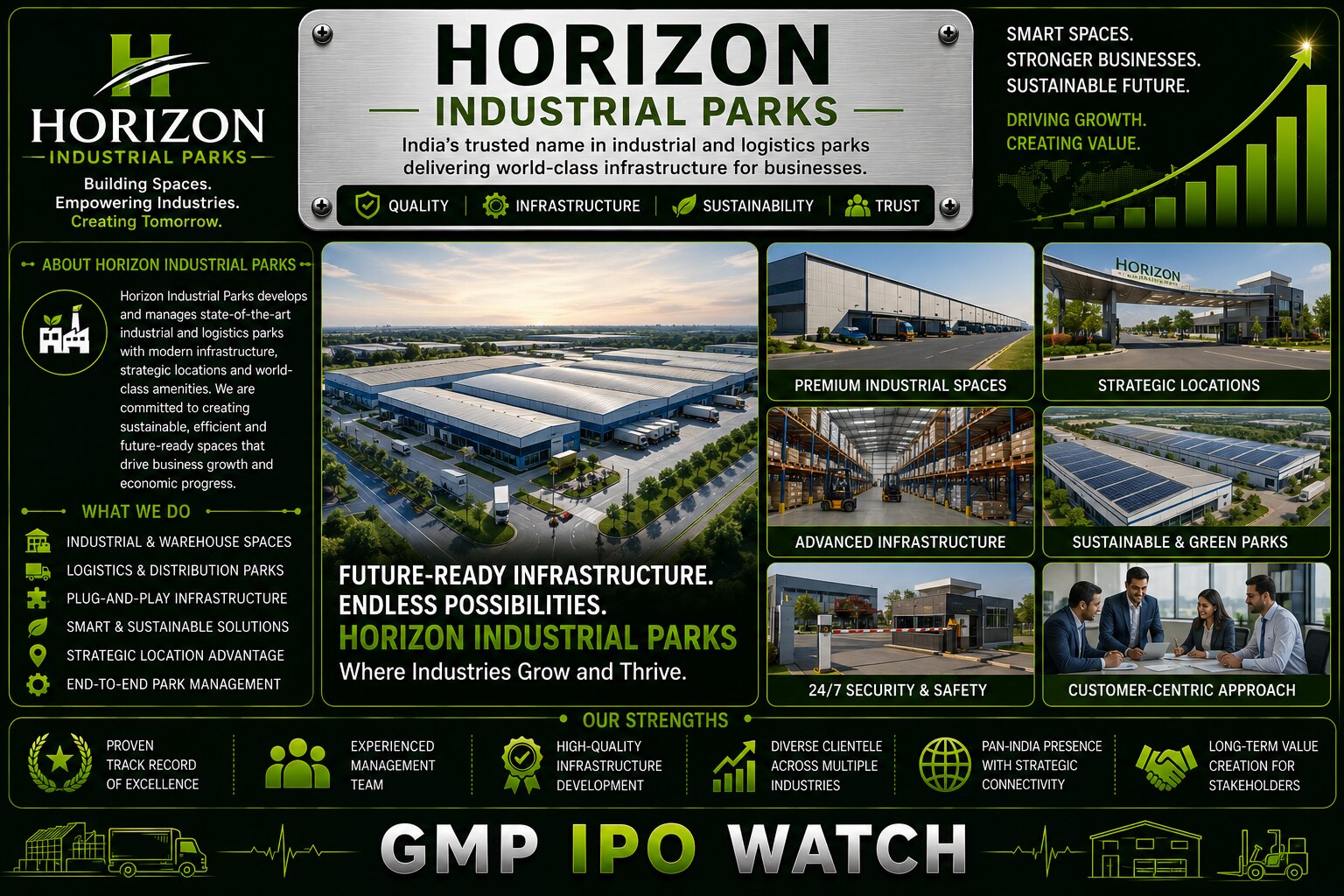
Horizon develops, owns and operates large industrial and logistics parks across India. According to the company, its network supports more than 100 customers across manufacturing, e-commerce and third-party logistics, while all of its operational parks are IGBC certified.
IPO disclosures describe Horizon as India's largest industrial and logistics infrastructure developer, owner and operator by total network, based on a JLL report. As of the relevant offer-document period, it owned 45 logistics and industrial assets across 10 major Indian cities, totalling roughly 58 million square feet.
That scale is already substantial.
The question investors now need to answer is different:
Can Horizon use ₹2,250 crore of IPO proceeds to reduce debt enough that its strong warehouse-level operating economics finally begin reaching the bottom line?
That is the central investment theme.
Horizon Is Not a Conventional Logistics Company
Horizon does not primarily earn money by transporting parcels.
Instead, it develops and leases physical infrastructure used by logistics and manufacturing companies.
Its major asset formats include:
- Fulfilment centres
- Industrial facilities
- In-city centres.
Fulfilment centres support large-scale warehousing and distribution.
Industrial facilities can be customised for manufacturing occupiers.
In-city centres are positioned closer to consumers and can support use cases such as:
- Last-mile logistics
- Dark stores
- Pharmaceutical distribution
- Cloud kitchens
- Retail operations.
That gives Horizon exposure to multiple parts of India's modern supply chain.
Rental Revenue Can Be More Predictable Than Transaction Revenue
A parcel company needs new shipments every day.
A warehouse landlord operates differently.
Once a customer signs a long lease and begins operating from the facility, revenue can become more predictable.
A tenant may remain for years because relocating a large warehouse is expensive and disruptive.
The customer may need to move:
- Inventory
- Equipment
- Technology systems
- Employees
- Distribution routes
That creates switching friction.
For Horizon, this can make occupied warehouse space economically valuable for long periods.
Occupancy Is One of the Most Important Metrics
A warehouse generates attractive economics only when someone is paying rent.
Imagine two identical 1 million sq ft parks.
Park A
95% occupied.
Park B
60% occupied.
Both required large amounts of development capital.
But Park A generates much more rental income from the same physical asset base.
That is why investors should watch:
occupancy + rental rate + lease duration
rather than simply counting total square feet.
Current IPO analysis highlights high occupancy as one of Horizon's operating strengths.
58 Million Sq Ft Creates Significant Scale
Horizon currently owns approximately 45 assets across 10 major cities, representing about 58 million sq ft of industrial and logistics infrastructure.
That scale matters in several ways.
A national customer may need warehouses in:
- Mumbai
- Delhi NCR
- Bengaluru
- Chennai
- Pune
A landlord with presence across multiple logistics markets can serve more of that customer's network.
This can increase customer stickiness and improve Horizon's ability to win large national accounts.
Scale Can Also Improve Tenant Acquisition
Large multinational companies generally evaluate:
- Compliance
- Sustainability
- Safety
- Infrastructure quality
- Land titles
- Delivery track record
before committing to major warehouse leases.
A scaled institutional platform with existing large clients may have an advantage over smaller developers.
Horizon says it serves more than 100 customers across manufacturing, e-commerce and 3PL sectors.
Fortune 500 Tenants Strengthen Portfolio Quality
One current prospectus-based analysis states that approximately 57.33% of Horizon's committed operational network is contracted to Fortune 500 companies.
This can be valuable because large global tenants may offer:
- Better credit quality
- Long-term requirements
- Larger facilities
However, even high-quality tenants do not eliminate concentration risk.
Top 10 Customers Contribute Around 43%
Economic Times' IPO analysis states that approximately 43% of revenue comes from Horizon's top 10 customers.
That is meaningful concentration.
If one large tenant:
- Reduces space
- Does not renew
- Consolidates operations
revenue could be affected.
The strongest future trajectory would therefore involve maintaining major clients while continuously adding new occupiers.
Geographic Concentration Is Also Significant
The same analysis notes that Horizon's top four cities contribute about four-fifths of total revenue.
This means Horizon has national scale but remains economically concentrated in its largest logistics hubs.
That is not necessarily negative.
India's logistics demand itself is concentrated around major manufacturing and consumption corridors.
However, investors should understand that weaker demand in one major market could materially affect the portfolio.
In-City Logistics Could Become More Valuable
Traditional logistics parks are often located on city outskirts where land is cheaper.
But e-commerce and quick delivery have created another requirement:
inventory needs to sit closer to consumers.
That is where in-city centres become interesting.
These facilities can support:
- Same-day delivery
- Quick commerce
- Dark stores
- Urban pharmaceutical distribution
Horizon identifies in-city centres as one of its core asset formats.
If urban delivery requirements increase, strategically located logistics space can become increasingly valuable.
E-Commerce Requires Physical Infrastructure
Online commerce looks digital.
But every physical order still needs to move through infrastructure.
A typical order journey may involve:
factory → regional warehouse → fulfilment centre → urban distribution hub → consumer.
Companies such as Horizon provide physical real estate underlying this digital-commerce network.
That makes warehousing an indirect way to participate in:
- E-commerce
- Organised retail
- Manufacturing
- 3PL growth
without competing directly for consumers.
Manufacturing Growth Is Another Structural Driver
Industrial parks are not limited to e-commerce.
Horizon also develops facilities for manufacturing occupiers.
Companies expanding manufacturing operations may need:
- Production space
- Supplier facilities
- Storage
- Distribution centres
Building these facilities internally requires:
- Land acquisition
- Construction
- Regulatory approvals
- Capital
Leasing a ready or customised industrial facility can allow companies to deploy capital into manufacturing rather than real estate.
That can create demand for institutional industrial parks.
Build-to-Suit Facilities Can Deepen Customer Relationships
A generic warehouse can be leased to several types of customers.
A build-to-suit facility is designed around one customer's specific requirements.
That can include:
- Building height
- Power load
- Dock configuration
- Floor strength
- Employee facilities
- Temperature requirements
These projects can create deeper tenant relationships because the property becomes integrated into the customer's operations.
The downside is that highly customised facilities can sometimes be harder to re-lease if the original occupier leaves.
Sustainability Can Help Attract Multinational Customers
Horizon states that all its operational parks are IGBC certified.
This is increasingly relevant because large companies have ESG and sustainability targets.
Modern logistics facilities may incorporate:
- Solar power
- Energy-efficient lighting
- Water management
- Green-building features
A warehouse landlord capable of helping tenants reduce environmental impact can strengthen its proposition to multinational clients.
Solar Solutions Create Another Tenant Benefit
Economic Times reports that Horizon also provides solar-energy solutions, alongside turnkey solutions, cold storage and on-site staff accommodation.
Solar infrastructure can reduce electricity costs and help occupiers meet renewable-energy targets.
For Horizon, such services can increase the value of the overall park rather than depending purely on base rent.
Cold Storage Broadens the Addressable Market
Cold storage requires infrastructure beyond conventional warehousing.
Potential users include:
- Food companies
- Pharmaceuticals
- Healthcare distributors
These facilities can command different economics because refrigeration, power reliability and specialised infrastructure are required.
Horizon offering cold-storage solutions broadens the customer segments it can serve.
FY2026 Income Increased 75%
Horizon reported FY2026 total income of approximately ₹767.84 crore, compared with ₹439.35 crore in FY2025.
That represents roughly 75% year-on-year growth.
The increase demonstrates substantial scale expansion.
But revenue growth alone does not tell the complete story.
Horizon remains loss making.
Revenue From Operations Has Grown Rapidly
Economic Times reports that revenue from operations grew at approximately 73.8% annually between FY2024 and FY2026, reaching roughly ₹691.4 crore in FY2026.
That growth likely reflects a combination of:
- Acquired assets
- New developments
- Higher occupied area
- Rental growth
The important question is whether future growth can continue without an equally aggressive increase in leverage.
EBITDA Growth Has Been Even Stronger
Horizon reported FY2026 EBITDA of approximately ₹607.8 crore, while EBITDA grew at roughly 100.3% annually between FY2024 and FY2026.
Its EBITDA margin expanded to around 79.2% in FY2026, compared with about 61.7% in FY2024.
This is a key feature of the business.
Once industrial real-estate assets are leased, incremental rental revenue can carry high operating margins because the property already exists.
Why Warehouse EBITDA Margins Can Be High
Suppose a warehouse generates ₹100 of rental revenue.
It does not need to buy raw materials worth ₹60 to generate that rent.
Operating costs primarily involve:
- Maintenance
- Staff
- Utilities for common areas
- Property management
That can create very high EBITDA margins.
However, the real financial burden appears below EBITDA.
For Horizon, that burden is debt and finance cost.
Horizon Is Still Loss Making
Despite strong operating growth, Horizon's FY2026 net loss widened to approximately ₹203 crore, compared with around ₹178 crore in FY2025.
This is the biggest contradiction in the IPO story:
high EBITDA + negative PAT.
The explanation lies largely in the capital-intensive nature of the business.
Warehouses require enormous investment in:
- Land
- Construction
- Acquisitions
Much of that growth has been financed with debt.
Net Debt Reached About ₹6,246 Crore
Economic Times reports Horizon's net debt increased from approximately ₹3,524.6 crore in FY2024 to ₹6,246.5 crore in FY2026.
That is substantial leverage.
It explains why the IPO is primarily a deleveraging transaction.
Horizon does not need the ₹2,600 crore issue mainly to prove it can acquire more warehouses.
It needs to repair the capital structure supporting the existing portfolio.
₹2,250 Crore Will Go Toward Debt Repayment
Of the ₹2,600 crore fresh issue, approximately ₹2,250 crore is earmarked for repayment or prepayment of borrowings of Horizon and several wholly owned subsidiaries.
That equals nearly 87% of the IPO size.
This is the single most important use of proceeds.
The IPO investment thesis is therefore fundamentally:
debt reduction → lower finance costs → better profit conversion.
Why Debt Reduction Could Transform the Income Statement
Imagine Horizon produces ₹600 crore EBITDA.
If large finance costs consume most of that operating profit, shareholders still see a loss.
Now reduce debt significantly.
The warehouses continue generating rent, but interest expense falls.
That can allow a larger proportion of operating profit to move toward:
- Pre-tax profit
- PAT
- Free cash flow
This makes Horizon very different from an IPO raising money primarily for aggressive new expansion.
Here, the IPO could improve profitability even without dramatic revenue growth.
Deleveraging May Be the Biggest Near-Term Earnings Driver
For many growth companies, future earnings depend mainly on more revenue.
For Horizon, the near-term path may be different:
same occupied portfolio + similar rental income + materially lower interest cost = substantially better net earnings.
That is why post-IPO finance costs may be one of the most important numbers to track.
Operating Cash Flow Is Already Strong
Horizon generated approximately ₹464.1 crore of operating cash flow in FY2026, up from roughly ₹119.3 crore in FY2024.
This is an important distinction.
The company reports accounting losses, but its underlying property portfolio is generating substantial operating cash.
The main financial challenge is how that cash is distributed among:
- Interest
- Debt
- Development
- Shareholders
after operating expenses.
Negative PAT Does Not Necessarily Mean Weak Assets
For asset-heavy infrastructure businesses, accounting profitability can be affected by:
- Finance costs
- Depreciation
even when properties generate substantial operating cash.
Therefore, investors should not evaluate Horizon only through P/E.
There is no meaningful P/E while the company remains loss making.
Metrics such as:
- EV/EBITDA
- Occupancy
- Rental growth
- Net debt
- Operating cash flow
are more informative.
Valuation Is Not Cheap on Operating Metrics
Economic Times estimates Horizon's FY2026 EV/EBITDA at about 38.7×, although that multiple has declined sharply from roughly 137.4× in FY2024 as EBITDA expanded.
The same analysis estimates a price-to-sales multiple around 25×.
Those are demanding headline valuation numbers.
However, valuation could change materially after IPO debt repayment because enterprise value and finance costs will be affected by the lower leverage.
Investors should therefore assess the company on a post-deleveraging basis rather than mechanically applying pre-IPO ratios.
No Direct Listed Indian Peer Makes Comparison Harder
Economic Times notes that Horizon does not have a directly comparable listed Indian peer.
This makes valuation more difficult.
It is not a conventional:
- Logistics transporter
- REIT
- Construction company
Instead, it combines:
industrial real estate + logistics infrastructure + development + asset management.
Investors therefore need to understand the asset economics directly.
Pipeline Provides Additional Growth Potential
Horizon has a development pipeline of approximately 6.31 million sq ft across seven cities.
That creates future capacity for rental growth.
But after an IPO focused on debt repayment, management will need to balance:
growth + leverage discipline.
The company should avoid immediately rebuilding the debt burden it is using IPO proceeds to reduce.
Growth Funded by Internal Cash Would Be Better Quality
The strongest post-IPO outcome would be:
lower interest cost → more retained cash → new projects funded increasingly through internal cash generation.
That would make the business less dependent on repeated debt-funded acquisitions.
Investors should therefore watch whether net debt begins climbing again after the IPO.
Horizon Is Backed by Blackstone
Horizon is backed by the Blackstone Group, one of the world's largest alternative asset managers.
Institutional sponsorship can provide:
- Capital-market experience
- Real-estate expertise
- Governance systems
However, promoter backing does not remove operational or valuation risk.
Investors still need to evaluate the company independently.
Promoter Holding Will Remain High
Economic Times reports the promoter group's stake is expected to decline from around 88.7% pre-IPO to 75.4% post-IPO.
That means promoters remain firmly in control even after the issue.
Because the IPO is completely fresh, dilution comes from new shares rather than promoters selling through an OFS.
The Entire IPO Is Fresh Capital
The ₹2,600 crore offer is 100% fresh issue, comprising roughly 43.34 crore shares.
There is no OFS.
For investors, that is an important structural feature.
The money raised is intended to strengthen the company's balance sheet rather than primarily finance shareholder exits.
Horizon Industrial Parks IPO GMP Today
InvestorGain's latest August 17 reading shows GMP around:
₹3.50 per share.
Against the ₹60 upper band:
Estimated unofficial price: ₹63.50
which represents approximately:
5.83% premium.
Economic Times reported a similar grey-market premium of roughly 6%, with a quoted GMP around ₹4 earlier today.
The difference reflects normal timing differences in unofficial GMP reporting.
GMP Has Remained Relatively Modest
InvestorGain's recent GMP history showed:
- August 12: ₹0
- August 13: ₹4.50
- August 14: ₹4
- August 15: ₹4
- August 16: ₹3.50
- August 17: ₹3.50.
This indicates positive but relatively restrained grey-market sentiment.
Investors should remember that GMP is unofficial and does not guarantee listing performance.
Day-1 Subscription Is Still Developing
InvestorGain showed the issue around 0.02× subscribed on its latest accessible live update.
A separate current tracker later showed materially higher demand, illustrating that opening-day numbers are changing rapidly as applications arrive.
Because Horizon's IPO remains open until August 19, Day-1 subscription should not be treated as a final demand signal.
The closing-day QIB book will be particularly important for an institutionally oriented infrastructure offering.
Why QIB Demand Matters for Horizon
Horizon is a large ₹2,600 crore mainboard issue.
Institutional investors are especially relevant because the business requires analysis of:
- Real-estate assets
- Lease economics
- Debt
- Cash flow
- Valuation
Final QIB subscription can therefore provide more useful information than early retail demand alone.
Key Strengths
Horizon enters the IPO with several meaningful advantages:
Scale: Approximately 45 assets and roughly 58 million sq ft across 10 major cities.
Customer quality: More than 100 customers, with significant Fortune 500 exposure.
Strong EBITDA: FY2026 EBITDA reached approximately ₹607.8 crore.
Operating cash flow: FY2026 cash flow from operations reached roughly ₹464.1 crore.
100% fresh IPO: No OFS.
Major deleveraging: ₹2,250 crore earmarked for debt repayment.
Structural logistics demand: Exposure to manufacturing, e-commerce and 3PL customers.
Major Risks
The biggest risk is high leverage. Net debt reached approximately ₹6,246.5 crore in FY2026 before the planned IPO repayment.
The second is continued losses. FY2026 net loss was around ₹203 crore despite substantial EBITDA.
The third is customer concentration, with the top 10 customers contributing roughly 43% of revenue.
The fourth is geographic concentration, with about four-fifths of revenue coming from the top four cities.
Other risks include warehouse occupancy, interest rates, land and development execution, tenant renewals and high valuation.
What Could Drive Horizon's Next Growth Phase?
Several factors could materially improve the business after listing.
Lower finance costs: The ₹2,250 crore debt repayment is the most immediate catalyst.
Higher occupancy: Additional leased area increases rental income from existing assets.
Rental escalation: Contractual increases can grow revenue without new construction.
Pipeline development: 6.31 million sq ft of planned assets provides future capacity.
In-city logistics: E-commerce and last-mile delivery can increase demand for urban facilities.
Manufacturing expansion: More industrial customers can support specialised facilities.
Solar and value-added services: Additional services can strengthen tenant relationships.
What Investors Should Track After Listing
The most important post-IPO metrics will be:
Net debt: Does leverage fall as expected after repayment?
Finance cost: How much interest expense disappears?
PAT: Does Horizon move toward profitability?
Occupancy: Are assets remaining highly utilised?
Rental growth: Is income per occupied sq ft increasing?
Operating cash flow: Does the portfolio continue generating strong cash?
Top-10 customer share: Is concentration decreasing?
Pipeline utilisation: Are new developments leased efficiently?
ROCE: Does the lower-debt capital structure improve returns?
The Most Important Post-IPO Equation
Horizon has already built the physical scale.
The IPO's purpose is to improve the financial architecture underneath that scale.
The attractive scenario is:
₹2,250 crore debt repayment → lower finance cost → stronger profit conversion → higher retained cash → disciplined expansion.
The weaker scenario is:
₹2,250 crore debt repayment → rapid new borrowing → aggressive development → leverage rises again.
Both scenarios can produce revenue growth.
Only the first creates a structurally stronger balance sheet.
Should Investors Consider Horizon Industrial Parks IPO?
The positive investment case includes:
- India's largest scaled industrial and logistics network by the cited JLL measure
- Roughly 58 million sq ft across 10 cities
- Strong FY2026 revenue and EBITDA growth
- High operating margins
- Strong operating cash flow
- 100% fresh issue
- ₹2,250 crore debt reduction
- Long-term e-commerce, manufacturing and logistics demand.
The caution points are equally important:
- The company remains loss making
- Pre-IPO debt is substantial
- Customer and geographic concentration remain meaningful
- Valuation is demanding on current operating metrics
- Warehouse development remains capital intensive.
Horizon should therefore be analysed as a large institutional logistics-real-estate platform undergoing a major deleveraging, rather than as a conventional transportation or warehouse-services company.
Final View on Horizon Industrial Parks IPO 2026
The Horizon Industrial Parks IPO opened today, August 17, 2026, and closes August 19. The ₹2,600 crore mainboard issue is priced at ₹57–₹60 per share and consists entirely of fresh equity.
Operationally, Horizon has already built significant scale.
Its portfolio includes around 45 assets across 10 major cities, representing roughly 58 million sq ft of industrial and logistics infrastructure. The company serves more than 100 customers across manufacturing, e-commerce and 3PL industries.
Financial growth has also been strong.
FY2026 total income reached approximately ₹767.84 crore, while revenue from operations reached about ₹691.4 crore. EBITDA stood near ₹607.8 crore, and operating cash flow reached approximately ₹464.1 crore.
But Horizon still reported a ₹203 crore FY2026 net loss, largely within a capital structure carrying substantial debt. Net debt reached approximately ₹6,246.5 crore before the IPO.
That is why the IPO is fundamentally a deleveraging story.
Approximately ₹2,250 crore of the ₹2,600 crore issue is earmarked for repayment or prepayment of borrowings.
The investment thesis can therefore be summarised as:
large warehouse portfolio + strong occupancy + recurring rental income + debt reduction = potential improvement in PAT and free cash flow.
Current GMP is only around ₹3.50–₹4, or roughly 6% above the upper band, indicating modest rather than euphoric short-term listing expectations.
For long-term investors, however, the important question is not whether the shares list at ₹63 or ₹64.
It is whether reducing debt by ₹2,250 crore allows Horizon's already strong asset-level EBITDA and operating cash generation to translate into sustainable bottom-line profitability.