GMP IPO Watch
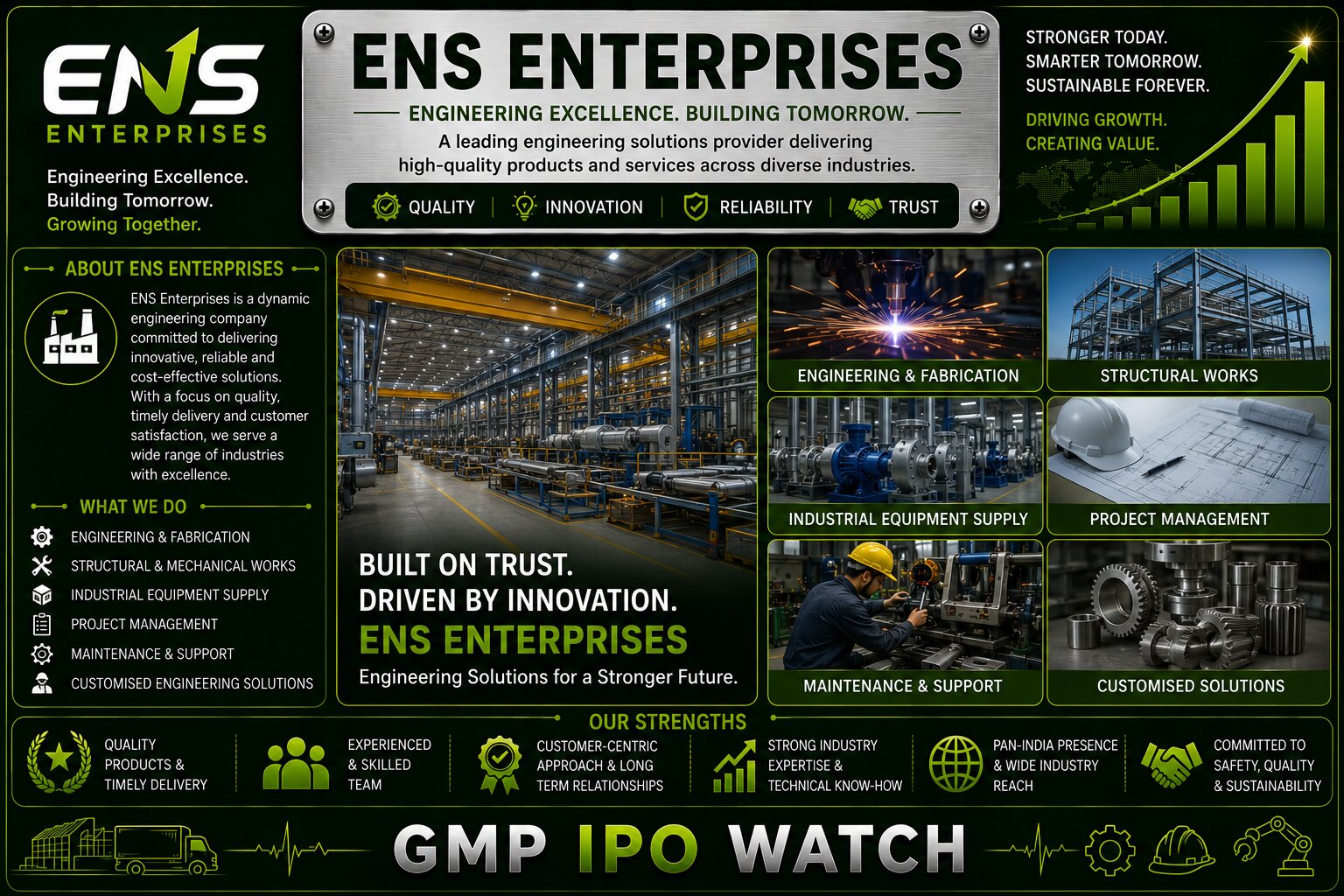
I checked the latest August 17, 2026 update. ENS Enterprises IPO is on Day 2 of active bidding today and closes tomorrow, August 18. The BSE SME issue is priced at ₹87–₹92 per share, with a total issue size of ₹33.14 crore. InvestorGain’s latest tracker shows subscription around 0.75× overall, while GMP remains ₹0, implying no unofficial premium over the ₹92 upper band at present.
This version is different from the earlier ENS Enterprises article. The focus here is on recurring digital-commerce revenue, ONDC monetisation, employee productivity, international client expansion, productisation, post-IPO capital efficiency and whether ENS can convert ₹17 crore-plus of manpower/product investment into scalable software revenue.
Title
ENS Enterprises IPO 2026: Day 2 Subscription, ₹51 Crore Revenue, ONDC Growth and Digital Commerce Outlook
Description
| Particular | Details |
|---|---|
| Company | ENS Enterprises Ltd. |
| IPO Type | Book Built SME IPO |
| Listing Platform | BSE SME |
| Issue Size | ₹33.14 Crore |
| Fresh Issue | ₹33.14 Crore |
| OFS | Nil |
| Price Band | ₹87 – ₹92 |
| Face Value | ₹10 Per Share |
| Lot Size | 1,200 Shares |
| Retail Minimum | 2,400 Shares |
| Retail Investment | ₹2,20,800 |
| IPO Open Date | August 14, 2026 |
| IPO Close Date | August 18, 2026 |
| Allotment Date | August 19, 2026 |
| Listing Date | August 21, 2026 |
| Lead Manager | Corporate Makers Capital |
| Registrar | Abhipra Capital |
ENS Enterprises IPO is a 100% fresh issue of 36,02,400 shares, with no OFS. The issue opened on August 14 and closes August 18, with tentative BSE SME listing scheduled for August 21.
ENS Enterprises IPO 2026 – Can a Services Company Build More Recurring Digital Revenue?
For many businesses, launching an online store is no longer enough.
A modern digital-commerce operation may require:
website + mobile application + payment systems + inventory integration + cloud infrastructure + marketplace connectivity + analytics + marketing automation.
These systems also need continuous maintenance.
That is where ENS Enterprises Limited operates.
The Noida-based company provides end-to-end digital-commerce and software-engineering services covering e-commerce platforms, web and mobile applications, cloud and DevOps, ONDC integrations, digital marketing and enterprise applications. It also works with commerce platforms such as Shopify, Magento and PrestaShop and has served clients across more than 12 countries.
ENS is now raising ₹33.14 crore through its BSE SME IPO.
For investors, however, the interesting question is not simply whether demand for IT services will continue.
It is:
Can ENS gradually transform project-based software work into longer-term, recurring and higher-value digital-commerce relationships?
That could determine the quality of its post-IPO growth.
ENS Is More Than a Website Development Company
ENS was incorporated in 2016 and has evolved from web and e-commerce development into broader digital-commerce enablement and custom software engineering. Its current capabilities include ONDC participation, enterprise applications, mobile and web development, cloud and DevOps services and digital marketing.
This evolution matters.
A company hired only to create a website may earn revenue once.
A company that also operates:
- Cloud infrastructure
- Software upgrades
- Integrations
- Support
- Mobile applications
can potentially remain connected to the client for years.
That creates a better business model.
Recurring Client Revenue Could Become the Real Opportunity
Consider two digital-development projects.
Project A
ENS builds an e-commerce site for ₹20 lakh.
After delivery, the customer leaves.
Project B
ENS builds the site and then continues providing:
- Maintenance
- Cloud services
- Application upgrades
- Digital integrations
- Ongoing development
The initial contract may be similar.
But Project B can generate significantly more lifetime revenue.
For investors, the percentage of revenue coming from repeat clients and ongoing engagements could eventually become more useful than simply tracking the number of projects completed.
Why Recurring Revenue Matters
IT-services businesses can face revenue volatility because projects eventually end.
Recurring engagements create better visibility.
If ENS begins each financial year already knowing that a meaningful portion of its previous customers will continue paying for:
maintenance + hosting + integration + development, planning becomes easier.
That can improve:
- Employee utilisation
- Revenue visibility
- Cash-flow predictability
A more recurring model can also justify a stronger valuation than purely one-time project revenue.
ONDC Gives ENS a Different Growth Channel
ENS is positioned as a Technology Service Provider for ONDC, according to current company/IPO information.
The Open Network for Digital Commerce is designed to connect buyers, sellers and technology providers through an interoperable commerce network.
For ENS, this can create opportunities from businesses that want to participate in ONDC but do not have the internal technical capability to build the required integrations.
They may require:
- Seller applications
- Buyer interfaces
- Catalogue systems
- APIs
- Order-management integrations
ENS can provide those technology services.
ONDC Revenue Still Needs to Become Commercially Meaningful
Being part of an emerging technology ecosystem is useful.
But investors should distinguish between:
technical capability
and:
actual profitable revenue.
The key post-listing question is whether ONDC projects become a meaningful contributor to ENS's sales.
If ONDC adoption expands but ENS earns only small integration fees, the financial impact may remain limited.
The stronger outcome is recurring technology contracts built around businesses participating in the network.
Shopify Expertise Creates Another Repeat-Revenue Opportunity
ENS also works with e-commerce platforms including Shopify, Magento and PrestaShop.
For merchants, launching a Shopify store is only the first step.
As their businesses grow, they may require:
- New payment methods
- Additional markets
- New design features
- Customer analytics
- Logistics connections
- Mobile applications
This can create repeat demand.
A merchant that starts as a small project could therefore become a much larger technology customer over time.
Customer Growth Can Increase ENS Revenue Automatically
Suppose ENS builds a digital platform for a retailer generating ₹10 crore annual sales.
Several years later, that retailer reaches ₹100 crore.
Its technology requirements may become significantly more complex.
It could need:
- Higher server capacity
- Better security
- More integrations
- New features
ENS can therefore potentially grow alongside successful customers.
That is different from businesses where the supplier must find a new customer for every incremental sale.
International Clients Expand the Addressable Market
ENS's current company profile indicates a delivery footprint across 12+ countries, including international markets.
That gives the company access to technology budgets larger than the domestic SME market alone.
International customers can potentially provide:
- Higher project values
- Foreign currency revenue
- Geographic diversification
However, ENS must compete against thousands of global software-services companies.
International growth therefore depends on quality, pricing and specialised capabilities rather than geography alone.
International Revenue Can Improve Employee Economics
A software company's primary production resource is its workforce.
Imagine one developer generates:
₹15 lakh annual billing from domestic projects.
If international work increases average billing to:
₹25 lakh
without an equivalent increase in salary costs, profitability can improve.
That makes revenue per employee an important long-term metric for ENS.
FY2026 Revenue Increased Sharply
ENS reported approximately:
| Financial Year | Revenue | PAT |
|---|---|---|
| FY2024 | ₹10.11 Cr | ₹0.90 Cr |
| FY2025 | ₹28.33 Cr | ₹3.70 Cr |
| FY2026 | ₹51.37 Cr | ₹8.40 Cr |
Revenue increased from approximately ₹10.11 crore in FY2024 to ₹51.37 crore in FY2026, while PAT increased from around ₹0.90 crore to ₹8.40 crore.
That represents a substantial change in operating scale over only two years.
FY2026 Revenue Grew More Than 80%
Revenue increased from approximately:
₹28.33 crore
to:
₹51.37 crore
between FY2025 and FY2026.
That is growth of more than 80%.
The growth rate is attractive.
But rapid pre-IPO acceleration needs to be tested after listing.
Investors should determine whether the new revenue base comes from:
- Many customers
- Repeat contracts
- A few large projects
The first two generally produce stronger revenue quality.
PAT More Than Doubled
PAT increased from:
₹3.70 crore in FY2025
to:
₹8.40 crore in FY2026.
That represents growth of more than 125%.
Profit therefore grew faster than revenue.
This suggests operating leverage.
But software companies can experience sudden margin changes when:
- Employee costs increase
- Large projects finish
- Hiring accelerates
Maintaining FY2026 profitability after the IPO will be important.
EBIT Margin Is Strong
Value Research reports FY2026 EBIT of approximately ₹11.24 crore on ₹51.37 crore revenue.
IPOPlatform separately reports EBITDA of about ₹11.71 crore, giving an EBITDA margin around 22.8%, while PAT margin is around 16.35% on its reported basis.
These are strong operating margins for a small technology-services company.
The main question is whether the company can maintain them after aggressively increasing manpower.
The IPO Is Entirely Fresh Capital
ENS is issuing 36,02,400 fresh shares, with no OFS.
This is one of the stronger aspects of the issue structure.
IPO capital is intended for company-level investments rather than primarily providing liquidity to existing shareholders.
The money can therefore potentially support:
- Product development
- Hiring
- IT infrastructure
- Debt repayment
- General growth.
The Fresh Capital Is Large Relative to the Existing Business
ENS had FY2026 net worth of approximately ₹18.44 crore.
The IPO size is ₹33.14 crore.
That means the company is raising equity equal to substantially more than its pre-IPO FY2026 net worth.
This creates an important capital-allocation challenge.
Management must generate enough incremental earnings from the new capital to prevent returns on equity from declining sharply.
Product and Manpower Investment Is the Biggest Strategic Bet
ENS plans to use a significant part of the IPO proceeds toward enhancement, maintenance and upgrading of existing products through manpower hiring. Its issue objectives also include IT infrastructure upgrades and repayment of borrowings.
This tells investors something important.
ENS does not need ₹30 crore primarily for buildings or machinery.
It needs to expand its:
people + software + technology infrastructure.
That makes hiring execution central to the IPO thesis.
Hiring More Developers Is Not Automatically Growth
Suppose ENS adds 100 software professionals.
Salary costs begin immediately.
But new employees create value only when they are productively assigned to revenue-generating work.
If hiring happens faster than customer acquisition, margins can decline.
Therefore, after listing, investors should watch:
employee count + revenue per employee + PAT margin.
Those three metrics together can reveal whether expansion is efficient.
Employee Utilisation Is a Hidden Profit Driver
Suppose 80% of ENS's technical workforce is deployed on billable customer projects.
That can create healthy economics.
If utilisation falls to 55% because hiring outpaces demand, the company still pays salaries while receiving less billing.
Software services therefore have their own form of capacity utilisation.
Factories measure machine utilisation.
IT companies should measure people utilisation.
Productisation Could Improve Scalability
Custom software services grow partly by adding employees.
A software product can scale differently.
Once the core product is built, one platform may serve many customers.
That can potentially create higher incremental margins.
ENS's proposed investment in upgrading existing products indicates management wants to strengthen the product side of the company.
If those products eventually generate subscription-like revenue, the company's earnings model could become more scalable.
But Product Businesses Are Difficult to Build
There is an important risk.
A good software-services company does not automatically become a successful product company.
Products require:
- Product-market fit
- Sales
- Marketing
- Continuous development
- Support
ENS therefore needs to prove that product investments can produce real customer adoption.
Investors should look for actual revenue rather than only product-launch announcements.
Cloud and DevOps Can Provide Recurring Work
ENS also offers cloud and DevOps services.
These services can create more recurring engagements because customers continuously need:
- Infrastructure monitoring
- Deployments
- Scaling
- Security
- Maintenance
Cloud services therefore have the potential to reduce reliance on one-time software-development contracts.
This segment could be strategically important even if it does not receive the same attention as ONDC.
Cybersecurity Is Important for Digital Commerce
ENS holds ISO 27001:2022 and ISO 9001:2015 certifications according to its current business profile.
Digital-commerce systems can handle:
- Customer data
- Payment integrations
- Business information
- User credentials
A material security failure could damage customer trust.
As ENS moves toward larger clients, information security capability becomes increasingly important.
Debt Is Not the Main Risk
ENS reported approximately ₹3.97 crore debt in FY2026, compared with no debt in FY2024 and FY2025 on Value Research's figures.
IPOPlatform reports debt-to-equity around 0.22×.
This is relatively modest leverage.
Therefore, unlike many manufacturing IPOs, the central issue is not debt reduction.
The central issue is how efficiently ENS uses new equity capital.
Post-IPO ROE Could Fall Initially
Current pre-IPO return ratios are high because ENS has been generating strong profit on a relatively small equity base.
Value Research reports FY2026 ROE around 45.54%, while IPOPlatform's alternate KPI presentation reports even higher return measures.
Once ₹33 crore of fresh IPO capital enters the balance sheet, those return ratios may decline unless profit grows rapidly.
This is normal initially.
But over time, management needs to demonstrate that the fresh capital can earn attractive returns.
The Real Post-IPO Test Is Incremental PAT
ENS earned roughly:
₹8.4 crore PAT in FY2026.
Now it is raising ₹33.14 crore.
If PAT remains around ₹8–₹9 crore for several years, the fresh capital has not produced much visible growth.
If PAT rises toward:
₹12 crore → ₹16 crore → ₹20 crore
while cash flow remains healthy, the IPO capital will appear much more productive.
That is the metric investors ultimately care about.
Valuation Is Around 14.9× on One Post-Issue Basis
IPOPlatform reports an indicative post-issue P/E of approximately 14.89× and market capitalisation around ₹125.07 crore.
The multiple is not unusually high compared with many software businesses.
But ENS also has SME-specific risks:
- Small revenue base
- Client concentration
- Key-person dependence
- Lower post-listing liquidity
Therefore, investors should not judge valuation only against larger listed IT companies.
ENS Enterprises IPO Subscription Today
As of August 17, 2026, InvestorGain's current IPO page shows ENS Enterprises subscribed approximately:
0.75× overall.
Another live source has shown the issue around 0.6–0.7×, reflecting different intraday refresh times.
The issue closes tomorrow, August 18, so final-day bidding could change the subscription materially.
Current Subscription Is Still Below 1×
Unlike several heavily subscribed SME IPOs, ENS Enterprises has not yet crossed full subscription based on the latest InvestorGain reading.
That means investors should pay close attention to tomorrow's final session.
SME IPOs can receive substantial last-day bidding, especially from NII and institutional categories.
The final closing figure will be more informative than today's intraday number.
Anchor Investors Put in ₹9.44 Crore
ENS allocated 10,26,000 shares at ₹92 per share to two anchor investors, raising approximately ₹9.44 crore ahead of public bidding.
The anchor allocation was split between Nexus Global Opportunities Fund and Puran Associates Pvt. Ltd.
Anchor participation provides some pre-IPO demand, but it does not guarantee strong public subscription or listing performance.
ENS Enterprises IPO GMP Today
As of August 17, 2026, InvestorGain reports:
GMP: ₹0
Upper Issue Price: ₹92
Estimated unofficial price: ₹92.
InvestorGain's seven-day history shows ₹0 GMP from August 11 through August 17.
This indicates grey-market sentiment has remained neutral throughout the recent IPO period.
₹0 GMP Does Not Mean ₹0 Business Potential
GMP measures unofficial short-term trading expectations.
It does not measure:
- Revenue growth
- PAT
- Product quality
- ONDC opportunity
- Customer retention
ENS's FY2026 financial growth remains the same regardless of whether GMP is ₹0 or ₹20.
For long-term analysis, fundamentals should therefore carry much more weight.
Competitive Strengths
ENS Enterprises enters the IPO with several attractive characteristics.
It has built capabilities across digital commerce, Shopify/Magento ecosystems, ONDC integrations, cloud/DevOps, mobile applications and enterprise software.
FY2026 revenue reached approximately ₹51.37 crore, while PAT reached approximately ₹8.40 crore.
Its EBITDA margin is reported around 22.8% on one prospectus-based analysis.
The IPO is fully fresh capital with no OFS, providing money for expansion rather than a major shareholder exit.
The company also has international exposure across more than 12 countries and recognised ONDC technology-provider capabilities.
Major Risks
The first risk is growth sustainability. Revenue has increased from around ₹10 crore to above ₹51 crore in only two years.
The second is employee dependence. Software services require skilled professionals, and rapid hiring can increase costs before new revenue arrives.
The third is client concentration and project volatility. A small company can be materially affected by the completion or loss of one large engagement.
The fourth is product-execution risk. Investing in software products does not guarantee recurring SaaS-like revenue.
The fifth is SME liquidity risk. BSE SME stocks can experience lower trading liquidity and greater price volatility than established mainboard companies.
What Could Drive ENS Enterprises' Next Growth Phase?
Several opportunities could support the business after listing.
ONDC adoption: More merchants and enterprises joining the ecosystem can generate integration demand.
E-commerce growth: Shopify and other commerce platforms create continuing development requirements.
International customers: Higher-value global projects can improve billing economics.
Cloud and DevOps: Recurring infrastructure work can improve revenue visibility.
Product revenue: Successful software products could reduce dependence on pure manpower growth.
Cross-selling: Existing commerce customers can purchase additional cloud, application and marketing services.
What Investors Should Track After Listing
The most useful metrics will be:
Revenue per employee: Is the larger workforce generating more economic output?
Employee count: Is hiring occurring faster than revenue growth?
PAT margin: Can ENS maintain its current double-digit profitability?
Repeat-client revenue: Are customers returning for additional work?
Product revenue: Are software products becoming commercially meaningful?
International revenue: Is geographic diversification increasing?
Operating cash flow: Does reported PAT convert into cash?
ROCE/ROE: Is the new ₹33.14 crore capital base being used productively?
The Most Important Post-IPO Equation
ENS's attractive growth path looks like:
IPO capital → better products + more skilled engineers → larger international and commerce clients → recurring engagements → higher revenue per employee → stronger PAT and cash flow.
The weaker path would be:
IPO capital → rapid hiring → rising salary cost → insufficient new contracts → falling utilisation and margins.
Both scenarios can produce a larger company.
Only the first creates a stronger business.
Should Investors Consider ENS Enterprises IPO?
ENS has an attractive recent financial profile.
Revenue and profit have grown sharply, margins are currently healthy, and the company operates in digital-commerce and software areas with long-term demand. The pure fresh-issue structure is also favourable from a capital-deployment perspective.
However, investors should balance those positives against:
- Rapid pre-IPO growth
- Small business scale
- Need for significant manpower hiring
- Current subscription below 1×
- ₹0 GMP
- SME-market liquidity
ENS should therefore be analysed as a fast-growing digital-commerce engineering company entering a capital-intensive hiring phase, rather than simply as a low-P/E IT IPO.
Final View on ENS Enterprises IPO 2026
The ENS Enterprises IPO is on Day 2 of active bidding today, August 17, and closes tomorrow, August 18. The ₹33.14 crore issue is priced at ₹87–₹92 per share, with tentative listing on BSE SME on August 21, 2026.
Financially, ENS has grown rapidly.
Revenue increased from approximately ₹10.11 crore in FY2024 to ₹28.33 crore in FY2025 and ₹51.37 crore in FY2026, while PAT increased from approximately ₹0.90 crore to ₹3.70 crore and then ₹8.40 crore.
The company operates across e-commerce platforms, ONDC integrations, mobile and enterprise applications, cloud/DevOps and digital marketing, with an international footprint spanning more than 12 countries.
The IPO is completely fresh capital with no OFS, meaning the new funds are intended to support product enhancement, manpower hiring, IT infrastructure and balance-sheet requirements.
The real investment thesis can therefore be summarised as:
digital-commerce demand + ONDC opportunity + international clients + product investment + more engineers = potential scalable technology growth.
But hiring is both ENS's opportunity and its biggest execution risk.
Software employees create expenses immediately. Revenue arrives only when those employees are productively deployed on customer work or successful products.
That makes revenue per employee, repeat-client revenue, recurring software income and post-IPO ROCE especially important after listing.
As of the latest August 17 update, subscription is around 0.75× overall, while GMP remains at ₹0.