 GMP IPO Watch
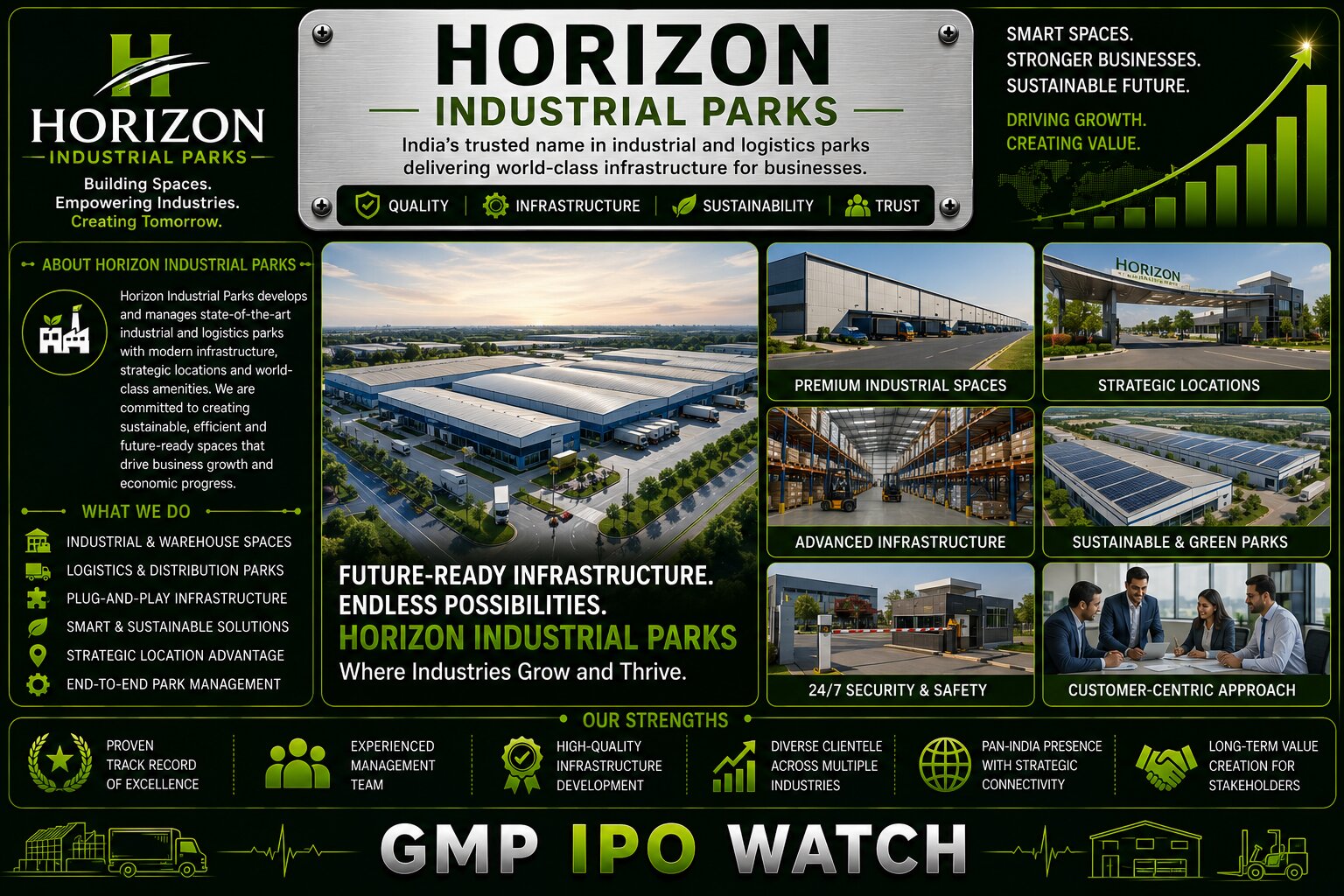
Horizon Industrial Parks IPO 2026 – A Bet on the Infrastructure Behind India’s Supply Chain
Every online order, supermarket shelf, automobile component and factory supply chain depends on something consumers rarely notice: industrial and logistics real estate.
Modern businesses need large warehouses, fulfilment centres and industrial facilities close to highways, manufacturing clusters and major consumption markets. As supply chains become faster and more organised, the quality and location of these facilities become increasingly important.
This is the business behind Horizon Industrial Parks Limited, which is preparing to launch its ₹2,600 crore mainboard IPO on August 17, 2026.
The IPO has a price band of ₹57 to ₹60 per share and will remain open until August 19, 2026. Anchor investor bidding is scheduled for August 14. Importantly, the entire ₹2,600 crore offer is a fresh issue, with no Offer for Sale component.
Unlike many IPOs where promoters or investors are monetising part of their holdings, Horizon is raising capital primarily to strengthen its balance sheet.
The biggest proposed deployment is approximately ₹2,250 crore toward repayment or prepayment of borrowings of the company and its subsidiaries.
That makes Horizon Industrial Parks a different IPO story:
large logistics portfolio + institutional backing + growing rental platform + significant debt reduction = potential improvement in financial structure.
Horizon Industrial Parks IPO Details
| Particular | Details |
|---|---|
| Company | Horizon Industrial Parks Limited |
| IPO Type | Mainboard Book Built IPO |
| Issue Size | ₹2,600 Crore |
| Fresh Issue | ₹2,600 Crore |
| Offer for Sale | Nil |
| Price Band | ₹57 – ₹60 Per Share |
| Face Value | ₹10 Per Share |
| IPO Opening Date | August 17, 2026 |
| IPO Closing Date | August 19, 2026 |
| Anchor Investor Date | August 14, 2026 |
| Listing | BSE & NSE |
| Issue Objective | Primarily Debt Repayment |
| Registrar | KFin Technologies Limited |
| Lead Managers | JM Financial, Axis Capital, IIFL Capital Services, SBI Capital Markets and 360 ONE WAM |
The ₹2,600 crore IPO was originally proposed as an entirely fresh issue in the company's SEBI filing, and the final price band has now been set at ₹57–₹60.
What Does Horizon Industrial Parks Actually Do?
Horizon is not simply a company that constructs warehouses and sells them.
Its business covers the broader lifecycle of institutional-grade industrial and logistics infrastructure.
The platform develops, owns and operates facilities including:
- Fulfilment centres
- Industrial facilities
- In-city logistics centres
- Built-to-suit facilities
- Plug-and-play industrial spaces
- Cold-storage infrastructure
- Energy solutions
- Staff accommodation
- Racking solutions
- Material-handling infrastructure
These properties serve sectors including e-commerce, FMCG, retail, renewable energy, automobile and auto components, and manufacturing.
This means Horizon participates in the physical infrastructure supporting India's movement of goods.
58.01 Million Sq. Ft. Network Is the Main Business Asset
Scale is one of Horizon's biggest strengths.
According to the JLL industry report included with the IPO documentation, Horizon is India's largest industrial and logistics infrastructure developer, owner and operator in terms of Total Network, as of December 2025.
Its portfolio consisted of:
45 assets
across:
10 cities
with a Total Network of:
58.01 million square feet.
The company reached this scale in just over five years after Blackstone acquired the first asset in the network in 2020.
That rapid expansion is a central part of the IPO story.
Why Warehouse Location Is More Important Than the Building
A warehouse is fundamentally different from an ordinary office building.
Imagine two identical 500,000-square-foot warehouses.
Warehouse A
Located near a major highway, industrial cluster and large consumer market.
Warehouse B
Located far from customers and major transport routes.
Even if construction quality is identical, Warehouse A can be much more valuable to a logistics customer.
Why?
Because transportation costs can exceed real-estate savings.
For Horizon, therefore, the long-term value of its portfolio depends heavily on:
location + connectivity + customer demand + infrastructure quality.
Fulfilment Centres Are the Largest Operational Category
As of November 2025, fulfilment centres represented approximately 15.55 million sq. ft., or around 58%, of Horizon's operational area, according to IPO information.
These facilities can serve companies operating in:
- E-commerce
- Retail
- FMCG
- Third-party logistics
Large fulfilment centres are designed to handle high volumes of products moving through supply chains.
The rise of e-commerce has made these buildings increasingly important.
Industrial Facilities Add a Different Growth Engine
Horizon is not dependent only on e-commerce warehouses.
Industrial facilities represented approximately 10.36 million sq. ft., or around 39%, of its operational portfolio as of November 2025.
These facilities can support industries such as:
- Automotive
- Auto components
- Renewable energy
- Electronics
- Light manufacturing
This provides exposure to India's broader manufacturing expansion.
In-City Centres Solve the Last-Mile Problem
Large warehouses are usually located outside expensive urban centres.
But fast deliveries require inventory to move closer to customers.
That creates demand for smaller in-city logistics facilities.
These properties can support:
- Same-day delivery
- Quick commerce
- E-commerce
- Urban distribution
As consumers expect faster deliveries, strategically located urban logistics facilities can become increasingly valuable.
Horizon Is Backed by Blackstone
One of the most notable features of the company is its institutional sponsorship.
Horizon is backed by investment entities associated with Blackstone, one of the world's largest alternative asset managers.
IPO-related disclosures indicate Blackstone-associated entities collectively hold a substantial majority stake in Horizon.
Institutional backing can provide advantages in:
- Capital access
- Acquisitions
- Asset management
- Governance
- Large-scale development
However, investors should evaluate the listed company on its own financial performance rather than assuming sponsor reputation alone guarantees shareholder returns.
Horizon Has Grown Through More Than Greenfield Development
A logistics platform can expand in several ways.
It can:
- Buy land and build new parks.
- Acquire existing logistics properties.
- Redevelop existing assets.
- Acquire operating portfolios.
Horizon has used a combination of acquisitions, greenfield development and redevelopment to build its network.
This strategy helped it scale rapidly.
But acquisitions can also increase leverage.
That brings us to the most important financial issue in this IPO.
Debt Is the Central IPO Story
Industrial real estate is capital intensive.
Before Horizon can collect rental income, it may need to spend heavily on:
- Land
- Construction
- Roads
- Utilities
- Warehouses
- Industrial infrastructure
That typically requires debt.
IPO-related FY2025 information showed Horizon carrying substantial borrowings, reflecting this capital-intensive expansion model.
Rather than using most IPO proceeds to buy even more assets immediately, Horizon intends to repair this side of the balance sheet.
₹2,250 Crore Planned for Debt Repayment
Of the ₹2,600 crore fresh issue, the company plans to use approximately:
₹2,250 crore
toward repayment or prepayment of certain borrowings of Horizon and its subsidiaries.
The balance is intended for general corporate purposes.
That means roughly 87% of the issue size is connected to deleveraging.
This is arguably the single most important fact investors should understand about the IPO.
Why Debt Reduction Can Change Horizon’s Earnings
Consider a simplified example.
Suppose a logistics property generates:
₹100 crore EBITDA
but requires:
₹70 crore interest expense.
Only ₹30 crore remains before depreciation and tax.
If debt repayment reduces interest to ₹35 crore, the underlying property has not changed—but considerably more operating profit can flow toward shareholders.
This is why deleveraging can materially change the economics of a real-estate platform.
Horizon Is EBITDA Positive but Loss Making
Horizon presents an interesting financial profile.
For FY2025, the company reported revenue from operations of approximately:
₹608.20 crore
compared with:
₹452.97 crore in FY2024.
EBITDA increased to approximately:
₹501.7 crore
from around:
₹326 crore.
However, the company still reported a net loss of approximately:
₹233 crore in FY2025, compared with a net loss of about ₹254.54 crore in FY2024.
This distinction is crucial.
Why Can a Company Have ₹500 Crore EBITDA and Still Lose Money?
Because EBITDA excludes several major expenses.
For a capital-intensive real-estate platform, these can include:
- Interest
- Depreciation
- Amortisation
- Taxes
Horizon owns and develops expensive physical infrastructure.
Therefore, large depreciation and finance costs can exist below EBITDA.
This is exactly why the ₹2,250 crore debt repayment matters.
Revenue Growth Has Been Strong
FY2025 revenue from operations increased roughly 34% year-on-year, from ₹452.97 crore to ₹608.20 crore.
At the same time, EBITDA increased significantly faster.
That suggests the operating platform has been gaining scale.
For investors, the key question is whether this growth can eventually translate into sustainable bottom-line profitability after deleveraging.
The IPO Should Not Be Analysed Using P/E Alone
Traditional investors often begin IPO analysis with:
What is the P/E ratio?
That is less useful when the company currently reports losses.
For Horizon, investors may need to pay more attention to:
- Enterprise value
- EBITDA
- Net debt
- Rental income
- Occupancy
- Lease duration
- Asset value
- Yield on completed assets
These metrics better reflect an industrial real-estate platform.
Occupancy Is One of the Most Important Metrics
Imagine Horizon builds a one-million-square-foot warehouse.
Scenario A
950,000 sq. ft. is leased.
Scenario B
500,000 sq. ft. is leased.
Construction cost may be similar, but revenue economics are completely different.
Therefore, occupancy and committed occupancy are critical.
A warehouse generates value only when customers actually lease the space.
Customer Quality Matters Too
Horizon serves more than 100 customers, and IPO-related portfolio information indicates a significant share of its committed operational network is leased to Fortune 500 companies.
Institutional tenants can offer advantages such as:
- Better credit quality
- Longer relationships
- Lower default risk
- Larger space requirements
Large customers may also expand within the same logistics platform as their Indian operations grow.
Customer Diversification Reduces Sector Risk
A warehouse platform dependent entirely on one e-commerce company would carry significant concentration risk.
Horizon serves industries including:
- E-commerce
- FMCG
- Retail
- Renewable energy
- Automobile
- Manufacturing
This gives the portfolio exposure to multiple demand drivers.
If e-commerce leasing temporarily slows, industrial manufacturing demand may still provide growth.
Built-to-Suit Facilities Can Strengthen Customer Relationships
Not every tenant wants a standard warehouse.
A manufacturing company may need:
- Specific floor loading
- Custom ceiling heights
- Power infrastructure
- Special ventilation
- Production layouts
Horizon can develop built-to-suit facilities around individual customer requirements.
These customised assets can create stronger tenant relationships because moving to another facility becomes more complicated.
Plug-and-Play Facilities Can Reduce Customer Setup Time
At the other end of the spectrum, some customers want to move quickly.
Fully fitted plug-and-play facilities can reduce the time between signing a lease and beginning operations.
This can be valuable for businesses expanding rapidly into new cities.
Horizon therefore serves both customised long-duration requirements and faster standardised occupancy needs.
Cold Storage Adds Another Specialised Segment
Cold-storage infrastructure serves products that cannot remain in ordinary warehouses.
Potential users include businesses handling:
- Food
- Pharmaceuticals
- Temperature-sensitive products
Cold storage generally requires more sophisticated infrastructure than a standard warehouse.
That can increase entry barriers but also requires greater capital and operating expertise.
India’s Manufacturing Growth Is Important for Horizon
The industrial parks business is connected to a broader shift in India's economy.
Companies are increasing investment in sectors such as:
- Electric vehicles
- Electronics
- Renewable energy
- Automotive components
- Consumer manufacturing
Factories require nearby supplier infrastructure and warehousing.
Therefore, Horizon can potentially benefit not only from e-commerce growth but also from India's manufacturing localisation trend.
E-Commerce Remains a Powerful Demand Driver
Every increase in online shopping creates physical infrastructure requirements.
Digital commerce still needs:
- Warehouses
- Sorting centres
- Fulfilment facilities
- Last-mile hubs
As e-commerce expands beyond India's largest metros, logistics networks also need to become geographically broader.
This creates long-term demand for institutional-grade warehousing.
Quick Commerce Could Increase In-City Logistics Demand
Quick-commerce companies promise delivery within minutes.
That requires inventory to sit much closer to consumers.
Traditional warehouses located far outside cities cannot solve the entire problem.
This can increase demand for:
in-city logistics centres and urban fulfilment infrastructure.
For Horizon, that creates another potential growth category.
10-City Presence Provides Geographic Diversification
Horizon has built its network across 10 major Indian cities.
This reduces dependence on a single logistics market.
Industrial demand can differ significantly between:
- Mumbai
- Delhi NCR
- Bengaluru
- Pune
- Chennai
- Other manufacturing and consumption hubs
A diversified portfolio allows Horizon to participate in several regional growth cycles.
A Proposed Bengaluru Acquisition Could Expand the Network Further
IPO-related disclosures also referenced a proposed acquisition of approximately 100 acres in Bengaluru, carrying potential development of roughly 2.55 million sq. ft.
If completed as contemplated, the broader network could reach approximately 60.56 million sq. ft. across 46 assets.
This demonstrates that the platform still has expansion opportunities beyond its current portfolio.
Sustainability Is Becoming Important in Warehousing
Large multinational tenants increasingly consider:
- Energy efficiency
- Renewable power
- Carbon emissions
- Water management
- Building standards
Horizon reported receiving a 5-Star GRESB rating and Green Star designation in its first participation for its operational portfolio.
For industrial real estate, ESG infrastructure can potentially become commercially important rather than simply a branding exercise.
Multinational customers may prefer facilities aligned with their own sustainability commitments.
Solar and Energy Solutions Can Create Additional Value
Large warehouses have enormous roof areas.
That creates an opportunity for rooftop solar installations.
Renewable power can potentially:
- Lower tenant energy costs
- Improve sustainability metrics
- Generate additional infrastructure value
Energy solutions therefore provide Horizon with another way to deepen relationships with tenants beyond basic rent collection.
Asset Scale Can Create Operating Advantages
Managing 45 assets provides opportunities for scale.
The company can potentially negotiate more effectively for:
- Construction
- Security
- Maintenance
- Insurance
- Energy systems
- Facility management
A larger platform can also share operating expertise across multiple parks.
This may create advantages over fragmented local warehouse owners.
But Large Scale Also Creates Execution Complexity
Managing 58 million sq. ft. is not simple.
Horizon must coordinate:
- Land development
- Construction
- Leasing
- Tenant relationships
- Maintenance
- Safety
- Regulatory approvals
Poor execution in one large project can absorb substantial capital.
Rapid expansion therefore increases management complexity.
Interest Rates Are an Important Risk
Industrial real estate is highly sensitive to financing costs.
When interest rates rise:
- Borrowing becomes more expensive.
- New developments require higher returns.
- Property valuations can face pressure.
Horizon’s planned debt reduction should lower some financial risk, but future developments may still require substantial capital.
Land Acquisition Creates Another Risk
Industrial parks require large land parcels.
Land acquisition in India can involve:
- Title verification
- Zoning
- Approvals
- Infrastructure access
- Local regulations
Delays can increase project costs.
For Horizon, disciplined land acquisition is therefore just as important as warehouse construction.
Construction Cost Inflation Can Affect Returns
Warehouses require significant quantities of:
- Steel
- Cement
- Electrical equipment
- Roofing
- Infrastructure materials
If construction costs rise sharply after project economics are established, development returns can fall.
Long-term tenant agreements must therefore be priced carefully.
Tenant Concentration Should Be Monitored
Large multinational customers are attractive tenants.
But dependence on a few large tenants can create risk.
If one customer leases millions of square feet and later consolidates operations, occupancy can fall.
Investors should therefore track:
- Top-10 tenant contribution
- Lease expiries
- Tenant retention
after listing.
Lease Duration Can Create Revenue Visibility
Industrial facilities often operate under multi-year lease agreements.
Long leases can give property owners relatively predictable revenue.
This is fundamentally different from businesses that must sell their entire output again every month.
For Horizon, a high-quality leased portfolio can provide recurring cash flows.
However, rental escalation clauses and renewal terms determine how effectively revenue keeps pace with inflation.
Development Pipeline Is Both Opportunity and Risk
Horizon has a large network that includes operational and development assets.
Projects under development represent future rental opportunities.
But until completed and leased, development land consumes capital without generating full rental income.
Investors therefore need to distinguish between:
operational area
and
future development potential.
A large total network does not mean every square foot is currently producing rent.
Horizon Industrial Parks IPO GMP Today
As of August 13, 2026, there does not appear to be a sufficiently established and consistently reported grey-market premium for Horizon Industrial Parks to treat a specific GMP number as reliable.
Recent IPO community tracking still showed the issue price at ₹60 with GMP marked as not available rather than a confirmed premium.
That may change as the August 17 opening approaches.
GMP is unofficial and should not be used as the primary basis for an investment decision.
Subscription Has Not Started Yet
As of August 13, 2026, the Horizon Industrial Parks IPO has not opened for public subscription.
Public bidding begins:
August 17, 2026
and ends:
August 19, 2026.
Therefore, there is currently no genuine retail, NII or QIB public subscription figure.
Anchor bidding begins on August 14.
Why QIB Demand Could Be Particularly Important
Horizon is an institutional-scale real-estate infrastructure business.
That means demand from:
- Mutual funds
- Insurance companies
- Foreign institutional investors
- Domestic institutions
could be especially informative.
Professional investors may focus heavily on:
- Asset valuation
- Lease quality
- Net debt
- EBITDA
- Development pipeline
Final QIB subscription will therefore be worth watching when the IPO closes.
Competitive Strengths
India's Largest Total Network
Horizon had 58.01 million sq. ft. across 45 assets and 10 cities as of December 2025, according to JLL's industry report.
Blackstone Backing
The platform has significant institutional sponsorship.
Diversified Tenant Industries
Customers span e-commerce, retail, FMCG, manufacturing, renewable energy and automotive sectors.
Strong EBITDA Growth
FY2025 EBITDA increased to approximately ₹501.7 crore.
Entirely Fresh IPO
There is no OFS in the ₹2,600 crore issue.
Significant Deleveraging
Around ₹2,250 crore is planned for repayment or prepayment of borrowings.
Pan-India Presence
The company has assets across 10 major markets.
Major Risks Investors Should Understand
The Company Is Loss Making
Despite strong EBITDA, Horizon reported a net loss in FY2025.
High Debt
Industrial property development requires substantial financing.
Capital-Intensive Business
New parks require large upfront investment before generating rent.
Interest-Rate Risk
Higher financing costs can reduce returns.
Occupancy Risk
Unleased facilities do not generate their full revenue potential.
Development Risk
Projects can face cost overruns and delays.
Land and Approval Risk
Acquisition and regulatory issues can delay development.
Tenant Concentration
Large tenants can represent meaningful portfolio exposure.
What Could Drive Horizon's Growth After Listing?
Several structural trends could support the company over the coming years:
- Growth in organised warehousing
- Expansion of Indian manufacturing
- E-commerce penetration
- Quick-commerce infrastructure
- Supply-chain formalisation
- Global companies expanding Indian manufacturing
- Demand for Grade-A industrial facilities
- Cold-storage growth
- Institutionalisation of logistics real estate
Horizon already has the scale to participate in several of these trends.
What Investors Should Track After Listing
Net Debt
Does the ₹2,250 crore repayment materially strengthen the balance sheet?
Finance Cost
How much interest expense disappears after deleveraging?
Occupancy
Is operational space consistently leased?
Revenue Growth
Does the existing portfolio continue generating higher rental income?
EBITDA
Can operating earnings continue growing?
PAT
Most importantly, can Horizon transition from losses to sustainable profitability?
Development Pipeline
How quickly does new space become operational and leased?
Return on Capital
Are new industrial parks creating adequate returns?
The Most Important Post-IPO Equation
Horizon does not need the IPO merely to become bigger.
It is already operating at very large scale.
The more important objective is to improve the financial structure supporting that scale.
The post-IPO equation is therefore:
₹2,600 crore fresh equity → ₹2,250 crore debt repayment → lower leverage → lower finance costs → stronger cash generation → potential path toward profitability.
That makes Horizon's IPO very different from an early-stage growth IPO.
Investors are effectively funding a substantial balance-sheet transformation.
Why the IPO Could Change Horizon's Financial Profile
Before the IPO, Horizon combined:
large assets + growing EBITDA + high borrowings + net losses.
After the IPO and proposed debt repayment, the company could potentially move toward:
large assets + growing EBITDA + lower borrowings + lower interest costs.
Whether that eventually produces consistent PAT is the central investment question.
The properties themselves do not suddenly become more profitable because of an IPO.
What changes is the amount of financial leverage sitting above those properties.
Should Investors Consider Horizon Industrial Parks IPO?
The positive case includes strong factors:
- 58.01 million sq. ft. total network
- 45 assets
- 10-city presence
- Blackstone backing
- Large institutional tenants
- Strong FY2025 EBITDA
- Growing logistics and manufacturing demand
- Entirely fresh IPO
- ₹2,250 crore deleveraging plan
However, the risks are equally important:
- Current net losses
- High historical leverage
- Capital-intensive expansion
- Interest-rate sensitivity
- Occupancy dependence
- Development execution
- Real-estate cyclicality
Horizon should therefore be evaluated as an industrial real-estate infrastructure and recurring rental platform, rather than as a traditional logistics company.
Final View on Horizon Industrial Parks IPO 2026
The Horizon Industrial Parks IPO 2026 is one of the more distinctive infrastructure offerings in the current IPO pipeline.
The company sits behind many of the economic trends transforming India:
e-commerce, organised retail, manufacturing, renewable energy, automotive production and modern supply chains.
Its scale is already substantial.
According to the JLL report accompanying its IPO documentation, Horizon had 45 assets across 10 cities with a Total Network of 58.01 million sq. ft. as of December 2025, making it India's largest industrial and logistics infrastructure developer, owner and operator by Total Network on that basis.
Financially, the story is more nuanced.
FY2025 revenue from operations increased to approximately ₹608.20 crore, while EBITDA reached roughly ₹501.7 crore. Yet the company remained loss-making, reporting a net loss of approximately ₹233 crore.
That is why the IPO's structure matters so much.
The entire ₹2,600 crore issue is fresh equity, and approximately ₹2,250 crore is intended for repayment or prepayment of borrowings.
The investment thesis is therefore not simply:
“India needs more warehouses.”
It is more specific:
Can Horizon combine its already-large logistics network with a substantially stronger post-IPO balance sheet and convert high EBITDA into sustainable shareholder earnings?
If deleveraging significantly reduces finance costs while occupancy, rental income and the operational portfolio continue growing, Horizon could emerge from the IPO with materially stronger economics.
But investors should not ignore the risks. The company operates a capital-intensive model, has historically carried significant borrowings and remains loss-making at the net-profit level.
For long-term investors, the numbers that matter most after listing will therefore be:
net debt, finance cost, occupancy, rental growth, EBITDA, operating cash flow and the eventual transition from net loss to PAT.
Overall, Horizon Industrial Parks represents a large-scale, Blackstone-backed industrial and logistics infrastructure IPO with a strong asset platform and a clearly defined deleveraging strategy. The opportunity is tied to India's long-term warehousing and manufacturing growth, while the key test after listing will be whether ₹2,250 crore of debt reduction can translate its substantial operating earnings into sustainable bottom-line profitability.