 GMP IPO Watch
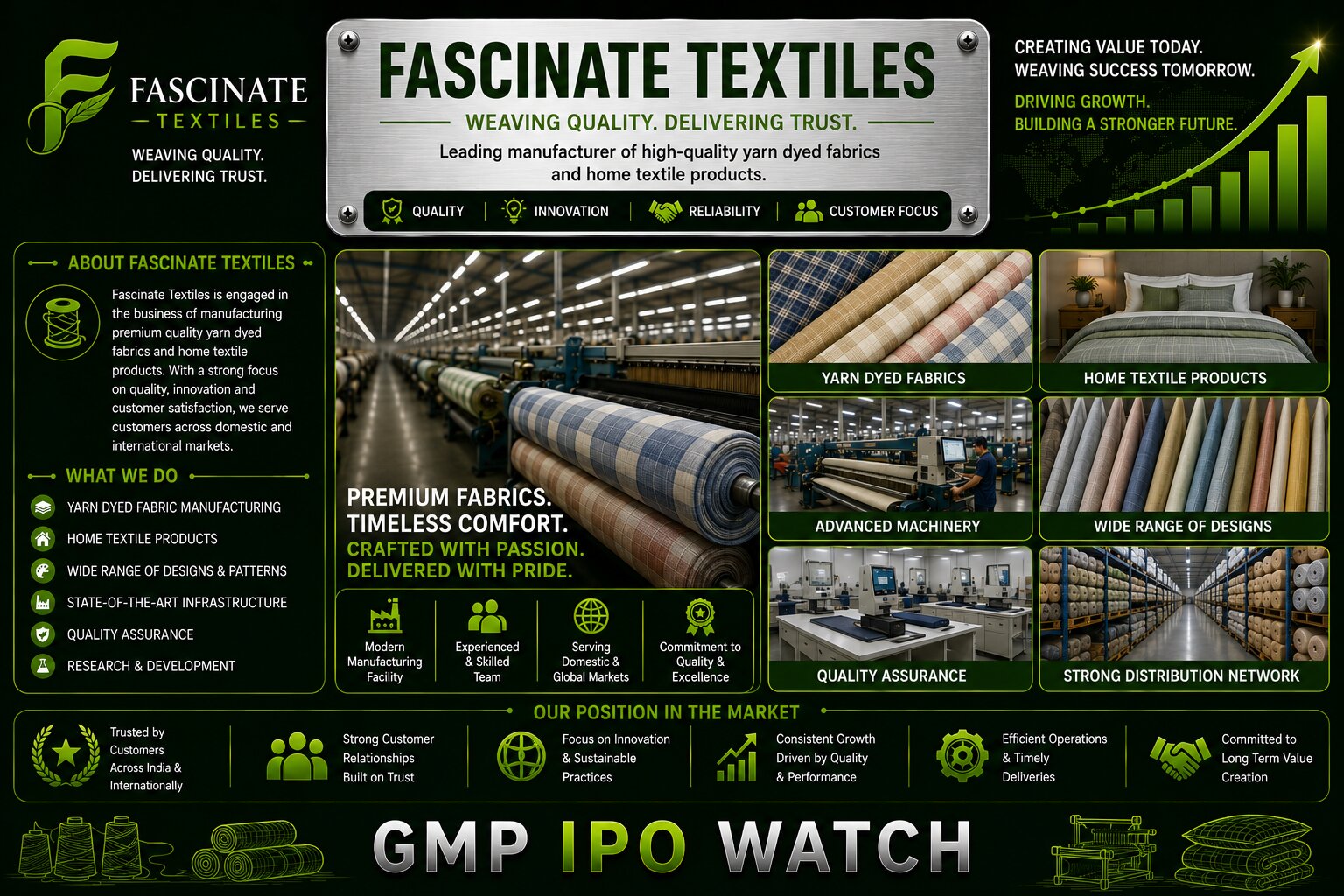
Fascinate Textiles IPO 2026 – Can Manufacturing Scale Create the Next Growth Phase?
Textile manufacturing looks simple from the outside.
Raw material enters a factory, fabric comes out, and the finished product is sold to garment manufacturers, wholesalers or other textile businesses.
In reality, profitability depends on dozens of variables.
Raw-material prices can change quickly. Machinery must remain productive. Customers demand consistent quality. Working capital can remain blocked for weeks. A small difference in production efficiency can have a meaningful impact on margins.
This operating environment is important when evaluating Fascinate Textiles Limited and its proposed IPO.
Fascinate Textiles is preparing to enter the capital market as investors increasingly look beyond simple revenue growth and focus on whether smaller manufacturing companies can generate sustainable returns from expansion.
The company's IPO story is therefore not merely about raising capital.
The bigger question is:
Can Fascinate Textiles convert additional manufacturing scale into better productivity, stronger margins and sustainable cash generation?
That is the central theme investors should evaluate.
Understanding Fascinate Textiles' Business
Fascinate Textiles operates in India's textile manufacturing ecosystem.
Its business is connected with manufacturing and supplying textile products used further across the apparel and textile value chain.
Unlike consumer-fashion businesses, textile manufacturers often operate behind the scenes.
Consumers may never recognise the manufacturer's name.
But the quality of the underlying textile material influences:
- Appearance
- Strength
- Comfort
- Durability
- Colour consistency
- Final garment quality
That means manufacturing discipline becomes extremely important.
Why Textile Manufacturing Is a Scale Business
A textile factory carries significant fixed costs.
These can include:
- Factory infrastructure
- Machinery
- Electricity connections
- Supervisory employees
- Maintenance
- Compliance
- Administration
Whether machinery operates at 50% or 80% utilisation, many of these expenses remain.
That creates operating leverage.
Imagine a factory with annual fixed operating costs of ₹10 crore.
At ₹50 crore revenue, those costs equal 20% of sales.
At ₹80 crore revenue, the same ₹10 crore represents only 12.5%.
This is why capacity utilisation can significantly influence textile-company profitability.
Capacity Utilisation Matters More Than Installed Capacity
IPO investors often see companies highlighting manufacturing capacity.
But installed capacity does not generate profits.
Utilised capacity does.
A company may own machinery capable of producing 10 million units annually.
If it produces only 5 million units, utilisation is 50%.
If production increases to 8 million units without major additional fixed investment, operating economics can improve substantially.
For Fascinate Textiles, investors should therefore watch how efficiently existing and future machinery is utilised.
The IPO Can Change the Company's Growth Profile
A manufacturing IPO can provide capital for several purposes.
Depending on the final offer structure and disclosed use of proceeds, growth capital can support areas such as:
- Manufacturing equipment
- Production capacity
- Working capital
- Debt reduction
- General corporate requirements
For a textile company, the quality of capital deployment is more important than the amount raised.
The ideal outcome is:
IPO capital → productive assets → additional orders → higher utilisation → stronger earnings.
Simply raising money does not create shareholder value.
Deploying it efficiently does.
Textile Machinery Can Improve Productivity
New machinery does not necessarily mean only more production.
Modern manufacturing equipment can also improve:
- Production speed
- Product consistency
- Energy consumption
- Labour productivity
- Waste reduction
- Quality control
This can allow revenue to increase without expenses rising at exactly the same pace.
That is where manufacturing operating leverage becomes valuable.
Waste Reduction Can Have a Large Effect on Profit
Consider a simplified example.
Suppose Fascinate processes ₹100 crore worth of material annually.
At 5% wastage:
₹5 crore worth of material is lost.
If better equipment and production control reduce wastage to 3%:
₹3 crore is lost.
That difference can materially improve profitability even if selling prices remain unchanged.
For textile manufacturers, small efficiency improvements can therefore produce surprisingly large earnings benefits.
Raw-Material Management Is Critical
Textile manufacturers are highly sensitive to input prices.
Depending on the product mix, relevant inputs can include:
- Cotton
- Yarn
- Polyester
- Synthetic fibres
- Dyes
- Chemicals
- Packaging
Raw-material prices can move because of:
- Agricultural production
- Crude-oil prices
- Currency movements
- Global textile demand
- Import costs
- Supply disruptions
If input prices increase rapidly while customer prices remain fixed, margins can fall.
Inventory Timing Can Create Profit or Loss
Imagine Fascinate buys raw materials when prices are high.
A few weeks later, market prices decline.
Competitors purchasing material at the lower price can offer customers cheaper finished products.
Fascinate may then need to:
- Reduce selling prices
- Accept lower margins
- Hold inventory longer
This makes procurement discipline extremely important.
A textile company is therefore partly a manufacturing business and partly an inventory-management business.
Working Capital Can Grow Faster Than Revenue
Textile businesses frequently operate with substantial working-capital requirements.
The cycle looks something like:
buy raw material → manufacture → hold finished inventory → sell to customer → wait for payment.
Cash can remain tied up throughout this process.
Suppose annual revenue rises from ₹100 crore to ₹150 crore.
That sounds positive.
But if receivables and inventory rise from ₹30 crore to ₹70 crore, much of the additional growth may be consuming cash.
Investors should therefore never analyse textile revenue in isolation.
Operating Cash Flow Is an Important Metric
A healthy manufacturing company should eventually convert accounting profit into cash.
Investors should compare:
PAT
with:
cash flow from operations.
If Fascinate reports ₹10 crore PAT but repeatedly generates only ₹2 crore of operating cash, investors should understand why.
Potential reasons can include:
- Rising receivables
- High inventory
- Advances
- Working-capital expansion
Strong earnings accompanied by strong cash conversion generally represent higher-quality growth.
Customer Credit Can Become a Competitive Tool
Textile manufacturers may provide credit to buyers.
For example:
A customer receives fabric today but pays after 30, 60 or 90 days.
Offering attractive payment terms can help win business.
But it also increases risk.
If customer payments are delayed, Fascinate still needs money to:
- Buy raw materials
- Pay salaries
- Pay electricity bills
- Run machinery
That makes receivable management particularly important.
Customer Concentration Needs Attention
Smaller manufacturing companies can sometimes depend heavily on a limited number of buyers.
This creates risk.
Imagine the company's top customer contributes 20% of annual revenue.
If that customer changes suppliers, the impact could be significant.
Investors should therefore examine the IPO documents for:
- Top customer contribution
- Top-five customer contribution
- Repeat customer percentage
- Customer relationship duration
A diversified customer base generally makes revenue more resilient.
Repeat Customers Can Be a Competitive Advantage
Textile buyers value consistency.
Once a buyer finds a supplier capable of delivering:
- Correct quality
- Required quantity
- Consistent specifications
- Reliable delivery
there may be little reason to change frequently.
Changing suppliers creates quality risk.
This can make long-standing customer relationships valuable.
For Fascinate Textiles, repeat orders would provide better revenue visibility than continuously relying on new customers.
Quality Control Can Become a Hidden Moat
Two textile products may look almost identical.
But buyers care about technical details such as:
- Strength
- Shrinkage
- Colour fastness
- Weight
- Texture
- Finish
Inconsistent production can lead to customer rejection.
A manufacturer capable of producing the same specification repeatedly can therefore build trust.
That trust can become an intangible competitive advantage.
Manufacturing Rejections Directly Hurt Margins
Suppose Fascinate manufactures ₹10 crore of product in one month.
If 1% fails quality checks, the financial impact may be manageable.
If rejection rises to 5%, profitability can deteriorate quickly.
Poor quality creates several costs:
- Lost raw material
- Machine time
- Labour
- Reprocessing
- Delayed deliveries
Therefore, rejection rate is an important operational indicator.
Energy Efficiency Matters in Textiles
Textile manufacturing can consume substantial electricity.
Machines may operate for long production cycles.
This makes power cost an important part of operating economics.
If newer machinery consumes less electricity per unit produced, Fascinate can improve margins without raising prices.
Energy efficiency can therefore provide a recurring benefit.
Labour Productivity Can Improve With Automation
Manufacturing remains dependent on skilled and semi-skilled workers.
However, automation can increase output per employee.
Consider:
Existing operation
100 employees produce 1 million units.
Improved operation
100 employees produce 1.4 million units.
Employee cost may remain relatively stable while production rises 40%.
That creates operating leverage.
The key is using IPO-funded equipment to improve productivity, not merely factory size.
India Provides a Large Domestic Textile Market
India has one of the world's largest textile and apparel ecosystems.
Demand comes from:
- Garment manufacturers
- Fashion brands
- Wholesalers
- Retailers
- Home textile companies
- Exporters
Domestic consumption provides a large addressable market.
Growing income levels and organised retail can support long-term textile demand.
Global Supply-Chain Diversification Is Another Opportunity
International brands have increasingly looked at diversifying sourcing across multiple countries.
India has several advantages:
- Large textile ecosystem
- Skilled labour
- Raw-material availability
- Manufacturing experience
If Fascinate develops export-oriented capabilities, international markets could provide an additional growth opportunity.
But exports also introduce new risks.
Export Business Can Improve Diversification
International customers can reduce dependence on domestic demand.
Exports can also potentially provide:
- Larger order sizes
- Higher-value products
- Foreign currency revenue
However, they introduce exposure to:
- Currency fluctuations
- Freight costs
- International compliance
- Global economic cycles
Export growth is therefore valuable only if margins and receivables remain healthy.
Product Mix Can Matter More Than Volume
Selling more textile products does not automatically create higher profit.
Suppose:
Product A
Revenue = ₹100
Profit contribution = ₹5
Product B
Revenue = ₹100
Profit contribution = ₹15
Shifting production toward Product B can triple profit contribution without increasing total sales.
For Fascinate, investors should therefore monitor whether future growth comes from:
higher volume
or:
higher-value products.
The second can create better shareholder economics.
Value-Added Textiles Can Support Better Margins
Commodity products face intense price competition.
Specialised or value-added products can potentially offer stronger pricing power.
These may involve:
- Special finishes
- Custom specifications
- Performance characteristics
- Higher-quality materials
If Fascinate gradually moves toward more differentiated products, margin quality can improve.
Geographic Expansion Can Increase Customer Reach
A stronger distribution and sales network can help Fascinate access textile clusters outside its existing markets.
India has major textile ecosystems across regions including:
- Gujarat
- Maharashtra
- Tamil Nadu
- Rajasthan
- Punjab
- NCR
Expanding customer relationships across multiple clusters can reduce geographic concentration.
But Expansion Must Be Controlled
Fast growth can create hidden problems.
A company can increase revenue by:
- Offering longer customer credit
- Holding more inventory
- Reducing prices
Revenue rises, but cash generation deteriorates.
Therefore, investors should distinguish between:
profitable growth
and:
growth purchased through working capital and discounts.
Debt Reduction Can Improve Earnings Quality
If part of IPO proceeds is ultimately used to reduce borrowings, the company could benefit from lower finance costs.
Suppose annual interest expense falls by ₹2 crore.
That saving can directly improve pre-tax profit.
Lower debt can also provide greater flexibility during textile-industry downturns.
Textile Cyclicality Remains an Important Risk
Textiles are not immune to economic cycles.
When consumer demand weakens, garment manufacturers can reduce orders.
That affects upstream suppliers.
The cycle can look like:
lower retail demand → lower garment production → lower textile orders → weaker factory utilisation.
For Fascinate, maintaining a flexible cost structure can help manage downturns.
Competitive Pricing Is a Constant Challenge
Textile manufacturing has many participants.
Customers can compare suppliers on:
- Price
- Quality
- Delivery
- Credit terms
A manufacturer that competes entirely on price can struggle to maintain margins.
Fascinate's long-term objective should therefore be to build advantages around:
quality + reliability + productivity + customer relationships.
Why Scale Can Strengthen Purchasing Power
Larger raw-material orders can sometimes improve supplier negotiations.
If Fascinate increases purchasing volume, it may potentially obtain:
- Better prices
- More favourable credit
- Reliable supply
That can improve gross margins.
However, purchasing large quantities also creates inventory risk if market prices subsequently fall.
IPO Valuation Needs Earnings Context
Investors evaluating Fascinate Textiles should not focus only on the absolute IPO price.
A ₹100 share can be expensive.
A ₹500 share can be cheap.
The relevant question is what investors are paying relative to:
- EPS
- Book value
- Earnings growth
- ROE
- ROCE
- Cash generation
The final valuation should therefore be compared with listed textile peers operating in reasonably similar businesses.
GMP Should Not Drive the Investment Decision
If grey-market quotations emerge around the Fascinate Textiles IPO, they may attract attention.
But GMP is unofficial.
It can change dramatically before listing.
A positive GMP does not improve:
- Factory productivity
- Customer relationships
- Cash flow
- ROCE
Similarly, weak GMP does not automatically mean the underlying company is poor.
Fundamentals should remain the primary consideration.
Key Strengths of Fascinate Textiles
The investment case can potentially benefit from several characteristics:
- Presence in India's large textile industry
- Existing manufacturing capabilities
- Opportunity to increase capacity utilisation
- Potential operating leverage
- Scope for automation
- Repeat B2B demand
- Potential value-added product expansion
- Domestic and export opportunities
These strengths become more valuable if the company demonstrates strong cash conversion.
Major Risks Investors Should Consider
Raw-Material Volatility
Cotton, yarn, synthetic fibre and chemical prices can affect margins.
Working-Capital Intensity
Inventory and receivables can absorb substantial cash.
Customer Concentration
Dependence on major customers can create revenue volatility.
Competition
The textile manufacturing market is highly competitive.
Capacity Utilisation
New machinery needs sufficient orders.
Energy Costs
Electricity can materially influence production expenses.
Economic Cyclicality
Weak consumer demand can eventually affect textile orders.
SME Liquidity
If the company lists on an SME platform, post-listing liquidity and volatility require additional consideration.
What Could Drive Fascinate Textiles' Next Growth Phase?
Better Capacity Utilisation
Higher production through existing infrastructure can improve fixed-cost absorption.
New Machinery
Modern equipment can increase output and reduce waste.
Value-Added Products
Better product mix can support margins.
New Customers
Customer diversification can improve revenue stability.
Geographic Expansion
Selling into additional textile clusters can increase the addressable market.
Export Business
International customers can provide another growth channel.
Working-Capital Support
More capital can allow the company to handle larger orders.
What Investors Should Track After Listing
The most useful metrics will include:
Revenue Growth
Is demand continuing after the IPO?
EBITDA Margin
Is manufacturing efficiency improving?
Capacity Utilisation
Are new and existing machines being used productively?
Inventory Days
Is too much cash being blocked in stock?
Receivable Days
Are customers paying on time?
Operating Cash Flow
Are reported profits converting into cash?
ROCE
Are IPO-funded investments generating adequate returns?
The Most Important Equation for Fascinate Textiles
The ideal post-IPO growth cycle is:
IPO capital → better machinery → higher utilisation → lower unit costs → higher-value production → stronger margins → better cash flow.
That would create genuine shareholder value.
The weaker outcome would be:
IPO capital → more capacity → insufficient orders → excess inventory → higher working capital → weak returns.
Both scenarios can initially produce a larger company.
Only the first produces a better business.
Should Investors Consider Fascinate Textiles IPO?
Fascinate Textiles offers exposure to India's large textile manufacturing ecosystem.
The potential positive case includes:
- Manufacturing scalability
- Operating leverage
- Domestic textile demand
- Productivity improvements
- Customer expansion
- Value-added product opportunity
The caution points include:
- Raw-material volatility
- Working-capital requirements
- Competitive pricing
- Customer concentration risk
- Capacity-utilisation risk
Investors should therefore focus less on how much manufacturing capacity Fascinate adds and more on how much profit and cash flow each rupee of new capacity generates.
Final View on Fascinate Textiles IPO 2026
The Fascinate Textiles IPO 2026 represents a manufacturing growth story where execution will ultimately matter more than headline expansion.
Textile businesses can benefit substantially from scale because machinery, infrastructure and overhead are spread across higher production volumes.
But scale can also become dangerous when production expands faster than customer demand.
For Fascinate Textiles, the strongest long-term outcome would come from combining:
higher capacity utilisation + better machinery + lower wastage + diversified customers + disciplined working capital + value-added products.
The company operates in an industry with significant long-term demand, but textiles remain competitive and sensitive to raw-material prices.
That makes cash-flow quality especially important.
After the IPO, investors should pay close attention to EBITDA margin, operating cash flow, inventory days, receivable days, capacity utilisation and ROCE rather than judging performance solely by revenue growth.
Ultimately, Fascinate Textiles' IPO story is not about producing more textile material.
It is about producing more value from every machine, every kilogram of raw material and every rupee of capital invested.
If management can achieve that while maintaining disciplined working capital and customer quality, Fascinate Textiles could build a stronger and more scalable manufacturing platform after its public-market debut.