 GMP IPO Watch
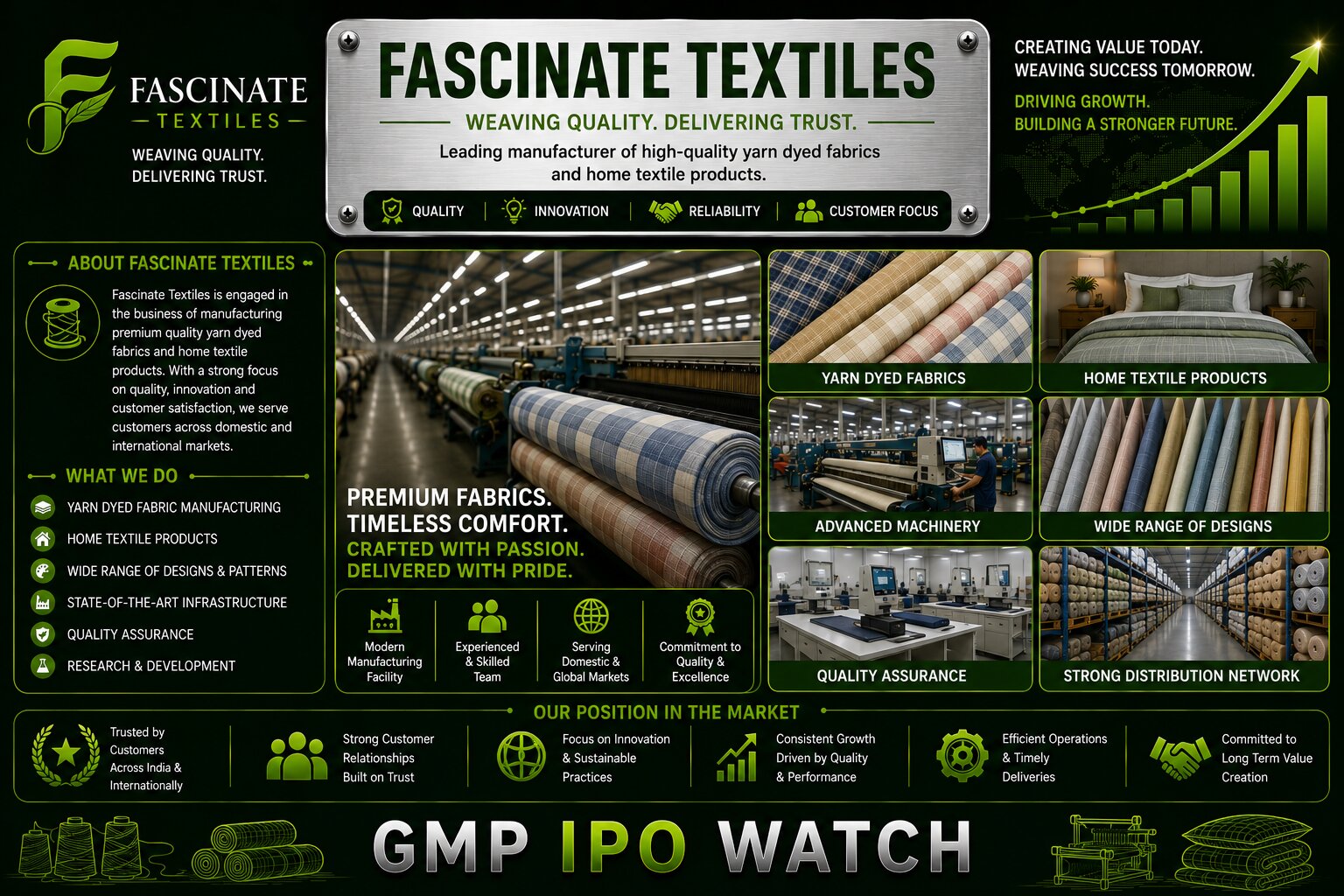
Fascinate Textiles IPO 2026 – Can a Garment Manufacturer Turn Rapid Growth Into a Sustainable Business?
The textile industry is often discussed in terms of cotton, yarn and fabric.
But the highest-value stage can come much later.
A piece of fabric must still be designed, cut, printed, stitched, finished, inspected, packed and delivered before it becomes a garment sitting on a retail shelf.
Fascinate Textiles Limited operates primarily at this apparel-manufacturing end of the textile value chain.
The Kolkata-based company manufactures knitted and woven garments across categories including:
- Infantwear
- Kidswear
- Menswear
- Womenswear
Its business has expanded rapidly ahead of the IPO, with FY2026 revenue reaching approximately ₹117.09 crore and PAT around ₹15.10 crore.
The company's NSE SME IPO opened on August 11, 2026, with a price band of ₹148 to ₹156 per share and an issue size of approximately ₹40.18 crore.
For investors, however, rapid historical growth is only the beginning of the analysis.
The more important question is:
Can Fascinate Textiles convert its recent revenue and profit expansion into sustainable post-IPO growth?
Fascinate Textiles IPO Details
| Particular | Details |
|---|---|
| Company | Fascinate Textiles Limited |
| IPO Type | Book Built SME IPO |
| Listing Platform | NSE SME |
| Issue Size | Approx. ₹40.18 Crore |
| Price Band | ₹148 – ₹156 Per Share |
| Face Value | ₹10 Per Share |
| IPO Opening Date | August 11, 2026 |
| Business | Readymade Garment Manufacturing |
| Product Categories | Infantwear, Kidswear, Menswear & Womenswear |
| Location | West Bengal |
The IPO consists of both a fresh issue and an Offer for Sale.
The fresh capital is particularly important because Fascinate is entering the public market while attempting to expand its operating scale.
What Does Fascinate Textiles Actually Do?
Fascinate Textiles is an apparel manufacturer.
The company works with both knitted and woven garments and supplies products across domestic and international markets.
Its manufacturing activities include areas such as:
Design → Fabric Processing → Cutting → Printing → Stitching → Finishing → Quality Control → Packing → Dispatch
The company states that stitching, finishing and printing capabilities are available at its facility.
Its website indicates production capacity of more than 2.5 lakh garments per month.
That means annualised garment output could be substantial if utilisation remains high.
Kidswear and Infantwear Are Interesting Categories
One important part of Fascinate's portfolio is children's clothing.
Kidswear has several attractive commercial characteristics.
Children outgrow clothing quickly.
That naturally creates a faster replacement cycle than many adult clothing categories.
Parents also purchase across multiple categories:
- Everyday wear
- School-related clothing
- Seasonal clothing
- Festival wear
- Sleepwear
- Occasion wear
Infantwear adds another specialised market where buyers place greater emphasis on comfort, fabric quality and safety.
This gives Fascinate exposure to consumer categories where demand is recurring rather than purely discretionary fashion demand.
Menswear and Womenswear Provide Diversification
The company is not dependent entirely on children's garments.
It also manufactures products for men and women.
A wider product portfolio can help a manufacturer serve larger apparel customers.
For example, a retailer may want one manufacturing partner capable of producing:
Kidswear + Menswear + Womenswear
instead of managing several smaller vendors.
That can potentially increase order size and strengthen customer relationships.
Manufacturing Capability Is Important, But So Is Outsourcing
One area investors should understand carefully is the distinction between processes performed directly by Fascinate and those handled through external processors.
The company's own website highlights in-house capabilities including:
- Stitching
- Finishing
- Printing
- Packing
But apparel production can also involve external processing for certain upstream textile activities.
This is not unusual in India's garment industry.
Many apparel companies outsource activities such as:
- Knitting
- Dyeing
- Fabric processing
- Specialised finishing
Outsourcing can reduce the amount of capital required to grow.
But it also creates supplier dependence.
Why Outsourcing Can Improve Capital Efficiency
Imagine Fascinate receives a large garment order.
Building every part of the textile chain internally would require investment in:
- Spinning
- Knitting
- Weaving
- Dyeing
- Processing
- Garmenting
That could require enormous capital.
Instead, the company can purchase or outsource some intermediate processes and concentrate investment on the areas where it adds the most value.
This can create a more asset-light growth model.
But only if outside vendors maintain:
- Quality
- Cost
- Delivery schedules
Supplier Quality Is Therefore Critical
A garment can fail quality inspection because of problems that occurred before stitching.
These can include:
- Incorrect fabric weight
- Colour variation
- Shrinkage
- Dye inconsistency
- Fabric defects
If Fascinate depends on outside processors for certain stages, vendor quality becomes part of the company's own reputation.
That makes supplier management extremely important.
FY2026 Was a Breakout Year
Fascinate Textiles reported approximately ₹117.09 crore revenue in FY2026.
Profit after tax increased to approximately ₹15.10 crore.
The magnitude of this improvement is one of the biggest attractions—and also one of the biggest questions—surrounding the IPO.
A rapidly growing SME can produce substantial shareholder value if the growth is sustainable.
But unusually rapid pre-IPO expansion deserves careful examination.
Investors need to determine whether FY2026 represents:
a new sustainable earnings base
or
an unusually strong year that may be difficult to repeat.
Revenue Growth Alone Is Not Enough
Suppose a company increases revenue from ₹60 crore to ₹120 crore.
That looks excellent.
But investors still need to ask:
- Did receivables double?
- Did inventory increase sharply?
- Did debt increase?
- Did operating cash flow improve?
- Did customer concentration rise?
- Are margins sustainable?
A healthy growth business should eventually convert reported profit into cash.
This is particularly important for SME companies.
Working Capital Is Central to Garment Manufacturing
Consider a garment export order.
Fascinate may need to spend money on:
- Fabric
- Accessories
- Labour
- Printing
- Packaging
- Transportation
before receiving full payment from the customer.
That creates a working-capital cycle:
Purchase material → manufacture garments → ship products → invoice customer → wait for payment
As revenue grows, the amount of cash trapped inside this cycle can also grow.
Why IPO Working Capital Can Accelerate Growth
Suppose Fascinate has orders worth ₹20 crore but only enough working capital to execute ₹12 crore immediately.
It may need to wait for customer collections before accepting additional business.
More working capital can remove that bottleneck.
This creates a possible cycle:
IPO capital → larger orders → higher production → higher sales → greater cash generation
But this works only when customers pay on time.
Receivables Need Close Monitoring
A company can report ₹15 crore profit without actually collecting ₹15 crore in cash.
If a large portion remains as receivables, the business may need additional borrowing to continue operating.
For Fascinate, investors should therefore monitor:
Revenue growth vs receivable growth
after listing.
If receivables grow much faster than sales, it can indicate deterioration in collection quality.
Export Markets Create a Large Opportunity
India has a significant position in the global textile and apparel supply chain.
International buyers increasingly diversify sourcing across multiple manufacturing countries.
India offers several structural advantages:
- Large textile ecosystem
- Skilled labour
- Cotton availability
- Established garment clusters
- Competitive manufacturing costs
- Large supplier network
For a smaller apparel manufacturer, even winning a few additional international customers can materially increase revenue.
But Export Orders Bring Additional Risks
Export customers can demand strict standards.
These may include:
- Product specifications
- Social compliance
- Quality audits
- Chemical restrictions
- Delivery timelines
- Packaging standards
Failure to meet requirements can result in:
- Rejected shipments
- Discounts
- Order cancellations
- Customer loss
Therefore, quality systems become increasingly important as export revenue grows.
Currency Movement Can Affect Export Economics
International apparel orders may be denominated in foreign currencies.
A weaker rupee can sometimes improve export realisations.
A stronger rupee can reduce competitiveness.
However, currency impact also depends on imported materials and hedging.
Investors should therefore not assume that currency depreciation automatically improves profits.
Fast Fashion Has Changed Apparel Manufacturing
Fashion cycles are becoming shorter.
Brands increasingly want:
- Smaller initial orders
- More styles
- Faster turnaround
- Quick replenishment
This changes what buyers expect from manufacturers.
Factories need flexibility.
A manufacturer capable of switching rapidly between garment designs can potentially become more valuable than one optimised only for extremely large standard orders.
Production Speed Can Become a Competitive Advantage
Suppose Retailer A identifies a product that is selling rapidly.
It wants another 50,000 pieces quickly.
The supplier that can respond in three weeks may win the repeat order over one requiring eight weeks.
Fascinate therefore needs to compete not only on price but also on:
speed + consistency + flexibility + quality.
Quality Certifications Can Support Larger Customers
Fascinate states that its manufacturing operations have certifications including ISO 9001 and SEDEX, while its website also references BSCI-related compliance.
For larger domestic and international buyers, compliance systems can be an important supplier-selection requirement.
Certifications do not guarantee future orders.
But they can help a manufacturer qualify for customers that may not work with unverified factories.
185+ Workers Support the Manufacturing Operation
The company reports a workforce of more than 185 professionals.
Garment manufacturing remains labour-intensive.
Even with automation, many processes require human skills:
- Cutting
- Stitching
- Inspection
- Finishing
- Packing
This makes workforce productivity an important economic factor.
Labour Availability Is a Risk
Apparel manufacturing can experience worker turnover.
If experienced sewing operators leave, factories may face:
- Lower production
- Training costs
- Quality issues
- Delayed orders
Labour availability and productivity therefore influence both margins and customer satisfaction.
Raw-Material Prices Can Affect Margins
Fabric represents a significant component of garment cost.
Prices can be influenced by:
- Cotton
- Polyester
- Yarn
- Dyeing chemicals
- Energy costs
If raw-material prices rise suddenly, Fascinate may not always be able to immediately pass the entire increase to customers.
That can temporarily compress margins.
Customer Concentration Deserves Attention
Small and mid-sized garment manufacturers often depend heavily on a limited number of major customers.
A large buyer can contribute significant annual revenue.
That creates risk.
If one customer changes sourcing strategy, annual sales can decline sharply.
Fascinate's future business quality would improve if revenue becomes distributed across a larger base of domestic and international customers.
IPO-Funded Expansion Must Produce Returns
Fresh IPO proceeds can support growth, but raising capital does not itself create value.
The key question is what return Fascinate earns on the additional money.
For example:
₹20 crore new capital → ₹5 crore additional annual profit
would be significantly more attractive than:
₹20 crore new capital → ₹1 crore additional annual profit.
Investors should therefore track ROCE after the IPO.
Strong FY2026 Margins Need to Be Tested
The FY2026 PAT of approximately ₹15.10 crore against revenue of around ₹117.09 crore implies a strong net profit margin for a garment manufacturer.
That makes margin sustainability one of the most important areas for investors to monitor.
The company will need to demonstrate that these margins can survive:
- Raw-material volatility
- Wage inflation
- Customer negotiations
- Competitive pricing
- Expansion costs
A few post-listing quarters should provide more clarity.
Fascinate Textiles IPO GMP
The grey-market market for Fascinate Textiles remains limited at the opening stage.
Early GMP indications have not shown a significant established premium.
Because the issue has only just opened, sentiment can change substantially before listing.
Investors should remember that GMP is:
- Unofficial
- Unregulated
- Highly volatile
- Not a guaranteed listing price
It should not replace fundamental analysis.
Day-1 Subscription
The Fascinate Textiles IPO opened on August 11, 2026.
Initial Day-1 data showed subscription activity only beginning across QIB, NII and retail categories.
Early morning Day-1 figures have little analytical value because investors, particularly institutions, frequently submit bids later.
The final subscription numbers will provide a more useful picture of demand.
What Makes Fascinate Textiles Interesting?
Rapid FY2026 Growth
Revenue reached approximately ₹117.09 crore with PAT of ₹15.10 crore.
Multiple Garment Categories
The company serves infantwear, kidswear, menswear and womenswear.
Domestic and Export Opportunity
International apparel sourcing provides a large addressable market.
Production Capability
The company states monthly capacity exceeding 2.5 lakh garments.
Integrated Garment Operations
Stitching, finishing, printing and packing capabilities support execution.
SME Growth Potential
Because the current revenue base is relatively small, winning a few major customers can materially affect growth.
Key Risks Investors Should Understand
Sustainability of FY2026 Growth
Recent revenue and profit growth has been unusually strong.
Margin Sustainability
High FY2026 profitability may attract competition and customer negotiation.
Outsourcing Dependence
External processing creates supplier and quality-control risk.
Customer Concentration
Loss of major customers could materially affect revenue.
Working-Capital Requirements
Fast growth can absorb significant cash.
Raw-Material Volatility
Cotton, yarn and fabric prices can affect margins.
Labour Dependence
Garment manufacturing remains workforce-intensive.
SME Liquidity
NSE SME stocks can experience low liquidity and sharp price movements after listing.
An Important Due-Diligence Point
Prospective investors should read Fascinate Textiles' final offer documents carefully, particularly disclosures regarding production processes, outsourced activities, capacity and segment reporting.
Public investor discussions have raised allegations questioning aspects of earlier manufacturing-capacity and outsourcing disclosures.
These are third-party allegations and should not be treated as established facts.
However, because such questions have been publicly raised, investors considering the IPO should independently compare the final RHP/addenda and company responses before making an investment decision.
For an SME IPO, understanding exactly which processes are performed internally and which are outsourced is especially important when evaluating margins and capital requirements.
What Should Investors Track After Listing?
Revenue Growth
Can Fascinate maintain meaningful growth after the IPO?
PAT Margin
Does FY2026 profitability remain sustainable?
Operating Cash Flow
Are reported earnings converting into actual cash?
Receivable Days
Are customers paying within reasonable periods?
Customer Diversification
Is dependence on large buyers declining?
Capacity Utilisation
Is manufacturing infrastructure being used efficiently?
Export Revenue
Can Fascinate win more international business?
ROCE
Does IPO-funded expansion generate attractive returns?
The Long-Term Opportunity
Fascinate does not need to become one of India's largest textile companies to grow meaningfully.
Its current revenue base is relatively small.
That means incremental orders can have a large impact.
For example, adding ₹30 crore of annual profitable business to a ₹117 crore revenue base would be meaningful.
The growth equation could therefore become:
More customers + larger orders + higher capacity utilisation + better product mix = earnings growth
But maintaining financial discipline will be essential.
Should Investors Consider Fascinate Textiles IPO?
The positive investment case includes:
- Strong FY2026 revenue growth
- ₹15 crore-plus reported PAT
- Diversified garment categories
- Domestic and export exposure
- Established garment-production capabilities
- Potential for IPO-funded expansion
The caution points include:
- SME IPO risk
- Sustainability of recent margins
- Working-capital intensity
- Outsourced manufacturing processes
- Customer concentration
- Raw-material volatility
- Publicly raised disclosure concerns requiring independent due diligence
This makes Fascinate Textiles an IPO where investors should look beyond headline growth numbers.
Final View on Fascinate Textiles IPO 2026
The Fascinate Textiles IPO 2026 arrives after a major expansion in the company's financial performance.
FY2026 revenue reached approximately ₹117.09 crore, while PAT increased to approximately ₹15.10 crore.
The company operates across infantwear, kidswear, menswear and womenswear and reports production capability of more than 2.5 lakh garments per month.
Its opportunity is supported by India's large apparel manufacturing ecosystem and the potential to increase both domestic and export orders.
But the central investment question is not whether Fascinate grew rapidly before the IPO.
That is already visible in the numbers.
The important question is:
How much of that growth can be repeated after listing?
Investors should therefore pay particular attention to cash-flow conversion, receivables, customer concentration, outsourced production arrangements and the sustainability of FY2026 margins.
If Fascinate can demonstrate that its recent profitability is supported by repeat customer demand, disciplined working capital and efficient production, the relatively small revenue base leaves room for meaningful expansion.
If margins normalise sharply or cash flow fails to match reported profits, however, the investment case could change quickly.
Overall, Fascinate Textiles represents a fast-growing SME apparel manufacturing IPO with strong recent financial performance and exposure to India's expanding garment ecosystem, but the unusually rapid FY2026 growth and publicly raised disclosure questions make careful reading of the final offer documents particularly important before considering the issue.