 GMP IPO Watch
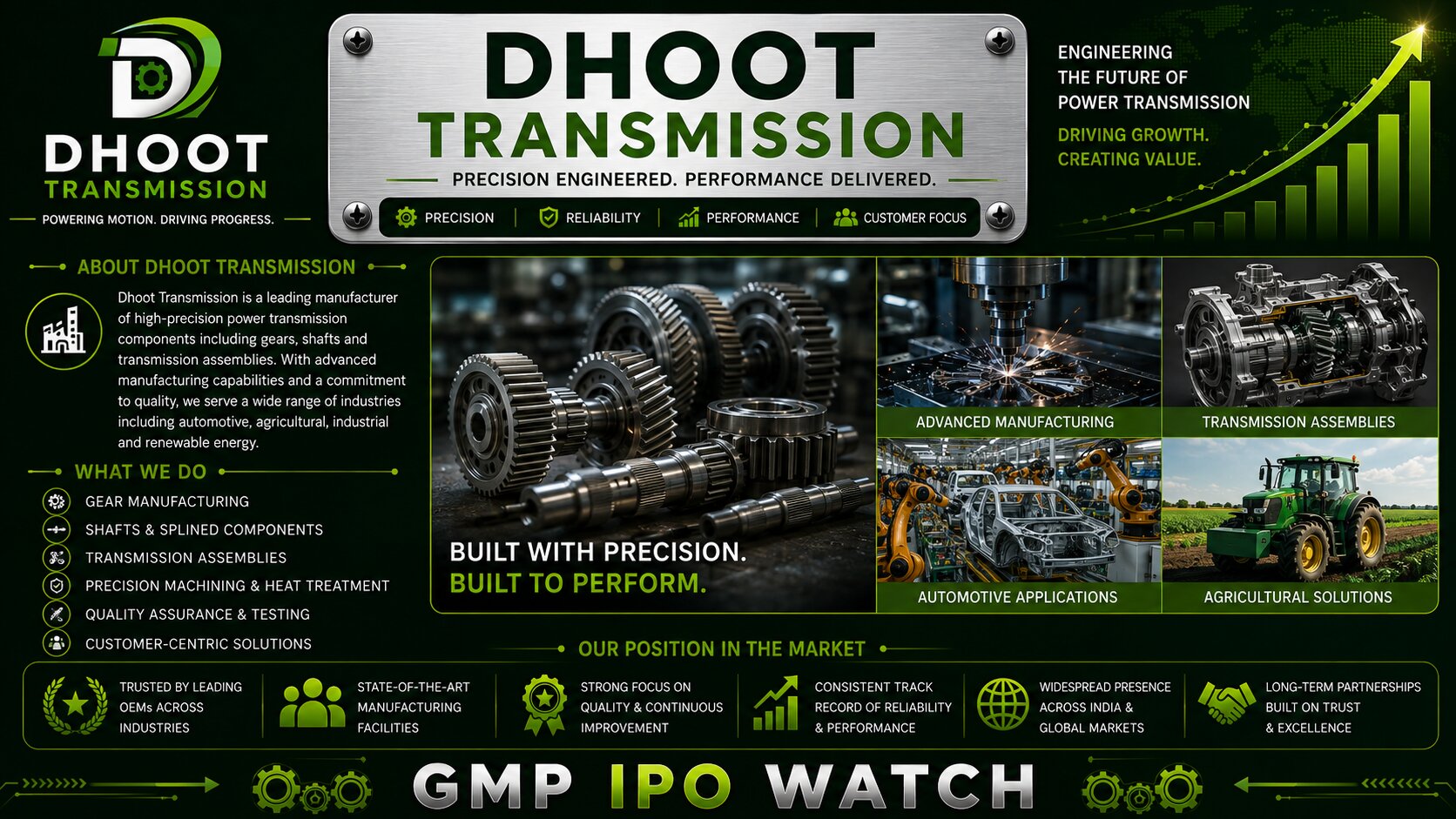
Dhoot Transmission IPO 2026 – Understanding the Business Behind a Vehicle's Electrical Network
Open the bonnet of a modern vehicle and beneath the visible engine, battery and mechanical components sits a complex network of wires.
Those wires connect almost everything.
The headlights, ignition system, dashboard, sensors, battery, electronic controls and safety systems all depend on an organised electrical distribution network known as a wiring harness.
That seemingly simple product is at the centre of Dhoot Transmission's business.
Dhoot Transmission is an established Indian automotive component manufacturer with operations spanning wiring harnesses, automotive cables, electronic components and related electrical systems. Over the years, the company has expanded beyond India and developed a manufacturing presence serving major automotive customers.
The company is now moving toward the public market, making the Dhoot Transmission IPO an important upcoming issue to track in India's automotive component space.
Unlike an IPO where pricing and subscription dates are already available, Dhoot Transmission remains at the regulatory preparation stage. Therefore, investors should separate confirmed business information from IPO terms that will only become available closer to launch.
This fresh review focuses on the economics behind the company's products, customer relationships, manufacturing footprint, EV opportunity and the factors that could determine its long-term value.
Dhoot Transmission IPO – Current Status
Dhoot Transmission has taken steps toward a proposed public issue by filing its IPO documents with the market regulator.
At the present stage, final details such as the following should be treated as pending until officially announced:
- IPO opening date
- IPO closing date
- Price band
- Lot size
- Final issue size
- Anchor investor date
- Allotment date
- Listing date
These details generally become available closer to the IPO opening through the company's Red Herring Prospectus and exchange announcements.
Investors should therefore avoid relying on unofficial dates or prices circulating before the final offer documents are released.
About Dhoot Transmission
Dhoot Transmission has built its business around automotive electrical and electronic components.
Its product portfolio includes areas such as:
- Wiring harnesses
- Automotive cables
- Battery cables
- Wiring assemblies
- Automotive switches
- Electronic components
- Vehicle electrical systems
- EV-related electrical products
These components are supplied primarily to Original Equipment Manufacturers, commonly known as OEMs.
The company's customers operate across multiple vehicle categories, creating exposure to the broader automotive manufacturing ecosystem.
Why Wiring Harnesses Are So Important
A wiring harness can be compared with the nervous system of a vehicle.
A human nervous system carries information between the brain and different parts of the body.
Similarly, a vehicle's wiring system carries electrical power and signals between different components.
For example:
Battery → wiring harness → control unit → headlights
or
Sensor → wiring → ECU → dashboard
As vehicles become more electronic, the number and complexity of these connections increase.
That makes electrical architecture increasingly important to automotive manufacturers.
More Electronics Per Vehicle Can Mean More Opportunity
Automobiles have changed considerably.
A basic vehicle once required relatively simple electrical systems.
Today's cars can contain:
- Touchscreen infotainment
- Multiple cameras
- Parking sensors
- Automatic climate control
- Electronic seats
- Digital instrument clusters
- ADAS sensors
- Connected-car technology
- Multiple airbags
- Electronic stability systems
Every additional electronic feature requires power and data connections.
This increases the electrical content per vehicle.
For wiring and electrical component suppliers, this trend can create growth even without extraordinary growth in overall vehicle volumes.
Two-Wheeler Market Is an Important Opportunity
India is one of the world's largest two-wheeler markets.
Motorcycles and scooters require wiring systems connecting components such as:
- Ignition
- Battery
- Headlamp
- Indicators
- Instrument cluster
- Sensors
- Fuel system
- Engine electronics
With premium motorcycles adding more electronic features, wiring complexity is also increasing.
Electric scooters create another layer of opportunity because their electrical architecture is fundamentally more important to vehicle operation.
Dhoot Transmission's Manufacturing Footprint
One important characteristic of Dhoot Transmission is the scale and geographic spread of its operations.
The company has developed manufacturing capabilities across India and international markets.
A broader manufacturing footprint can provide several advantages:
- Production closer to OEM customers
- Reduced transportation time
- Better customer support
- Geographic diversification
- Access to international markets
- Lower dependence on one manufacturing location
Automotive manufacturers often prefer suppliers capable of supporting them near major production hubs.
This can make manufacturing proximity an important competitive advantage.
Why Being Close to an OEM Matters
Automotive production works on strict schedules.
Vehicle assembly plants cannot afford to stop production because one small component is unavailable.
Suppliers therefore need reliable delivery systems.
Imagine an OEM produces 2,000 motorcycles every day.
If a ₹1,000 wiring harness does not arrive, the manufacturer cannot simply sell the vehicle without it.
Thousands of rupees of missing components can potentially delay crores of rupees worth of finished vehicles.
That gives dependable suppliers strategic importance within automotive supply chains.
How Dhoot Transmission Earns Revenue
Dhoot Transmission's business is primarily based on supplying automotive components to customers.
A simplified commercial cycle looks like:
OEM develops vehicle → supplier receives specifications → product development → testing → OEM approval → commercial production → recurring component supply
Once a supplier's product is approved for a particular vehicle programme, it may continue supplying that component throughout the model's production lifecycle.
This creates the possibility of recurring revenue from existing customer programmes.
OEM Approval Creates an Entry Barrier
Becoming an automotive supplier is not simply about manufacturing a similar product at a cheaper price.
OEMs typically evaluate:
- Product quality
- Engineering capability
- Production capacity
- Financial stability
- Delivery performance
- Safety standards
- Manufacturing processes
- Quality certifications
Components may then undergo extensive validation.
This creates a natural barrier to entry.
An established supplier with approved products and a strong delivery record may therefore have an advantage over a new entrant.
But OEM Relationships Create Customer Concentration Risk
Strong customer relationships can create stable business.
However, they can also create dependence.
Suppose a large vehicle manufacturer contributes a significant percentage of revenue.
If that customer:
- Loses market share
- Changes supplier
- Reduces production
- Discontinues a model
- Negotiates lower prices
the component supplier can experience a meaningful impact.
Therefore, investors should closely study Dhoot Transmission's customer concentration once detailed IPO financial disclosures are available.
Electric Vehicles Could Reshape the Business
EVs represent one of the biggest long-term changes in automotive manufacturing.
A conventional internal-combustion vehicle uses electrical systems primarily to support the mechanical powertrain.
An electric vehicle relies much more heavily on electricity.
EV architecture includes:
- Battery packs
- Battery management systems
- Electric motors
- Charging systems
- Power electronics
- High-voltage cables
- Electronic control units
- Thermal-management systems
This creates new requirements for wiring and electrical component manufacturers.
High-Voltage Wiring Can Create Higher-Value Opportunities
Traditional automotive wiring generally carries relatively low voltage.
EVs require specialised high-voltage connections between components such as:
Battery → inverter → motor
and
Charging port → battery pack
These systems require:
- Better insulation
- Thermal resistance
- High-voltage connectors
- Safety protection
- Precision manufacturing
Suppliers that successfully develop these capabilities can potentially increase their value per vehicle.
For Dhoot Transmission, EV-related product development could therefore become an important future growth driver.
EV Transition Also Creates Risk
The transition isn't automatically positive for every automotive supplier.
Some conventional vehicle components may become less important.
Technology may change quickly.
OEMs may develop new supplier relationships.
International component manufacturers may enter India.
Therefore, the key question isn't whether EV adoption will grow.
The key question is whether Dhoot Transmission can win a meaningful share of the electrical content inside future EV platforms.
Copper Is an Important Raw Material
Automotive wiring relies heavily on copper.
That creates commodity-price exposure.
If copper prices increase sharply, manufacturing costs rise.
Whether that affects profitability depends on the company's contracts with customers.
Some agreements may allow raw-material price adjustments.
Others may involve a delay before higher costs can be passed through.
Investors should therefore monitor the relationship between:
Copper prices → product pricing → gross margins.
Labour Efficiency Matters Too
Wiring harness manufacturing can involve significant manual assembly.
Individual wires must be:
- Cut
- Stripped
- Crimped
- Connected
- Bundled
- Routed
- Tested
Complex harnesses may contain numerous individual connections.
This makes workforce productivity, quality control and automation important to profitability.
Quality Failure Can Be Expensive
Automotive electrical components are safety-critical.
A defective wiring harness could cause:
- Electrical failure
- Sensor malfunction
- Lighting problems
- Vehicle breakdown
- Safety issues
Large quality failures can potentially lead to:
- Warranty claims
- Customer penalties
- Product recalls
- Reputation damage
Maintaining strict quality standards is therefore fundamental to the business.
International Operations Provide Diversification
A global manufacturing presence can reduce dependence on the Indian automotive cycle.
International operations may provide exposure to:
- European automotive markets
- Overseas OEM customers
- Global component supply chains
- Foreign currency revenue
Geographic diversification can improve growth opportunities.
However, international operations also introduce risks such as:
- Currency fluctuations
- Different labour regulations
- Geopolitical disruptions
- Overseas operating costs
- Local economic cycles
What Financial Numbers Matter Most?
Once the final IPO documents provide updated financial statements, investors should focus on several metrics.
Revenue Growth
Is the company consistently increasing its business with OEM customers?
EBITDA Margin
Does Dhoot maintain healthy profitability despite raw-material volatility?
Profit After Tax
Is earnings growth keeping pace with revenue?
Operating Cash Flow
Are reported profits converting into actual cash?
Debt
How leveraged is the business?
ROCE
Is management generating attractive returns from manufacturing investments?
Working Capital
How much money is locked in inventory and customer receivables?
These metrics together provide a more meaningful view than revenue alone.
Working Capital Is Particularly Important
Automotive suppliers generally purchase raw materials and manufacture components before customers pay them.
Cash can therefore become tied up in:
- Copper
- Plastic components
- Connectors
- Work-in-progress
- Finished goods
- Trade receivables
Fast growth can actually increase working-capital requirements.
Investors should therefore compare revenue growth with operating cash-flow growth.
Product Diversification Can Reduce Risk
Dhoot Transmission's opportunity isn't limited to one wiring product.
A broader electrical component portfolio can allow the company to increase the amount of revenue generated from each vehicle platform.
For example, instead of supplying only a harness, the company could potentially supply:
Harness + cable + switch + electronic component
Increasing content per vehicle can become an important growth strategy.
Automotive Premiumisation Is Another Tailwind
Consumers increasingly prefer vehicles with more features.
Even relatively affordable cars and two-wheelers now include technology previously found mainly in premium vehicles.
Examples include:
- Digital displays
- Bluetooth connectivity
- USB charging
- LED lighting
- Navigation
- Electronic safety features
Every additional electrical feature potentially increases the complexity of vehicle wiring.
This trend can support demand for sophisticated electrical systems.
Localisation Can Benefit Indian Suppliers
Automobile manufacturers continue increasing localisation of components.
Domestic sourcing can help OEMs:
- Reduce import costs
- Shorten supply chains
- Lower currency risk
- Improve delivery reliability
- Respond faster to production changes
Established Indian component manufacturers can benefit if they successfully replace imported products with locally manufactured alternatives.
Competitive Strengths to Watch
Dhoot Transmission's investment case may be supported by several factors.
Long Automotive Industry Experience
An established operating history can strengthen OEM confidence.
Existing Customer Relationships
Approved supplier relationships can create repeat business.
International Manufacturing Presence
Geographic diversification expands the addressable market.
Wiring Harness Expertise
Electrical content per vehicle continues increasing.
Multiple Automotive Segments
Exposure across vehicle categories can reduce dependence on one segment.
EV Opportunity
High-voltage and electronic systems could create new product opportunities.
Major Risks Investors Should Understand
Customer Concentration
Large OEM customers may represent substantial revenue.
Commodity Prices
Copper and other raw-material fluctuations can affect margins.
Automotive Cyclicality
Vehicle demand can slow during weaker economic conditions.
EV Technology Transition
New electrical architectures may require substantial investment.
Quality Risk
Product defects could lead to warranty or customer claims.
Global Operations
International manufacturing introduces currency and geopolitical risks.
Working Capital
Rapid growth may require significant additional funding.
Pricing Pressure
Large automobile manufacturers often have strong negotiating power over suppliers.
What Could Drive Dhoot Transmission's Next Growth Phase?
Several structural trends may create opportunities.
More Electronics Per Vehicle
Connected and feature-rich vehicles require more complex electrical systems.
Electric Two-Wheelers
India's rapidly evolving electric scooter and motorcycle market creates new wiring requirements.
Passenger EVs
Higher-voltage architecture may increase electrical content per vehicle.
Export Growth
International customer expansion can diversify revenue.
Premiumisation
More vehicle features create additional component opportunities.
Localisation
OEM efforts to source more components domestically can support Indian suppliers.
IPO Pricing Will Be Critical
Because the final price band has not yet been announced, it is too early to make a complete valuation assessment.
Even an excellent company can become an unattractive investment if offered at an excessive valuation.
Once the price band is announced, investors should compare Dhoot Transmission with relevant listed automotive component companies using metrics such as:
- P/E ratio
- EV/EBITDA
- Price-to-book value
- ROE
- ROCE
- EBITDA margin
- Revenue growth
Valuation should be analysed alongside business quality.
Don't Treat GMP as Important Yet
Until the IPO price band and subscription schedule are officially announced, any supposed Grey Market Premium should be treated cautiously.
Meaningful GMP tracking generally begins closer to the actual issue.
Investors should avoid making decisions based on unofficial numbers circulated while an IPO remains at the filing stage.
Questions Investors Should Ask Before Applying
Before investing in Dhoot Transmission IPO, investors should examine:
- What percentage of revenue comes from the top five customers?
- How much revenue is generated outside India?
- What percentage of business comes from wiring harnesses?
- How much revenue is already linked to electric vehicles?
- What are the company's EBITDA and PAT margins?
- How volatile are margins when copper prices rise?
- What is the debt position?
- How strong is operating cash flow?
- What will the fresh IPO proceeds be used for?
- At what valuation is the IPO being offered?
These answers will be far more useful than simply asking whether the IPO will list at a premium.
Should Long-Term Investors Track Dhoot Transmission IPO?
Dhoot Transmission operates in an industry with several attractive structural trends.
The company may benefit from:
- Rising automotive production
- Increasing electronics per vehicle
- EV adoption
- Vehicle premiumisation
- Component localisation
- International expansion
At the same time, the business faces important risks involving customer concentration, commodity prices, OEM pricing power and technology changes.
Therefore, the IPO deserves attention, but the final investment case should only be formed after reviewing the updated financial statements and valuation in the offer documents.
Final View on Dhoot Transmission IPO 2026
The Dhoot Transmission IPO offers an interesting way to look at India's automobile transformation from inside the vehicle rather than from the showroom.
As automobiles become more electronic, the wiring network connecting their systems becomes increasingly sophisticated. Electric vehicles push this transformation further by making electrical architecture central to the entire powertrain.
Dhoot Transmission's established wiring-harness expertise, automotive customer relationships, manufacturing footprint and exposure to electrical components position it to participate in this change.
The company's future opportunity will depend on three things in particular:
First, whether it can increase the amount of electrical content supplied per vehicle.
Second, whether it can successfully transition toward high-value EV and electronic products.
Third, whether it can convert revenue growth into healthy margins, cash flow and returns on capital.
The proposed IPO could provide investors with exposure to an established automotive component manufacturer participating in India's transition toward more connected, electronic and electric vehicles.
However, because final IPO terms are still awaited, investors should avoid making an application decision until the price band, issue structure, updated financial performance, use of proceeds and valuation are officially available.
Overall, Dhoot Transmission represents a potentially important automotive-component IPO to track in 2026, with its long-term opportunity driven by increasing vehicle electronics, EV adoption and global manufacturing expansion rather than simply growth in traditional vehicle volumes.