 GMP IPO Watch
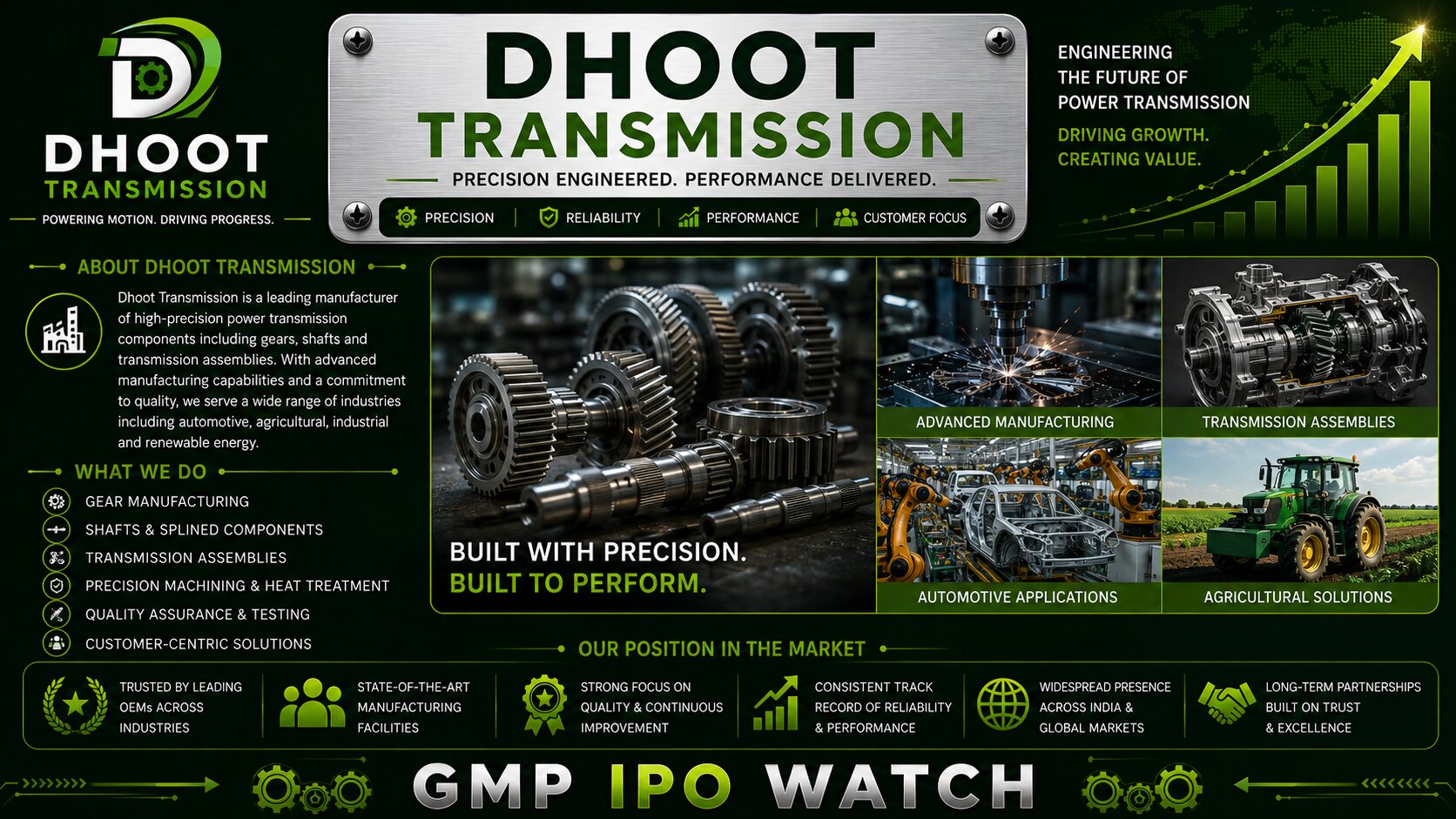
Dhoot Transmission IPO 2026 – The Opportunity Is Becoming Bigger Than Wiring Harnesses
A wiring harness may appear to be a collection of cables and connectors.
But inside a modern vehicle, that network connects almost every major electrical and electronic function.
As vehicles become more connected, feature-rich and electric, the value of those electrical systems increases.
That is the opportunity Dhoot Transmission Limited is trying to capture.
The company has spent decades building a large automotive electrical and electronics business, but the next stage of its growth is increasingly centred on products beyond traditional wiring harnesses.
Its portfolio now includes areas such as:
- Battery assemblies
- DC-DC converters
- On-board chargers
- Charging guns
- Sensors
- Electronic controllers
- Automotive switches
- Connectors and terminals
The company's CFO has identified electrification as the biggest growth driver, followed by vehicle premiumisation.
The Dhoot Transmission IPO opened on August 10, 2026, closes on August 12, 2026, and carries a price band of ₹829 to ₹871 per share.
For investors, the central question is therefore no longer simply whether Dhoot can sell more wiring harnesses.
It is whether Dhoot can increase the amount of electrical and electronic content it supplies inside every vehicle.
Dhoot Transmission IPO Details
| Particular | Details |
|---|---|
| Company | Dhoot Transmission Limited |
| IPO Type | Mainboard Book Built IPO |
| Total Issue Size | ₹3,066.89 Crore |
| Fresh Issue | ₹1,400 Crore |
| Offer for Sale | ₹1,666.89 Crore |
| Price Band | ₹829 – ₹871 Per Share |
| Face Value | ₹2 Per Share |
| Lot Size | 17 Shares |
| Minimum Retail Investment | ₹14,807 at ₹871 |
| IPO Opening Date | August 10, 2026 |
| IPO Closing Date | August 12, 2026 |
| Expected Allotment | August 13, 2026 |
| Expected Listing | August 17, 2026 |
| Listing | BSE & NSE |
| Registrar | KFin Technologies Limited |
The issue includes a fresh issue of approximately 1.61 crore shares worth ₹1,400 crore and an OFS aggregating approximately ₹1,666.89 crore.
What Does Dhoot Transmission Actually Manufacture?
Dhoot Transmission operates across automotive electrical and electronic systems.
Its product portfolio includes:
- Wiring harnesses
- Electrical distribution systems
- Battery packs and assemblies
- Sensors
- Controllers
- Automotive switches
- Terminals
- Connectors
- Automotive cables
- Power supply cords
- EV-specific electrical products
The company supplies products for both internal-combustion-engine and electric vehicle platforms.
Its customers include major automotive manufacturers such as Bajaj Auto, TVS Motor Company, Honda Motorcycle and Scooter India and Royal Enfield.
Dhoot Is Already a Major Wiring-Harness Player
Dhoot Transmission is among India's leading suppliers of wiring harnesses for two-wheelers and three-wheelers.
Recent IPO disclosures put its overall market share in this segment at roughly 41% in FY2026, while earlier FY2025 disclosures put the share at approximately 44.64% by value.
The more striking number is its position in electric two- and three-wheelers.
The company commands approximately 70% market share in EV two-wheeler and three-wheeler wiring harnesses.
That creates direct exposure to one of India's fastest-moving electrification segments.
Why Two- and Three-Wheeler EVs Matter
India's EV transition is currently particularly strong in two- and three-wheelers because:
- Purchase prices are lower than cars
- Daily journeys are shorter
- Urban fleet usage is high
- Charging requirements can be simpler
Dhoot believes this transition can increase the electrical content required per vehicle.
An electric scooter is therefore not simply replacing one petrol scooter with a similar wiring system.
The electrical architecture becomes more important to the vehicle itself.
EVs Can Increase Wiring Content Per Vehicle
A conventional vehicle may use wiring for:
- Lighting
- Ignition
- Sensors
- Dashboard
- Controls
An electric vehicle additionally requires electrical connectivity around:
- Battery packs
- Motor controllers
- Charging systems
- Power electronics
- Thermal management
- High-voltage circuits
This can increase the value of electrical components supplied per vehicle.
That is why Dhoot's existing EV market share is strategically important.
The Bigger Story Is Non-Harness Revenue
Dhoot is deliberately expanding beyond wiring harnesses.
Its non-harness portfolio increased to approximately 23% of revenue, compared with about 18% in FY2024.
That means nearly one-fourth of revenue is now coming from products other than the company's traditional core harness business.
These products include EV and electronics categories such as:
- Battery assemblies
- On-board chargers
- DC-DC converters
- Charging guns
- Sensors
- Controllers
This diversification can potentially increase revenue per vehicle and reduce dependence on a single product category.
Increasing Content Per Vehicle Can Be a Powerful Growth Strategy
Consider a simplified example.
Suppose Dhoot previously supplied ₹4,000 worth of wiring products to one vehicle.
If it later supplies:
- Wiring harness: ₹4,000
- Electronic controller: ₹1,500
- Charging component: ₹2,000
- Battery-related assembly: ₹2,500
the company's content value becomes ₹10,000 per vehicle.
Vehicle volumes did not need to increase 2.5 times.
Instead, Dhoot increased the value captured from each vehicle.
This is one of the most attractive potential growth levers in the business.
Around 95% of the Portfolio Is EV-Focused or Powertrain-Neutral
One major risk for conventional auto-component suppliers is technological obsolescence during the transition from ICE vehicles to EVs.
Dhoot appears comparatively well positioned.
Approximately 95% of its automotive product portfolio is either EV-focused or powertrain-neutral.
Powertrain-neutral means the product can potentially remain relevant regardless of whether the vehicle uses:
- Petrol
- Diesel
- Hybrid
- Battery electric power
That reduces the risk that electrification destroys a large part of the existing product portfolio.
Vehicle Premiumisation Is Another Growth Driver
Modern vehicles increasingly include:
- Digital instrument clusters
- Connected features
- Additional sensors
- Electronic safety systems
- Premium lighting
- Smart switches
- Charging ports
- ADAS-related electronics
Every new feature can require additional electrical and electronic content.
Dhoot's management expects premiumisation to be an important growth driver alongside electrification.
This means the company could benefit even if overall vehicle volumes grow moderately.
Dhoot Has Already Invested Heavily in Capacity
The company has spent approximately ₹1,000 crore on capital expenditure over the last four to five years.
That capital has supported:
- Manufacturing expansion
- New product categories
- Electronics capabilities
- EV systems
- International operations
Management expects further investment to support capacity growth while targeting annual margins around 15%–16%.
This makes Dhoot a significant manufacturing platform rather than a small single-product supplier.
Existing Manufacturing Footprint Is Large
As of December 31, 2025, Dhoot operated:
- 22 manufacturing facilities
- 3 engineering and design centres
- 7 warehouses
across India and overseas markets.
The company also had four additional plants under construction in India.
Scale matters because large OEMs generally prefer suppliers capable of supporting production across several locations.
Two New Wiring-Harness Plants Are Planned
Dhoot intends to use approximately ₹150 crore of IPO proceeds to establish new wiring-harness manufacturing facilities at:
- Jhajjar, Haryana
- Shoolagiri, Hosur, Tamil Nadu
These locations can strengthen its ability to supply automotive manufacturing clusters in North and South India.
The investment is expected to be deployed over FY2027 and FY2028.
Why Location Near OEMs Matters
Automotive manufacturing relies heavily on just-in-time supply chains.
An OEM may produce thousands of vehicles each day.
If a critical wiring component does not arrive, production can be disrupted.
Manufacturing closer to customer facilities can potentially reduce:
- Delivery time
- Inventory requirements
- Logistics costs
- Supply interruptions
This can strengthen supplier relationships.
IPO Money Will Also Reduce Debt
The fresh issue proceeds will be used partly to strengthen the balance sheet.
Around ₹464.80 crore is planned for repayment or prepayment of Dhoot Transmission's own borrowings.
Another approximately ₹301.77 crore is planned for investment into subsidiaries so those businesses can repay debt.
These subsidiaries include businesses associated with automotive components, electronics and Dhoot's UK operations.
Debt reduction could lower finance costs and provide additional flexibility for future expansion.
Fresh Issue vs Offer for Sale
The ₹3,066.89 crore IPO consists of:
₹1,400 crore fresh issue
and
₹1,666.89 crore OFS.
Under the OFS, BC Asia Investments XV, associated with Bain Capital, is selling shares worth nearly ₹1,395 crore, while Mangalam Capital is selling approximately ₹272 crore worth of shares.
Therefore, slightly more than half of the overall IPO represents shareholder exits rather than capital entering Dhoot Transmission.
Bain Capital Backing
Bain Capital made a strategic growth investment in the Dhoot Transmission Group in January 2025.
The investment was intended to support continued expansion in automotive components and related growth opportunities.
Private-equity backing can bring:
- Growth capital
- Governance support
- Strategic discipline
- International automotive expertise
However, Bain is also partially monetising its investment through the IPO.
FY2026 Financial Performance
Dhoot Transmission reported strong growth in FY2026.
| Financial Metric | FY2025 | FY2026 |
| Total Income | ₹3,472.24 Cr | ₹4,563.70 Cr |
| Profit After Tax | ₹353.89 Cr | ₹396.84 Cr |
| Income Growth | — | ~31% |
| PAT Growth | — | ~12% |
The company's FY2026 total income increased approximately 31%, while PAT increased around 12%.
This indicates strong top-line growth, although profit expanded more slowly than revenue.
Revenue Has Scaled Rapidly Over Three Years
Earlier disclosures show revenue from operations increased from approximately:
₹2,125.86 crore in FY2023
to
₹3,444.86 crore in FY2025.
PAT increased from approximately:
₹163.91 crore in FY2023
to
₹353.89 crore in FY2025.
During the same period, EBITDA margin improved from approximately 14.05% to 17.15%.
That demonstrates both scale and improved operating efficiency.
Bajaj Auto Concentration Is a Major Risk
Dhoot has relationships with several large OEMs, but customer concentration remains important.
Reuters reported that Bajaj Auto contributed about one-third of Dhoot Transmission's FY2026 revenue.
This creates meaningful concentration risk.
If Bajaj Auto were to:
- Reduce production
- Change suppliers
- Negotiate lower prices
- Shift technology
- Lose market share
Dhoot's results could be affected.
Diversifying the customer base and increasing business with other OEMs will therefore be important.
Large OEMs Also Have Pricing Power
Automotive manufacturers are generally much larger than component suppliers.
They can negotiate strongly on:
- Component prices
- Cost reductions
- Payment terms
- Quality standards
- Delivery schedules
Suppliers must continuously improve productivity to protect margins.
Dhoot's scale and product diversification may help, but OEM pricing pressure remains a structural feature of the industry.
Raw Materials Can Affect Margins
Wiring and electrical systems require inputs such as:
- Copper
- Plastics
- Electronic components
- Connectors
- Semiconductors
Copper price volatility is particularly relevant to wiring businesses.
If input prices rise faster than selling-price adjustments, margins can temporarily come under pressure.
Electronics Also Creates Supply-Chain Risk
As Dhoot expands into electronic components, it becomes increasingly exposed to:
- Semiconductor supply
- Controllers
- Sensors
- Power electronics
- Imported components
Global electronics shortages can therefore influence manufacturing schedules.
This is different from the company's traditional wiring-harness supply chain.
International Operations Add Opportunity and Complexity
Dhoot has operations beyond India, including Dhoot Transmission UK.
International presence can support:
- Global OEM relationships
- Export revenue
- Geographic diversification
- Technology capability
But it also introduces:
- Currency risk
- Overseas labour costs
- Regulatory complexity
- International economic cycles
Investors should evaluate whether international expansion improves consolidated returns.
Dhoot Transmission IPO Day-2 Subscription Context
On Day 1, the IPO was subscribed approximately:
- Overall: 0.63×
- Retail: 0.74×
- NII: 1.09×
- QIB: 0.06×
The relatively low first-day QIB subscription is not necessarily unusual because institutions often place bids later in the issue period.
The final subscription mix after August 12 will provide a more useful signal.
Anchor Book Was Strong
Ahead of the public issue, Dhoot Transmission raised approximately ₹918.27 crore from 72 anchor investors.
The company allotted roughly 1.05 crore shares to anchors at the upper price of ₹871 per share.
Strong anchor participation indicates institutional interest before opening.
However, it should not be interpreted as a guarantee of post-listing returns.
Dhoot Transmission IPO GMP Today
The latest reported Grey Market Premium is approximately:
₹259 per share.
Against the upper issue price of ₹871, this represents an unofficial premium of roughly:
30%.
That implies an unofficial indicated price around ₹1,130.
However, GMP is:
- Unofficial
- Unregulated
- Highly volatile
- Not guaranteed
It should be used only as a short-term sentiment indicator.
Valuation Is Not Cheap
One brokerage analysis cited in current IPO coverage estimates that Dhoot is seeking a valuation of approximately 44.9× FY2026 earnings at the upper price band.
The post-issue market capitalisation is estimated at approximately ₹17,816 crore.
This means investors are paying a meaningful premium for:
- Market leadership
- EV exposure
- Strong growth
- Customer relationships
- Product diversification
The valuation leaves less room for execution mistakes.
Why a Premium Valuation Could Still Work
A higher P/E can be justified if Dhoot successfully delivers:
- Strong revenue growth
- Higher EV content
- Better product mix
- New plant utilisation
- Lower debt
- Customer diversification
- Stable margins
But if growth slows sharply, the market could re-rate the stock even if the company remains profitable.
Therefore, valuation and business quality should be considered together.
Competitive Strengths
Dhoot enters the IPO with several important advantages.
EV Wiring-Harness Leadership
Approximately 70% share in electric two- and three-wheeler wiring harnesses.
Large Overall Market Position
Among India's leading two- and three-wheeler wiring harness manufacturers.
EV-Ready Product Portfolio
Around 95% of products are EV-focused or powertrain-neutral.
Expanding Non-Harness Revenue
Non-harness products have increased from about 18% to 23% of revenue.
Large Manufacturing Base
22 plants and additional facilities under development as of December 2025.
Strong Financial Scale
FY2026 total income exceeded ₹4,500 crore.
New Capacity
₹150 crore planned for two new wiring-harness plants.
Major Risks
Customer Concentration
Bajaj Auto contributes about one-third of revenue.
Valuation
A roughly 45× FY2026 P/E creates high expectations.
Expansion Execution
New plants must achieve healthy utilisation.
OEM Pricing Pressure
Large vehicle manufacturers possess significant bargaining power.
Raw-Material Volatility
Copper and electronics prices can affect profitability.
Technology Risk
EV architecture continues evolving.
Capital Requirements
Management expects continued investment to support growth.
Large OFS
More than ₹1,600 crore of the IPO represents selling-shareholder proceeds.
What Investors Should Track After Listing
Long-term investors should focus on:
EV Revenue Contribution
Is Dhoot converting its market share into faster revenue growth?
Non-Harness Revenue
Does the 23% contribution continue rising?
Content Per Vehicle
Can Dhoot sell more products to each OEM programme?
Bajaj Auto Concentration
Does dependence on the largest customer fall?
EBITDA Margin
Can management maintain its targeted 15%–16% range?
New Plant Utilisation
Are Jhajjar and Hosur capacity additions producing returns?
Debt
Does IPO-funded repayment materially strengthen the balance sheet?
What Is the Real Long-Term Investment Thesis?
Dhoot Transmission should not be viewed simply as a wiring-harness manufacturer.
The investment thesis increasingly depends on whether it can evolve into a broader vehicle electrical and electronics systems supplier.
The growth equation can be expressed as:
More vehicles + more electronics per vehicle + higher EV penetration + more Dhoot products per vehicle
If all four factors move positively, revenue can potentially grow faster than the underlying automobile market.
Should Investors Consider Dhoot Transmission IPO?
The positive investment case includes:
- Strong EV market share
- Established OEM relationships
- ₹4,500 crore-plus FY2026 income
- Broad manufacturing footprint
- Expanding electronics portfolio
- Rising non-harness revenue
- IPO-funded debt reduction
- New manufacturing capacity
- Strong current GMP
The areas requiring caution include:
- Customer concentration
- Premium valuation
- OEM pricing power
- Capex execution
- Commodity-price volatility
- OFS size
The IPO therefore combines strong business positioning with demanding valuation expectations.
Final View on Dhoot Transmission IPO 2026
The Dhoot Transmission IPO 2026 offers investors exposure to one of India's largest automotive electrical and electronics manufacturers at a time when the vehicle architecture itself is changing rapidly.
Dhoot already controls approximately 70% of the electric two- and three-wheeler wiring-harness market, while around 95% of its automotive portfolio is EV-focused or powertrain-neutral.
At the same time, it is moving beyond its traditional core business.
Non-harness products now account for roughly 23% of revenue, up from about 18% in FY2024, with the company developing battery assemblies, chargers, converters and other EV systems.
Financially, FY2026 total income increased to approximately ₹4,563.70 crore, while PAT reached about ₹396.84 crore.
The ₹1,400 crore fresh issue will help reduce debt, strengthen subsidiaries and establish new plants in Haryana and Tamil Nadu.
The main concern is valuation and concentration.
At roughly 44.9× FY2026 earnings, Dhoot is not entering the market at a low multiple, while Bajaj Auto alone contributes about one-third of revenue.
Therefore, the long-term success of the listed company will depend on whether Dhoot can use its EV leadership to:
increase content per vehicle, diversify customers, grow non-harness electronics and maintain margins while executing substantial capacity expansion.
Overall, Dhoot Transmission represents a high-quality automotive electrification IPO with strong market share, established manufacturing scale and significant EV exposure, but investors should balance those strengths against customer concentration and a relatively premium IPO valuation.