 GMP IPO Watch
Credent Connect N Care IPO 2026 – Can Healthcare Outsourcing Become a Scalable National Business?
A diagnostic laboratory may own sophisticated testing machines.
A hospital may employ doctors.
But neither organisation necessarily wants to internally manage thousands of people moving diagnostic samples, performing home collections and coordinating healthcare logistics across multiple cities.
That creates a specialised outsourcing opportunity.
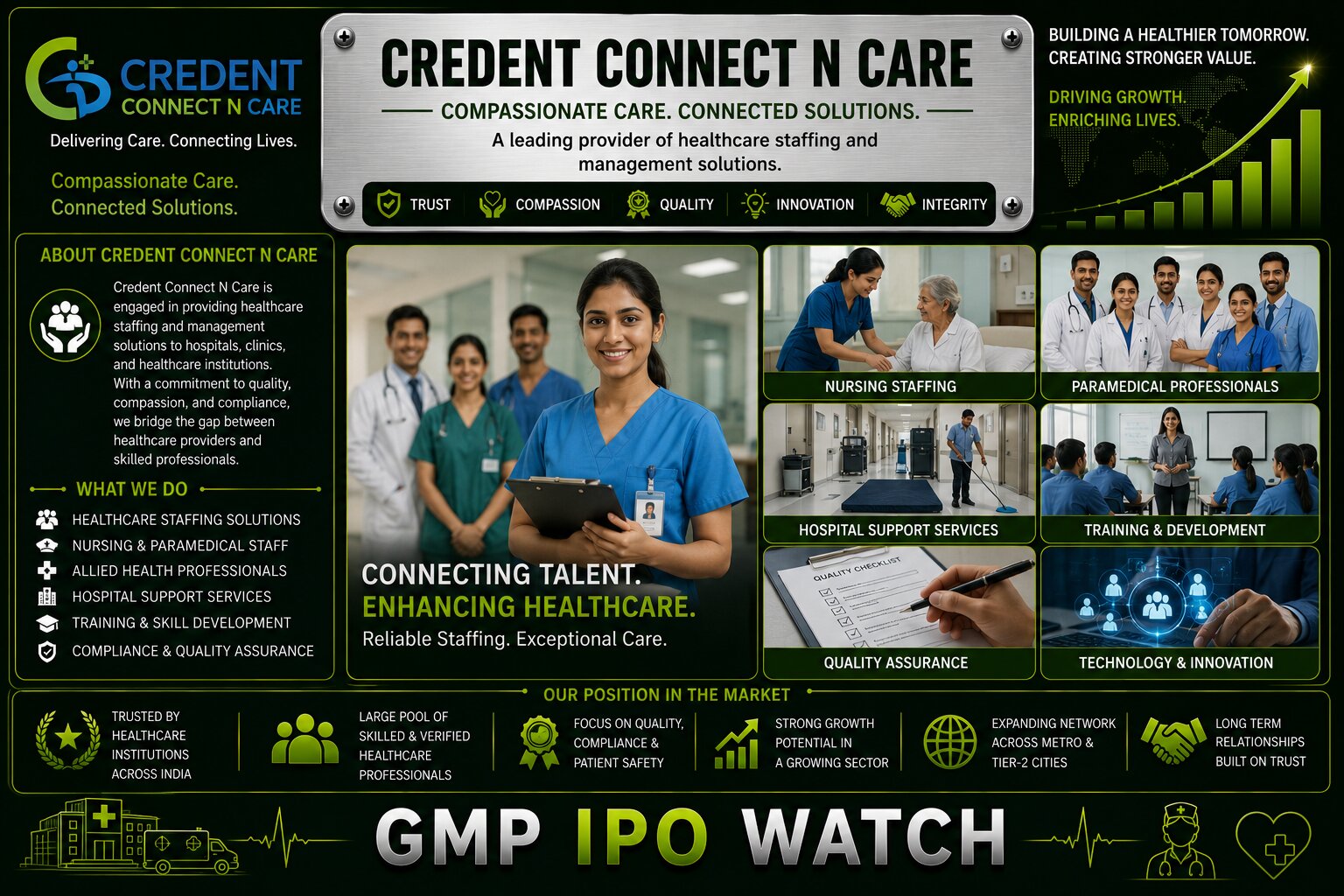
Credent Connect N Care Limited operates in this less visible part of India's healthcare system.
Instead of competing directly with hospitals or diagnostic laboratories, Credent helps those businesses operate.
Its services span healthcare logistics, diagnostic sample transportation, workforce deployment, home sample collection and related healthcare-support activities.
The company's NSE SME IPO opened today, August 13, 2026, and closes on August 17. The issue has a price band of ₹179 to ₹189 per share and an overall size of approximately ₹93.90 crore.
The issue is entirely fresh capital, meaning the money raised is intended to strengthen and expand the business rather than fund a major shareholder exit.
The investment case becomes especially interesting because Credent's financial scale changed sharply in FY2026.
Revenue from operations increased to approximately ₹214.16 crore, compared with ₹77.94 crore in FY2025, while PAT increased from approximately ₹2.25 crore to ₹18.45 crore.
That is an enormous acceleration.
For investors, the central question is therefore:
Has Credent reached a structurally larger operating scale, or is FY2026 growth too exceptional to extrapolate into the future?
Credent Connect N Care IPO Details
| Particular | Details |
|---|---|
| Company | Credent Connect N Care Limited |
| IPO Type | NSE SME Book Built IPO |
| Total Issue Size | Approx. ₹93.90 Crore |
| Issue Structure | Entirely Fresh Issue |
| Total Shares | 49,68,000 Shares |
| Price Band | ₹179 – ₹189 Per Share |
| Face Value | ₹10 Per Share |
| Lot Size | 600 Shares |
| Minimum Retail Application | 1,200 Shares |
| Minimum Retail Investment | ₹2,26,800 at ₹189 |
| IPO Opening Date | August 13, 2026 |
| IPO Closing Date | August 17, 2026 |
| Expected Allotment | August 18, 2026 |
| Expected Listing | August 20, 2026 |
| Listing Platform | NSE SME |
| Registrar | KFin Technologies |
| Lead Manager | Hem Securities |
Current issue documents show 49.68 lakh shares in the overall issue, with the public offer structured as fresh capital.
What Does Credent Connect N Care Actually Do?
Credent operates as a healthcare-support platform.
Its business involves services connected with:
- Diagnostic sample logistics
- Home sample collection
- Phlebotomist deployment
- Healthcare manpower
- Field workforce
- Corporate healthcare support
- Healthcare operations management
This makes Credent primarily a B2B healthcare infrastructure company.
Its customers can outsource operational tasks that would otherwise require them to recruit people, manage vehicles and build logistics systems internally.
Why Healthcare Companies Outsource Operations
Imagine a diagnostic chain expands from 10 cities to 40 cities.
Its laboratories may already be capable of processing samples.
But expansion creates several new problems:
- Who collects home samples?
- Who transports samples?
- How are field employees managed?
- How are routes monitored?
- How are thousands of pickups coordinated?
Building all of this internally requires significant management attention.
An outsourced provider can potentially solve the problem more efficiently.
This creates Credent's fundamental value proposition:
healthcare companies focus on diagnosis while Credent manages parts of the operating network around diagnosis.
Outsourcing Can Convert Fixed Costs Into Variable Costs
Suppose a diagnostic company hires 1,000 phlebotomists directly.
It carries salaries and HR costs regardless of daily testing volume.
If it outsources parts of that activity, more costs can potentially be linked to actual business requirements.
This can make outsourcing attractive when customers are:
- Expanding rapidly
- Entering new markets
- Managing seasonal volumes
- Building home collection businesses
Credent can therefore benefit as healthcare businesses become larger and more geographically dispersed.
FY2026 Was a Completely Different Scale of Business
Credent's financial performance changed dramatically.
| Financial Year | Revenue from Operations | Profit After Tax |
| FY2024 | ₹75.73 Cr | ₹2.66 Cr |
| FY2025 | ₹77.94 Cr | ₹2.25 Cr |
| FY2026 | ₹214.16 Cr | ₹18.45 Cr |
FY2026 revenue was almost 2.75 times FY2025 revenue, while PAT increased more than eight-fold.
This is the most important financial development surrounding the IPO.
Revenue Growth Was Extraordinary
Revenue increased from:
₹77.94 crore
to:
₹214.16 crore
in a single financial year.
That represents roughly 175% growth.
For a company already operating for several years, such a sharp increase requires careful analysis.
Investors should understand whether the growth came from:
- New large customers
- Larger existing contracts
- New service verticals
- Geographic expansion
- Subsidiary operations
The sustainability of those contracts matters more than the historical growth percentage itself.
PAT Growth Was Even Faster
PAT increased from approximately:
₹2.25 crore in FY2025
to:
₹18.45 crore in FY2026.
That is an increase of more than 700%.
The growth suggests powerful operating leverage.
Once Credent had built:
- Management systems
- Regional infrastructure
- Technology
- Workforce processes
additional revenue may have been added without corporate expenses increasing proportionately.
Margin Expansion Changes the Investment Case
Based on FY2026 revenue and PAT, the net profit margin improved significantly compared with earlier years.
That matters because Credent's FY2024 and FY2025 profitability was relatively modest.
The IPO story would be much less attractive if revenue rose rapidly but margins remained around 3%.
Instead, FY2026 indicates a stronger earnings model.
The question is whether that improvement is repeatable.
Large Contracts Can Transform a Small Company Quickly
Suppose Credent wins a ₹50 crore national contract.
For a ₹200 crore company, that is extremely meaningful.
For a ₹20,000 crore company, it would barely move the numbers.
Credent's current scale therefore creates both opportunity and volatility.
One large new customer can significantly increase revenue.
But losing one can also significantly reduce it.
That makes customer concentration particularly important.
Recurring Contracts Could Improve Revenue Visibility
Healthcare logistics and workforce services are generally ongoing operational requirements.
A diagnostic chain does not need sample transportation only once.
It needs it:
- Today
- Tomorrow
- Next month
- Next year
If Credent's contracts are long-term and customers remain satisfied, recurring operating requirements can create relatively predictable demand.
This differentiates the business from project-based companies where revenue disappears once a project is completed.
Route Density Can Improve Margins as Scale Increases
One of the most interesting economics in logistics is route density.
Imagine one rider needs to collect five samples spread across an entire city.
Travel costs are high.
Now imagine that same rider collects 15 samples concentrated within a smaller radius.
Revenue increases while travel time per sample declines.
That can improve productivity.
As Credent signs more customers within existing markets, its network can potentially become more efficient without increasing logistics costs at the same rate.
Density Can Become a Network Advantage
A new healthcare logistics competitor entering a city may have:
- Few customers
- Few pickups
- Long travel distances
Credent may already have:
- Existing riders
- Existing routes
- Existing healthcare customers
- Operational supervisors
That can make incremental business cheaper to serve.
If managed well, scale can therefore become a competitive advantage.
Workforce Productivity Is Equally Important
Credent's model is not purely technology-driven.
It requires people.
These can include:
- Phlebotomists
- Field riders
- Operations staff
- Supervisors
- Support employees
Therefore, one of the most important metrics is:
Revenue per employee or field worker.
If employee count doubles while revenue triples, productivity improves.
If workforce costs rise faster than revenue, margins can fall.
Technology Can Help Control a Large Workforce
Managing thousands of people manually would be extremely difficult.
Technology can support:
- Attendance
- Route planning
- Employee deployment
- Sample tracking
- Pickup scheduling
- Customer reporting
- Performance monitoring
As the operating network expands, good software and operational systems become increasingly valuable.
This can allow management to scale beyond what would be possible through manual supervision.
The IPO Raised ₹26.53 Crore From Anchor Investors
Ahead of opening, Credent Connect N Care raised approximately ₹26.53 crore from 10 anchor investors.
The anchor allocation included participation from investors linked to Abakkus Asset Manager, while market participants such as Ashish Kacholia and Abakkus already had pre-IPO exposure to the company.
Anchor participation provides evidence of institutional interest.
However, it should not be interpreted as a guarantee of post-listing returns.
Why Anchor Participation Matters More for an SME IPO
Large institutional investors conduct substantial due diligence before making investments.
For an SME issue, recognised anchor participation can therefore increase market attention.
But anchor investors may have:
- Different investment horizons
- Different entry prices
- Different risk tolerance
Retail investors should still evaluate valuation and business fundamentals independently.
The IPO Is Entirely Fresh Capital
One of Credent's strongest issue-structure features is the absence of a large OFS.
The entire approximately ₹93.90 crore issue consists of new shares.
This means IPO proceeds are intended to support company-level objectives rather than largely monetising existing shareholders.
For a fast-growing company, that can be constructive.
Working Capital Is a Major Use of Funds
Healthcare outsourcing requires continuous cash.
Credent may need to pay:
- Employee salaries
- Field expenses
- Fuel
- Vendors
- Vehicle costs
before institutional customers settle invoices.
This creates a working-capital gap.
IPO proceeds can allow Credent to take on larger contracts without relying entirely on short-term borrowing.
Why Working Capital Can Directly Support Revenue Growth
Suppose Credent wins a new ₹40 crore annual contract.
The customer may pay invoices after 60 days.
But Credent must start paying employees immediately.
Without sufficient working capital, even a profitable contract can be difficult to execute.
Additional IPO capital therefore provides more than financial comfort.
It can increase the company's capacity to accept larger contracts.
Healthcare Subsidiary Expansion Adds Another Growth Layer
Part of the company's strategy also involves expanding its healthcare subsidiary operations.
This can help Credent move beyond basic transportation into a broader healthcare-support ecosystem.
The more services it can offer one customer, the greater its potential revenue per client.
Cross-Selling Can Improve Customer Economics
Imagine a diagnostic chain already uses Credent for logistics.
Credent could potentially provide:
- Home collection staff
- Phlebotomists
- Operational manpower
- Corporate health support
Instead of acquiring another customer, Credent increases revenue from an existing one.
That can reduce sales costs and deepen the relationship.
This creates an important long-term growth strategy.
Customer Stickiness Can Increase With More Services
A customer using only one Credent service may find it relatively easy to switch providers.
A customer using:
logistics + workforce + home collection support
has a much deeper operational integration.
Changing vendors can become more complicated.
This can improve retention and reduce competitive risk.
Home Diagnostics Remains a Structural Opportunity
Consumer healthcare behaviour continues changing.
Patients increasingly expect services at home.
This includes:
- Routine blood tests
- Preventive health packages
- Elderly care testing
- Follow-up testing
Every home collection creates two requirements:
- Someone must collect the sample.
- Someone must safely move it to the laboratory.
Credent participates in both sides of this operating problem.
Diagnostic Chains Can Expand Faster Through Outsourcing
Imagine a diagnostic brand wants to enter 20 new cities.
Building internal logistics infrastructure in every city may take significant time.
An outsourcing partner with an existing network can potentially help accelerate expansion.
Therefore, Credent's opportunity is indirectly connected with the growth ambitions of its healthcare customers.
If diagnostic chains grow, Credent can grow with them.
Nationwide Expansion Could Create a Bigger Moat
Healthcare networks increasingly operate nationally.
A vendor that can serve:
- Delhi
- Mumbai
- Pune
- Chennai
- Varanasi
- Other major cities
can become more useful than a local supplier.
A national customer may prefer one service provider rather than managing different vendors across dozens of locations.
This creates a potential scale advantage for Credent.
But Geographic Expansion Is Operationally Difficult
The same service quality must be maintained everywhere.
Credent needs to ensure:
- Timely pickups
- Proper sample handling
- Trained personnel
- Reliable transportation
across a much larger geography.
Poor execution in one major region can damage national customer relationships.
Expansion therefore requires strong middle management and technology.
Healthcare Quality Risk Is Different From Normal Logistics Risk
If an ordinary parcel arrives late, the customer may be annoyed.
If a diagnostic sample is:
- Delayed
- Mislabelled
- Mishandled
- Exposed to improper temperature
it may become unusable.
That can force another sample collection and potentially delay medical decisions.
Therefore, quality control is critical.
Credent is not simply moving packages.
It is handling healthcare-related materials.
Cold-Chain Capabilities Can Be Valuable
Certain biological samples require specific temperature conditions.
Reliable cold-chain operations involve:
- Correct packaging
- Monitoring
- Transportation procedures
- Staff training
These capabilities can create an entry barrier because a general courier company cannot automatically become a medical logistics specialist.
B2B Customer Concentration Is One of the Main Risks
Rapid FY2026 growth could have been supported by a limited number of large contracts.
If that is the case, customer concentration deserves close attention.
The risk is straightforward.
Suppose one customer generates ₹50 crore of annual revenue.
Losing that customer could meaningfully affect a ₹214 crore business.
Investors should therefore track:
- Top customer share
- Top-5 customer share
- Contract duration
after listing.
Receivables Could Grow Rapidly
B2B healthcare customers generally do not pay immediately.
They may receive credit periods.
As Credent grows, receivables can therefore increase.
That creates an important distinction:
Revenue is not the same as cash collected.
FY2026's strong PAT will be much more valuable if it is accompanied by equally strong operating cash flow.
Cash Conversion Should Be a Top Investor Metric
Consider two companies each earning ₹18 crore PAT.
Company A
Generates ₹17 crore operating cash flow.
Company B
Generates ₹2 crore because receivables rise sharply.
Company A generally has much stronger earnings quality.
For Credent, investors should monitor whether FY2026 profits are converting into cash.
Employee Cost Inflation Can Pressure Margins
A large field workforce creates exposure to:
- Salary inflation
- Minimum wage changes
- Employee turnover
- Recruitment expenses
If Credent's customer contracts do not allow equivalent pricing increases, margins can decline.
Therefore, contract pricing discipline is important.
Customer Pricing Power Is Another Risk
Large diagnostic chains and healthcare companies may be significantly bigger than Credent.
They can negotiate aggressively on:
- Contract price
- Service levels
- Payment terms
Credent's best defence is providing enough service quality and geographic scale that switching becomes inconvenient.
Credent Connect N Care IPO GMP Today
As of August 13, 2026, current GMP trackers are showing unusually strong opening-day sentiment.
IndiaIPO reports GMP around:
₹72 per share, implying an unofficial price of approximately ₹261 against the ₹189 upper band.
InvestorGain and IPO Premium have shown readings around approximately ₹62–₹72 during the day.
That translates into an unofficial premium of roughly 33%–38%.
GMP can change rapidly and remains entirely unofficial.
Day-1 Subscription Has Already Crossed 1×
Unlike yesterday, public subscription is now live.
Current intraday tracking from InvestorGain showed the issue at approximately 1.63× overall subscription at one point today.
Because today is only Day 1 and bidding continues through August 17, this figure can change substantially.
The final subscription figure will be far more important.
What Final Subscription Should Investors Watch?
QIB Demand
Institutional participation can indicate valuation acceptance.
NII Demand
Often reacts strongly to GMP and short-term sentiment.
Retail Demand
Shows broader SME investor interest.
Because the issue already has anchor participation, final QIB bidding will be particularly worth monitoring.
Valuation Should Be Based on FY2026 Sustainability
The biggest danger in valuing Credent is automatically applying FY2026 growth forever.
Revenue increased from ₹78 crore to ₹214 crore.
PAT increased from ₹2.25 crore to ₹18.45 crore.
Those are exceptional numbers.
A valuation based entirely on them assumes the new earnings level is sustainable.
Investors should therefore ask:
- Are contracts recurring?
- Are margins normalised?
- Is cash flow strong?
- Is customer concentration controlled?
These questions matter more than simply comparing IPO P/E with peers.
Competitive Strengths
Rapid FY2026 Scale-Up
Revenue increased to approximately ₹214.16 crore.
Sharp Profit Improvement
FY2026 PAT reached approximately ₹18.45 crore.
Healthcare-Focused Business Model
Specialisation differentiates Credent from general logistics firms.
Multiple Service Verticals
Logistics, workforce and collection support create cross-selling opportunities.
Entirely Fresh Issue
The IPO is raising new capital rather than funding a large OFS.
Anchor Participation
₹26.53 crore was raised from 10 anchor investors.
Strong Current GMP
Opening-day grey-market sentiment is strongly positive.
Major Risks
Sustainability of FY2026 Growth
The scale-up from FY2025 was extremely rapid.
Customer Concentration
Large contracts could represent significant portions of revenue.
Working-Capital Intensity
Rapid expansion can consume cash.
Employee Dependence
Healthcare logistics remains highly workforce intensive.
Receivable Risk
Institutional customers can have extended payment cycles.
Service Quality
Diagnostic logistics requires highly reliable execution.
SME Liquidity
NSE SME shares may experience significant price volatility after listing.
GMP Dependence
Strong grey-market sentiment can reverse quickly.
What Could Drive Credent's Next Growth Phase?
New National Healthcare Contracts
Large diagnostic networks can transform revenue quickly.
Deeper Existing Customer Relationships
Cross-selling can increase revenue per client.
Home Diagnostics
Continued adoption can increase collection volume.
Geographic Density
More customers within existing cities can improve route economics.
New Cities
Expansion can broaden the addressable market.
Healthcare Subsidiary Growth
Additional healthcare services can diversify revenue.
Technology
Automation can increase workforce productivity.
What Investors Should Track After Listing
Quarterly Revenue
Does the FY2026 run rate continue?
EBITDA and PAT Margin
Are recent profitability levels sustainable?
Operating Cash Flow
Are reported profits translating into cash?
Receivable Days
Does rapid expansion create collection pressure?
Customer Concentration
Is dependency on major contracts declining?
Revenue Per Employee
Is workforce productivity improving?
ROCE
Is the ₹93.90 crore fresh capital producing attractive incremental returns?
The Most Important Question After the IPO
Credent does not need to prove that it can grow.
FY2026 already demonstrated rapid growth.
It now needs to prove that it can repeat and monetise that growth.
The ideal post-IPO cycle would be:
fresh capital → larger healthcare contracts → higher route density → improved workforce productivity → stronger margins → operating cash flow.
If that cycle works, Credent can potentially become much larger than its pre-IPO scale.
If rapid expansion instead creates:
receivables + employee costs + customer concentration
without sufficient cash generation, the story becomes less attractive.
Should Investors Consider Credent Connect N Care IPO?
The positive investment case includes:
- ₹214 crore-plus FY2026 revenue
- ₹18 crore-plus PAT
- Healthcare outsourcing exposure
- Home diagnostics opportunity
- Entirely fresh issue
- Strong anchor participation
- Scalable B2B business
- Strong opening-day GMP and subscription
The caution points include:
- Exceptionally rapid recent growth
- Need to establish earnings sustainability
- Customer concentration
- Working-capital requirements
- Workforce intensity
- SME-market volatility
Credent should therefore be evaluated as a fast-scaling healthcare infrastructure and outsourcing company, rather than simply a courier or staffing business.
Final View on Credent Connect N Care IPO 2026
The Credent Connect N Care IPO 2026 opened today with substantially stronger market sentiment than was visible before the issue began.
The IPO is priced at ₹179–₹189, raises approximately ₹93.90 crore entirely through fresh shares, and closes on August 17.
Before opening, the company raised approximately ₹26.53 crore from 10 anchor investors, adding institutional interest to the offering.
But the biggest change in the investment story is financial.
Revenue from operations increased from approximately ₹77.94 crore in FY2025 to ₹214.16 crore in FY2026, while PAT increased from approximately ₹2.25 crore to ₹18.45 crore.
That means Credent enters the market after a genuine step change in operating scale.
Its long-term opportunity is supported by structural trends including:
diagnostic outsourcing + home collection + organised healthcare logistics + workforce outsourcing + nationwide diagnostic expansion.
The company's challenge is proving that FY2026 was not a one-off leap.
For shareholders, the most important evidence will come after listing:
Are large contracts recurring? Are receivables under control? Is operating cash flow growing? Can margins remain healthy as the workforce expands?
Current GMP around ₹62–₹72 and opening-day subscription above 1× indicate strong short-term sentiment, but neither guarantees future returns.
Overall, Credent Connect N Care represents a high-growth healthcare-services SME IPO with a differentiated operating model, strong FY2026 financial acceleration and encouraging institutional demand. Its long-term investment case will depend on whether management can turn rapid contract growth into recurring, cash-generating healthcare infrastructure at national scale.