 GMP IPO Watch
Behari Lal Engineering IPO 2026 – A Business Where Metallurgy Matters More Than Steel Volume
Steel businesses are often judged by how many tonnes they produce.
But Behari Lal Engineering Limited operates in a part of the steel industry where volume alone is not enough.
Its customers may require a metal roll, casting, shaft or alloy component with a very specific:
- Chemical composition
- Hardness
- Strength
- Diameter
- Heat-treatment profile
- Surface finish
Producing these products consistently requires engineering knowledge rather than simply melting and selling steel.
That makes Behari Lal Engineering more specialised than a conventional commodity-steel manufacturer.
The company's IPO is currently on its second subscription day on August 13, 2026. The issue remains open until August 14 and is priced at ₹271–₹285 per equity share. The total IPO size is approximately ₹301.62 crore.
Investor demand has strengthened substantially. As of the latest Day-2 update, the issue was subscribed around 5.33 times overall.
For long-term investors, however, the more important question is not whether today's IPO subscription is strong.
It is:
Can Behari Lal continue moving toward higher-value customised engineering products while preserving margins and return on capital?
Behari Lal Engineering IPO Details
| Particular | Details |
|---|---|
| Company | Behari Lal Engineering Limited |
| IPO Type | Mainboard Book Built IPO |
| Total Issue Size | Approx. ₹301.62 Crore |
| Fresh Issue | Approx. ₹93 Crore |
| Offer for Sale | Balance through OFS |
| Price Band | ₹271 – ₹285 Per Share |
| Face Value | ₹10 Per Share |
| Lot Size | 52 Shares |
| Minimum Retail Investment | ₹14,820 at ₹285 |
| IPO Opening Date | August 12, 2026 |
| IPO Closing Date | August 14, 2026 |
| Expected Allotment | August 17, 2026 |
| Expected Listing | August 19, 2026 |
| Listing | NSE & BSE |
| Registrar | MUFG Intime India Pvt. Ltd. |
The final issue offers about 1.058 crore shares, with approximately ₹93 crore coming through fresh issuance.
What Does Behari Lal Engineering Manufacture?
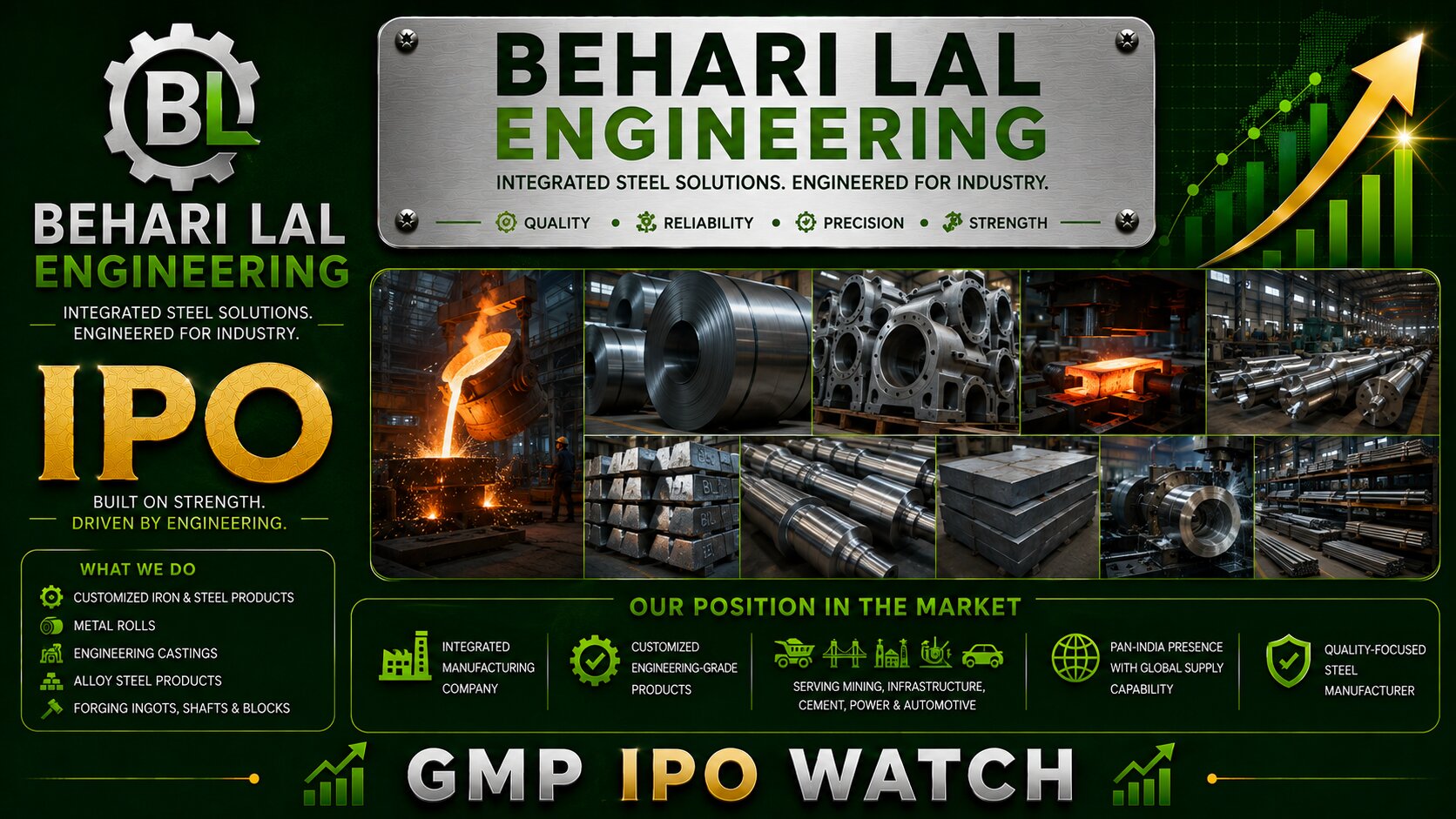
Behari Lal Engineering was incorporated in 1995 and operates as an integrated iron and steel engineering company. Its product portfolio includes:
- Metal rolls
- Alloy steel products
- Engineering castings
- Forging ingots
- Forged shafts
- Forged blocks
- Custom-engineered industrial products
These products serve sectors including:
- Steel
- Automotive
- Mining
- Infrastructure
- Cement
- Power
- Aerospace
- Defence
- Heavy engineering.
This industry exposure means Behari Lal's fortunes are connected with India's broader industrial capital-expenditure cycle.
Metal Rolls Are Not Commodity Products
Metal rolls are critical to rolling mills.
They help shape metal into products such as:
- Bars
- Sections
- Sheets
- Plates
A poor-quality roll can affect:
- Surface finish
- Production efficiency
- Mill downtime
- Final product quality
This means a customer does not necessarily choose a supplier only because it offers the lowest price.
Reliability matters.
If Behari Lal's roll lasts longer or performs better, the customer may save significantly more than the difference in purchase price.
That creates room for engineering-based pricing rather than pure commodity pricing.
Customer Qualification Can Create Stickiness
Industrial buyers often test components extensively before approving a supplier.
They may evaluate:
- Metallurgy
- Product life
- Dimensional accuracy
- Heat treatment
- Failure rate
Once a supplier consistently meets specifications, changing vendors can introduce production risk.
That creates potential customer stickiness.
This is very different from businesses where customers can switch suppliers almost instantly.
Customisation Can Protect Margins
Suppose two manufacturers sell identical standard steel products.
Customers will usually choose heavily on price.
Now suppose a customer needs a customised forged shaft built to exact industrial specifications.
The number of capable suppliers may be much smaller.
That reduces direct price comparison.
For Behari Lal, increasing the contribution from customised engineering products could therefore support:
- Better margins
- Stronger customer retention
- Higher value per tonne
This product mix is arguably more important than simply increasing steel output.
Foundry Expertise Is an Important Capability
Engineering castings require careful control over the entire foundry process.
A manufacturer needs to manage:
Metal composition → melting → moulding → cooling → heat treatment → machining → inspection
A failure at any stage can result in a defective component.
For critical industrial equipment, such defects can be extremely expensive for customers.
This creates a natural entry barrier for suppliers without established process capability.
Forging Adds Another Engineering Layer
Forged components are shaped under pressure, which can improve their structural characteristics.
Forging may produce products with greater:
- Strength
- Fatigue resistance
- Reliability
These qualities matter in heavy industrial applications.
Behari Lal's ability to combine casting, alloy steel and forging capabilities gives it a broader engineering portfolio than a single-process manufacturer.
Financial Growth Has Been Consistent
The company's historical financials show a steady expansion in both revenue and profit.
| Financial Year | Total Revenue | Profit After Tax | EBITDA |
|---|---|---|---|
| FY2023 | ₹467.46 Cr | ₹28.80 Cr | — |
| FY2024 | ₹449.96 Cr | ₹35.79 Cr | ₹60.99 Cr |
| FY2025 | ₹516.30 Cr | ₹52.95 Cr | ₹81.31 Cr |
These figures show that even though FY2024 revenue temporarily declined, PAT continued to rise.
That suggests improvement in operating efficiency rather than growth being driven only by higher sales.
Profit Growth Has Outpaced Revenue Growth
From FY2023 to FY2025:
Revenue increased from roughly ₹467 crore to ₹516 crore.
PAT increased from roughly ₹28.8 crore to ₹52.95 crore.
Profit therefore increased significantly faster than the top line.
That is one of the most attractive features of the financial history.
But it also creates an important question:
How much of the margin improvement is structural?
If better product mix and manufacturing efficiency drove the improvement, it may be sustainable.
If temporary factors contributed significantly, margins could normalise.
FY2026 Continues the Growth Story
Current IPO reporting indicates FY2026 revenue and profit continued improving from FY2025 levels. The company's own investor section also now lists financial disclosures for 2025–26, confirming that the business has updated annual financial information available for investors.
The key investment takeaway is that Behari Lal enters the IPO after several years of improving profitability rather than after a single turnaround year.
EBITDA Margin Is Already Healthy
IPO prospectus analysis reports an EBITDA margin around 16.01% and ROE around 21.91% on the cited prospectus basis.
For an industrial manufacturer, these are meaningful numbers.
A strong EBITDA margin can indicate:
- Higher-value products
- Efficient manufacturing
- Better capacity utilisation
- Pricing discipline
The post-IPO challenge will be maintaining these margins while capacity expands.
Manufacturing Expansion Is a Major IPO Objective
The IPO is not purely a shareholder-exit transaction.
Behari Lal is raising fresh capital to support business objectives including:
- Capacity expansion
- Machinery and equipment
- Civil works
- Debt reduction
- Energy-related investments.
This gives investors a clear operating rationale for the fresh issue.
Why New Machinery Can Improve More Than Capacity
Modern equipment can potentially improve:
- Production speed
- Product accuracy
- Energy consumption
- Rejection rates
- Labour productivity
This means capex may improve both:
volume
and:
margin.
For a specialised engineering company, precision improvement can also help win more demanding customers.
Capacity Expansion Can Create Operating Leverage
Imagine Behari Lal's fixed overhead is ₹50 crore.
If annual output generates ₹500 crore of revenue, those fixed costs represent 10% of sales.
If the same infrastructure supports ₹700 crore of revenue, fixed-cost absorption improves.
This is one way expansion can support margins.
But it works only if demand fills the new capacity.
Underutilised Capacity Is the Main Risk
Buying machinery is easy.
Generating profitable orders for it is harder.
Suppose the company invests heavily in new capacity but industrial demand slows.
The new machines still generate:
- Depreciation
- Maintenance
- Employee costs
even if production volumes are weak.
Therefore, investors should track capacity utilisation after listing.
Order Book Provides Some Revenue Visibility
The company has previously disclosed a meaningful order pipeline, supporting near-term production visibility.
For an engineering manufacturer, order visibility helps management plan:
- Raw-material procurement
- Production scheduling
- Working capital
But investors should remember:
order-book value is not the same as profit.
The quality and margin of those orders matter.
Customer Diversification Is Important
Behari Lal serves multiple industrial sectors.
This can reduce dependence on one end market.
For example:
A slowdown in cement demand may be partly offset by demand from:
- Steel
- Mining
- Automotive
- Infrastructure
Diversification makes earnings potentially more resilient than a business supplying only one industry.
India’s Industrial Capex Cycle Is a Structural Tailwind
The company's addressable demand is connected with expansion in:
- Steel capacity
- Mining
- Infrastructure
- Defence manufacturing
- Power
- Heavy industry
When industrial companies invest in new capacity, they require engineered components.
This can create a multi-year opportunity for specialised suppliers.
Defence and Aerospace Exposure Can Be Valuable
Behari Lal's industry profile includes applications in defence and aerospace.
These sectors can require demanding technical standards.
If the company expands further into approved defence or aerospace products, potential advantages include:
- Higher entry barriers
- Longer qualification cycles
- Greater product value
However, qualification and procurement cycles can also be slow.
Export Markets Can Add Diversification
Engineering products can also be exported.
International customers provide an opportunity to reduce dependence on Indian industrial demand.
Exports can potentially offer:
- Larger addressable market
- Foreign currency revenue
- Customer diversification
But they also create exposure to:
- Exchange-rate movement
- Shipping costs
- International certification
Raw-Material Prices Remain a Major Risk
Behari Lal depends on metal inputs.
Prices can fluctuate because of:
- Scrap markets
- Iron ore
- Alloy metals
- Energy
- Global steel cycles
A sudden increase in input costs can reduce margins if customer prices do not adjust quickly.
For a company with roughly 16% EBITDA margins, raw-material management remains critical.
Energy Cost Matters in Foundry Operations
Melting and heat treatment consume substantial energy.
Electricity and fuel costs can therefore materially affect manufacturing economics.
This is why energy-efficiency investments can be strategically important.
Reducing power cost per tonne can produce a recurring operating benefit.
Solar Investment Can Improve Manufacturing Economics
Behari Lal's IPO expansion plan has included energy-efficiency initiatives alongside manufacturing capex.
For an energy-intensive business, even a modest reduction in per-unit power costs can improve margins year after year.
The benefit compounds as production volume increases.
Working Capital Still Requires Attention
A manufacturing company buys raw materials before receiving customer payments.
Cash becomes tied up in:
- Metal inventory
- Work-in-progress
- Finished products
- Receivables
Fast growth can therefore increase cash requirements.
Investors should compare:
PAT growth
with:
operating cash flow growth.
Strong accounting profit with weak cash conversion would be a warning sign.
Day-2 IPO Subscription Is Strong
As of August 13, 2026, the latest category-wise subscription was:
| Category | Subscription |
|---|---|
| QIB | 1.17× |
| Retail | 6.73× |
| NII | 7.34× |
| Overall | 5.33× |
The issue had already been subscribed around 2.03× on Day 1, so demand has strengthened considerably today.
This indicates strong participation from retail and non-institutional investors.
NII Demand Is Currently the Strongest
The NII category has reached about 7.34×, slightly ahead of retail demand at 6.73×.
This shows substantial interest from larger individual investors.
QIB subscription is currently lower at around 1.17×, although institutions often place significant bids on the final day.
The final August 14 QIB figure will therefore be particularly worth watching.
Behari Lal Engineering IPO GMP Today
Economic Times' latest Day-2 reporting indicates the grey market is pricing the issue at roughly a 26% premium to the upper issue price.
Against ₹285, that would imply an unofficial value around:
₹359 per share
based on that premium.
However, another grey-market tracker currently shows a much lower or zero reading, illustrating that GMP sources can disagree materially.
For that reason, investors should treat GMP as an unofficial sentiment indicator rather than a reliable listing forecast.
Final-Day Subscription Will Matter More Than GMP
The IPO closes on August 14, 2026.
Tomorrow's final data will reveal:
- Final QIB demand
- Final NII demand
- Retail oversubscription
- Overall institutional acceptance
Those numbers provide more useful information than an unofficial grey-market quote.
Valuation Should Be Compared With Business Quality
The ₹271–₹285 price band should be evaluated against:
- Earnings growth
- ROE
- EBITDA margin
- ROCE
- Growth capex
A specialised manufacturer deserves a better valuation than a commodity producer only if it can consistently produce:
better margins + higher returns + stronger cash generation.
That is ultimately what investors are paying for.
Competitive Strengths
Nearly Three Decades of Operating History
Behari Lal Engineering was incorporated in 1995.
Specialised Engineering Portfolio
Metal rolls, alloy steel products, castings and forged components create a diversified industrial offering.
Exposure to Multiple Industries
Customers span steel, automotive, mining, infrastructure, power, aerospace, defence and cement.
Strong Profit Growth
PAT rose from ₹28.80 crore in FY2023 to ₹52.95 crore in FY2025.
Healthy EBITDA Margin
Prospectus analysis indicates EBITDA margin around 16%.
Expansion-Focused Fresh Issue
The fresh capital supports productive business investment.
Strong Current IPO Demand
Overall Day-2 subscription has reached 5.33×.
Major Risks
Raw-Material Volatility
Steel and alloy prices can reduce margins.
Industrial Cyclicality
Demand depends partly on customer capex.
Capacity Utilisation
New machines need adequate order volumes.
Working Capital
Rapid growth can consume cash.
Energy Costs
Foundry and forging operations are energy intensive.
Customer Concentration
Major industrial customers can possess bargaining power.
Export Risk
International business creates currency and logistics exposure.
Margin Sustainability
Recent profitability improvements need to continue.
What Could Drive the Next Growth Phase?
Higher-Value Engineering Products
Customised products can improve margin quality.
New Manufacturing Capacity
IPO-funded machinery can increase output.
Defence and Aerospace
Higher-specification industries can provide additional opportunities.
Export Expansion
International customers can diversify demand.
Industrial Capex
India's manufacturing cycle can support order growth.
Energy Efficiency
Lower power costs can improve manufacturing margins.
What Investors Should Track After Listing
Capacity Utilisation
Are new machines generating adequate production?
EBITDA Margin
Can Behari Lal maintain its current margin profile?
PAT Growth
Does profit continue growing faster than revenue?
Operating Cash Flow
Are earnings converting into cash?
Order Book
Is future revenue visibility strengthening?
Export Contribution
Is geographic diversification improving?
ROCE
Are IPO-funded investments generating attractive returns?
The Most Important Investment Question
Behari Lal does not need to prove that it can manufacture steel.
It has been doing that for decades.
It needs to prove that it can keep moving up the engineering value chain.
The ideal cycle is:
better products → stronger customers → better margins → higher cash flow → reinvestment into advanced capacity.
If this cycle continues, the company can become much more valuable without relying only on commodity steel volume.
Should Investors Consider Behari Lal Engineering IPO?
The positive investment case includes:
- Established manufacturing history
- Customised engineering products
- Strong PAT growth
- Healthy EBITDA margins
- Diversified industrial applications
- Fresh capital for expansion
- Strong Day-2 subscription
- Positive current grey-market sentiment
The caution points include:
- Industrial cyclicality
- Raw-material prices
- Energy intensity
- Working-capital requirements
- Need to maintain recent margins
The company should therefore be evaluated as a specialised engineering manufacturer rather than a conventional steel commodity play.
Final View on Behari Lal Engineering IPO 2026
The Behari Lal Engineering IPO 2026 enters Day 2 with strong investor demand.
As of August 13, the issue has reached approximately 5.33× overall subscription, led by around 7.34× NII and 6.73× retail demand.
The ₹301.62 crore IPO remains open through August 14 at a price band of ₹271–₹285.
What makes the company interesting, however, is the underlying business rather than the subscription numbers.
Behari Lal produces metal rolls, engineering castings, alloy steel and forged components for industries where quality and technical performance matter.
Its historical financial performance shows meaningful improvement: FY2025 revenue reached approximately ₹516.30 crore, while PAT increased to ₹52.95 crore, compared with ₹28.80 crore in FY2023.
The investment opportunity can be summarised as:
engineering capability + capacity expansion + industrial capex growth + higher-value product mix = potential long-term earnings growth.
The risks are equally clear:
raw-material inflation + cyclical industrial demand + underutilised new capacity = margin and return pressure.
For long-term investors, the most important post-listing metrics will be EBITDA margin, capacity utilisation, operating cash flow, order growth and ROCE.
Overall, Behari Lal Engineering represents a profitable and increasingly specialised industrial manufacturing IPO with strong current investor demand and a credible expansion opportunity. Its long-term success will depend on whether management can maintain margin quality while deploying fresh capital into higher-value engineering capacity rather than simply chasing additional steel volumes.