 GMP IPO Watch
Behari Lal Engineering IPO 2026 – An Engineering Business Built Around Heavy Industry
Steel is often discussed as a commodity.
But once steel moves into specialised industrial applications, the business can become much more engineering-driven.
A steel plant, rolling mill, mining operation or heavy engineering facility may require components that must withstand:
- High temperature
- Heavy pressure
- Continuous mechanical stress
- Abrasion
- Repeated industrial use
That creates demand for specialised products such as metal rolls, engineering castings, forged shafts and alloy steel components.
Behari Lal Engineering Limited operates in this specialised part of India's industrial manufacturing ecosystem.
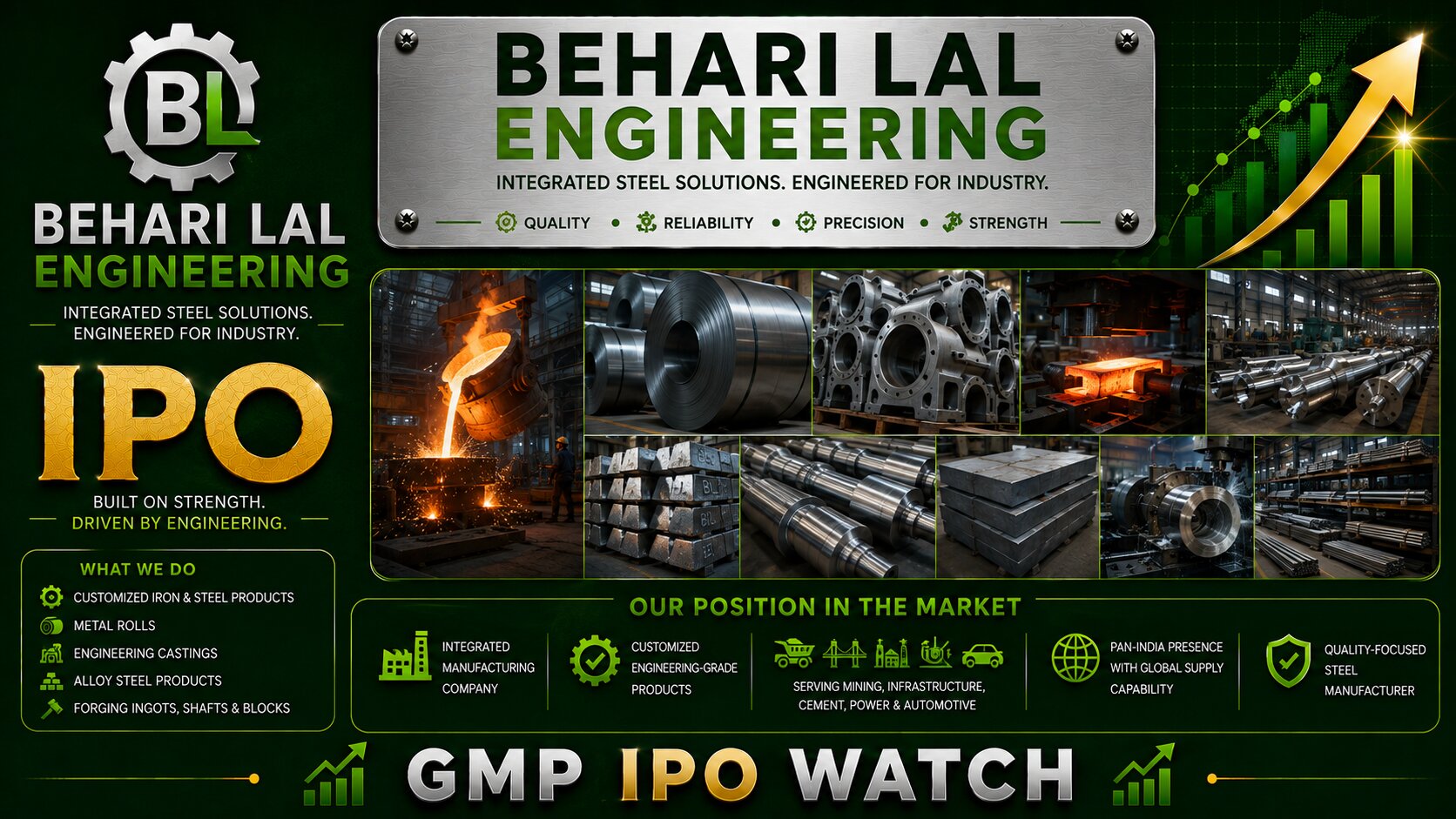
The company is an integrated iron and steel manufacturer supplying customised engineering products for critical industrial applications.
Its mainboard IPO opens on August 12, 2026 and closes on August 14, 2026, with a price band of ₹271 to ₹285 per share. The issue comprises a fresh issue of approximately ₹93 crore and an Offer for Sale of roughly ₹208.62 crore, taking the total size to just above ₹301 crore.
Unlike a commodity steel company dependent only on selling basic metal, Behari Lal Engineering attempts to create additional value through engineering, customisation and specialised manufacturing.
That makes the most important investment question:
Can the company continue moving toward higher-value engineered products while expanding capacity without weakening margins or cash flow?
Behari Lal Engineering IPO Details
| Particular | Details |
|---|---|
| Company | Behari Lal Engineering Limited |
| IPO Type | Mainboard Book Built IPO |
| Total Issue Size | Approx. ₹301.62 Crore |
| Fresh Issue | Approx. ₹93 Crore |
| Offer for Sale | Approx. ₹208.62 Crore |
| Price Band | ₹271 – ₹285 Per Share |
| Face Value | ₹10 Per Share |
| Lot Size | 52 Shares |
| Minimum Retail Investment | ₹14,820 at ₹285 |
| IPO Opening Date | August 12, 2026 |
| IPO Closing Date | August 14, 2026 |
| Expected Allotment | August 17, 2026 |
| Expected Listing | August 19, 2026 |
| Listing | BSE & NSE |
| Registrar | MUFG Intime India Pvt. Ltd. |
At the upper band of ₹285, one retail lot of 52 shares requires approximately ₹14,820.
What Does Behari Lal Engineering Actually Manufacture?
Behari Lal Engineering manufactures specialised products used in industrial and engineering applications.
Its portfolio includes:
- Metal rolls
- Engineering castings
- Alloy steel products
- Forging ingots
- Forged shafts
- Other customised forged components
These products can be used by customers operating in sectors such as:
- Steel
- Mining
- Cement
- Heavy engineering
- Industrial machinery
- Metal processing
The business is therefore closely linked with capital expenditure and industrial production rather than consumer demand.
Why Metal Rolls Matter
Metal rolls are critical components in rolling mills.
Steel manufacturers use rolls to shape hot or cold metal into products such as:
- Sheets
- Bars
- Sections
- Plates
A roll must withstand enormous mechanical pressure.
Poor-quality rolls can create:
- Surface defects
- Downtime
- Lower production efficiency
- Replacement costs
This makes quality, metallurgy and product life important to customers.
For Behari Lal Engineering, this creates an opportunity to compete on performance rather than price alone.
Engineering Castings Add Another Revenue Stream
Industrial castings are produced by pouring molten metal into specially designed moulds.
After cooling, the component is:
- Machined
- Heat treated
- Inspected
- Finished
depending on customer specifications.
Engineering castings can be highly customised.
That means the manufacturer needs expertise in:
- Metallurgy
- Mould design
- Heat treatment
- Machining
- Quality control
The more complex the casting, the harder it can be for a low-cost general manufacturer to replace an established supplier.
Forged Components Can Create Higher-Value Business
Forging involves shaping metal under pressure rather than simply casting it.
The process can improve characteristics such as:
- Strength
- Durability
- Fatigue resistance
Forged shafts and related products may be used in heavy machinery and industrial systems where component failure is expensive.
That allows specialised manufacturers to move further away from commodity steel economics.
Integrated Manufacturing Is an Important Advantage
Behari Lal Engineering operates two manufacturing facilities in Mandi Gobindgarh, Punjab.
An integrated manufacturing setup can help the company control more stages of production.
This may support:
- Product consistency
- Quality control
- Faster production
- Customer customisation
- Lower outsourcing dependence
But integrated manufacturing also increases capital intensity.
The company must continuously invest in:
- Machinery
- Furnaces
- Energy infrastructure
- Pollution control
- Maintenance
The IPO Will Fund Additional Capacity
One of the most important objectives of the fresh issue is to expand manufacturing capabilities.
The company plans to invest in:
- New machinery
- Equipment
- Related civil works
- Manufacturing Facility 1
- Manufacturing Facility 2
This means part of the IPO is directly linked with increasing productive capability.
For investors, the key post-IPO metric will be capacity utilisation.
New machinery creates value only when sufficient orders exist to keep it productive.
Why Capacity Utilisation Matters
Suppose Behari Lal installs machinery capable of producing ₹100 crore of additional annual output.
If customer orders generate only ₹30 crore of additional sales, returns on the investment may be weak.
If demand quickly fills most of the new capacity, the economics can become much stronger.
Higher utilisation can improve:
- Fixed-cost absorption
- EBITDA margins
- ROCE
- Cash generation
The company's existing order book provides some comfort, but future order wins remain important.
₹178.57 Crore Order Book Provides Visibility
As of May 31, 2026, Behari Lal Engineering reported an order book of approximately ₹178.57 crore.
That represents confirmed future business that has not yet been fully recognised as revenue.
For a manufacturing company, a healthy order book can help with:
- Raw-material planning
- Production scheduling
- Capacity utilisation
- Revenue visibility
But an order book is not guaranteed profit.
Execution still depends on:
- Customer schedules
- Raw-material availability
- Manufacturing performance
- Delivery
- Pricing
Order Quality Matters More Than Order Size
Consider two ₹100 crore order books.
Order Book A
High-margin customised engineering products.
Order Book B
Low-margin commodity products.
Both are worth ₹100 crore in revenue terms.
But their economic value can be completely different.
Investors should therefore examine whether Behari Lal's future order growth is coming from:
higher-value engineered products
rather than only:
higher-volume basic metal sales.
That distinction can determine future margins.
FY2026 Financial Performance
Behari Lal Engineering reported continued growth in FY2026.
| Financial Year | Total Income | Profit After Tax |
| FY2025 | ₹516.30 Cr | ₹52.95 Cr |
| FY2026 | ₹546.52 Cr | ₹64.64 Cr |
Total income increased by roughly 6%.
PAT increased by approximately 22%.
This means profit grew substantially faster than revenue.
That is an encouraging signal if the improvement came from sustainable operating efficiency and product mix.
Why PAT Growing Faster Than Revenue Is Important
Revenue increased only moderately.
But profit increased much faster.
Possible reasons include:
- Better product mix
- Improved manufacturing efficiency
- Higher-value products
- Better capacity utilisation
- Lower finance costs
- Improved cost controls
For investors, the important question is whether this margin improvement can continue after the IPO.
FY2026 PAT Margin Is Strong
Using total income of approximately ₹546.52 crore and PAT of around ₹64.64 crore, Behari Lal generated a net profit margin of roughly 11.8% in FY2026.
For an integrated engineering and steel-products manufacturer, that level of profitability deserves attention.
However, margins can remain sensitive to:
- Raw-material costs
- Energy
- Customer pricing
- Product mix
Future results will show how durable the current margin structure is.
Return Ratios Are Also Attractive
FY2026 valuation disclosures report several strong return indicators, including:
- ROE: approximately 23.60%
- ROCE: approximately 27.11%
- EBITDA Margin: approximately 18.97%
- PAT Margin: approximately 12.10%
- Debt-to-equity ratio: approximately 0.06
- EPS: approximately ₹16.56
- RoNW: approximately 23.60%
- NAV: approximately ₹70.18
These numbers indicate a profitable business with relatively low financial leverage.
The low debt-to-equity ratio is particularly important because heavy engineering companies can sometimes become highly leveraged.
Low Debt Reduces Financial Risk
A debt-to-equity ratio near 0.06 suggests Behari Lal is entering the IPO with limited leverage.
That can provide advantages including:
- Lower finance costs
- Stronger balance sheet
- Better resilience during industry downturns
- Capacity to fund future expansion
The company still intends to use part of IPO proceeds for repayment or prepayment of certain borrowings.
That could further strengthen the balance sheet.
IPO Proceeds Will Also Fund Rooftop Solar
An unusual but strategically interesting use of IPO proceeds is the installation of rooftop solar systems at both manufacturing facilities.
Heavy engineering and steel processing consume substantial electricity.
Solar generation can potentially help:
- Reduce grid electricity costs
- Improve energy security
- Lower carbon intensity
- Protect against future power-price increases
The savings may look small compared with total revenue, but over several years they can improve manufacturing economics.
Energy Costs Matter in Heavy Manufacturing
Processes such as:
- Melting
- Forging
- Heat treatment
- Machining
can consume significant amounts of energy.
A manufacturer that lowers energy cost per tonne or per component gains an advantage.
That means the rooftop solar investment is more than a sustainability initiative.
It can also be an operating-cost strategy.
The Company Has Served 1,825 Customers
As of March 31, 2026, Behari Lal Engineering had served approximately 1,825 domestic and international customers.
Its disclosed clientele includes names such as:
- Amba Shakti Industries
- BMW Industries
- Shyam Metalics and Energy
- Laxcon Steels
- MSP Steel & Power
- Jai Balaji Industries
- Propel Industries
- Metso India
A broad historical customer base can reduce dependence on one small market segment.
However, investors should still examine actual revenue concentration among the largest current customers.
Why Repeat Industrial Customers Are Valuable
Industrial buyers generally do not change suppliers casually when components affect production quality.
Once a supplier proves:
- Product reliability
- Metallurgical consistency
- Delivery performance
- Technical capability
repeat business can follow.
This creates potentially sticky customer relationships.
However, customers also continuously compare suppliers on cost.
Behari Lal therefore needs to maintain both quality and pricing discipline.
Manufacturing in Mandi Gobindgarh Is Strategically Relevant
Mandi Gobindgarh is a major iron and steel manufacturing cluster in Punjab.
Operating inside an established industrial ecosystem can provide access to:
- Raw-material suppliers
- Skilled workers
- Transport networks
- Engineering vendors
- Industrial customers
Cluster advantages can improve supply-chain efficiency.
They can also increase local competition.
Raw Materials Are a Major Risk
Behari Lal's manufacturing economics depend heavily on metal inputs.
Steel and alloy prices can move because of:
- Global commodity cycles
- Scrap prices
- Iron ore
- Coal
- Energy
- Imports
- Government policy
If raw-material prices rise faster than selling prices, margins can decline.
The company's ability to pass cost increases to customers therefore matters significantly.
Customised Products Can Offer Better Pricing Power
Commodity steel products are relatively easy to compare.
Customised engineering products are different.
If a customer needs a component with:
- Specific alloy chemistry
- Precise dimension
- Particular heat treatment
- Performance guarantees
supplier choice becomes more technical.
This can reduce pure price competition.
Expanding customised engineering revenue could therefore improve the quality of Behari Lal's business over time.
Working Capital Is Still Important
Even with low debt, manufacturing requires working capital.
Cash can become tied up in:
- Raw materials
- Work-in-progress
- Finished goods
- Customer receivables
The production cycle may look like:
Purchase metal → manufacture → inspect → dispatch → invoice → collect cash
Rapid growth can increase the amount of capital needed within this cycle.
Investors should therefore track operating cash flow along with PAT.
Offer for Sale Is Larger Than Fresh Issue
The total IPO includes:
- Fresh issue: approximately ₹93 crore
- OFS: approximately ₹208.62 crore.
This means most of the public offering relates to existing shareholders selling shares.
Only the fresh issue strengthens the company's own capital base.
This is not automatically negative.
But investors should clearly understand that the majority of the roughly ₹301 crore IPO is not being invested back into operations.
Approximately ₹63.61 Crore Is Identified for Specific Uses
The company has outlined approximately ₹63.61 crore for specific objectives including:
- New equipment and machinery
- Civil works
- Rooftop solar systems
- Debt repayment
with remaining fresh proceeds available for permitted general corporate purposes.
This gives investors relatively clear visibility into how a substantial part of the fresh capital will be deployed.
Valuation at ₹285
Using FY2026 EPS of approximately ₹16.56, the upper issue price of ₹285 implies a simple historical P/E of roughly:
₹285 ÷ ₹16.56 ≈ 17.2 times
That is an important reference point.
The valuation should be compared with listed engineering, casting and specialty-steel peers, but direct comparison can be difficult because different companies have different:
- Product mixes
- Margins
- debt
- customer industries
- capital intensity
The strongest argument for the valuation would be continued profitable growth after the proposed capacity expansion.
Peer Valuation Needs Context
Some listed peers in engineering castings and specialty steel trade at significantly higher earnings multiples.
However, investors should avoid concluding that Behari Lal is cheap based only on peer P/E.
A smaller company may deserve a discount because of:
- Scale
- Customer concentration
- Liquidity
- Execution risk
Valuation should reflect both opportunity and business risk.
GMP Is Still Early
Because the IPO opens on August 12, current grey-market activity remains early and can change materially once public bidding begins.
Investors should avoid giving too much importance to pre-opening GMP.
More useful indicators will include:
- Anchor allocation
- Day 1 subscription
- QIB participation
- Final institutional demand
Grey Market Premium remains unofficial and unregulated.
What Could Drive Behari Lal's Next Growth Phase?
Capacity Expansion
New machinery can increase production capability.
Higher-Value Products
More customised engineering products could improve margins.
Order-Book Growth
A larger project pipeline can improve revenue visibility.
Export Customers
International business can expand the addressable market.
Energy Savings
Rooftop solar could reduce manufacturing costs.
Debt Reduction
Lower finance costs can improve earnings quality.
Industrial Capex Cycle
Growth in steel, mining and infrastructure investment can increase demand for engineered components.
Competitive Strengths
Behari Lal Engineering enters the IPO with several positives.
Established Operating History
The company has been operating since 1995.
Specialised Product Portfolio
It manufactures metal rolls, engineering castings, forged products and alloy steel components.
Large Customer Base
More than 1,800 domestic and international customers have been served.
₹178.57 Crore Order Book
Provides near-term production visibility.
Strong FY2026 Profit Growth
PAT increased about 22% despite only modest revenue growth.
Low Leverage
Debt-to-equity is approximately 0.06.
Expansion-Focused Fresh Issue
IPO proceeds are being used for productive manufacturing investments.
Major Risks
Raw-Material Price Volatility
Steel and alloy costs can affect margins.
Industrial Cyclicality
Demand depends on steel, infrastructure and heavy-industry capex.
Customer Concentration
A broad historical customer base does not eliminate dependence on major current buyers.
Capacity Expansion Risk
New machinery must achieve sufficient utilisation.
Energy Costs
Heavy manufacturing remains energy-intensive.
Working Capital
Inventory and receivables can absorb cash.
Large OFS
The Offer for Sale is substantially larger than the fresh issue.
Order Execution
The ₹178.57 crore order book must convert into profitable revenue.
What Investors Should Track After Listing
Order Book
Does the company continue winning new business?
Capacity Utilisation
Are IPO-funded machines being used effectively?
Product Mix
Is revenue shifting toward higher-value engineering products?
EBITDA Margin
Can the company maintain approximately 19% levels?
Operating Cash Flow
Are profits converting into cash?
Energy Cost
Does rooftop solar create measurable savings?
ROCE
Does new capex maintain strong returns on capital?
Should Investors Consider Behari Lal Engineering IPO?
The positive investment case includes:
- Established engineering manufacturing business
- Strong FY2026 PAT growth
- ₹178 crore-plus order book
- Low debt
- Healthy return ratios
- Product diversification
- Clear capex plan
- Energy-efficiency investment
The caution points include:
- Industrial cyclicality
- Raw-material prices
- OFS-heavy issue structure
- Execution of new capacity
- Working-capital requirements
At roughly 17× FY2026 EPS at the upper band, the issue deserves comparison with both peer valuations and the company's future growth potential.
Final View on Behari Lal Engineering IPO 2026
The Behari Lal Engineering IPO 2026 provides investors with exposure to a specialised engineering and metal-products manufacturer rather than a conventional commodity steel company.
The company manufactures metal rolls, engineering castings, alloy steel products, forging ingots and forged components for critical industrial applications.
Financially, total income increased from approximately ₹516.30 crore in FY2025 to ₹546.52 crore in FY2026, while PAT increased from around ₹52.95 crore to ₹64.64 crore.
The stronger profit growth relative to revenue is encouraging, particularly alongside a low debt-equity ratio and healthy return ratios.
The existing ₹178.57 crore order book as of May 31, 2026 provides additional near-term visibility.
The fresh IPO proceeds will support machinery purchases, civil works, rooftop solar installations and debt repayment, potentially improving both production capacity and operating efficiency.
However, most of the approximately ₹301 crore IPO consists of an Offer for Sale, meaning the company itself receives only the fresh issue component.
The investment thesis can therefore be simplified as:
existing engineering capability + ₹178 crore order book + new machinery + lower energy and finance costs = potential earnings growth.
The key risk is whether industrial demand remains strong enough to keep the expanded facilities well utilised.
Overall, Behari Lal Engineering represents a profitable, low-leverage industrial manufacturing IPO with attractive return ratios and meaningful order visibility. Its long-term performance will depend on capacity utilisation, raw-material management, product mix and the company's ability to convert its engineering expertise into sustained post-IPO growth.