 GMP IPO Watch
Anawil Wire and Engineering IPO 2026 – Final-Day Detailed Review
India’s clean-energy transition is creating a large market not only for renewable-power developers but also for manufacturers supplying critical equipment used in wind and solar projects.
Wind-turbine towers are an important part of this ecosystem. A tower supports the turbine’s blades, hub, nacelle and electricity-generating equipment at a suitable height. It must remain structurally stable despite carrying heavy equipment and facing wind pressure, vibration, changing temperatures and long-term environmental exposure.
Anawil Wire and Engineering Limited manufactures customised tubular steel towers and heavy fabricated structures used in wind-power projects. The company operates as a business-to-business manufacturer, supplying products according to the technical designs and quality requirements of wind-turbine manufacturers and renewable-energy customers.
The Anawil Wire and Engineering IPO closes today, August 5, 2026. The company is offering shares within a price band of ₹257 to ₹270 per share through an NSE SME issue aggregating to approximately ₹177.81 crore. The allotment is expected on August 6, while the tentative listing date is August 10, 2026.
This updated review examines the company from a fresh perspective, focusing on its order book, revenue visibility, manufacturing economics, debt-repayment strategy, customer approvals, financial growth, valuation, final-day market response and risks.
About Anawil Wire and Engineering Limited
Anawil Wire and Engineering was incorporated in 2021 and operates in the heavy-engineering and renewable-energy equipment segment.
Its main IPO story is centred on the fabrication of tubular windmill towers and related components. These structures are manufactured according to client-specific drawings, turbine capacity, tower height, steel grade, load requirements and project conditions.
The company’s operations require:
- Heavy steel fabrication
- Precision plate rolling
- Industrial welding
- Flange fitting
- Surface treatment
- Dimensional inspection
- Non-destructive testing
- Quality certification
- Oversized logistics management
The business is therefore substantially different from ordinary wire production or general fabrication.
What Is a Tubular Wind-Turbine Tower?
A tubular wind tower is a tall, hollow steel structure that supports the electricity-generating portion of a wind turbine.
The tower is normally manufactured in multiple cylindrical sections because transporting a complete tower in one piece would be impractical. These sections are carried separately to the wind-project site and assembled using large flanges and specialised bolts.
A tower must be designed to support:
- The nacelle
- Generator equipment
- Rotor hub
- Turbine blades
- Internal electrical systems
- Service platforms
- Ladders and safety equipment
It must also withstand continuous mechanical stress throughout the wind project’s operating life.
Why Wind-Tower Manufacturing Has High Entry Barriers
Wind-tower fabrication is not simply a matter of rolling and welding steel.
Manufacturers generally need specialised infrastructure and customer approvals before they can receive regular commercial orders.
Important requirements include:
- Heavy plate-rolling machinery
- Automated welding systems
- Large factory space
- Flange-alignment capabilities
- Testing laboratories
- Qualified welding procedures
- Experienced engineers
- Skilled technicians
- Surface-treatment facilities
- Product traceability
- Strict quality documentation
Wind-turbine manufacturers may inspect the factory, review production controls and test initial tower sections before approving a new supplier.
This approval process can create entry barriers for smaller fabricators that lack the required infrastructure, quality systems or financial strength.
Anawil’s Order Book and Revenue Visibility
An order book represents the value of confirmed contracts that have not yet been fully executed or recognised as revenue.
Earlier public disclosures referred to an Anawil Wire and Engineering order book of approximately ₹220.06 crore as of June 30, 2025.
Compared with FY2025 revenue of approximately ₹79 crore, this indicated meaningful future business visibility at that time.
A strong order book can support:
- Future production planning
- Raw-material procurement
- Capacity utilisation
- Revenue visibility
- Employee deployment
- Supplier negotiations
However, the entire order book should not be treated as guaranteed revenue or profit.
Conversion depends on:
- Customer project schedules
- Availability of steel
- Manufacturing progress
- Technical inspections
- Dispatch approvals
- Transportation arrangements
- Project cancellations or amendments
- Collection of customer payments
Investors should check the latest order-book figure in the final offer document and determine how much is expected to be executed within the next 12 to 24 months.
Quality of the Order Book Matters More Than Size
A ₹200 crore order book can have very different economic value depending on the contract terms.
Investors should assess:
- Number of customers
- Contract margins
- Steel-price adjustment clauses
- Payment schedules
- Advance payments
- Completion deadlines
- Penalty clauses
- Project locations
- Customer creditworthiness
- Expected execution period
An order book concentrated among one or two customers carries greater risk than the same amount distributed across several established wind-energy companies.
Similarly, fixed-price contracts may become less profitable when steel prices rise after the order is accepted.
How Anawil Generates Revenue
The company follows a project-based manufacturing cycle.
A typical order may involve:
- Receiving technical specifications from the customer
- Estimating steel and production requirements
- Procuring steel plates and flanges
- Cutting and rolling plates into cylindrical shells
- Welding individual shells
- Joining shells into tower sections
- Installing internal components and flanges
- Conducting quality tests
- Applying protective surface coatings
- Dispatching the completed sections
Revenue may be recognised based on dispatch, delivery, customer acceptance or contractual milestones.
Because production and invoicing are linked to project schedules, quarterly revenue may be uneven.
Importance of Customer Advances
Wind-tower manufacturing requires substantial upfront expenditure.
If customers provide advances, they can help finance:
- Steel procurement
- Labour costs
- Welding consumables
- Factory operations
- Flanges and internal components
- Transportation preparation
Without adequate advances, the company may need to rely more heavily on bank borrowing and working-capital facilities.
Investors should therefore compare customer advances with inventories, receivables and short-term debt.
Manufacturing Capacity and Operating Leverage
Heavy-engineering plants involve significant fixed expenses.
These may include:
- Factory lease or ownership costs
- Machinery depreciation
- Permanent employees
- Electricity infrastructure
- Quality laboratories
- Maintenance
- Insurance
- Administrative costs
When production is low, these expenses are spread over fewer tower sections.
When utilisation increases, fixed costs are distributed across higher output, potentially improving profit margins.
This is known as operating leverage.
Anawil’s sharp improvement in profitability may partly reflect better utilisation of its manufacturing assets. However, the same operating leverage can work in reverse if orders decline.
Wind-Tower Manufacturing Process
Plate Inspection
Steel plates are checked for grade, thickness and compliance with customer requirements.
Cutting and Beveling
The plates are cut to the required size, while their edges are prepared for welding.
Rolling
Heavy rolling machines shape flat steel plates into curved shells.
Longitudinal Welding
The plate edges are welded to create individual cylindrical sections.
Circular Assembly
Several shells may be joined together to create a larger tower section.
Flange Installation
Flanges are welded or fitted at the section ends so tower sections can be connected at the project site.
Internal Assembly
Ladders, platforms, electrical supports and safety components may be installed inside the tower.
Surface Protection
The tower undergoes blasting, painting or coating to protect it from corrosion.
Testing and Inspection
Welds, dimensions, materials and coatings are inspected before dispatch.
Failure at any stage can cause rework, customer rejection, project delay or warranty exposure.
Anawil Wire and Engineering IPO Details
| Particular | Details |
|---|---|
| IPO Type | Book-Built SME IPO |
| Total Issue Size | Approximately ₹177.81 crore |
| Fresh Issue | Approximately ₹142.69 crore |
| Offer for Sale | Approximately ₹35.12 crore |
| Total Shares Offered | Approximately 65.86 lakh shares |
| Face Value | ₹10 per equity share |
| Price Band | ₹257 to ₹270 per share |
| Base Lot Size | 400 shares |
| Minimum Retail Quantity | 800 shares |
| IPO Opening Date | August 3, 2026 |
| IPO Closing Date | August 5, 2026 |
| Expected Allotment | August 6, 2026 |
| Expected Demat Credit | August 7, 2026 |
| Tentative Listing Date | August 10, 2026 |
| Listing Platform | NSE SME |
| Lead Manager | Hem Securities Limited |
| Registrar | Bigshare Services Private Limited |
The offering contains both fresh shares and an Offer for Sale. The company will receive the fresh-issue proceeds, while the OFS proceeds will be paid to the selling shareholders.
Lot Size and Minimum Investment
The market lot contains 400 shares, but the minimum retail application is 800 shares.
At the upper price band of ₹270, the minimum retail application amount is:
800 shares × ₹270 = ₹2,16,000
The higher minimum investment and lot-based secondary-market trading make liquidity an important consideration for SME IPO investors.
Purpose of the IPO
A major portion of the fresh issue is intended for debt repayment or prepayment.
The proceeds are proposed to support:
- Repayment or prepayment of borrowings
- Improvement of the capital structure
- Reduction of finance costs
- General corporate purposes
Using IPO capital to repay debt may not immediately increase manufacturing capacity, but it can improve the company’s financial position and future earnings quality.
Why Debt Reduction Is Important
Heavy fabrication requires large amounts of capital because steel must be purchased well before the final customer payment is received.
Borrowings may be used to finance:
- Raw materials
- Inventory
- Work in progress
- Customer receivables
- Bank guarantees
- Factory operations
- Transportation
High debt creates interest expenses that reduce net profit.
Debt repayment can potentially:
- Lower finance costs
- Improve the debt-to-equity ratio
- Increase future cash flow
- Strengthen tender eligibility
- Reduce refinancing risk
- Improve borrowing capacity for future projects
Investors should compare the pre-IPO and projected post-IPO debt position to understand the actual balance-sheet improvement.
Financial Performance
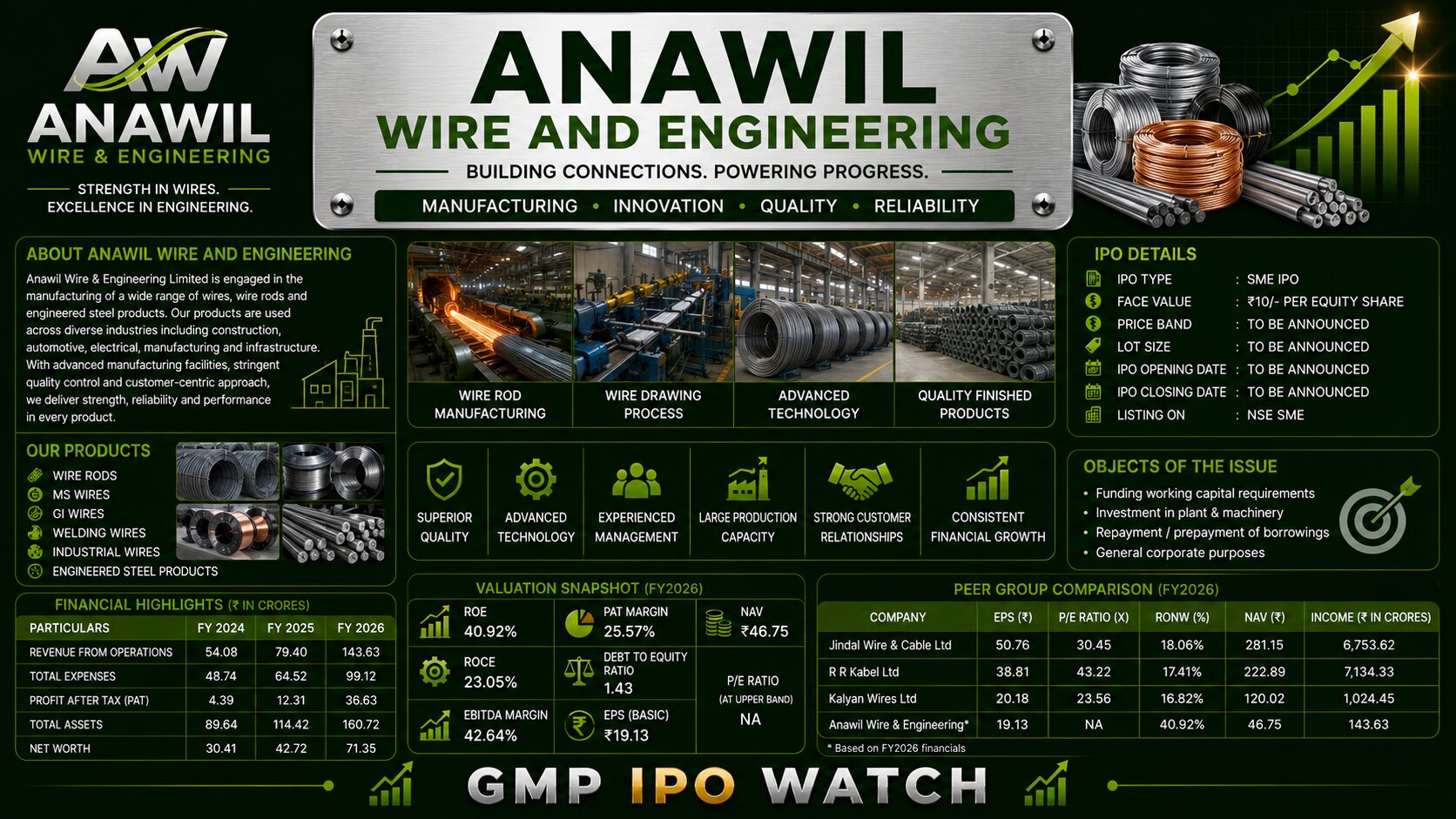
Anawil Wire and Engineering has reported rapid growth over the latest three financial years.
| Financial Year | Revenue | Profit After Tax |
| FY2024 | ₹54.08 crore | ₹4.39 crore |
| FY2025 | ₹79.40 crore | ₹12.31 crore |
| FY2026 | ₹143.63 crore | ₹36.63 crore |
Revenue increased by approximately 81% between FY2025 and FY2026.
PAT increased nearly three times during the same period, indicating that profit grew much faster than sales.
What the Financial Growth Indicates
The improvement may reflect:
- Larger wind-tower orders
- Higher production
- Better capacity utilisation
- Improved pricing
- Better absorption of factory overheads
- More profitable product mix
- Strong demand from renewable-energy customers
The growth is encouraging, but investors should determine whether FY2026 represented a normal operating year or benefited from exceptionally favourable contracts.
Profit Sustainability Requires Careful Review
Rapid profit growth can sometimes be affected by:
- One major contract
- Temporary raw-material benefits
- Higher other income
- Lower employee expenses
- Timing of revenue recognition
- One-time operational efficiencies
- Customer advances
- Delayed expense recognition
Investors should review the detailed profit-and-loss statement rather than relying only on PAT.
Important areas include:
- Raw-material consumption
- Employee expenses
- Power and fuel
- Other operating costs
- Finance costs
- Depreciation
- Other income
- Tax expense
Cash Flow vs Reported Profit
Profit does not automatically mean that the company has received cash.
A wind-tower manufacturer can report revenue after dispatching products while still waiting for customer payment.
Cash may remain blocked in:
- Receivables
- Retention money
- Inventory
- Work in progress
- Security deposits
- Supplier advances
Investors should compare cumulative PAT with operating cash flow.
Consistently weak cash conversion could indicate:
- Delayed customer payments
- High inventory requirements
- Aggressive revenue recognition
- Rapid expansion funded through debt
Cash-flow quality is one of the most important factors in evaluating a project-based manufacturing company.
Customer-Concentration Risk
Wind-tower manufacturers generally work with a limited number of approved turbine manufacturers and renewable-energy companies.
Customer concentration can provide large repeat orders, but it also creates risk.
The company may be affected if a major customer:
- Reduces purchases
- Delays a project
- Changes suppliers
- Renegotiates pricing
- Faces financial problems
- Cancels a wind project
Investors should review the percentage of revenue generated from the largest five and ten customers.
A strong order book is more reliable when it is supported by multiple financially sound buyers.
Steel-Price Risk
Steel is the primary raw material used in wind-tower manufacturing.
A sharp rise in steel prices can increase production costs significantly.
Margin protection depends on:
- Customer price-escalation clauses
- Purchase-order terms
- Procurement timing
- Inventory levels
- Supplier agreements
- Ability to renegotiate prices
Contracts containing effective raw-material pass-through provisions are generally less exposed than fixed-price orders.
Logistics and Transportation Risk
Wind-tower sections are oversized products requiring specialised transportation.
Their movement may involve:
- Route planning
- Heavy trailers
- Regulatory permits
- Road clearances
- Escort vehicles
- Coordination with project teams
- Temporary removal of obstacles
Transportation delays can affect delivery schedules and increase costs.
The company must therefore coordinate manufacturing with project-site readiness and logistics availability.
Renewable-Energy Industry Opportunity
Wind energy remains important to India because it can complement solar generation.
Solar plants primarily generate electricity during daylight hours. Wind-generation patterns may differ by season and location, helping create a more balanced renewable-power supply.
Demand for wind towers may be supported by:
- New wind-energy projects
- Wind-solar hybrid projects
- Corporate renewable-power demand
- Larger turbine models
- Repowering of older wind farms
- Energy-storage-linked projects
- Government renewable targets
However, the industry can experience uneven project awards and delays caused by land, tariff or transmission issues.
Final-Day Subscription Position
Anawil Wire and Engineering entered its final bidding day with strong investor interest.
Live market pages showed overall subscription of approximately 10.41 times during the morning of August 5, although live figures can change quickly as additional institutional, HNI and retail bids are submitted before closing.
Earlier reports showed that the issue had already received bids several times above the shares offered during the initial stages of the subscription period.
The final exchange-confirmed subscription should be checked after bidding closes.
High subscription can support listing sentiment, but it does not remove company-specific risks or guarantee gains.
Grey Market Premium
Unofficial GMP indications have varied significantly during the IPO period.
Reported observations included premiums of approximately:
- ₹60 per share
- ₹80 per share
- ₹90 per share
A ₹90 GMP against the upper issue price of ₹270 would represent an unofficial premium of about 33%.
However, GMP is unofficial, unregulated and can change quickly.
Differences between trackers also show that it should not be treated as reliable exchange data.
Valuation Considerations
The upper issue price is ₹270 per share.
Investors should assess the valuation using:
- Diluted earnings per share
- Post-issue price-to-earnings ratio
- Return on equity
- Return on capital employed
- Net debt
- Cash-flow conversion
- Order-book quality
- Customer concentration
- Capacity utilisation
- Margin sustainability
Recent earnings growth may make the valuation appear attractive, but the investment case becomes weaker if FY2026 profit cannot be repeated.
A project-based manufacturer should not be valued only on one year’s P/E ratio.
Competitive Strengths
Specialised Renewable-Energy Manufacturing
The company operates in a technically demanding wind-tower segment.
Strong Reported Financial Growth
Revenue increased from approximately ₹54 crore in FY2024 to ₹143.63 crore in FY2026.
Improving Profitability
PAT rose from ₹4.39 crore to ₹36.63 crore over the same period.
Existing Order Visibility
Earlier disclosures indicated an order book substantially larger than FY2025 revenue.
Customer-Approval Entry Barriers
Technical approval requirements can make it harder for new competitors to enter established supply chains.
IPO-Funded Debt Reduction
Lower borrowings may improve future net earnings and financial flexibility.
Renewable-Energy Tailwinds
Wind and hybrid-energy development can support long-term demand.
Major Risk Factors
Short Operating History
The company was incorporated in 2021 and has limited experience across full industry cycles.
Customer Concentration
Dependence on a small number of large customers could create revenue volatility.
Order-Execution Risk
Delays in inspection, dispatch or project schedules may affect revenue recognition.
Steel-Price Volatility
Raw-material inflation may reduce margins.
Working-Capital Pressure
Large orders require substantial capital before customer payments are received.
Cash-Flow Risk
Rapid accounting profit growth may not translate immediately into operating cash flow.
Product-Quality Risk
Manufacturing defects could result in rework, claims or customer rejection.
Logistics Risk
Oversized tower sections are difficult and expensive to transport.
Wind-Industry Dependence
A slowdown in wind-project activity may reduce demand.
Margin Normalisation
Recent profitability may decline if capacity utilisation or contract pricing weakens.
SME Liquidity
NSE SME shares may experience low trading volume and substantial price volatility after listing.
Future Growth Opportunities
Higher Capacity Utilisation
More orders could improve operating leverage without proportionate fixed-cost growth.
Larger Turbine Towers
Higher-capacity wind turbines generally require larger and more valuable tower structures.
New Customer Approvals
Adding turbine manufacturers could reduce revenue concentration.
Hybrid Renewable Projects
Wind-solar projects may create additional tower demand.
Interest-Cost Savings
Debt reduction may improve PAT and cash flow.
Export Markets
International wind-energy expansion may create future opportunities, subject to certification and logistics.
Related Heavy-Fabrication Products
The company could potentially use its manufacturing capabilities for other renewable or infrastructure components.
What Investors Should Check Before Applying
Investors should carefully review:
- Latest order-book value
- Revenue from the largest customers
- Customer advances
- Steel-price pass-through clauses
- Production capacity and utilisation
- Inventory and receivable days
- Operating cash flow
- Pre- and post-IPO debt
- Finance-cost reduction expected after the issue
- Contract penalties
- Product-warranty obligations
- Related-party transactions
- Pending legal and tax proceedings
- Post-issue promoter holding
- Final valuation and subscription mix
These factors provide a more dependable basis for investing than GMP or headline demand alone.
Why Investors Are Following the IPO
Anawil Wire and Engineering has attracted attention because of:
- Rapid revenue growth
- Strong recent PAT growth
- Exposure to wind-energy equipment
- Meaningful historical order-book visibility
- Proposed debt repayment
- Strong final-day subscription
- Positive unofficial GMP
- Technical manufacturing entry barriers
- Potential operating leverage
The business nevertheless remains exposed to concentration, cash-flow, raw-material and execution risks.
Should You Apply for Anawil Wire and Engineering IPO?
Anawil Wire and Engineering offers an opportunity to participate in India’s renewable-energy equipment supply chain through a specialised wind-tower manufacturer.
Its positive factors include:
- Strong recent financial performance
- A growing wind-energy market
- Technical manufacturing capabilities
- Historical order-book visibility
- Potential interest-cost savings
- Strong IPO demand
- Positive grey-market sentiment
The major concerns include:
- Short business history
- Customer concentration
- Steel-price exposure
- Working-capital requirements
- Cash-flow conversion
- Sustainability of FY2026 margins
- Project-based revenue
- SME trading risk
The IPO may be more appropriate for investors who understand industrial manufacturing and can tolerate business as well as post-listing volatility.
Final Verdict
The Anawil Wire and Engineering IPO 2026 presents a high-growth manufacturing story connected with India’s wind-energy expansion.
The company has reported substantial improvement in revenue and profit, while its historical order book provides evidence of customer demand. The planned repayment of borrowings may also reduce finance costs and strengthen the balance sheet.
Final-day investor interest is strong, with live subscription information showing demand above ten times during the morning of August 5. Unofficial GMP estimates have also remained positive, although both figures may change before the IPO closes.
However, investors should avoid evaluating the issue only through subscription demand.
Anawil remains a relatively young, project-based manufacturer exposed to large customers, steel prices, working-capital pressure, execution schedules and SME liquidity.
The IPO can therefore be classified as a higher-risk renewable-equipment opportunity supported by strong recent growth and order visibility, but with meaningful concentration and cash-flow risks.
A final investment decision should be based on the company’s audited financial statements, order-book quality, customer diversification, post-IPO debt, cash-flow conversion, valuation and the investor’s individual risk tolerance.