 GMP IPO Watch
Aegeus Technologies IPO 2026 – Complete Updated Review
India is rapidly adding solar-power capacity, but installing panels is only one part of operating a successful solar plant. Once commissioned, panels must be regularly inspected, cleaned and maintained to prevent dust, vegetation, equipment faults and other operational problems from reducing electricity generation.
Traditional cleaning methods can involve large quantities of water and significant manual labour, particularly at utility-scale solar plants covering hundreds of acres. This has created a market for autonomous machines capable of cleaning solar modules without water while reducing human intervention.
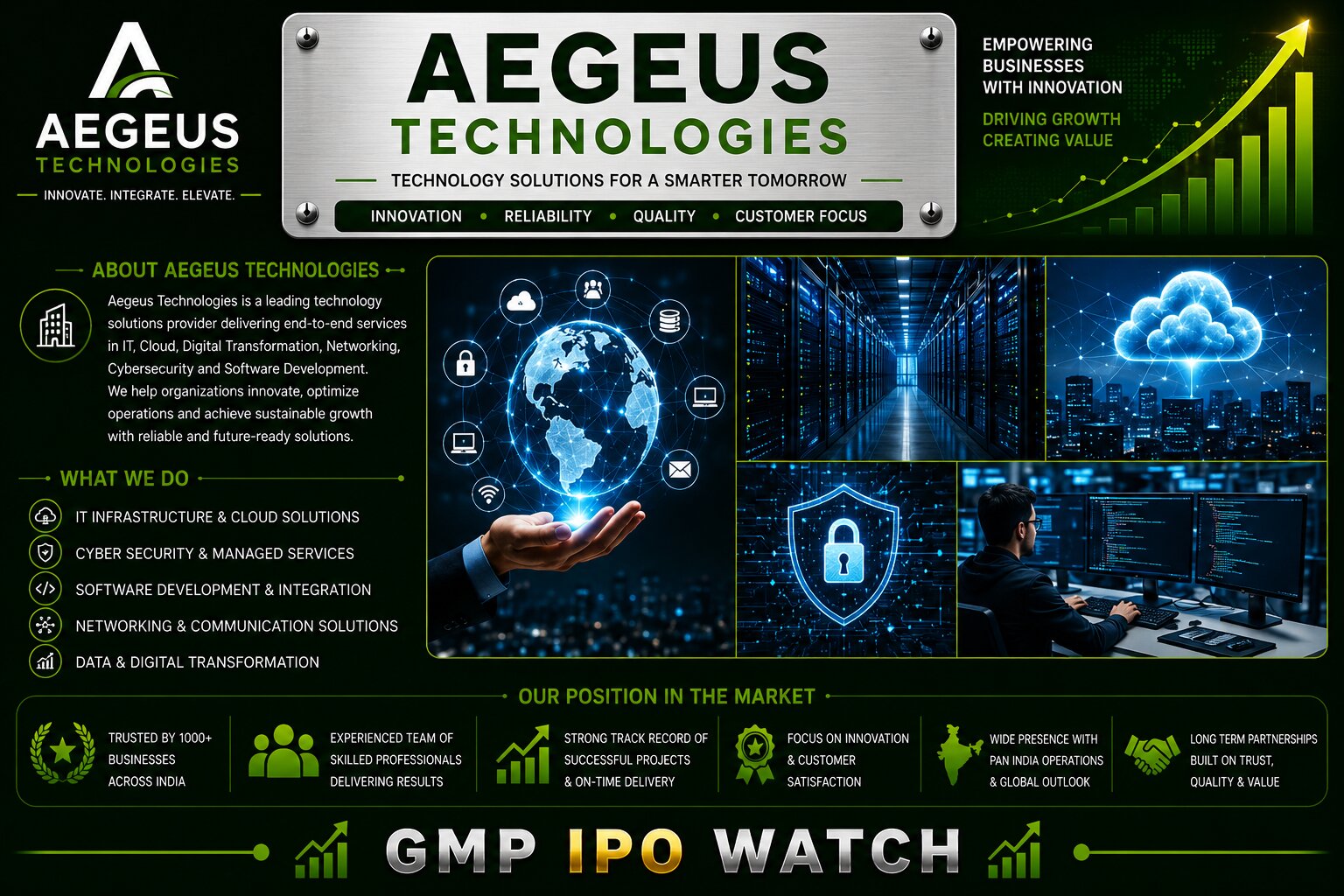
Aegeus Technologies Limited operates in this specialised clean-technology segment. The company designs and manufactures robotic systems for waterless solar-panel cleaning, automated plant inspection and vegetation-management applications.
The Aegeus Technologies IPO opened on August 4, 2026, and closes on August 6, 2026. The company has fixed a price band of ₹100 to ₹105 per equity share, while the public issue is valued at approximately ₹23.71 crore. Its shares are proposed to list on the BSE SME platform on August 11, 2026.
This review examines the company’s actual business, products, financial performance, IPO terms, industry opportunity, competitive strengths, risks and important factors investors should evaluate before applying.
About Aegeus Technologies Limited
Aegeus Technologies is a Bengaluru-based clean-technology and robotics company founded in 2017. It develops automated systems intended to improve the operation and maintenance of solar-power plants.
The company combines robotics, Internet of Things connectivity, artificial intelligence, machine learning and data-led monitoring to reduce the time, labour and water required for maintaining solar installations.
Its core objective is to help solar-plant owners maintain panel efficiency while lowering operating costs and environmental impact.
Aegeus was originally incorporated as a private company and subsequently converted into a public limited company before filing for its SME IPO.
What Does Aegeus Technologies Actually Do?
Aegeus Technologies is not a conventional solar-module manufacturer or power producer.
It operates as a technology supplier to companies that own, develop or maintain solar-power plants.
Its solutions broadly cover:
- Waterless robotic solar-panel cleaning
- Autonomous plant inspection
- Solar-module performance monitoring
- Vegetation-management systems
- Predictive-maintenance support
- IoT-enabled equipment monitoring
- Robotic operations and maintenance
- Plant-level data collection and analysis
The company earns revenue from the manufacture and sale of robotic equipment, system deployment, integration and related service support.
Why Solar Panels Need Regular Cleaning
Solar modules generate electricity when sunlight reaches their surface. Dust, sand, bird droppings, pollution and other deposits can block sunlight and reduce output.
The problem can become more serious in:
- Dry and dusty regions
- Desert environments
- Industrial areas
- Agricultural locations
- Regions with limited rainfall
- Large utility-scale solar parks
Manual cleaning requires workers, equipment and water. At large plants, this process may need to be repeated frequently.
Waterless robotic systems can potentially reduce these requirements by moving across panel rows and cleaning the module surface automatically.
The commercial value of such a system depends on whether the energy recovered through better cleaning exceeds the cost of purchasing, installing and maintaining the robots.
Unicorn Waterless Solar-Cleaning Robot
One of Aegeus Technologies’ key products is its Unicorn robotic solar-cleaning system.
The robot is designed to clean photovoltaic panels without using water. Depending on the project configuration, the system can operate across panel rows and remove accumulated dust through automated mechanical cleaning.
Potential benefits include:
- Reduced water consumption
- Lower dependence on manual labour
- More frequent cleaning cycles
- Improved panel availability
- Reduced exposure of workers to difficult sites
- Better monitoring of cleaning activity
- More consistent maintenance schedules
A waterless design can be particularly useful for solar plants in regions where water is scarce or expensive.
Autonomous Inspection Solutions
Cleaning alone does not address every maintenance requirement at a solar plant.
Solar assets may also experience:
- Module damage
- Hotspots
- Cable faults
- Mounting problems
- Inverter-related issues
- Vegetation growth
- Uneven panel performance
- Structural defects
Aegeus Technologies develops systems intended to automate parts of the inspection process.
Autonomous inspection may help operators identify potential problems earlier and direct maintenance teams toward specific areas instead of relying only on broad manual inspections.
This could reduce downtime and improve plant-level decision-making, although the effectiveness depends on sensor accuracy, software quality and field conditions.
Vegetation-Management Opportunity
Vegetation can create operational problems at ground-mounted solar plants.
Uncontrolled grass and plant growth may:
- Shade lower portions of panels
- Restrict access for maintenance teams
- Increase fire risk
- Interfere with equipment
- Attract pests
- Raise recurring maintenance costs
Aegeus Technologies has expanded its robotics platform toward vegetation-management applications.
This creates an opportunity beyond panel cleaning, allowing the company to address multiple operations-and-maintenance requirements within the same solar facility.
Business Model
Aegeus Technologies follows a technology-led manufacturing and services model.
Its potential revenue sources include:
- Sale of solar-cleaning robots
- Installation and commissioning
- Custom system integration
- Inspection-robot deployment
- Vegetation-management solutions
- Software and monitoring tools
- Operations-and-maintenance support
- Replacement parts
- Annual maintenance contracts
- Product upgrades
Equipment sales may generate larger one-time revenue, while maintenance contracts and software-linked services can create more recurring income.
The balance between hardware sales and recurring service revenue will be important for the company’s long-term profitability.
Target Customers
The company’s solutions may be used by:
- Utility-scale solar-power developers
- Independent power producers
- Solar EPC contractors
- Renewable-energy asset managers
- Operations-and-maintenance companies
- Commercial and industrial solar users
- Government-backed solar projects
- Infrastructure investors owning renewable assets
Large solar developers may require customised deployment based on module design, row length, terrain and plant configuration.
This means Aegeus must demonstrate both product reliability and the ability to customise systems for different project environments.
Aegeus Technologies IPO Details
| Particular | Details |
|---|---|
| IPO Type | Book-Built SME IPO |
| Total Issue Size | Approximately ₹23.71 crore |
| Price Band | ₹100 to ₹105 per share |
| Face Value | ₹10 per equity share |
| Lot Size | 1,200 shares |
| IPO Opening Date | August 4, 2026 |
| IPO Closing Date | August 6, 2026 |
| Basis of Allotment | Expected August 7, 2026 |
| Credit to Demat | Expected August 10, 2026 |
| Tentative Listing Date | August 11, 2026 |
| Listing Platform | BSE SME |
Investors should verify the final application structure, allotment schedule and issue allocation through the Red Herring Prospectus and their broker before bidding.
Lot Size and Minimum Investment
The base lot contains 1,200 shares.
Under the applicable SME IPO application structure, retail investors may be required to apply for at least two lots, or 2,400 shares.
At the upper price band of ₹105, the approximate minimum investment would be:
2,400 shares × ₹105 = ₹2,52,000
The final bidding quantity displayed in the ASBA or broker application should be checked before submitting the bid.
Objectives of the IPO
The company is expected to use the fresh issue proceeds for strengthening its operations and supporting future expansion.
The proposed utilisation may include:
- Working-capital requirements
- Product development
- Research and development
- Expansion of manufacturing capabilities
- Technology infrastructure
- Deployment of robotic systems
- General corporate purposes
Working capital can be important because the company may need to purchase components, manufacture robots and complete installation before receiving full payment from customers.
The exact allocation of proceeds should be verified from the final offer document.
Financial Performance
Aegeus Technologies has reported strong improvement in revenue and profitability over the latest disclosed financial periods.
| Period Ended | Revenue | Expenses | Profit After Tax | Total Assets |
| FY2024 | ₹15.28 crore | ₹14.36 crore | ₹0.93 crore | ₹13.56 crore |
| FY2025 | ₹21.90 crore | ₹20.00 crore | ₹1.39 crore | ₹22.09 crore |
| FY2026 | ₹41.22 crore | ₹35.80 crore | ₹4.02 crore | ₹39.36 crore |
Revenue increased from ₹15.28 crore in FY2024 to ₹41.22 crore in FY2026, representing considerable expansion over two years.
PAT increased from ₹0.93 crore to ₹4.02 crore during the same period, meaning profit grew faster than revenue.
Understanding the Revenue Growth
Revenue increased by approximately 43% between FY2024 and FY2025 and by around 88% between FY2025 and FY2026.
Possible growth drivers include:
- Increased solar-robot deployments
- Larger customer contracts
- Expansion of manufacturing
- Higher demand from utility-scale projects
- New inspection and vegetation-management products
- Improved industry acceptance of automated cleaning
- Increased solar capacity across India
Rapid growth from a relatively small base can appear impressive, but investors should determine how much revenue comes from repeat customers and how much depends on a few major projects.
Profitability and Key Ratios
The company’s FY2026 performance indicators include:
| Financial Indicator | FY2026 Value |
| Return on Equity | 29.93% |
| Return on Capital Employed | 24.75% |
| EBITDA Margin | 15.82% |
| PAT Margin | 9.81% |
| Debt-to-Equity Ratio | 0.77 |
| Earnings Per Share | ₹6.57 |
| Return on Net Worth | 29.93% |
| Net Asset Value | ₹25.18 |
A PAT margin of nearly 10% and ROE of approximately 30% indicate improved profitability.
However, investors should determine whether these returns can be sustained as the company expands manufacturing, hires technical staff and invests in product development.
IPO Valuation
At the upper price band of ₹105 and reported EPS of ₹6.57, the implied price-to-earnings ratio is approximately:
₹105 ÷ ₹6.57 = 15.98 times
This valuation should be assessed alongside:
- Revenue growth
- Profit sustainability
- Customer concentration
- Order-book visibility
- Cash-flow generation
- Technology risk
- Warranty obligations
- Competitive position
- Post-issue dilution
A P/E of around 16 times may appear reasonable for a growing technology manufacturer, but only when earnings are recurring and supported by healthy cash flow.
Debt Position
The company’s reported debt-to-equity ratio of 0.77 indicates moderate financial leverage.
Debt may be used for:
- Purchasing components
- Funding inventory
- Manufacturing equipment
- Product development
- Customer project execution
- Working-capital requirements
Borrowing can support growth, but interest costs and repayment obligations may create pressure if customer collections are delayed.
Investors should evaluate total borrowings, finance costs and operating cash flow in the offer document.
Solar Operations and Maintenance Market
The opportunity for Aegeus Technologies is linked to the growth of operating solar capacity rather than only new installations.
Every newly commissioned solar plant creates long-term requirements for:
- Cleaning
- Inspection
- Monitoring
- Vegetation control
- Performance analysis
- Fault detection
- Component maintenance
As India’s installed solar base grows, the total addressable operations-and-maintenance market also expands.
This can benefit companies offering solutions that reduce operating costs or improve electricity generation.
Water Conservation as a Business Driver
Large solar plants may require significant water for conventional panel cleaning.
In water-stressed regions, operators may face:
- Limited water availability
- High transportation costs
- Regulatory restrictions
- Community concerns
- Sustainability targets
Waterless robotics can therefore provide both an operating and environmental benefit.
Customers, however, will compare the upfront robot cost against expected water savings, labour reduction and energy recovery.
Aegeus Technologies must demonstrate measurable returns rather than relying only on the environmental appeal of its products.
Technology and Product Development
Robotic systems used outdoors must operate under challenging conditions.
They may face:
- Extreme heat
- Dust
- Wind
- Uneven module alignment
- Mechanical wear
- Electrical faults
- Communication problems
- Battery degradation
- Changing plant layouts
Continuous research and product development are essential.
The company must improve hardware reliability, software intelligence, navigation, remote monitoring and component life while keeping the systems commercially affordable.
Competitive Strengths
Specialised Solar-Robotics Platform
The company focuses on robotics for solar operations rather than general-purpose automation.
Waterless Cleaning Technology
Its systems address both cleaning efficiency and water conservation.
Made-in-India Product Development
Local design and manufacturing may support faster customisation, maintenance and replacement-part availability.
Expanding Product Portfolio
Cleaning, inspection and vegetation-management systems create multiple applications within solar plants.
Strong Recent Financial Growth
Revenue and PAT have increased substantially between FY2024 and FY2026.
Improving Return Ratios
Reported ROE and ROCE indicate stronger capital efficiency during FY2026.
Structural Renewable-Energy Opportunity
Growth in installed solar capacity expands the long-term maintenance market.
Major Risk Factors
Limited Operating History
Aegeus Technologies was founded in 2017 and remains a relatively young company compared with established engineering manufacturers.
Its long-term performance across different market cycles has not yet been fully tested.
Customer Concentration
Solar robotics is a specialised B2B market. Revenue may depend on a limited number of large solar developers or project orders.
The delay or cancellation of one major contract could affect revenue.
Technology Obsolescence
New cleaning methods, alternative robotic systems or changes in solar-module design may reduce demand for existing products.
Product Reliability
Equipment failure at large solar plants can lead to warranty costs, customer claims and reputational damage.
Long Sales Cycle
Large renewable-energy companies may require technical trials and approvals before placing commercial orders.
Component Dependence
The company may depend on suppliers for motors, electronics, sensors, batteries and specialised mechanical components.
Working-Capital Requirements
Manufacturing and deploying robots may require expenditure before customers make full payment.
Competition
Aegeus faces competition from domestic and international solar-cleaning technology providers as well as manual-maintenance contractors.
SME Liquidity Risk
BSE SME shares may experience lower trading volume, wider price spreads and higher volatility after listing.
Current GMP and Market Sentiment
Early grey-market indications have shown an approximately ₹0 GMP around the opening of the issue.
This suggests that the unofficial market was not pricing in a significant listing premium at that stage.
However, GMP can change during the subscription period based on:
- Investor demand
- Market conditions
- Overall SME sentiment
- Subscription levels
- Institutional participation
Grey Market Premium is unofficial and unregulated. It should not be used as the primary reason to apply or avoid an IPO.
Future Growth Opportunities
Expansion of Utility-Scale Solar
Every additional large solar plant creates potential demand for automated cleaning and inspection.
International Markets
Dry and water-scarce solar markets in the Middle East, Africa and other regions may offer export potential.
Recurring Maintenance Revenue
Annual maintenance contracts, monitoring tools and replacement parts could increase predictable revenue.
Autonomous Inspection
Inspection robots may help the company expand beyond routine cleaning into higher-value asset monitoring.
Vegetation Management
Automated vegetation control provides another use case within solar plants.
Data and Analytics
Plant data collected through robotic systems could support predictive maintenance and performance optimisation.
Product Leasing
Rental or service-based deployment models may make the technology accessible to customers unwilling to make a large upfront purchase.
What Investors Should Check Before Applying
Investors should review the following information in the RHP:
- Revenue contribution from the largest customers
- Current order book and execution schedule
- Share of revenue from robot sales versus services
- Operating cash flow
- Receivable and inventory levels
- Warranty and product-liability obligations
- Research and development expenditure
- Imported-component dependence
- Intellectual-property ownership
- Pending litigation or tax matters
- Capacity utilisation
- Post-IPO debt level
- Related-party transactions
- Export contribution
- Post-issue valuation
These factors are more important than short-term GMP.
Why Investors Are Watching Aegeus Technologies IPO
The IPO has attracted attention because of:
- Exposure to solar robotics
- Waterless cleaning technology
- Strong FY2026 revenue growth
- PAT increasing to ₹4.02 crore
- ROE of approximately 29.93%
- An implied P/E of around 16 times
- India’s expanding solar-maintenance market
- A small ₹23.71 crore issue
- Potential growth in inspection and vegetation robotics
At the same time, investors must consider its small business scale, customer concentration, technology risk and SME liquidity.
Should You Apply for Aegeus Technologies IPO?
Aegeus Technologies offers a distinctive investment opportunity within the renewable-energy ecosystem.
Unlike solar developers that generate and sell electricity, Aegeus provides robotics intended to make operating solar plants more efficient and environmentally sustainable.
Its positive factors include:
- Rapid revenue growth
- Strong improvement in PAT
- Specialised technology
- Water-conservation benefits
- Exposure to recurring solar O&M demand
- Improving return ratios
- Moderate implied earnings valuation
The major concerns include:
- Small operating scale
- Limited historical track record
- Customer concentration
- Technology and product-reliability risk
- Working-capital requirements
- Competition
- SME share liquidity
The issue may be more suitable for investors who understand small technology manufacturers and can tolerate higher business and market risk.
Final Verdict
The Aegeus Technologies IPO 2026 offers exposure to a specialised clean-technology company developing robotic solutions for solar-panel cleaning, plant inspection and vegetation management.
The company’s revenue increased from ₹15.28 crore in FY2024 to ₹41.22 crore in FY2026, while PAT increased from ₹0.93 crore to ₹4.02 crore. The latest reported ROE of 29.93%, ROCE of 24.75% and PAT margin of 9.81% indicate meaningful improvement in financial performance.
Its long-term opportunity is supported by the expanding installed base of solar plants and growing demand for water-efficient maintenance.
However, Aegeus Technologies remains a relatively small company exposed to customer concentration, product reliability, technology changes, working-capital pressure and SME liquidity risk.
The IPO can therefore be viewed as a higher-risk, technology-led renewable-energy opportunity with promising growth but limited operating scale.
The final investment decision should depend on the company’s order book, customer diversification, audited cash flow, use of IPO proceeds, post-issue valuation and the investor’s personal risk tolerance—not only on the clean-energy theme or Grey Market Premium.