 GMP IPO Watch
G V Electricals IPO 2026 – Latest Detailed Review
India’s power sector is often discussed in terms of electricity generation, renewable-energy capacity and transmission projects. However, electricity cannot reach consumers reliably without an efficient distribution network.
Distribution infrastructure includes transformers, substations, cables, feeders, poles, meters and control systems that deliver electricity from the transmission network to homes, factories, offices and public facilities.
These assets require regular inspection, preventive maintenance, emergency repairs, meter management and network upgrades. Electricity distribution companies therefore depend on specialised contractors capable of maintaining infrastructure and executing complex projects across large service areas.
G V Electricals Limited operates in this segment through operation and maintenance services, power-distribution projects, turnkey EPC assignments, metering solutions and allied electrical work.
The G V Electricals IPO opened on July 31, 2026, and closes today, August 4, 2026. The company is raising approximately ₹42.25 crore at a price band of ₹123 to ₹130 per equity share. Its shares are proposed to list on the BSE SME platform on August 7, 2026.
This updated review examines the company’s utility-services model, revenue sources, IPO structure, working-capital requirements, industry opportunity, subscription trend, strengths, risks and overall investment outlook.
About G V Electricals Limited
G V Electricals has been associated with electrical and power-infrastructure projects for more than four decades. The company states that it has experience in low-tension and high-tension installations extending up to 400 KV.
Its services are directed toward electricity distribution utilities, industrial customers, infrastructure developers, commercial establishments and other organisations requiring electrical-project execution or network maintenance.
The company’s major service areas include:
- Operation and maintenance
- Turnkey EPC projects
- Power-distribution infrastructure
- Electro-civil work
- Meter management and governance
- Metering and billing solutions
This makes G V Electricals a service-led infrastructure contractor rather than a conventional manufacturer of electrical equipment.
Understanding the Utility Outsourcing Model
Electricity distribution companies operate large networks containing thousands of individual assets.
Maintaining these networks internally can require substantial manpower, equipment, local teams and technical expertise. Utilities may therefore outsource selected activities to specialised service providers.
A contractor such as G V Electricals may be responsible for:
- Inspecting distribution assets
- Maintaining transformers and feeders
- Repairing damaged cables
- Replacing faulty electrical equipment
- Restoring electricity after breakdowns
- Managing consumer meters
- Supporting billing operations
- Executing network upgrades
- Testing newly installed infrastructure
- Maintaining service records
The commercial opportunity comes from the continuous nature of electricity distribution.
Unlike a one-time construction project, operation and maintenance services may continue throughout the contract period, potentially providing recurring revenue.
Operation and Maintenance Services
Operation and maintenance, commonly known as O&M, forms an important part of the company’s service portfolio.
Electrical networks require regular attention because equipment may deteriorate because of:
- Ageing infrastructure
- Overloading
- Weather conditions
- Accidental damage
- Voltage fluctuations
- Water exposure
- Poor connections
- Growing electricity demand
Preventive maintenance can reduce the risk of breakdowns and help utilities improve network availability.
O&M contracts may include scheduled inspections, emergency repair services, asset replacement, manpower deployment and reporting.
The quality of execution is critical because delays can affect electricity supply to a large number of consumers.
Turnkey EPC Projects
G V Electricals also undertakes Engineering, Procurement and Construction projects.
Under a turnkey EPC contract, the company may manage the complete project lifecycle, including:
- Technical planning
- Engineering and design
- Procurement of equipment
- Civil and electrical installation
- Testing
- Commissioning
- Final handover
The company’s project capabilities include electrical installations for utility, industrial and commercial applications. It also presents itself as an executor of end-to-end power-infrastructure projects.
EPC projects can generate higher revenue than routine maintenance contracts, but they also involve greater cost, execution and working-capital risk.
Power-Distribution Infrastructure
Power-distribution projects may involve the construction, renovation or expansion of:
- Substations
- Underground cable networks
- Overhead distribution lines
- Transformers
- Distribution panels
- Feeder systems
- Consumer connections
- Metering infrastructure
- Electrical control systems
- Supporting civil structures
Demand for these services is linked to urban growth, industrial expansion, rural electrification and the modernisation of ageing networks.
As electricity consumption increases, distribution infrastructure must be upgraded to handle higher loads safely and efficiently.
Meter Management and Governance
Electricity meters are central to the commercial operations of a distribution utility.
A meter-management programme may include:
- Meter installation
- Replacement of defective meters
- Consumer-data verification
- Meter reading
- Testing and calibration
- Record maintenance
- Complaint resolution
- Monitoring of meter performance
Improved metering can help utilities reduce billing errors, identify losses and improve revenue collection.
The expansion of smart-meter programmes may create additional opportunities for companies with field-execution, data-management and utility-service capabilities.
Metering and Billing Solutions
Metering and billing services connect physical electricity consumption with consumer invoicing.
These services may require:
- Accurate meter data
- Field staff
- Digital systems
- Consumer-database management
- Billing support
- Exception reporting
- Coordination with the utility
While billing-related work can provide recurring service revenue, it also exposes contractors to service-level requirements, data-quality issues and consumer complaints.
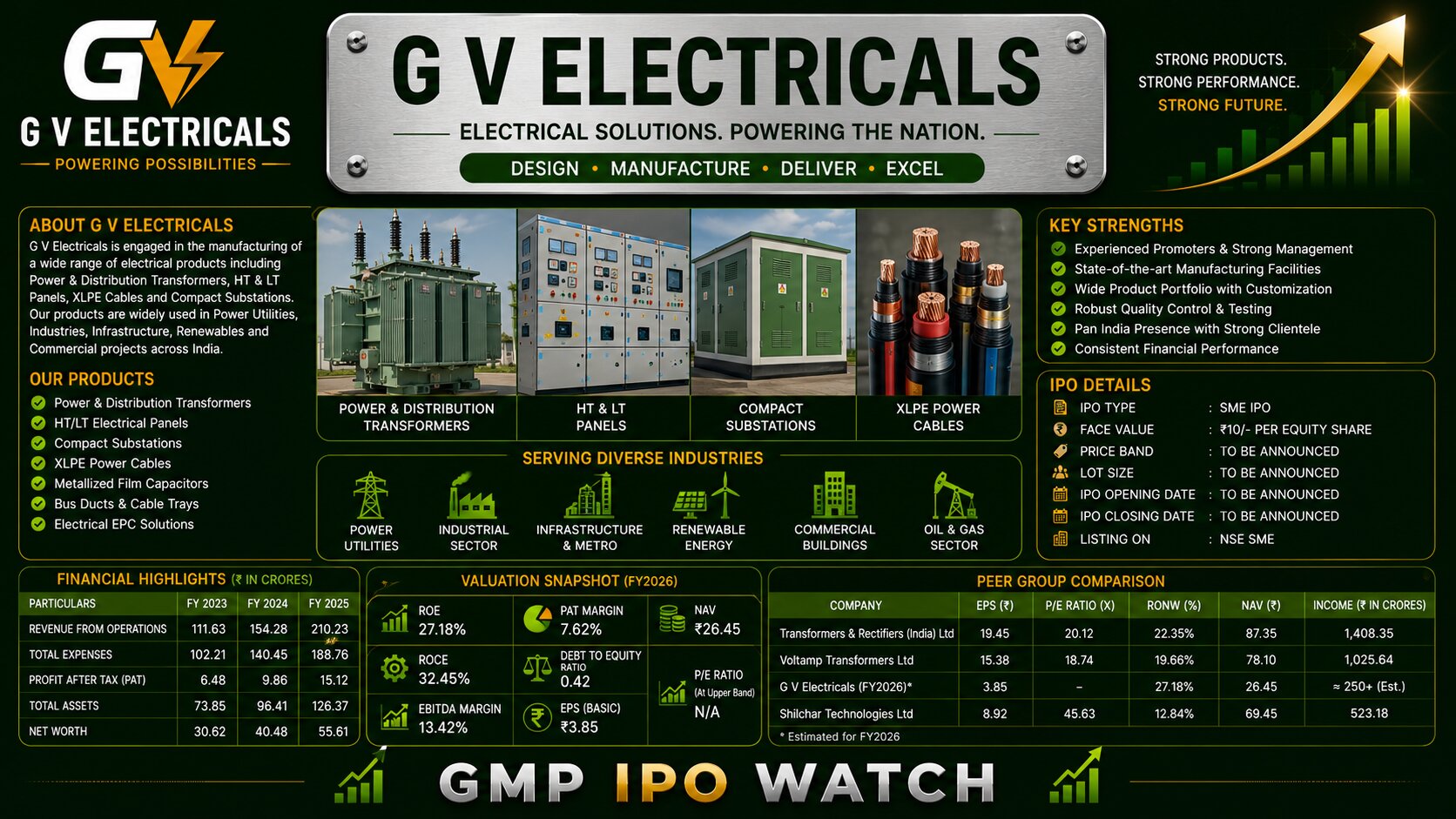
G V Electricals IPO Details
| Particular | Details |
|---|---|
| IPO Type | Book-Built SME IPO |
| Total Issue Size | Approximately ₹42.25 crore |
| Fresh Issue | 30,00,000 equity shares, approximately ₹39 crore at the upper band |
| Offer for Sale | 2,50,000 equity shares, approximately ₹3.25 crore at the upper band |
| Face Value | ₹10 per equity share |
| Price Band | ₹123 to ₹130 per share |
| Base Lot Size | 1,000 shares |
| IPO Opening Date | July 31, 2026 |
| IPO Closing Date | August 4, 2026 |
| Basis of Allotment | Expected August 5, 2026 |
| Demat Credit and Refund Process | Expected August 6, 2026 |
| Tentative Listing Date | August 7, 2026 |
| Listing Platform | BSE SME |
The IPO contains both a fresh issue and an Offer for Sale. The fresh-issue proceeds will be received by the company, while the OFS proceeds will go to the selling shareholders.
Lot Size and Minimum Investment
The base bidding lot contains 1,000 shares.
Under the applicable SME IPO structure, the minimum retail application is shown as 2,000 shares.
At the upper price band of ₹130, the minimum application amount is:
2,000 shares × ₹130 = ₹2,60,000
Some platforms displayed approximately ₹2,46,000 when calculated at the lower price band of ₹123. Investors should verify the quantity and amount displayed in their broker or ASBA application before submitting the bid.
Objectives of the IPO
The company proposes to use the fresh issue proceeds for:
- Repayment of a portion of existing borrowings
- Funding working-capital requirements
- General corporate purposes
These objectives are directly connected with the financial requirements of an infrastructure-contracting business.
Debt repayment may reduce finance costs, while additional working capital can improve the company’s ability to execute larger or multiple contracts simultaneously.
Why Working Capital Matters
G V Electricals may need to incur substantial expenses before receiving full payment from a customer.
A project can require expenditure on:
- Electrical equipment
- Cables and conductors
- Transformers
- Switchgear
- Labour
- Subcontractors
- Civil material
- Transportation
- Site offices
- Safety equipment
- Performance guarantees
Customer payments may depend on project milestones, inspection reports and certification.
This can create a gap between expenditure and cash collection.
If receivables remain unpaid for a long period, the company may need additional short-term borrowings. Therefore, investors should not judge the business solely on reported revenue or profit.
Operating cash flow, receivable days and working-capital utilisation are equally important.
Subscription Status Before the Final Day
The IPO had received strong demand by the end of August 3, 2026.
The reported subscription figures were:
| Investor Category | Subscription as of August 3 |
| Qualified Institutional Buyers | Approximately 3.52 times |
| Non-Institutional Investors | Approximately 18.87 times |
| Retail or Individual Investors | Approximately 29.33 times |
| Overall | Approximately 19.63 times |
Retail investors were leading the demand, followed by strong participation from non-institutional investors.
These figures were recorded before the final day. Final subscription can increase substantially during the closing hours as institutional and HNI applications are submitted.
A high subscription level can improve listing sentiment, but it does not remove business, valuation or liquidity risk.
Grey Market Premium
One grey-market tracker reported a GMP of approximately ₹18 per share, implying an unofficial estimated price of about ₹148 against the upper issue price of ₹130.
This would represent a possible unofficial premium of around 13.8%.
However, the available ₹18 reading was published before the IPO’s final day and may not reflect the latest market trade.
GMP is unofficial, unregulated and can change rapidly. It should not be treated as a guaranteed listing-price forecast or as the primary reason to invest.
Power-Distribution Industry Opportunity
India’s distribution infrastructure requires ongoing investment because of:
- Rising electricity consumption
- Urban population growth
- Industrial development
- Renewable-energy integration
- Smart-meter installations
- Rural network expansion
- Reduction of distribution losses
- Modernisation of old substations
- Underground cabling
- Electric-vehicle charging demand
Even when power-generation capacity grows, consumers cannot benefit unless the distribution network is capable of delivering that electricity reliably.
This gives utility-service and EPC contractors a long-term opportunity.
However, business growth will depend on tender availability, competitive pricing, execution capacity and timely payment from customers.
Impact of Smart Metering
The installation of smart meters represents an important change in electricity distribution.
Smart meters can help utilities:
- Record consumption remotely
- Improve billing accuracy
- identify unusual usage
- Reduce manual meter reading
- Detect outages
- Support prepaid electricity
- Reduce commercial losses
- Improve consumer service
G V Electricals’ experience in meter management and billing solutions may provide a base for participating in related projects.
However, smart-meter projects often require technology partnerships, cybersecurity capabilities and large-scale data systems in addition to field execution.
Recurring Revenue vs Project Revenue
G V Electricals’ business may contain two different revenue characteristics.
O&M and Utility Services
These contracts may provide recurring revenue throughout the contract period.
EPC Projects
These assignments may generate larger revenue but can fluctuate according to the project schedule.
A healthy mix can provide stability and growth.
However, investors should examine how much revenue comes from recurring operations and how much depends on one-time projects.
A company dependent heavily on a few large EPC contracts may experience uneven annual performance.
Customer Concentration
Electrical-infrastructure companies frequently depend on a limited number of utilities, government agencies or major industrial customers.
High customer concentration can create several risks:
- Loss of a major contract
- Delayed payments
- Lower future tender awards
- Dependence on customer budgets
- Pressure on contract pricing
- Concentrated receivables
Investors should examine revenue contribution from the largest customers and the value of outstanding receivables in the IPO documents.
Order Book and Revenue Visibility
The order book is an important indicator for an EPC and utility-services company.
It can show:
- Contracted project value
- Expected future revenue
- Type of customer
- Geographic spread
- Project duration
- Execution timeline
However, order-book value should not be treated as guaranteed profit.
Revenue and earnings depend on:
- Site availability
- Customer approvals
- Material procurement
- Labour deployment
- Project costs
- Timely billing
- Collection of payments
- Contract modifications
Investors should assess both the size and quality of the order book.
Competitive Strengths
More Than Four Decades of Experience
The company states that it has operated across electrical infrastructure projects for over 40 years.
Diversified Utility Services
Its activities extend across O&M, EPC projects, electro-civil work, power distribution, meter management and billing.
High-Voltage Project Capability
The company reports experience in electrical installations extending up to 400 KV.
Experience Across Complex Projects
Its official website refers to more than 200 projects and approximately 50 ongoing assignments.
Essential Infrastructure Exposure
Electricity distribution and maintenance remain necessary regardless of short-term consumer demand cycles.
Fresh Capital for Working Capital
The IPO may improve the company’s ability to execute additional contracts.
Strong IPO Subscription
Demand had reached approximately 19.63 times overall before the final bidding day.
Major Risk Factors
Dependence on Utilities and Government Projects
A substantial share of business may depend on tenders, public-sector budgets and utility spending.
Payment Delays
Government agencies and distribution companies may take time to certify and settle invoices.
Working-Capital Pressure
Delayed receivables can increase short-term borrowing requirements.
Competitive Bidding
Contracts may be awarded to the lowest technically qualified bidder, creating pressure on margins.
Project Execution Risk
Delays, cost overruns or site-related problems may reduce profitability.
Raw-Material Price Changes
Fluctuations in copper, aluminium, steel, cables and electrical equipment may affect project costs.
Customer Concentration
Dependence on major customers can create revenue instability.
Contract Penalties
Failure to meet deadlines or performance standards may lead to penalties.
Employee and Subcontractor Dependence
The company requires skilled engineers, technicians, labour contractors and field teams.
SME Listing Liquidity
BSE SME shares may experience lower trading volume, wider bid-ask spreads and greater price volatility than established mainboard shares.
Financial Factors Investors Should Evaluate
Investors should examine the audited financial statements for:
- Revenue growth
- EBITDA margin
- Profit after tax
- Interest cost
- Total borrowings
- Debt-to-equity ratio
- Return on equity
- Return on capital employed
- Operating cash flow
- Trade receivables
- Inventory
- Contract assets
- Customer advances
- Contingent liabilities
For an EPC business, revenue and PAT alone may not present the complete picture.
A company can report profit while cash remains tied up in unfinished projects or unpaid invoices.
Valuation Considerations
At the upper issue price of ₹130, investors should compare G V Electricals with other listed electrical EPC and utility-services companies using:
- Price-to-earnings ratio
- Return on equity
- Return on capital employed
- Debt levels
- EBITDA margins
- Order-book-to-revenue ratio
- Cash-flow conversion
- Customer concentration
- Working-capital cycle
- Post-issue market capitalisation
A high subscription rate can support short-term market interest, but it does not automatically make the valuation attractive.
The issue should be assessed based on sustainable earnings and cash generation.
Future Growth Opportunities
Distribution-Network Modernisation
Utilities need to replace ageing transformers, cables and distribution assets.
Smart-Meter Projects
Large-scale meter replacement can create installation, maintenance and consumer-management work.
Renewable-Energy Integration
Solar and wind capacity require stronger distribution and grid infrastructure.
Urban Underground Cabling
Cities are increasingly considering underground power networks for reliability and safety.
Industrial Expansion
New manufacturing plants require substations, panels, cabling and power-distribution systems.
Electric-Vehicle Infrastructure
EV charging growth may create demand for additional local electrical capacity.
Recurring O&M Contracts
Long-duration maintenance assignments can strengthen revenue visibility.
Geographic Expansion
Entering additional states and utility networks may reduce customer and regional concentration.
What Investors Should Check Before Applying
Before subscribing, investors should review:
- Latest order-book value
- Revenue from the largest customers
- Share of revenue from O&M versus EPC
- Trade-receivable days
- Operating cash flow
- Total borrowings and finance costs
- Contract penalties and disputes
- Pending legal or tax matters
- Related-party transactions
- Geographic concentration
- Utility and government exposure
- Use of IPO proceeds
- Post-issue promoter holding
- Post-issue valuation
- Final subscription by investor category
These disclosures provide a stronger basis for decision-making than GMP alone.
Why Investors Are Tracking G V Electricals IPO
The IPO has attracted attention because of:
- Strong subscription before the final day
- More than four decades of project experience
- Exposure to essential power infrastructure
- O&M and recurring utility-service opportunities
- Turnkey EPC execution capabilities
- Smart-metering potential
- Fresh capital for working capital
- Planned debt repayment
- A modest positive unofficial GMP
The positive market response should nevertheless be balanced against working-capital, customer-concentration and project-execution risks.
Should You Apply for G V Electricals IPO?
G V Electricals operates in an essential infrastructure segment supported by rising electricity consumption and long-term investment in distribution networks.
Its positive factors include:
- Established operating history
- Diverse utility-service portfolio
- Power-distribution experience
- Recurring O&M potential
- Fresh funds for working capital
- Strong investor subscription
- Opportunities from smart meters and network modernisation
The main concerns include:
- Dependence on utility and government contracts
- Long receivable cycles
- Competitive tendering
- Project delays
- Margin pressure
- Working-capital requirements
- Customer concentration
- SME liquidity
The IPO may be suitable for investors who understand infrastructure-contracting businesses and can tolerate SME-market volatility.
Conservative investors should carefully examine the company’s cash flow, receivables, debt and valuation before applying.
Final Verdict
The G V Electricals IPO 2026 offers investors exposure to a company providing operation and maintenance, power-distribution, turnkey EPC, meter-management and billing services within India’s electrical-infrastructure ecosystem.
The company benefits from more than four decades of operating experience and participation in an industry supported by electricity-demand growth, smart-meter programmes, industrial expansion and distribution-network modernisation.
Market interest has been strong. By the end of August 3, the IPO was subscribed approximately 19.63 times overall, with retail demand at around 29.33 times.
However, investors should not base their decision solely on subscription figures or unofficial GMP.
G V Electricals remains exposed to working-capital pressure, delayed utility payments, competitive bidding, execution risk and SME share liquidity.
The issue can therefore be viewed as a power-infrastructure growth opportunity with an established operating history, but meaningful cash-flow and project-execution risks.
The final investment decision should depend on the company’s audited financials, order-book quality, receivable position, debt profile, post-issue valuation and the investor’s personal risk tolerance.