 GMP IPO Watch
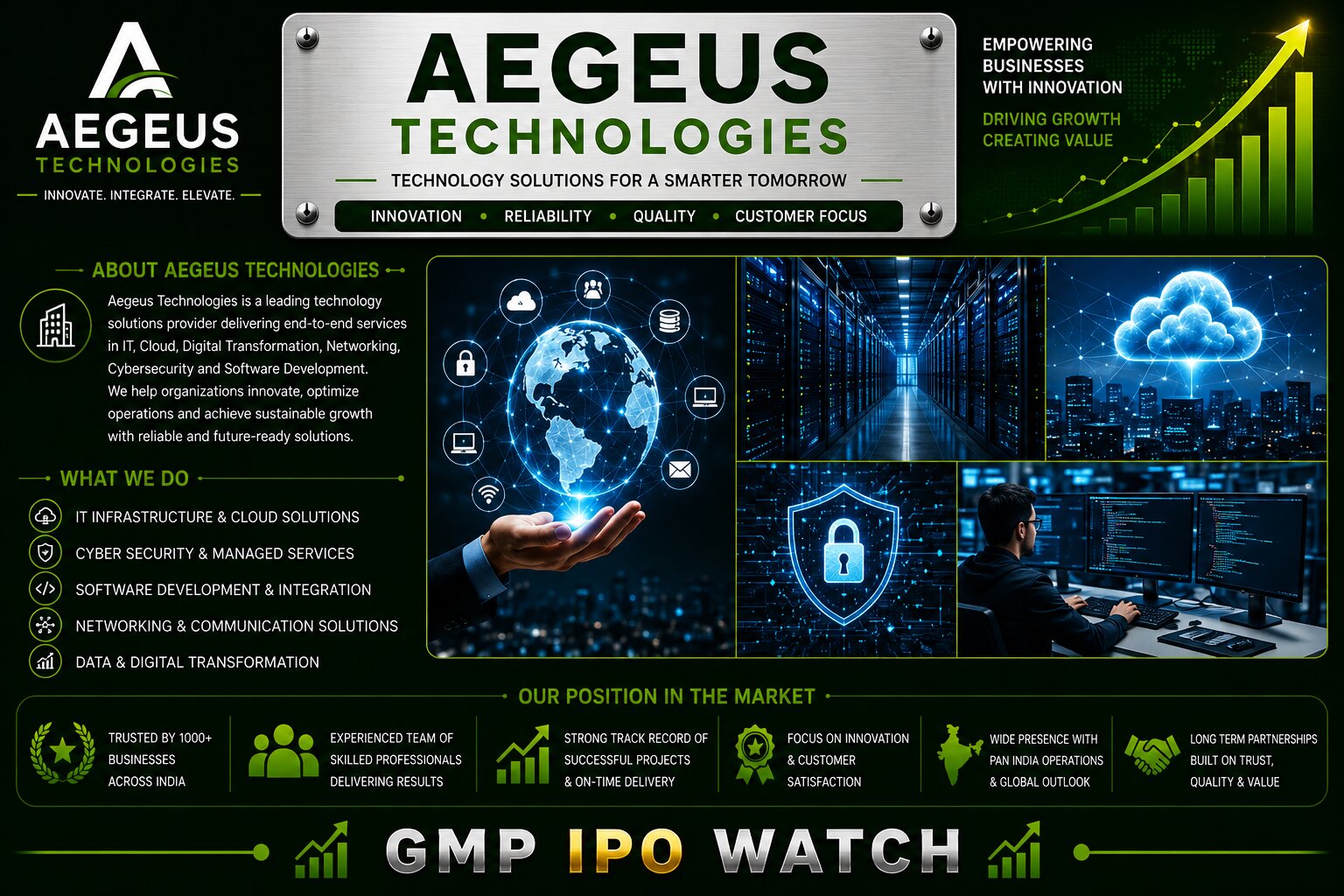
Aegeus Technologies IPO 2026 – Latest Detailed Review
India’s solar-energy capacity is expanding rapidly, but the long-term performance of a solar project depends on more than installing photovoltaic modules. Once a plant begins generating electricity, its panels must be cleaned, inspected and maintained regularly to limit generation losses caused by dust, dirt, vegetation and equipment faults.
This requirement has created a growing operations-and-maintenance market around solar assets.
Aegeus Technologies Limited operates in this specialised market by designing and developing robotic automation systems for solar-power plants. Its products are intended to automate panel cleaning, plant inspection and vegetation management while reducing water use and manual intervention.
The Aegeus Technologies IPO opened on August 4, 2026, and will close on August 6, 2026. The price band has been fixed at ₹100 to ₹105 per equity share, and the total fresh issue is approximately ₹23.71 crore. The shares are proposed to list on the BSE SME platform.
Unlike many solar-sector IPOs, Aegeus Technologies does not develop power projects or manufacture solar modules. Its opportunity comes from supplying technology that helps existing solar plants operate more efficiently.
This updated review examines the company’s product portfolio, manufacturing model, financial performance, IPO objectives, growth opportunities, competitive strengths, valuation factors and major investment risks.
About Aegeus Technologies Limited
Aegeus Technologies is a Bengaluru-based robotics and automation company focused primarily on the renewable-energy sector.
The company designs and builds robotic systems for:
- Waterless solar-panel cleaning
- Autonomous solar-plant inspection
- Vegetation management
- Data-based plant monitoring
- Predictive maintenance support
- Solar operations automation
Its products combine mechanical engineering with technologies such as sensors, software, artificial intelligence, machine learning and Internet of Things connectivity.
The company describes its systems as 100% Made in India and positions them as solutions for reducing soiling losses, water consumption and manual maintenance requirements at solar plants.
Why Solar-Plant Maintenance Matters
Solar panels produce electricity only when sunlight reaches their active surface.
Dust and other deposits can reduce the amount of sunlight reaching the solar cells. Over time, this can result in lower energy generation and reduced project revenue.
Soiling may be caused by:
- Dust
- Sand
- Industrial pollution
- Bird droppings
- Pollen
- Mud
- Agricultural activity
- Construction near the project site
The impact may be particularly significant in dry and dusty locations where rainfall is limited.
Solar-plant owners therefore need to balance three factors:
- How frequently the panels should be cleaned
- How much cleaning costs
- How much generation can be recovered through cleaning
Aegeus Technologies attempts to improve this equation through automated, waterless robotic systems.
The Waterless Cleaning Opportunity
Traditional panel-cleaning methods may require large quantities of water.
For utility-scale projects containing thousands or millions of modules, regular water-based cleaning can create several challenges:
- Water procurement costs
- Transportation expenses
- Storage infrastructure
- Labour requirements
- Uneven cleaning quality
- Environmental concerns
- Limited water availability
- Damage from inappropriate cleaning practices
These challenges are greater in arid regions, which are often suitable for solar-power generation because they receive strong sunlight but may have limited water resources.
Waterless cleaning robots can help operators reduce dependence on both water and manual labour.
Aegeus states that its patented cleaning systems can process approximately 1,800 to more than 2,000 panels per hour, depending on the product and operating configuration.
Aegeus Technologies Product Portfolio
The company has developed multiple robotic products for different solar-installation requirements.
Its portfolio includes solutions such as:
- Unicorn Smart
- Unicorn R2R
- Shreem
- Autonomous inspection systems
- Vegetation-management robots
- IoT-enabled monitoring solutions
Each product addresses a different solar-plant size, module arrangement or maintenance requirement.
Unicorn Smart
Unicorn Smart is designed as an automated cleaning solution for large solar-panel installations.
The system may combine:
- Waterless brushes
- Automated movement
- Remote monitoring
- Scheduled cleaning
- Operational alerts
- Data collection
- Low-supervision operation
A fully automated system can allow cleaning to be performed during suitable periods without requiring large field teams.
The commercial success of the product depends on its reliability, cleaning effectiveness, maintenance cost and ability to operate under difficult weather conditions.
Unicorn R2R
The Unicorn R2R platform is designed to improve movement and cleaning across solar-module rows.
Utility-scale solar plants may have gaps, changes in alignment or separate module tables. Moving efficiently between these sections can be an important technical challenge for cleaning robots.
A row-to-row system may improve:
- Cleaning coverage
- Robot utilisation
- Operational flexibility
- Labour savings
- Maintenance planning
However, plant design differs across projects. The company may therefore need to customise deployment according to panel dimensions, tilt, spacing and mounting structure.
Shreem for Rooftop Solar
Shreem is associated with waterless cleaning for smaller rooftop solar installations.
The rooftop segment includes:
- Homes
- Commercial buildings
- Factories
- Warehouses
- Hospitals
- Schools
- Shopping centres
- Institutional properties
Rooftop panels can be difficult or unsafe to clean manually, particularly on high-rise or sloped structures.
A compact robotic system may reduce worker exposure while enabling more regular cleaning.
The commercial challenge is affordability. Residential and small commercial users may compare the robot’s cost with the lower cost of occasional manual cleaning.
Autonomous Solar-Plant Inspection
Cleaning is only one part of solar-plant maintenance.
A project may also experience:
- Damaged modules
- Electrical faults
- Hotspots
- Broken cables
- Loose connections
- Tracker problems
- Structural damage
- Inverter failures
- Uneven plant performance
Manual inspection of a large plant can be slow and expensive.
Aegeus develops robotic and data-driven inspection systems intended to help identify maintenance problems more quickly.
The value of automated inspection may come from:
- Faster fault detection
- Reduced manual inspection
- More frequent plant monitoring
- Better maintenance records
- Reduced downtime
- Improved asset performance
The accuracy of the sensors and analytical software will be critical to customer acceptance.
Vegetation-Management Robotics
Ground-mounted solar plants often cover large areas of land. Grass, shrubs and other vegetation can grow between or beneath module structures.
Uncontrolled vegetation may:
- Shade solar panels
- Restrict maintenance access
- Increase fire risk
- Interfere with cables
- Damage equipment
- Increase pest activity
- Raise maintenance expenses
Aegeus Technologies has expanded its platform to include robotic vegetation-management systems.
This provides the company with another product category within the same solar-plant customer base.
A customer using Aegeus cleaning robots could potentially also purchase inspection, monitoring or vegetation-management solutions, creating cross-selling opportunities.
Business Model
Aegeus Technologies follows a product-led engineering and service model.
Its possible revenue streams include:
- Sale of robotic systems
- Custom engineering
- Installation and commissioning
- Software integration
- Annual maintenance contracts
- Replacement parts
- Product servicing
- Remote monitoring
- Technology upgrades
- Operations support
Hardware sales may produce large but irregular revenue.
Maintenance agreements and monitoring services may create recurring income over the operating life of the robots.
For long-term investors, the company’s ability to increase recurring revenue may be as important as the number of robots sold.
Sale Model vs Service Model
Aegeus may commercialise its technology through different approaches.
Direct Equipment Sale
The customer purchases the robot and becomes responsible for the asset.
This can provide immediate revenue but may not create substantial recurring income beyond maintenance and replacement parts.
Robotics-as-a-Service
The company may provide cleaning or inspection based on usage, capacity or service duration.
This model can produce recurring revenue but requires Aegeus to invest capital in robot ownership and deployment.
Annual Maintenance Contract
Customers pay for maintenance, software updates and technical support after purchasing the equipment.
Rental or Leasing
Customers gain access to the system without paying the complete purchase price upfront.
A balanced mix of equipment sales and services could improve revenue predictability.
Aegeus Technologies IPO Details
| Particular | Details |
|---|---|
| IPO Type | Book-Built SME IPO |
| Total Issue Size | Approximately ₹23.71 crore |
| Fresh Issue | 22,58,400 equity shares |
| Offer for Sale | Nil |
| Face Value | ₹10 per equity share |
| Price Band | ₹100 to ₹105 per share |
| Base Lot Size | 1,200 shares |
| Minimum Retail Quantity | 2,400 shares |
| IPO Opening Date | August 4, 2026 |
| IPO Closing Date | August 6, 2026 |
| Basis of Allotment | Expected August 7, 2026 |
| Demat Credit | Expected August 10, 2026 |
| Listing Platform | BSE SME |
| Lead Manager | Turnaround Corporate Advisors Private Limited |
| Registrar | Skyline Financial Services Private Limited |
The IPO consists entirely of a fresh issue. This means the issue proceeds, after expenses, will be available to the company rather than being paid to selling shareholders.
Lot Size and Minimum Investment
The base lot contains 1,200 equity shares.
Retail investors are required to apply for a minimum of 2,400 shares under the applicable SME bidding structure.
At the upper price band of ₹105, the minimum retail investment is:
2,400 shares × ₹105 = ₹2,52,000
This higher application requirement should be considered alongside the liquidity and volatility usually associated with SME-listed shares.
Objectives of the IPO
The company proposes to use the IPO proceeds for four major purposes.
| Objective | Proposed Amount |
| Product development | Approximately ₹2.86 crore |
| Land purchase and civil work for a manufacturing facility | Approximately ₹5.74 crore |
| Working-capital requirements | Approximately ₹8 crore |
| General corporate purposes | Remaining permitted amount |
The IPO therefore supports both near-term operating requirements and long-term manufacturing expansion.
Investment in Product Development
Robotics products require continuous improvement.
Aegeus may need to invest in:
- Mechanical design
- Motor efficiency
- Sensors
- Navigation technology
- Battery performance
- Remote-control systems
- Software
- Artificial intelligence
- Safety features
- Weather resistance
- Product testing
Product development is essential because solar-panel layouts and operating conditions vary across projects.
The company must also respond to competition from new robotic technologies and lower-cost maintenance alternatives.
New Manufacturing Facility
A portion of the proceeds is proposed for purchasing land and completing civil works for a manufacturing facility.
A dedicated plant could help the company:
- Increase production capacity
- Improve manufacturing control
- Reduce dependence on external vendors
- Maintain product consistency
- Shorten delivery schedules
- Protect intellectual property
- Improve quality testing
- Support future exports
However, a larger facility also increases fixed costs.
The investment will create value only when customer demand is sufficient to utilise the additional manufacturing capacity.
Working-Capital Requirements
Robotics manufacturing can require significant working capital.
Before collecting payment from a customer, the company may need to purchase:
- Motors
- Batteries
- Electronic controllers
- Sensors
- Brushes
- Metal structures
- Wheels and drive systems
- Communication equipment
- Imported components
- Packaging materials
Cash may remain blocked in inventory, work in progress and customer receivables.
The proposed ₹8 crore working-capital allocation may help the company execute larger orders without relying excessively on short-term borrowing.
Financial Performance
Aegeus Technologies has reported improving revenue and profitability.
| Financial Period | Total Income | EBITDA | Profit After Tax | Total Assets |
| FY2023 | ₹5.61 crore | ₹0.37 crore | Approximately break-even | ₹7.03 crore |
| FY2024 | ₹15.28 crore | ₹1.66 crore | ₹0.93 crore | ₹13.56 crore |
| FY2025 | ₹21.90 crore | ₹3.13 crore | ₹1.39 crore | ₹22.09 crore |
| Quarter ended June 2025 | ₹14.46 crore | ₹2.60 crore | ₹1.72 crore | ₹33.34 crore |
Revenue rose substantially between FY2023 and FY2025, while PAT improved from approximately break-even to ₹1.39 crore. The June-quarter performance also showed higher profitability compared with earlier full-year periods.
Understanding Recent Growth
Possible reasons for the company’s growth include:
- Greater adoption of waterless cleaning
- Larger commercial deployments
- Growth in India’s installed solar capacity
- New customer contracts
- Expansion of the product portfolio
- Better technology acceptance
- Higher-value robotic solutions
- Improved production capacity
The June 2025 quarter generated revenue equal to a substantial proportion of the previous full year.
This may indicate strong growth, but it could also reflect project timing.
Investors should examine whether revenue is evenly recurring or concentrated around a small number of major deliveries.
Profitability and Key Ratios
For FY2025, the company reported approximately:
| Financial Indicator | Value |
| EBITDA Margin | 14.28% |
| PAT Margin | 6.36% |
| Return on Equity | 16.14% |
| Return on Capital Employed | 18.66% |
| Return on Net Worth | 16.14% |
| Debt-to-Equity Ratio | Approximately 0.36 |
The improving EBITDA margin suggests that revenue growth is beginning to create operating leverage.
However, the company remains relatively small, and one major order can materially influence annual margins.
Borrowing Position
Reported total borrowing increased from approximately:
- ₹1.77 crore in FY2023
- ₹4.16 crore in FY2024
- ₹4.10 crore in FY2025
- ₹7.09 crore by June 2025
The increase may be connected with working capital, inventory and business expansion.
Borrowing can support growth, but investors should assess:
- Finance costs
- Repayment terms
- Short-term debt
- Secured borrowings
- Operating cash flow
- Receivable collection
- Post-IPO funding requirements
If revenue expands but collections remain slow, the company may continue requiring additional working capital.
Order Execution and Revenue Recognition
A robotic deployment may involve multiple commercial stages:
- Customer enquiry
- Site assessment
- Product customisation
- Purchase order
- Component procurement
- Manufacturing
- Testing
- Installation
- Customer acceptance
- Final payment
This process can create a long sales and collection cycle.
Revenue may be recognised when equipment is delivered or when contractual milestones are completed.
Investors should therefore review the company’s receivables, unbilled income and customer-acceptance conditions.
Solar O&M Industry Opportunity
The market opportunity for Aegeus is connected with cumulative solar capacity.
Every operating project may need cleaning and maintenance for 20 years or more.
As the installed base grows, demand may expand for:
- Automated cleaning
- Remote monitoring
- Predictive maintenance
- Inspection robotics
- Vegetation management
- Performance optimisation
- Equipment servicing
The company does not need to depend only on new solar-project construction.
It may also sell products to existing plants seeking to reduce operating costs.
Potential Export Opportunity
Water scarcity and dust are not limited to India.
Large solar markets in regions such as the Middle East, Africa and parts of Asia may face similar cleaning challenges.
International expansion could provide:
- Larger project opportunities
- Higher revenue per deployment
- Geographical diversification
- Foreign-currency revenue
- Access to large desert solar parks
However, exports would also require:
- International certifications
- Local service support
- Distribution partners
- Product adaptation
- Warranty infrastructure
- Currency-risk management
Aegeus must build a strong domestic operating record before scaling internationally.
Intellectual Property and Patented Technology
Aegeus presents patented robotic technology as one of its competitive strengths.
Intellectual property may protect:
- Mechanical cleaning systems
- Robot movement
- Navigation
- Brush design
- Control systems
- Row-transfer mechanisms
- Automated operation
Patents can create entry barriers, but they do not guarantee commercial success.
Competitors may develop alternative designs that achieve similar outcomes without infringing the patents.
Investors should examine the number, jurisdiction, ownership and remaining life of the company’s patents in the offer document.
Competitive Strengths
Specialised Renewable-Energy Robotics
Aegeus focuses on solar operations rather than offering general industrial automation.
Waterless Cleaning Solutions
Its products address water conservation and operational efficiency simultaneously.
Multiple Products for Solar O&M
Cleaning, inspection and vegetation-management products create cross-selling opportunities.
Patented Technology
The company identifies proprietary robotic technology as a core competitive advantage.
Made-in-India Manufacturing
Domestic development may support customisation, service and replacement-part availability.
Improving Financial Performance
Revenue, EBITDA and PAT have increased across the reported periods.
Fresh-Issue Structure
All public issue proceeds are being raised for company purposes rather than shareholder exits.
Dedicated Manufacturing Investment
A proposed new facility may improve production control and scale.
Major Risk Factors
Small Operating Scale
The company’s FY2025 revenue was approximately ₹21.90 crore.
A small number of orders can therefore materially affect annual performance.
Customer Concentration
Large solar developers may contribute a significant share of sales.
The loss or delay of one major project could affect revenue and cash flow.
Product-Reliability Risk
Robots must operate outdoors in heat, dust, wind and changing environmental conditions.
Failures may result in warranty costs and reputational damage.
Technology Obsolescence
New competitors or alternative cleaning technologies may reduce demand for existing products.
Working-Capital Pressure
The company must purchase components and manufacture systems before receiving complete customer payment.
Component Dependency
Specialised electronics, batteries, motors and sensors may come from a limited number of suppliers.
Manufacturing Expansion Risk
The proposed facility may increase costs before generating additional revenue.
Long Customer-Approval Cycle
Solar developers may require pilot testing before approving commercial deployment.
Competition from Manual Cleaning
In regions where labour and water remain inexpensive, customers may not see a strong financial case for automation.
Intellectual-Property Risk
Patent disputes or competing technologies could weaken the company’s market position.
SME Liquidity Risk
BSE SME shares may experience limited trading volume and considerable price volatility.
Valuation Considerations
Investors should evaluate the issue using:
- Post-issue earnings per share
- Price-to-earnings ratio
- Price-to-book ratio
- Revenue growth
- EBITDA margin
- Operating cash flow
- Customer concentration
- Order-book visibility
- Product-development spending
- Warranty costs
- Post-IPO dilution
Historical FY2025 EPS was approximately ₹2.40 before considering the impact of the IPO and later earnings.
Using only FY2025 profit could result in a relatively high historical earnings multiple.
Investors should therefore examine the company’s annualised recent earnings and determine whether quarterly growth is sustainable.
Future Growth Opportunities
More Utility-Scale Deployments
Large solar plants can create demand for multiple robots per project.
Recurring Service Revenue
Maintenance, software, monitoring and replacement parts may improve revenue stability.
Rooftop Solar Growth
Shreem and related products may serve commercial and residential rooftop markets.
Inspection Robotics
Automated inspection can become a higher-value service beyond routine cleaning.
Vegetation Management
The company can sell additional products to existing customers.
Export Markets
Water-scarce countries may offer significant demand for dry-cleaning solutions.
Robotics-as-a-Service
Service-based deployment may reduce customer upfront costs and create recurring income.
Manufacturing Scale
A dedicated facility may improve production capacity and delivery speed.
What Investors Should Check Before Applying
Before submitting an application, investors should review:
- Current order book
- Revenue from the largest customers
- Number of robots commercially deployed
- Revenue from products versus maintenance services
- Operating cash flow
- Receivable and inventory days
- Product warranty costs
- Imported-component dependence
- Patent ownership and validity
- Manufacturing-capacity plans
- Post-IPO borrowing requirements
- Related-party transactions
- Pending legal or tax matters
- Export contribution
- Post-issue valuation
These disclosures are more useful than unofficial market sentiment alone.
Why Investors Are Tracking Aegeus Technologies IPO
The IPO has attracted attention because of:
- A specialised solar-robotics business
- Patented waterless cleaning technology
- Exposure to India’s solar O&M market
- Improving revenue and EBITDA
- Product-development funding
- A proposed manufacturing facility
- An entirely fresh issue
- Potential recurring maintenance revenue
- Long-term water-conservation benefits
At the same time, the company’s small scale, customer concentration, working-capital needs and technology risks require careful assessment.
Should You Apply for Aegeus Technologies IPO?
Aegeus Technologies offers a differentiated way to participate in India’s renewable-energy growth.
Instead of owning solar assets, it provides technology intended to improve their operating efficiency.
Its positive factors include:
- Specialised technology
- Waterless cleaning
- Multiple solar-maintenance products
- Revenue growth
- Improving margins
- Product-development plans
- Manufacturing expansion
- Recurring service potential
The main concerns include:
- Small financial scale
- Limited operating history
- Customer concentration
- Technology and product-reliability risk
- Working-capital requirements
- Expansion-execution risk
- SME liquidity
- Uncertainty around long-term valuation
The IPO may suit investors who understand emerging robotics businesses and can tolerate higher operational and market risk.
Final Verdict
The Aegeus Technologies IPO 2026 provides investors with exposure to a specialised robotics company developing waterless solar-cleaning, autonomous inspection and vegetation-management systems.
The business has a meaningful long-term opportunity because every additional solar plant adds to the potential market for cleaning and maintenance technology.
The company’s financial performance has improved, with total income rising from ₹5.61 crore in FY2023 to ₹21.90 crore in FY2025. PAT increased from approximately break-even to ₹1.39 crore, while the quarter ended June 2025 produced PAT of ₹1.72 crore.
IPO proceeds will support product development, working capital and a new manufacturing facility, which could help the company scale its operations.
However, Aegeus remains a small business exposed to customer concentration, product reliability, technology changes, component supply, working-capital pressure and SME trading risk.
The IPO should therefore be viewed as a technology-led renewable-energy opportunity with promising growth potential, but limited financial scale and meaningful execution risk.
The final investment decision should be based on the company’s order book, customer diversification, audited cash flow, recurring service revenue, post-issue valuation and the investor’s personal risk tolerance—not only on the solar-energy theme.