GMP IPO Watch
Dhanwel Hybrid Seeds IPO 2026 – Can Strong Seed Demand Grow Without Increasing Agricultural Risk?
A farmer does not buy seed only because it is inexpensive.
The real value of seed appears several months later.
A good-quality seed can influence:
germination + crop yield + disease resistance + harvest quality + farmer income.
That makes agricultural seed manufacturing a very different business from ordinary commodity trading.
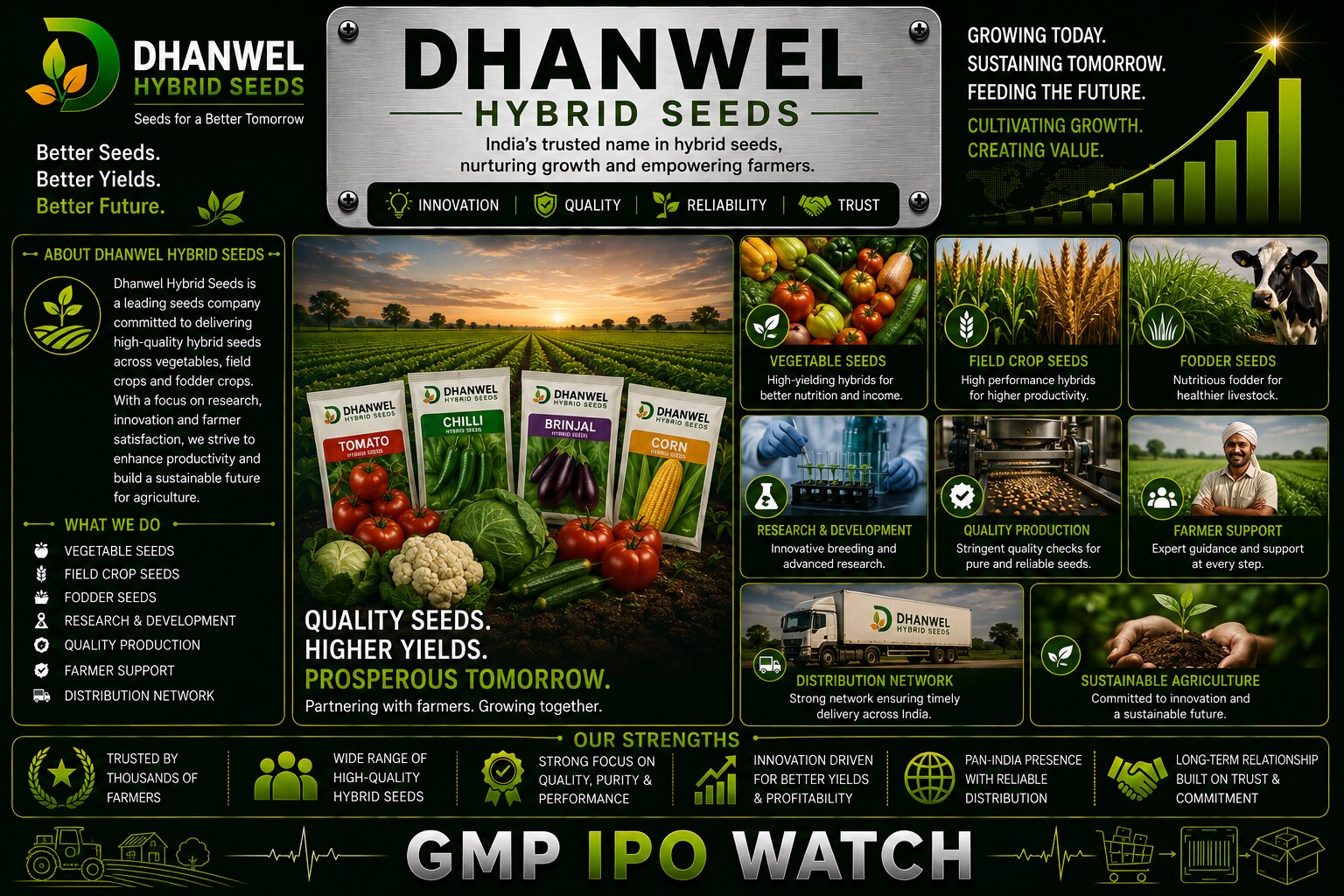
Dhanwel Hybrid Seeds Limited operates across the development, multiplication, processing and supply of seeds for field crops and vegetables. Its portfolio includes groundnut, soybean, sesame, wheat, gram, cumin, fodder, bajri, onion, coriander and other crop categories.
The company markets its products under the Dhanwel Seeds brand and processes seeds at its Jashapar facility in Jamnagar district, Gujarat.
The IPO opens tomorrow.
But the long-term investment question is:
Can Dhanwel use fresh IPO capital to finance a larger seed-production cycle while protecting margins against weather, crop concentration, farmer execution and working-capital risk?
That is the more important story.
Dhanwel Hybrid Seeds IPO Details
| Particular | Details |
|---|---|
| Company | Dhanwel Hybrid Seeds Ltd. |
| IPO Type | Book Built SME IPO |
| Listing Platform | BSE SME |
| Issue Size | ₹26.73 Crore |
| Fresh Issue | ₹26.73 Crore |
| OFS | Nil |
| Price Band | ₹95 – ₹99 |
| Face Value | ₹10 Per Share |
| Lot Size | 1,200 Shares |
| Retail Minimum | 2,400 Shares |
| Retail Investment | ₹2,37,600 |
| IPO Open Date | August 19, 2026 |
| IPO Close Date | August 21, 2026 |
| Allotment Date | August 24, 2026 |
| Refund Date | August 25, 2026 |
| Listing Date | August 26, 2026 |
| Lead Manager | Wealth Mine Networks |
| Registrar | Cameo Corporate Services |
The IPO consists of 27 lakh shares and is entirely a fresh issue, with no Offer for Sale.
What Does Dhanwel Hybrid Seeds Actually Do?
Dhanwel operates across several stages of the seed value chain.
Its activities include:
- Seed development
- Multiplication
- Farmer-based cultivation
- Procurement
- Cleaning
- Grading
- Treatment
- Packaging
- Distribution.
The company sources improved genetic seed material from recognised institutions, agricultural research organisations and other approved sources.
That genetic material is then multiplied through farming arrangements before being processed and sold commercially.
Contract Farming Is an Important Part of the Model
Dhanwel does not need to own all the agricultural land used for seed production.
Instead, it works with identified farmers.
The company can provide:
- Seed material
- Cultivation protocols
- Technical guidance
while field staff and agronomists monitor production and crop quality.
This creates a relatively asset-light production structure.
The company can expand seed multiplication without buying thousands of acres of farmland.
But Contract Farming Creates Execution Risk
The advantage of contract farming is lower fixed-land investment.
The disadvantage is lower direct control.
Actual crop output can still depend on:
- Rainfall
- Temperature
- Pest incidence
- Farmer execution
- Irrigation
That means Dhanwel can provide technical supervision but cannot eliminate agricultural risk.
Seed Quality Matters More Than Manufacturing Volume Alone
A conventional factory may measure success by units produced.
Seed companies need another measure:
germination and biological quality.
A poorly performing seed can damage farmer trust.
That makes quality control particularly important.
Dhanwel states that it follows testing and quality-control processes and holds ISO 9001:2015 certification for seed manufacturing, processing and supply.
The Processing Facility Is in Jamnagar
Dhanwel's seed-processing facility at Jashapar in Jamnagar district covers more than 10,000 square feet and handles activities such as:
- Cleaning
- Grading
- Treatment
- Packaging
- Storage.
Its machinery includes equipment such as separators, graders, de-stoners and groundnut-processing systems.
This infrastructure allows harvested seed to be converted into commercial-quality packaged seed.
Groundnut Is the Biggest Revenue Category
One current prospectus-based analysis indicates that oilseeds contributed around 56.67% of FY2026 revenue, with groundnut forming a major part of the category.
That is significant.
A diversified seed portfolio exists, but economically the company still has meaningful exposure to oilseeds and groundnut.
This creates concentration risk.
Why Groundnut Can Be an Attractive Market
Gujarat is an important groundnut-growing region.
Being based in Jamnagar gives Dhanwel proximity to:
- Seed-growing farmers
- Agricultural markets
- Groundnut-producing districts
That can support sourcing and distribution.
But concentration in one major crop also means weather or acreage changes can affect sales.
Crop Diversification Can Reduce Risk
The company also sells seeds across:
- Soybean
- Sesame
- Wheat
- Gram
- Cumin
- Fodder
- Bajri
- Onion
- Coriander.
A broader product range helps because agricultural conditions differ across crops.
A weak season for one crop does not necessarily mean weak demand for every seed category.
This is one of Dhanwel's more useful structural strengths.
Spices Are Becoming More Important
Current business analysis indicates spice seeds contributed around 12.09% of FY2026 revenue, up from about 3.53% in FY2025.
That indicates an evolving product mix.
If categories such as cumin, coriander and other seeds grow, Dhanwel can gradually reduce dependence on groundnut.
Product diversification could improve revenue stability.
Flower Seeds and Fertiliser Are Emerging Segments
The same current analysis identifies flower seeds and fertiliser as newer FY2026 contributors.
These categories remain smaller than core seed products.
But they show the company is attempting to broaden its agricultural-input portfolio.
The key question will be whether these newer segments generate sustainable margins rather than simply increasing revenue.
FY2026 Revenue Increased About 69%
Dhanwel reported:
| Financial Year | Revenue | EBITDA | PAT |
|---|---|---|---|
| FY2024 | ₹35.48 Cr | ₹2.78 Cr | ₹1.90 Cr |
| FY2025 | ₹44.10 Cr | ₹3.74 Cr | ₹2.15 Cr |
| FY2026 | ₹74.58 Cr | ₹9.23 Cr | ₹6.11 Cr |
FY2026 revenue increased from approximately ₹44.10 crore to ₹74.58 crore, a rise of around 69%.
That is strong growth.
But PAT grew even faster.
PAT Increased About 183%
Profit increased from approximately:
₹2.15 crore in FY2025
to:
₹6.11 crore in FY2026.
That is growth of roughly 183%.
This means FY2026 did not simply produce higher sales.
Profitability also improved substantially.
EBITDA Margin Improved to 12.38%
The company's FY2026 EBITDA margin is approximately:
12.38%
compared with lower margins in earlier years.
PAT margin improved to around:
8.20%.
This is one of the strongest trends in the financial profile.
Investors should now determine whether FY2026 margins represent a sustainable new level.
Why Seed Margins Can Move Significantly
Seed profitability can depend on:
- Crop mix
- Selling prices
- Procurement costs
- Processing yields
- Inventory losses
A higher contribution from better-margin seed categories can improve PAT significantly.
But the opposite can also happen.
That means margin stability is just as important as revenue growth.
ROE Is Around 31%
Current FY2026 KPI data reports:
- ROE: 31.11%
- ROCE: 49.36%
- Debt-to-equity: 0.39×
- PAT margin: 8.20%
- EBITDA margin: 12.38%.
These are attractive headline return ratios.
However, the IPO will significantly increase the equity base.
Post-IPO ROE could decline unless fresh capital quickly generates additional profit.
The Entire IPO Is Fresh Capital
One of the more attractive structural features is:
No OFS.
The IPO is being used to raise money for Dhanwel itself rather than primarily allowing existing shareholders to sell shares.
This means investors can evaluate the issue mainly through the question:
What return will the company generate from this new capital?
₹11.60 Crore Is Planned for Working Capital
Dhanwel proposes using approximately ₹11.60 crore toward working-capital requirements.
This is the largest stated use of proceeds.
That makes working capital central to the IPO thesis.
Seed businesses need money well before final customer collections arrive.
Why Seed Production Requires Working Capital
The cycle can look like:
genetic seed material → farmer cultivation → harvesting → procurement → processing → packaging → dealer sale → collection.
Cash can remain tied up for months.
The company may need to pay farmers and suppliers well before distributors settle invoices.
As production expands, working-capital needs can therefore increase rapidly.
₹11.60 Crore Could Fund a Much Larger Crop Cycle
Suppose Dhanwel wants to increase seed production substantially.
It needs more money for:
- Farmer advances
- Seed procurement
- Processing
- Packaging
- Inventory
Fresh working capital can help the company execute a larger crop cycle without relying entirely on bank borrowing.
The attractive outcome is:
more working capital → more seed production → higher sales → cash collected efficiently.
Working Capital Can Also Become Trapped in Inventory
Seeds have biological and seasonal characteristics.
Unlike generic industrial stock, certain seed varieties may be most relevant to particular sowing windows.
If inventory misses the seasonal demand period, its commercial value can weaken.
Therefore, inventory management is especially important.
Dhanwel needs to forecast:
crop demand + geography + sowing season
accurately.
₹7.60 Crore Is Planned for Debt Repayment
The company also intends to use approximately ₹7.60 crore toward repayment or prepayment of bank and financial-institution borrowings.
This can improve the balance sheet.
Lower debt can reduce:
- Interest costs
- Financial risk
- Cash-flow pressure
This is especially useful in agriculture, where weather can create unpredictable operating conditions.
Debt-to-Equity Has Already Improved Sharply
Current KPI data shows debt-to-equity at approximately:
0.39× in FY2026
compared with:
7.17× in FY2024.
That is a dramatic improvement.
The planned IPO debt repayment could strengthen leverage further.
Lower Debt Provides Protection Against Weak Crop Years
Agriculture is cyclical and weather-sensitive.
If a weak monsoon or crop issue reduces sales, a highly leveraged business still needs to pay significant interest.
A lower-debt company has more flexibility.
That can improve resilience during difficult agricultural seasons.
Dhanwel Has an Order Book of About ₹13.12 Crore
Current IPO information cites an order book of approximately ₹13.12 crore, comprising confirmed orders pending execution.
The order book provides some near-term visibility.
But investors should not treat it like a multi-year infrastructure order book.
Seed orders can be seasonal and need timely execution.
Dealer and Distributor Relationships Matter
Seed companies need to reach farmers before sowing begins.
Distribution therefore matters almost as much as production.
A strong dealer relationship helps Dhanwel:
- Place products locally
- Understand crop demand
- Reach farmers quickly
The company's existing customer and distributor relationships are therefore important business assets.
Farmer Trust Can Become a Powerful Moat
A farmer may test a new seed variety once.
If it performs well, repeat purchasing becomes more likely.
If it performs poorly, the farmer may switch brands immediately.
This means brand value in seeds is built through field performance rather than advertising alone.
Repeated successful harvests can create strong loyalty.
Seed Replacement Rate Is a Long-Term Growth Opportunity
Farmers can either reuse harvested seed or purchase certified/improved seed for the next crop.
Greater adoption of commercially produced quality seeds can increase demand for companies such as Dhanwel.
The long-term industry opportunity therefore comes from:
higher agricultural productivity + better seed adoption + organised distribution.
But competition among seed companies remains intense.
Weather Is the Biggest Uncontrollable Risk
A seed company can control:
- Genetic material
- Processing
- Packaging
- Distribution
It cannot control rainfall.
Poor monsoon conditions can affect:
- Farmer planting decisions
- Seed production
- Crop acreage
- Seed demand
This makes Dhanwel inherently exposed to weather.
Diversifying crops and geographies can reduce this risk but cannot remove it completely.
Government Regulation Also Matters
Seeds are part of India's agricultural regulatory framework.
Companies need to comply with requirements around:
- Seed quality
- Labelling
- Certification
- Sale of varieties
Changes in regulations can influence the business.
Quality failures can also create reputational and legal risks.
Valuation Is Around 14.7× Earnings
IPOPlatform estimates Dhanwel's post-issue valuation at approximately:
Market cap: ₹90.12 crore
P/E: 14.74×
EV/EBITDA: 10.53×
P/B: 1.94×.
On headline numbers, this is not an unusually expensive SME valuation.
But investors need to consider that FY2026 PAT grew 183%.
If profit normalises, the effective forward valuation could look different.
A Low P/E Is Attractive Only if FY2026 Earnings Are Sustainable
Suppose FY2027 PAT remains near ₹6 crore or grows.
A roughly 15× historical multiple could appear reasonable.
But if FY2026 was unusually strong and PAT returns toward ₹3–₹4 crore, valuation would become less attractive.
Therefore, sustainability matters more than the headline P/E.
Dhanwel Hybrid Seeds IPO GMP Today
As of August 18, 2026, current grey-market data is mixed.
InvestorGain reports:
₹0 GMP
and estimated price of ₹99.
IPOGram reports approximately:
₹1 GMP
and an estimated price near ₹100.
Therefore, the safest description today is:
GMP is essentially flat, around ₹0–₹1.
That indicates very limited pre-opening grey-market enthusiasm.
There Is No Public Subscription Data Yet
The IPO opens:
August 19, 2026
and closes:
August 21, 2026.
Therefore, there is currently no valid:
- Retail subscription
- NII subscription
- Overall subscription
to report.
The first live subscription figures will be available after bidding starts tomorrow.
Retail Investors Need ₹2.37 Lakh
The IPO lot size is 1,200 shares, but the minimum retail application is 2 lots, or 2,400 shares.
At ₹99:
2,400 × ₹99 = ₹2,37,600.
This is significantly higher than the minimum investment required in most mainboard IPOs.
That higher ticket size is an important characteristic of SME investing.
Competitive Strengths
Dhanwel enters the IPO with several positives.
Strong FY2026 growth: Revenue increased to approximately ₹74.58 crore.
Rapid PAT expansion: Profit increased to around ₹6.11 crore.
Improving margins: EBITDA margin reached approximately 12.38%.
Diversified crops: Portfolio spans oilseeds, pulses, spices, cereals and vegetables.
Contract farming: Allows production expansion without owning large farmland.
Fresh issue: No OFS.
Debt reduction: ₹7.60 crore is planned for repayment.
Working-capital expansion: ₹11.60 crore can support a larger seed cycle.
Major Risks
The largest risks include:
Weather dependence: Rainfall can affect seed production and farmer demand.
Groundnut/oilseed concentration: Oilseeds account for more than half of FY2026 revenue on one prospectus-based analysis.
Seasonality: Seed sales depend heavily on sowing cycles.
Working-capital intensity: Production begins months before final collections.
Farmer execution: Contract farming does not eliminate cultivation risk.
Inventory risk: Unsold seasonal seeds can affect capital efficiency.
Small company scale: FY2026 revenue remains below ₹75 crore.
SME liquidity: BSE SME stocks can experience lower liquidity and higher volatility.
What Could Drive Dhanwel's Next Growth Phase?
Several growth areas could support the company.
Larger working-capital base: Can increase seed production.
Crop diversification: More spices, vegetables and emerging categories can reduce groundnut concentration.
Dealer expansion: Wider distribution can increase farmer reach.
Repeat farmer demand: Good crop performance can strengthen brand loyalty.
Lower debt: Reduced finance expenses can improve PAT.
New varieties: Additional seed varieties can increase market opportunity.
What Investors Should Track After Listing
| Metric | Why It Matters |
|---|---|
| Revenue Growth | FY2026 sustainability |
| PAT Margin | Profit quality |
| Oilseed Share | Crop concentration |
| Inventory Days | Seasonal stock risk |
| Receivable Days | Cash collection |
| Operating Cash Flow | Profit-to-cash conversion |
| Debt | IPO repayment impact |
| ROCE | Fresh capital efficiency |
| Dealer Network | Distribution growth |
| New Crop Categories | Diversification |
These numbers will provide a much better picture of Dhanwel's progress than GMP alone.
The Most Important Post-IPO Equation
Dhanwel's strongest growth path looks like:
IPO capital → larger crop-production cycle → broader seed portfolio → stronger dealer sales → timely collections → higher PAT and cash flow.
The weaker outcome would be:
IPO capital → more farmer production → weak seasonal demand → excess seed inventory → cash trapped in working capital.
Both scenarios involve producing more seeds.
Only the first creates stronger shareholder economics.
Should Investors Consider Dhanwel Hybrid Seeds IPO?
The positive investment case includes:
- 69% FY2026 revenue growth
- About 183% PAT growth
- Improving EBITDA margin
- Strong ROCE
- Diversified seed portfolio
- Fully fresh issue
- ₹11.60 crore working-capital deployment
- ₹7.60 crore debt repayment
- Moderate headline P/E around 14.7×.
The caution case includes:
- Agricultural seasonality
- Weather dependence
- Groundnut/oilseed concentration
- Small operating scale
- Working-capital requirements
- Flat current GMP
- SME liquidity risk
Dhanwel should therefore be evaluated as a fast-growing agricultural seed SME with improving profitability but meaningful seasonal and crop-cycle risk.
Final View on Dhanwel Hybrid Seeds IPO 2026
The Dhanwel Hybrid Seeds IPO opens tomorrow, August 19, 2026, and closes August 21. The ₹26.73 crore BSE SME issue has a price band of ₹95–₹99 per share, with allotment expected August 24 and listing on August 26.
Financially, the company enters the IPO after an exceptional FY2026.
Revenue increased from approximately ₹44.10 crore in FY2025 to ₹74.58 crore in FY2026, while PAT increased from ₹2.15 crore to ₹6.11 crore. EBITDA reached around ₹9.23 crore, with EBITDA margin near 12.38%.
The IPO is entirely fresh capital.
Approximately ₹11.60 crore is planned for working capital and ₹7.60 crore for repayment or prepayment of borrowings.
This creates a straightforward investment thesis:
fresh capital + larger seed-production cycle + lower debt + diversified crops = potential profitable growth.
But agricultural businesses face risks that capital alone cannot remove.
Rainfall, crop acreage, farmer execution, seasonal demand and inventory management can all materially affect performance.
As of August 18, there is no subscription data because the issue opens tomorrow, while current GMP is essentially flat at around ₹0–₹1 depending on the tracker.
For long-term investors, the more useful post-listing indicators will therefore be crop diversification, operating cash flow, inventory days, PAT margin, debt reduction and ROCE on the fresh IPO funds.