GMP IPO Watch
Credent Connect N Care IPO 2026 – The Infrastructure Behind Diagnostic Healthcare
When a patient gives a blood sample, most people think the next step happens inside a laboratory.
In reality, a large operational network may begin working before that sample reaches the testing machine.
The sample must be collected correctly, labelled, stored at an appropriate temperature, transported safely and delivered within a defined time.
At scale, this becomes a specialised healthcare logistics business.
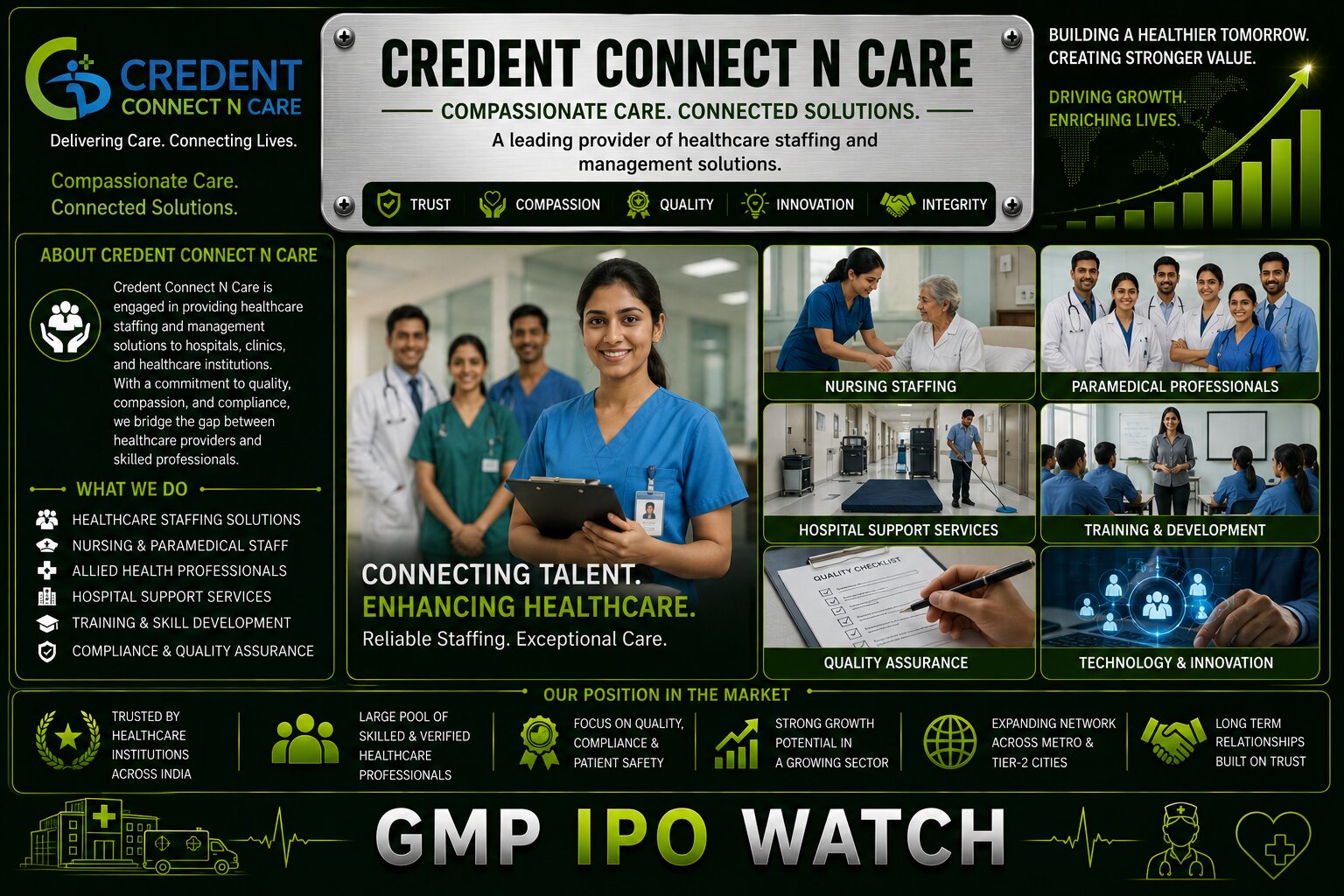
Credent Connect N Care Limited, also associated with the C3 Logistics brand, operates in this behind-the-scenes part of India's healthcare ecosystem.
Its business includes integrated healthcare logistics, workforce deployment, home sample collection, phlebotomy support and technology-enabled services for diagnostic and healthcare institutions.
The company is now entering the public market with an approximately ₹93.90 crore NSE SME IPO, opening on August 13, 2026.
The IPO price band has been fixed at ₹179 to ₹189 per share. The issue is entirely fresh capital, meaning the money raised is intended for the company rather than an Offer for Sale by existing shareholders.
For investors, the central question is unusual:
Can Credent turn the operational complexity of India's diagnostic industry into a scalable healthcare-services platform?
Credent Connect N Care IPO Details
| Particular | Details |
|---|---|
| Company | Credent Connect N Care Limited |
| Brand / Operating Identity | C3 Logistics |
| IPO Type | Book Built SME IPO |
| Listing Platform | NSE Emerge |
| Issue Size | Approx. ₹93.90 Crore |
| Fresh Issue | Approx. ₹93.90 Crore |
| Offer for Sale | Nil |
| Price Band | ₹179 – ₹189 Per Share |
| Face Value | ₹10 Per Share |
| IPO Opening Date | August 13, 2026 |
| IPO Closing Date | August 17, 2026 |
| Expected Allotment | August 18, 2026 |
| Expected Listing | August 20, 2026 |
| Minimum Retail Application | 1,200 Shares |
| Minimum Retail Amount at ₹189 | ₹2,26,800 |
| Listing Exchange | NSE SME |
| Lead Manager | Hem Securities Limited |
| Registrar | KFin Technologies Limited |
The IPO consists of approximately 49.68 lakh fresh equity shares.
What Does Credent Connect N Care Actually Do?
Credent is not a hospital.
It is not primarily a diagnostic laboratory either.
Instead, the company provides the operational infrastructure that helps healthcare and diagnostic organisations function efficiently.
Its service ecosystem includes areas such as:
- Diagnostic sample logistics
- Home sample collection support
- Phlebotomist deployment
- Healthcare workforce solutions
- Cold-chain transportation
- Technology-enabled operational support
- Corporate wellness-related services
This makes Credent a healthcare B2B services company rather than a conventional patient-facing healthcare brand.
Why Diagnostic Sample Logistics Is Different From Normal Delivery
Transporting a blood or biological sample is not the same as delivering an ordinary parcel.
A sample can be affected by:
- Temperature
- Transit time
- Handling
- Packaging
- Identification errors
If the sample becomes unusable, the patient may need to provide another one.
In healthcare, logistics quality can therefore affect diagnostic quality.
This creates a specialised requirement for companies that understand healthcare transportation.
Cold-Chain Capability Can Become an Entry Barrier
Some biological samples need to remain within specific temperature ranges.
That means logistics providers may require:
- Specialised containers
- Temperature monitoring
- Defined transportation procedures
- Trained personnel
- Rapid route execution
This creates more complexity than conventional last-mile delivery.
If Credent consistently performs these tasks reliably, customer relationships can become difficult for competitors to displace.
Credent Operated 94 Commercial Vehicles
As of September 30, 2025, Credent owned and operated a fleet of 94 commercial vehicles used for sample transportation and related healthcare logistics activities.
This physical logistics network supports the company's ability to control transportation rather than relying completely on third-party providers.
Owning vehicles provides greater operational control.
But it also creates expenses involving:
- Drivers
- Fuel
- Insurance
- Maintenance
- Repairs
- Vehicle replacement
Fleet utilisation therefore becomes an important profitability metric.
2,039 Field Riders Show the Scale of Operations
Credent's operational network included approximately 2,039 field riders and around 3,778 payroll employees, according to information highlighted around its DRHP filing.
That is significant for an SME healthcare-services company.
The scale shows that Credent's business is heavily dependent on coordinating people across multiple locations.
This makes workforce management a major part of the investment story.
Phlebotomy Is More Important Than It Looks
A phlebotomist is responsible for collecting blood samples.
For a diagnostic company offering home collection, the customer experience may depend heavily on the person who arrives at the patient's home.
The phlebotomist must:
- Arrive on time
- Verify the patient
- Collect the sample safely
- Label it correctly
- Package it properly
- Transfer it into the logistics network
A mistake at this first stage can compromise the entire diagnostic process.
Credent's workforce solutions therefore solve an important operational problem for diagnostic companies.
Home Diagnostics Can Support Long-Term Demand
Consumers increasingly expect healthcare services to come to them.
Instead of visiting a diagnostic centre, patients can book a home collection.
This is particularly useful for:
- Elderly patients
- Routine blood tests
- Preventive health packages
- Busy professionals
- Patients requiring frequent testing
As home diagnostics grow, the number of collection points becomes much larger.
That creates additional demand for organised logistics and workforce coordination.
The Business Can Scale Without Owning Laboratories
One interesting feature of Credent's model is that it can participate in diagnostic-industry growth without needing to own every laboratory.
A diagnostic chain may invest in:
- Testing machines
- Laboratories
- Pathologists
while Credent provides:
- Collection workforce
- Transportation
- Operational support
This allows Credent to participate in the broader healthcare ecosystem without carrying the same laboratory-equipment burden as a full diagnostic chain.
But Credent Is Still a Working-Capital-Heavy Business
An asset-light-looking service business does not necessarily mean a cash-light business.
Credent has thousands of employees and field personnel.
It may need to pay:
- Salaries
- Rider expenses
- Fuel
- Vendors
- Operating costs
before collecting payments from institutional customers.
This creates working-capital requirements.
That explains why working capital represents an important part of the IPO proceeds.
₹26.30 Crore Planned for Working Capital
Current IPO disclosures indicate approximately ₹26.30 crore is intended to meet the company's working-capital requirements.
This capital can support higher operating volumes.
Imagine Credent wins several large diagnostic contracts simultaneously.
The company may need to deploy:
- More phlebotomists
- More riders
- More transportation
- More supervisors
immediately.
But customer payments may arrive later.
Additional working capital can bridge that timing difference.
Subsidiary Investment Is Another Major IPO Objective
Credent plans to invest approximately ₹17.89 crore in its wholly owned subsidiary, Credent Healthcare Private Limited, for working-capital requirements.
This is important because it indicates management intends to expand the broader healthcare-services ecosystem rather than only the parent company's logistics operation.
The subsidiary also has planned capital expenditure for machinery of approximately ₹2.05 crore.
Debt Repayment Is Also Planned
Around ₹4.12 crore of the proceeds is identified for repayment or prepayment of company borrowings.
Debt reduction can help:
- Reduce interest costs
- Improve cash flow
- Strengthen the balance sheet
- Provide greater flexibility
However, working capital will remain structurally important because the business employs a large operational workforce.
Entire IPO Is a Fresh Issue
The roughly ₹93.90 crore issue contains no OFS according to the current IPO structure.
This is noteworthy.
Instead of existing shareholders using the IPO primarily to sell their holdings, the capital is intended to enter the company.
For a growing SME, that can be constructive when proceeds are deployed productively.
FY2025 Revenue Was ₹78.23 Crore
Credent reported total income of approximately:
₹78.23 crore in FY2025
compared with:
₹76.02 crore in FY2024
and:
₹59.93 crore in FY2023.
This shows strong growth between FY2023 and FY2024, followed by comparatively modest growth in FY2025.
Historical Financial Performance
| Financial Year | Total Income | PAT | EBITDA |
| FY2023 | ₹59.93 Cr | ₹2.70 Cr | ₹4.01 Cr |
| FY2024 | ₹76.02 Cr | ₹2.66 Cr | ₹4.30 Cr |
| FY2025 | ₹78.23 Cr | ₹2.25 Cr | ₹5.00 Cr |
The unusual feature here is clear.
Revenue increased over the three-year period.
EBITDA also improved.
But PAT declined from approximately ₹2.70 crore in FY2023 to ₹2.25 crore in FY2025.
That deserves investor attention.
Why FY2025 PAT Decline Matters
Growing revenue is positive only when the business eventually converts that growth into earnings and cash.
Credent's FY2025 PAT declined by around 15% year-on-year, despite higher income.
Possible pressures in a workforce-heavy business can include:
- Employee costs
- Logistics costs
- Fuel
- Administrative expenses
- Finance costs
- Expansion expenses
Investors should therefore avoid evaluating the company based only on top-line growth.
Recent Performance Appears Much Stronger
IPO valuation data based on the later reporting period indicates annualised FY2026 figures of approximately:
- Revenue: ₹180.04 crore
- EBITDA: ₹23.64 crore
- PAT: ₹15.20 crore
- EBITDA Margin: 13.13%
- PAT Margin: 8.44%.
These figures represent a major acceleration compared with FY2025.
However, investors should pay close attention to the fact that these figures are presented on an annualised basis in the cited IPO analysis rather than treating them automatically as full-year audited FY2026 numbers.
Margin Expansion Could Transform the Business
If Credent can sustainably achieve an EBITDA margin around 13% and PAT margin around 8%, the economics look substantially stronger than the earlier FY2025 performance.
The key question becomes:
What caused the improvement?
Investors should examine whether it resulted from:
- Higher-value contracts
- Better workforce utilisation
- Greater operating scale
- Subsidiary growth
- Improved route density
- Temporary factors
Sustainable margin improvement would materially strengthen the IPO story.
Route Density Is a Hidden Competitive Advantage
Imagine 100 samples need to be collected across a city.
Logistics Company A
Its riders travel long distances between each pickup.
Logistics Company B
Its customers are concentrated along efficient routes.
Company B can potentially transport more samples using the same workforce.
This is called route density.
As Credent wins more healthcare customers in the same geographic markets, logistics economics can improve.
Technology Can Make the Network More Efficient
Managing thousands of riders and employees manually would be extremely difficult.
Technology can support areas such as:
- Route planning
- Rider tracking
- Sample tracking
- Attendance
- Workforce deployment
- Turnaround monitoring
- Customer reporting
The larger Credent becomes, the more valuable efficient technology infrastructure becomes.
Technology therefore has the potential to create operating leverage even though the company's core services remain workforce-intensive.
Four Branch Offices Support Multi-City Operations
As of September 2025, Credent operated through two warehouses and four branch offices, including locations in:
- Mumbai
- Pune
- Chennai
- Varanasi
while its headquarters are in Ashok Vihar, Delhi.
This gives the company an operating footprint across multiple regions of India.
For a healthcare logistics provider, geographic reach can be important when serving diagnostic chains with multi-city operations.
National Diagnostic Chains Prefer Scalable Partners
Consider a diagnostic company operating in 50 cities.
Managing a different logistics vendor in every city creates complexity.
A service provider capable of handling multiple markets can offer:
- Standardised processes
- Central reporting
- Consistent service levels
- Simplified vendor management
If Credent expands effectively, its national network can therefore become more valuable to larger healthcare customers.
Customer Concentration Still Needs Monitoring
B2B healthcare service businesses can become dependent on a small number of major contracts.
A large diagnostic customer may contribute substantial annual revenue.
That creates risk.
If a major client:
- Renegotiates prices
- Reduces volume
- Changes supplier
- Builds logistics internally
Credent's financial performance could be affected.
Post-listing investors should therefore monitor customer concentration carefully.
Workforce Scale Creates Both Opportunity and Risk
Thousands of employees give Credent operational reach.
But people-intensive businesses face challenges such as:
- Employee turnover
- Recruitment costs
- Training
- Wage inflation
- Attendance
- Service quality
If wages increase faster than contract pricing, margins can come under pressure.
This makes workforce productivity one of the company's most important long-term variables.
Healthcare Logistics Requires Reliability
A delayed e-commerce parcel may frustrate a customer.
A delayed diagnostic sample can be more serious.
Healthcare customers therefore care about:
- Turnaround time
- Sample integrity
- Tracking
- Reliability
A strong operating record can become a competitive advantage.
But service failures can also damage customer relationships quickly.
Cold-Chain Compliance Is Critical
Some diagnostic samples require controlled temperature conditions.
A breakdown in the cold chain can affect sample integrity.
Credent therefore needs robust systems involving:
- Packaging
- Transportation
- Temperature management
- Staff training
- Documentation
As the business expands, maintaining the same service quality across thousands of daily movements becomes increasingly difficult.
Healthcare Outsourcing Is the Bigger Opportunity
The long-term story extends beyond logistics.
Healthcare institutions increasingly outsource non-core operations so they can focus on clinical services.
Potential outsourced activities include:
- Logistics
- Workforce deployment
- Home collection
- Administrative support
- Corporate wellness
Credent's opportunity is to become an integrated operating partner rather than simply a transportation vendor.
That could increase revenue per healthcare customer.
Cross-Selling Can Improve Customer Economics
Suppose a diagnostic chain already uses Credent for sample transportation.
Credent could potentially also provide:
- Phlebotomists
- Home-collection personnel
- Workforce support
Instead of acquiring an entirely new customer, the company increases revenue from an existing relationship.
This can reduce customer-acquisition costs and make contracts more valuable.
ROE and ROCE Indicate Strong Recent Returns
IPO valuation disclosures based on annualised performance indicate:
- ROE: approximately 38.61%
- ROCE: approximately 24.22%
- RoNW: approximately 32.36%
- EBITDA Margin: approximately 13.13%
- PAT Margin: approximately 8.45%.
These are attractive return ratios.
But because some of the latest figures are annualised, investors should see whether similar returns are maintained after the IPO and expanded equity base.
Fresh Equity Can Reduce ROE Initially
Suppose Credent earns ₹15 crore PAT on a relatively small net worth.
ROE can appear very high.
After raising roughly ₹94 crore through fresh equity, the company's equity base increases substantially.
If profits do not rise proportionately, ROE can fall.
This is not necessarily negative.
The important question is whether management can deploy IPO capital to produce attractive incremental returns.
The IPO Investment Thesis Is About Capital Deployment
Credent is raising significant capital relative to its historical size.
That makes capital allocation extremely important.
The company needs to convert IPO proceeds into:
- Larger contracts
- More productive workforce
- Better logistics density
- Subsidiary growth
- Higher cash flow
If ₹94 crore of new capital produces only modest additional earnings, shareholder returns may weaken.
If it enables the business to scale rapidly while maintaining margins, the outcome can be much stronger.
Credent Connect N Care IPO GMP Today
Grey-market tracking on August 12, 2026 shows Credent Connect N Care GMP has reached approximately ₹35, after being around ₹10 on August 11.
At the upper IPO price of ₹189, a ₹35 GMP implies an unofficial indicated price of approximately:
₹224 per share
or roughly:
18.5% above the upper issue price.
This is only a grey-market indication.
GMP is unofficial, unregulated and can change rapidly before listing.
Subscription Has Not Started Yet
Unlike some IPOs currently open in the market, Credent Connect N Care's public bidding begins tomorrow, August 13.
Therefore, there is no meaningful public subscription figure yet.
The issue remains open through August 17, with allotment expected August 18 and listing tentatively scheduled for August 20.
The QIB, NII and retail demand after opening will provide a better indication of investor interest.
What Could Drive Credent's Next Growth Phase?
Growth in Home Diagnostics
More home collections can increase demand for phlebotomy and sample logistics.
Diagnostic Industry Expansion
More laboratories and testing volumes create more transportation requirements.
Geographic Expansion
Additional cities can increase the addressable market.
Customer Cross-Selling
Existing logistics customers can potentially purchase workforce and other healthcare services.
Technology
Better route planning and workforce management can improve productivity.
Subsidiary Expansion
IPO funding for Credent Healthcare can broaden the group's healthcare-service offering.
Working Capital
Additional capital can support larger contracts.
Competitive Strengths
Integrated Healthcare Services
Credent combines logistics, workforce and technology-enabled support.
Large Field Network
The disclosed operating scale included approximately 2,039 field riders.
Large Payroll Workforce
Around 3,778 payroll employees demonstrate substantial execution capability.
Owned Vehicle Fleet
94 commercial vehicles support sample transportation.
Multi-City Presence
Branches and operational infrastructure extend beyond Delhi.
Entirely Fresh IPO
The ₹93.90 crore issue is intended to bring new capital into the business.
Strong Recent Annualised Performance
Latest annualised IPO data indicates a substantial improvement in revenue and profitability.
Major Risks Investors Should Understand
Workforce-Intensive Operations
Thousands of employees create salary and management risk.
Customer Concentration
Loss of a major diagnostic client could affect revenue.
Working-Capital Requirements
Large contracts can absorb substantial cash.
Service Quality
Healthcare logistics errors can damage customer relationships.
Cold-Chain Risk
Temperature-sensitive samples require strict execution.
Vehicle Operating Costs
Fuel and maintenance can pressure logistics margins.
SME Liquidity
NSE SME shares can experience lower liquidity and greater volatility.
Capital Deployment
The company must generate sufficient returns from the large fresh issue.
What Investors Should Track After Listing
Revenue Growth
Can Credent sustain the acceleration seen in recent annualised figures?
PAT Margin
Does profitability remain around the newer, stronger level?
Customer Concentration
Is revenue becoming more diversified?
Employee Productivity
Is revenue growing faster than workforce costs?
Receivable Days
Are institutional customers paying on time?
Operating Cash Flow
Is accounting profit converting into cash?
ROCE
Is the ₹93.90 crore IPO capital being deployed productively?
Why Receivables Will Be Especially Important
Credent's customers are primarily businesses and healthcare institutions rather than consumers paying immediately.
That can mean payment cycles of several weeks or months.
If revenue grows rapidly but receivables grow even faster, the company may continuously need more working capital.
Investors should therefore compare:
Revenue growth vs receivable growth vs operating cash flow.
This can reveal more about business quality than revenue alone.
Should Investors Consider Credent Connect N Care IPO?
The positive investment case includes:
- Healthcare-focused logistics platform
- Home diagnostics exposure
- Large field workforce
- Owned commercial vehicle fleet
- Multi-city operations
- Entirely fresh issue
- Working-capital funding for expansion
- Subsidiary investment
- Strong recent annualised financial momentum
- Positive pre-opening GMP
The caution points include:
- Historical FY2025 PAT decline
- Workforce intensity
- Working-capital requirements
- Customer concentration risk
- Execution complexity
- SME liquidity
- Need to prove sustainability of recent margin expansion
The company therefore deserves evaluation as a healthcare infrastructure and services business, not simply as a logistics company.
Final View on Credent Connect N Care IPO 2026
The Credent Connect N Care IPO 2026 brings an unusual healthcare business model to the SME market.
Rather than owning hospitals or focusing purely on diagnostic testing, Credent provides the operational network connecting patients, phlebotomists, diagnostic laboratories and healthcare institutions.
Its infrastructure includes thousands of field and payroll personnel, a fleet of 94 commercial vehicles, warehouses and branch operations across multiple Indian cities.
Historically, financial performance was mixed.
Total income increased from approximately ₹59.93 crore in FY2023 to ₹78.23 crore in FY2025, but PAT declined from roughly ₹2.70 crore to ₹2.25 crore during the same period.
More recent annualised IPO figures indicate a significant acceleration, with approximately ₹180.04 crore revenue and ₹15.20 crore PAT on the stated annualised basis.
That improvement makes the IPO considerably more interesting, but it also creates the biggest question for investors:
Is the recent profitability the company's new normal, or does it represent a period that will be difficult to repeat?
The approximately ₹93.90 crore fresh issue gives Credent significant capital to answer that question through expansion.
Working capital, subsidiary investment, machinery and debt repayment can help the company support larger healthcare contracts and broaden its service offering.
The long-term opportunity can be summarised as:
more diagnostic testing + more home collection + more outsourcing + better logistics density + integrated workforce services = potential scalable growth.
However, Credent remains a people-intensive and working-capital-dependent business.
Its success after listing will therefore depend on whether revenue grows faster than employee costs, whether customers pay on time and whether management generates adequate returns on the substantial new equity capital.
Overall, Credent Connect N Care represents a differentiated healthcare-services SME IPO with exposure to diagnostic logistics, home sample collection and outsourced healthcare operations. The business has an attractive structural opportunity, but investors should closely monitor cash-flow conversion, customer concentration, workforce productivity and the sustainability of the sharp recent improvement in profitability.