 GMP IPO Watch
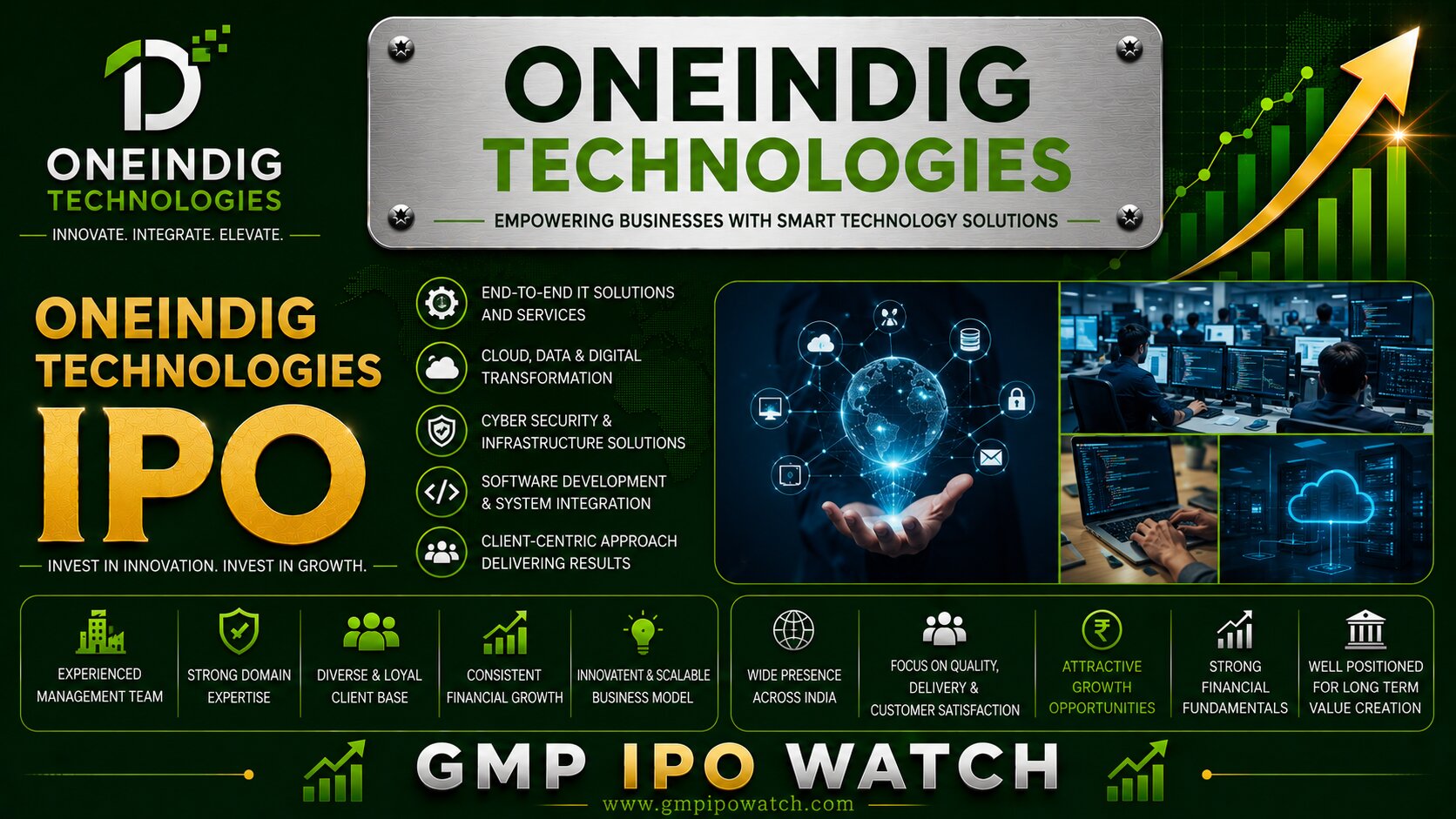
Oneindig Technologies IPO 2026: Solar EPC Business, Financial Growth, Issue Details and Investment Analysis
Oneindig Technologies IPO closes on August 3, 2026. Explore the company’s solar EPC operations, ₹27.65 crore SME issue, price band, financial growth, business strengths, key risks, expansion plans, and investment outlook.
Live IPO tracking available
Check GMP movement, allotment details, subscription demand, and deeper IPO context for this company.
Use these shortcuts to keep exploring
The archive button opens all articles from this category. The IPO details button opens the live IPO page on your GMP site in a new tab.
Oneindig Technologies IPO 2026 – Complete and Updated Review
India’s renewable-energy transition is creating opportunities not only for large power producers but also for companies that design, procure, install, commission, and maintain solar projects. Solar Engineering, Procurement and Construction, commonly known as solar EPC, has therefore become an important part of India’s clean-energy ecosystem.
Oneindig Technologies Limited operates in this specialised segment. Contrary to what its name may initially suggest, the company is not primarily a conventional information-technology services provider. It is an integrated solar-solutions company offering EPC services for solar power projects and related renewable-energy applications.
The Oneindig Technologies IPO opened on July 30, 2026, and closes today, August 3, 2026. The SME issue has a price band of ₹91 to ₹96 per share and an overall issue size of approximately ₹27.65 crore. The shares are proposed to be listed on the BSE SME platform on August 6, 2026, subject to completion of the allotment and listing process.
This detailed review explains the company’s business model, solar project capabilities, financial growth, issue structure, strengths, risks, industry opportunity and the factors investors should evaluate before applying.
About Oneindig Technologies Limited
Oneindig Technologies Limited is a solar-integrated solutions provider established on November 2, 2016. The company has its corporate office in New Delhi and has developed solar power projects across several Indian states, including Delhi, Haryana, Uttar Pradesh, Rajasthan, Madhya Pradesh, Maharashtra, Gujarat, Punjab, Uttarakhand and West Bengal.
Its core business is centred on providing end-to-end solar EPC services. This generally involves planning a project, procuring equipment, installing the system, completing electrical and civil works, testing the plant and making it ready for commercial operation.
The company’s renewable-energy offerings also include solar water-pumping solutions and selected smart-city or technology-enabled energy applications.
What Does Oneindig Technologies Actually Do?
Oneindig Technologies works as an execution partner for customers planning to establish solar-power systems.
A typical solar EPC project may involve:
- Understanding the customer’s energy requirements.
- Conducting technical and site assessments.
- Designing the solar-power system.
- Selecting suitable modules, inverters and other equipment.
- Procuring project components.
- Completing civil and electrical installation.
- Testing and commissioning the project.
- Providing post-installation operational support.
By managing several stages of project execution, the company offers customers a single point of responsibility instead of requiring them to coordinate separately with designers, equipment suppliers, electrical contractors and project managers.
Business Model
Oneindig Technologies follows a project-based solar EPC business model.
The company generally earns revenue by executing solar projects according to agreed technical specifications, capacity, delivery schedules and contractual terms.
Its business activities include:
- Solar EPC project execution.
- Rooftop solar installations.
- Ground-mounted solar projects.
- Solar power-plant commissioning.
- Solar water-pumping systems.
- Procurement of solar equipment.
- Project-management services.
- Electrical and civil installation.
- Operations and maintenance support.
- Renewable-energy consulting.
Revenue recognition in an EPC business is closely linked to project progress, completion milestones, customer certification and collection of receivables.
This means order-book quality and execution ability are as important as headline revenue growth.
End-to-End Solar EPC Capabilities
Oneindig Technologies positions itself as a complete solar-solutions provider rather than only an equipment reseller.
Its EPC work can broadly be divided into the following stages.
Engineering
The engineering stage covers system design, technical configuration, capacity planning, equipment selection and preparation of project specifications.
A well-designed system is important because solar-project performance depends on factors such as location, sunlight availability, module placement, shading, equipment quality and grid connectivity.
Procurement
The company procures solar modules, inverters, cables, mounting structures and other project materials.
Procurement efficiency directly affects project costs and margins because equipment represents a significant portion of total EPC expenditure.
Construction
Construction includes civil work, mounting structures, equipment installation, cabling, grid integration and other on-site activities.
Testing and Commissioning
After installation, the project undergoes technical testing before being connected and made commercially operational.
Operations Support
Post-commissioning support can include performance monitoring, fault identification, preventive maintenance and technical assistance.
Oneindig Technologies IPO Details
| Particular | Details |
|---|---|
| IPO Type | Book-Built SME IPO |
| Issue Size | Approximately ₹27.65 crore |
| Fresh Issue | Approximately ₹26.27 crore |
| Face Value | ₹10 per equity share |
| Price Band | ₹91 to ₹96 per share |
| IPO Opening Date | July 30, 2026 |
| IPO Closing Date | August 3, 2026 |
| Basis of Allotment | August 4, 2026 |
| Refund Initiation | August 5, 2026 |
| Credit to Demat | August 5, 2026 |
| Tentative Listing Date | August 6, 2026 |
| Listing Platform | BSE SME |
| Registrar | Maashitla Securities Private Limited |
The issue includes approximately 28.80 lakh equity shares, with the public offer aggregating to about ₹27.65 crore at the upper price band.
Lot Size and Minimum Investment
The application lot contains 1,200 equity shares. However, under the current SME IPO application structure, the minimum retail application may require two lots, or 2,400 shares.
At the upper price of ₹96 per share, the minimum retail investment is therefore approximately:
2,400 shares × ₹96 = ₹2,30,400
Some platforms display the base bidding lot of 1,200 shares, while the retail minimum is shown at roughly ₹2.18 lakh to ₹2.30 lakh depending on the applied price and category. Investors should verify the exact application quantity shown in their broker or ASBA interface before submitting the bid.
Purpose of the IPO
A substantial portion of the issue consists of fresh capital. The funds are expected to support the company’s operating and growth requirements, particularly working capital.
Working capital is crucial for an EPC business because the company may have to procure equipment, pay contractors and deploy manpower before receiving the complete payment from a customer.
IPO proceeds may support:
- Working-capital requirements.
- Procurement of project materials.
- Execution of the existing order book.
- Participation in larger solar projects.
- General corporate purposes.
- Strengthening the company’s balance sheet.
Investors should review the final offer document for the exact allocation of issue proceeds.
Why Working Capital Matters in Solar EPC
Solar EPC companies can report strong revenue and profits while still facing cash-flow pressure.
For example, Oneindig may purchase modules and inverters, pay project vendors and complete installation work before receiving full payment from the customer. If certification or payment is delayed, cash remains blocked in receivables and project inventory.
This makes the following indicators particularly important:
- Trade receivables.
- Unbilled revenue.
- Inventory.
- Advances to suppliers.
- Operating cash flow.
- Short-term borrowings.
- Customer payment cycles.
The IPO can reduce some of this pressure if fresh funds are efficiently deployed toward profitable projects and collected on time.
Financial Performance
Oneindig Technologies has recorded considerable growth over the reported financial periods.
| Financial Year | Revenue | EBITDA | Profit After Tax |
| FY2023 | ₹19.32 crore | ₹1.35 crore | ₹0.11 crore |
| FY2024 | ₹43.64 crore | ₹5.22 crore | ₹2.95 crore |
| FY2025 | ₹46.01 crore | ₹6.71 crore | ₹4.16 crore |
During the ten-month FY2026 reporting period referenced in IPO coverage, revenue was reported at approximately ₹57.46 crore, while profit after tax reached around ₹6.16 crore.
The financial trend indicates that the company moved from a relatively small profit base in FY2023 to materially higher earnings in FY2024, FY2025 and the subsequent reporting period.
Understanding the Revenue Growth
Revenue increased sharply between FY2023 and FY2024, rising from approximately ₹19.32 crore to ₹43.64 crore.
Growth moderated in FY2025, when reported revenue reached about ₹46.01 crore. However, profitability continued to improve.
This distinction is important.
Revenue growth indicates that the company is executing more business, but profit growth reveals whether it is managing project costs and overheads effectively.
The rise in PAT from around ₹2.95 crore in FY2024 to ₹4.16 crore in FY2025 suggests that earnings grew faster than sales during that period.
Balance-Sheet Position
Reported financial figures indicate the following balance-sheet movement:
| Particular | FY2023 | FY2024 | FY2025 |
| Total Assets | ₹13.64 crore | ₹27.15 crore | ₹35.32 crore |
| Net Worth | ₹2.74 crore | ₹7.49 crore | ₹14.68 crore |
| Total Debt | ₹7.45 crore | ₹8.08 crore | ₹6.79 crore |
The increase in net worth and reduction in reported debt during FY2025 are positive developments. However, investors should also examine the composition of assets, receivables, contingent liabilities and working-capital borrowings rather than relying only on total debt.
Order Book and Revenue Visibility
IPO-related disclosures have referenced an order book of more than ₹319 crore.
Compared with the company’s FY2025 revenue of around ₹46 crore, this represents substantial potential revenue visibility. However, the size of an order book should not be treated as guaranteed profit.
Actual outcomes depend on:
- Project commencement.
- Customer clearances.
- Availability of sites and equipment.
- Timely execution.
- Contract margins.
- Payment collection.
- Cancellation or modification clauses.
A large order book can support future growth, but execution quality ultimately determines whether it converts into revenue, profit and cash.
Solar Industry Outlook
India’s renewable-energy expansion creates a favourable long-term environment for solar EPC businesses.
Demand is being supported by:
- Government renewable-energy targets.
- Falling long-term solar-generation costs.
- Rooftop solar adoption.
- Commercial and industrial demand for cheaper power.
- Sustainability commitments.
- Growth in solar-powered agriculture.
- Increasing investment in distributed energy.
- Expansion of utility-scale solar projects.
However, the sector is also competitive. Solar EPC contracts can have tight margins, and customers may award work primarily on price, execution experience and financial capacity.
Rooftop Solar Opportunity
Commercial buildings, factories, institutions, warehouses and households are increasingly considering rooftop solar to reduce electricity costs.
Rooftop projects can create opportunities for companies such as Oneindig because they typically require:
- Site-specific engineering.
- Custom system design.
- Electrical integration.
- Regulatory approvals.
- Installation and commissioning.
- Maintenance support.
The market can be fragmented, however, and competition from regional installers may put pressure on pricing.
Solar Water-Pumping Opportunity
Oneindig also identifies solar water pumps as part of its solutions portfolio.
Solar pumps can help agricultural users reduce dependence on diesel-powered systems or unreliable grid electricity. They may also support irrigation and water-supply requirements in areas with limited access to conventional power.
Growth in this segment may be influenced by government programmes, subsidy availability, tender awards, product quality and after-sales service.
Competitive Strengths
Integrated Solar EPC Offering
The company provides multiple stages of project execution, from engineering and procurement to construction and commissioning.
Presence Across Several States
Execution experience across multiple Indian states provides geographical exposure and may support participation in a wider range of projects.
Growing Financial Performance
Revenue, EBITDA and profit have improved materially compared with FY2023.
Large Reported Order Book
The reported order book provides potential visibility for future project execution, subject to conversion and collection.
Exposure to Renewable-Energy Growth
The company operates in a sector benefiting from the long-term transition toward cleaner electricity.
Reduced Reported Debt
Reported total debt declined from ₹8.08 crore in FY2024 to ₹6.79 crore in FY2025.
Areas That Require Caution
High Customer Concentration
IPO-related risk analysis has indicated that approximately 97.25% of revenue may be concentrated among a limited number of customers during the relevant reporting period.
This creates a major business risk. The loss, delay or reduced spending of even one important customer could materially affect revenue and cash flows.
Negative Operating Cash Flow
The company has reportedly experienced negative operating cash flow during certain periods.
For an EPC business, this may arise because payments are collected after project expenditure has already been incurred. Nevertheless, persistent negative cash flow can increase borrowing requirements and financial risk.
Tax Demand
IPO coverage has also referenced a tax demand of approximately ₹9.34 crore.
Investors should study the nature of the proceeding, management’s response, potential financial exposure and disclosures in the offer document before investing.
Project-Based Revenue
Revenue may vary depending on project completion and certification schedules. This can produce uneven quarterly or annual performance.
Dependence on Suppliers
Solar EPC execution depends on the timely availability of modules, inverters, cables and other components.
Margin Pressure
Aggressive bidding, equipment-cost volatility or project delays may reduce EPC margins.
SME Liquidity Risk
After listing, SME shares may experience lower trading volumes, wider bid-ask spreads and greater price volatility than established mainboard companies.
Valuation Considerations
At the upper price of ₹96 per share, investors should compare the implied valuation with:
- FY2025 earnings.
- Latest reported earnings.
- Post-issue equity capital.
- Earnings per share.
- Return on equity.
- Order-book quality.
- Cash-flow performance.
- Customer concentration.
- Comparable listed EPC and renewable-energy companies.
A strong growth rate alone does not automatically justify a high valuation. The quality and sustainability of earnings are equally important.
Investors should also determine whether recent profits include any unusually favourable project mix or non-recurring items.
What Could Drive Growth After the IPO?
The company’s next phase of growth may depend on several factors.
Order-Book Execution
Timely conversion of the reported order book into revenue will be one of the most important growth drivers.
Working-Capital Availability
Fresh IPO funds could help the company execute more projects without relying excessively on short-term borrowing.
Customer Diversification
Reducing dependence on a small number of customers would improve business stability.
Geographic Expansion
Experience across multiple states could support entry into additional solar markets.
Higher-Value Projects
Larger commercial, industrial or utility-scale contracts may increase revenue, although they may also require more working capital.
Operations and Maintenance
Expanding recurring maintenance services could create more predictable revenue compared with one-time EPC execution.
Why Investors Are Tracking the IPO
The Oneindig Technologies IPO has attracted attention because of:
- Exposure to India’s renewable-energy growth.
- Rapid improvement in reported profitability.
- A sizeable reported project order book.
- A ₹27.65 crore SME issue.
- Solar EPC experience across multiple states.
- Long-term demand for rooftop and utility-scale solar.
- Fresh capital for working-capital requirements.
At the same time, investors must balance these positives against customer concentration, cash-flow pressure, project-execution risk and the reported tax dispute.
Should You Apply for Oneindig Technologies IPO?
Oneindig Technologies operates in an attractive long-term sector and has demonstrated notable growth in revenue and profitability. Its solar EPC capabilities, geographical presence and order book create a platform for further expansion.
However, this is not a low-risk business.
The biggest concerns are high customer concentration, negative operating cash flow during reported periods, execution-related working-capital needs and the disclosed tax demand.
The IPO may therefore be more suitable for investors who:
- Understand SME IPO volatility.
- Can tolerate project-execution risk.
- Are comfortable with renewable EPC businesses.
- Have reviewed the offer document.
- Are investing with a suitable risk appetite.
Investors seeking stable cash flows, diversified customers and predictable earnings may prefer to study these risks more carefully before applying.
Final Verdict
The Oneindig Technologies IPO 2026 offers exposure to a growing solar EPC company at a time when India continues to expand renewable-energy capacity.
The company has reported strong improvement in revenue and profit, reduced reported debt and built a sizeable order book. These factors create a positive growth narrative.
At the same time, investors should not overlook the company’s high customer concentration, operating cash-flow challenges, working-capital requirements, project-execution risks and reported tax proceedings.
The IPO should therefore be evaluated as a growth-oriented but higher-risk SME offering rather than solely as a clean-energy opportunity.
A final decision should be based on the confirmed valuation, subscription demand, use of proceeds, audited financial statements and the investor’s personal risk tolerance. Grey Market Premium, if available, should be treated only as an unofficial sentiment indicator and not as the primary reason to invest.