 GMP IPO Watch
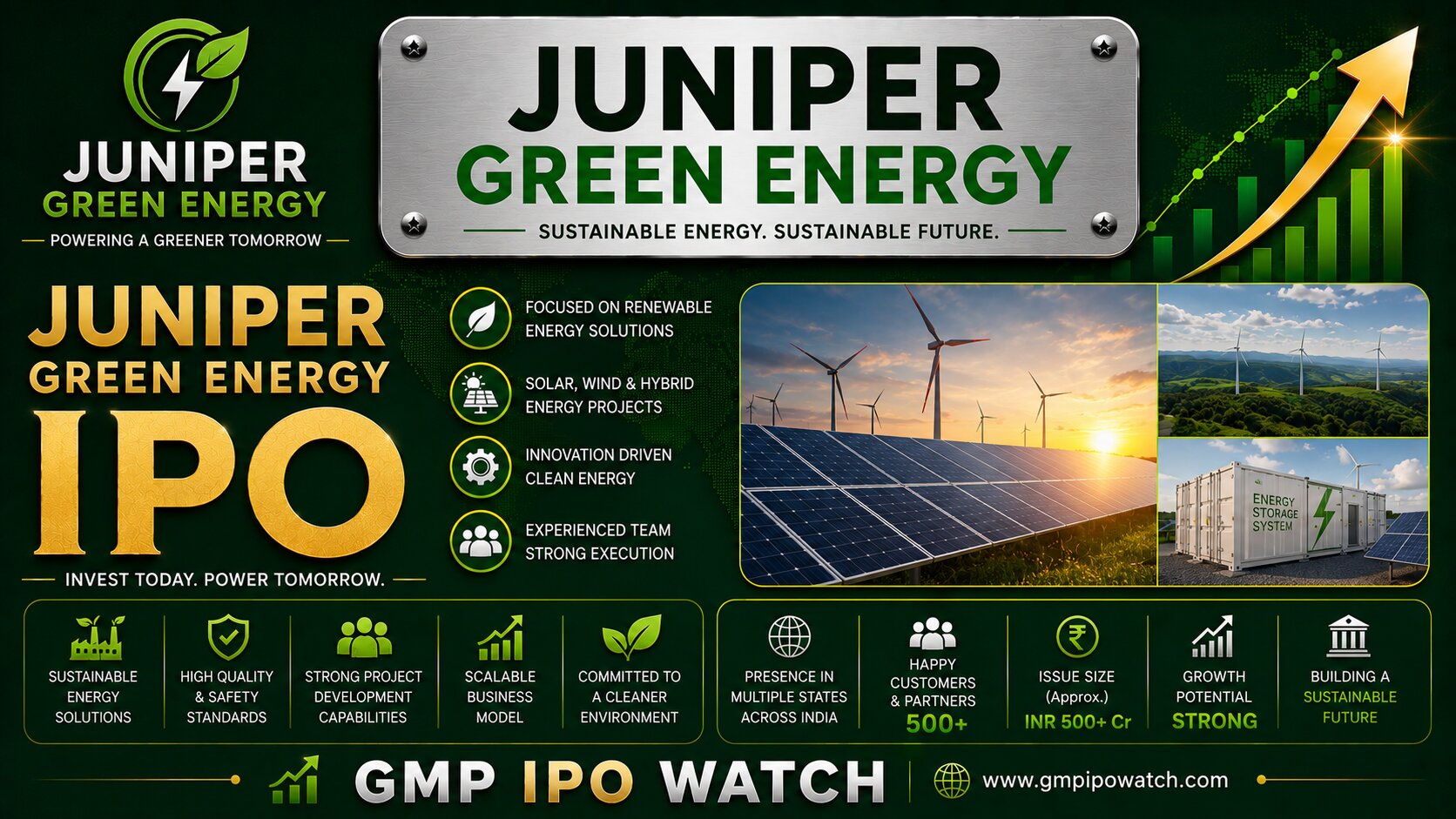
Juniper Green Energy IPO 2026: Renewable Portfolio, ₹1,800 Crore Issue, Financial Outlook and Investment Review
Juniper Green Energy IPO closes on August 3, 2026. Read the latest review covering its ₹1,800 crore fresh issue, ₹214–₹225 price band, solar and wind portfolio, financial model, debt-repayment plan, strengths, risks, GMP trend and long-term investment outlook.
Use these shortcuts to keep exploring
The archive button opens all articles from this category. The IPO details button opens the live IPO page on your GMP site in a new tab.
Juniper Green Energy IPO 2026 – Complete and Updated Review
India’s renewable-energy sector continues to attract significant investment as the country expands solar, wind, hybrid and energy-storage capacity. Rising electricity consumption, government renewable targets, corporate clean-energy commitments and increasing demand for round-the-clock green power are creating opportunities for independent power producers capable of developing projects at scale.
Juniper Green Energy Limited is one of the renewable-energy companies seeking to participate in this long-term transition through a portfolio that includes solar, wind, wind-solar hybrid and firm and dispatchable renewable-energy projects.
The Juniper Green Energy IPO opened on July 30, 2026, and closes today, August 3, 2026. The company is raising ₹1,800 crore entirely through a fresh issue of equity shares, meaning the proceeds will go to the company rather than selling shareholders. The price band has been fixed at ₹214 to ₹225 per share, while the tentative listing date is August 6, 2026, on the BSE and NSE.
This article examines Juniper Green Energy’s actual business, project portfolio, revenue model, IPO structure, use of proceeds, financial position, competitive strengths, major risks and overall investment outlook.
About Juniper Green Energy Limited
Juniper Green Energy is an independent renewable-energy power producer involved in developing, constructing, owning and operating renewable-power projects in India.
The company’s portfolio includes:
- Solar power projects
- Wind energy projects
- Wind-solar hybrid projects
- Firm and dispatchable renewable-energy projects
- Battery energy-storage-linked renewable projects
- Utility-scale clean-energy assets
As of June 30, 2026, the company reported a total portfolio of approximately 10,247 MWp spread across 50 projects in four Indian states. This portfolio includes operating assets, projects under construction and awarded or planned capacity.
The company is backed by the AT Group and has built its platform around long-term power-generation assets rather than short-duration engineering contracts.
Understanding Juniper Green Energy’s Business Model
Juniper Green Energy operates as an independent power producer, commonly referred to as an IPP.
An IPP develops renewable projects, arranges financing, completes construction and then earns revenue by selling electricity to customers under long-term agreements.
Its business cycle generally includes:
- Identifying suitable renewable-energy opportunities.
- Participating in competitive power auctions or negotiating supply agreements.
- Securing land and grid connectivity.
- Arranging project financing.
- Procuring equipment and completing construction.
- Commissioning the project.
- Selling electricity under long-term Power Purchase Agreements.
- Operating and maintaining the asset over its useful life.
This model requires substantial capital during the development and construction stage but can generate relatively predictable revenue once projects become operational and begin supplying electricity under contracted arrangements.
Power Purchase Agreements and Revenue Visibility
One of the most important aspects of Juniper Green Energy’s business is its use of long-term Power Purchase Agreements, or PPAs.
A PPA establishes the terms under which electricity will be supplied to a buyer over an agreed period. It generally covers:
- Contracted power capacity
- Electricity tariff
- Agreement duration
- Delivery obligations
- Payment terms
- Performance requirements
Approximately 98% of Juniper Green Energy’s capacity is reportedly backed by long-term PPAs, providing the company with meaningful revenue visibility once projects become operational.
However, a signed agreement does not eliminate every risk. Project delays, grid constraints, counterparty payment delays and lower-than-expected generation can still influence financial performance.
Renewable-Energy Portfolio
Juniper Green Energy’s portfolio is diversified across different clean-energy technologies.
Solar Power
Solar projects generate electricity using photovoltaic modules and generally offer predictable daytime production patterns.
Utility-scale solar remains an important part of India’s renewable-energy expansion because of its scalability, declining long-term generation costs and relatively short construction cycle.
Wind Energy
Wind projects produce electricity using turbines installed in locations with suitable wind resources.
Wind generation can complement solar because production patterns may differ across seasons and times of day.
Wind-Solar Hybrid Projects
Hybrid projects combine solar and wind generation within a single renewable platform.
The combination can improve utilisation of transmission infrastructure and produce a more balanced electricity profile than a standalone solar or wind project.
Firm and Dispatchable Renewable Energy
Firm and dispatchable renewable-energy projects combine renewable generation with storage or other balancing mechanisms to deliver electricity more consistently.
This category is becoming increasingly important as power buyers seek renewable electricity beyond periods when sunlight or wind is naturally available.
Battery Energy Storage
Battery storage can store electricity during periods of higher generation and release it when power is required.
Storage may improve project reliability, grid integration and the ability to meet scheduled power-supply commitments.
Juniper Green Energy IPO Details
| Particular | Details |
|---|---|
| IPO Type | Mainboard Book-Built IPO |
| Total Issue Size | ₹1,800 crore |
| Fresh Issue | ₹1,800 crore |
| Offer for Sale | Nil |
| Face Value | ₹10 per share |
| Price Band | ₹214 to ₹225 per share |
| IPO Opening Date | July 30, 2026 |
| IPO Closing Date | August 3, 2026 |
| Anchor Investor Date | July 29, 2026 |
| Basis of Allotment | August 4, 2026 |
| Refund Initiation | August 5, 2026 |
| Credit to Demat | August 5, 2026 |
| Tentative Listing Date | August 6, 2026 |
| Listing Exchanges | BSE and NSE |
| Registrar | Kfin Technologies Limited |
The issue consists entirely of new shares and does not include an Offer for Sale. Therefore, the IPO will bring fresh capital into the company.
Lot Size and Retail Investment
The minimum bidding lot is 66 shares.
At the upper price band of ₹225, the minimum retail application amount is:
66 shares × ₹225 = ₹14,850
Retail investors can submit applications based on the permitted number of lots within the applicable investment limit.
Why Is Juniper Green Energy Raising ₹1,800 Crore?
The company intends to use the fresh capital primarily for strengthening its balance sheet and supporting its renewable-energy platform.
The IPO proceeds are expected to be used for:
- Repayment or prepayment of borrowings
- Investment in subsidiaries for debt reduction
- Strengthening financial flexibility
- Supporting renewable-project development
- General corporate purposes
Debt repayment is particularly important for renewable-energy developers because projects are generally financed through a combination of equity and borrowings. Reducing debt can lower finance costs and improve the company’s ability to fund new capacity.
Why Debt Matters in Renewable Energy
Renewable-power development is capital intensive.
Before a project starts generating revenue, the developer must spend money on:
- Land
- Solar modules or wind turbines
- Construction
- Transmission connectivity
- Electrical infrastructure
- Project management
- Regulatory approvals
- Interest during construction
Borrowing helps finance these investments, but it also creates interest obligations.
A highly leveraged company may experience pressure if projects are delayed or revenue begins later than expected. Therefore, using IPO proceeds to repay debt can improve financial stability, although it may also mean that a substantial portion of the issue is not directly funding new capacity.
Financial Performance
Juniper Green Energy’s earnings profile has been shaped by the commissioning of new renewable assets, finance costs and the development stage of its portfolio.
The company reported revenue of approximately ₹391.6 crore in FY2024 and a net profit of around ₹40 crore for that period, according to IPO-related coverage.
Investors reviewing the offer document should compare the following across the most recent financial periods:
- Revenue from power sales
- EBITDA
- Profit or loss after tax
- Finance costs
- Total borrowings
- Operating cash flow
- Installed capacity
- Plant-load or capacity-utilisation factors
- Receivables from power buyers
- Capital expenditure
- Net worth
For an expanding power producer, reported earnings may change substantially as new projects move from construction to commercial operation.
Installed Capacity vs Total Portfolio
Investors should distinguish between the company’s total portfolio and its operational capacity.
A renewable company may classify projects as:
- Operational
- Under construction
- Awarded
- Contracted
- Development-stage
- Planned pipeline
Only operating projects currently generate electricity revenue.
Projects under construction may become future revenue sources, but they also carry execution, financing and commissioning risks.
Juniper Green Energy’s reported total portfolio exceeds 10 GWp, but investors should separately assess how much capacity is already operational and how much remains dependent on future construction or approvals.
Customer and Counterparty Concentration
Juniper Green Energy reportedly derives a substantial portion of its revenue from a limited number of government-backed electricity buyers.
This concentration can offer some stability because government utilities and agencies generally enter long-term contracts. However, dependence on a small group of buyers creates counterparty risk.
Potential issues include:
- Delayed payments
- Renegotiation disputes
- Tariff disagreements
- Curtailment of power
- Changes in procurement policies
- Concentration of receivables
IPO-related analysis has highlighted that revenue depends heavily on two major government electricity buyers.
Investors should examine the proportion of revenue and receivables attributable to the largest customers in the final prospectus.
Competitive Strengths
Large Renewable Portfolio
The company has built a sizeable portfolio across solar, wind, hybrid and storage-linked technologies.
Long-Term Contracted Revenue
A high proportion of capacity backed by PPAs provides potential revenue visibility after project commissioning.
Diversified Renewable Technologies
Exposure to solar, wind, hybrid and firm renewable projects reduces dependence on a single generation technology.
Experience Across the Project Lifecycle
The company manages development, financing, construction and operation of renewable assets.
Exposure to India’s Energy Transition
India’s rising electricity demand and renewable-energy expansion create a supportive long-term operating environment.
Fresh-Issue Structure
Because the IPO is entirely a fresh issue, the funds will directly strengthen the company rather than providing an exit to existing shareholders.
Key Risk Factors
High Leverage
Renewable-energy projects require substantial borrowing. High debt increases finance costs and can reduce profitability.
Project Execution Risk
Delays in construction, land acquisition, equipment delivery or grid connectivity may postpone revenue generation.
Customer Concentration
Dependence on a limited number of power buyers could affect revenue and cash collection if one counterparty faces financial or operational issues.
Regulatory Dependence
Renewable projects are influenced by tariffs, auctions, grid rules, environmental approvals and government policies.
Weather Variability
Solar and wind generation depend on natural resources. Lower irradiation or wind availability can reduce electricity production.
Equipment Supply Risk
Delays or cost increases involving modules, turbines, batteries or electrical equipment may affect project economics.
Interest-Rate Risk
Higher borrowing costs can influence the returns generated by capital-intensive renewable projects.
Transmission Constraints
Even a completed project may face operational challenges if evacuation or grid infrastructure is delayed.
Latest Subscription and GMP Trend
Juniper Green Energy’s IPO entered its final bidding day with a relatively subdued market response.
On the second day, reports indicated that the issue had received bids for approximately 44% of the shares offered by midday, suggesting cautious investor participation.
The Grey Market Premium also weakened during the issue period. It was reportedly around 8% before opening, fell to roughly 4% during the second day, and was near 1% on the final day.
This declining GMP suggests that expectations for immediate listing gains became more conservative as bidding progressed.
GMP is unofficial, unregulated and highly volatile. It should not be treated as a reliable indicator of listing performance or long-term investment returns.
Why Has the Market Response Been Cautious?
Several factors may be influencing the relatively restrained response.
These may include:
- The company’s high debt
- Significant capital requirements
- Execution risk across a large project pipeline
- Concentration among power purchasers
- Dependence on government policy
- Uncertainty around near-term profitability
- Valuation expectations
- Weakening grey-market sentiment
At the same time, long-term investors may still find the renewable-energy opportunity attractive because of contracted capacity and India’s growing clean-power requirements.
Valuation Considerations
Investors should not value Juniper Green Energy solely on its total portfolio size.
Important valuation factors include:
- Operational capacity
- Capacity under construction
- Revenue and EBITDA from commissioned projects
- Net debt
- Finance costs
- Enterprise value per operating megawatt
- Price-to-book ratio
- Expected return on equity
- Cash-flow generation
- Project pipeline
- PPA tariffs
- Remaining contract tenure
A 10 GW portfolio may appear attractive, but projects that are not yet operational still require capital and carry execution risk.
The issue valuation should therefore be compared with listed renewable-power producers using both operational and financial metrics.
Growth Strategy After Listing
Juniper Green Energy’s future growth will likely depend on its ability to execute projects while maintaining financial discipline.
Important growth drivers include:
Commissioning Projects on Time
Moving projects from construction to operation can increase revenue and cash flow.
Expanding Hybrid Capacity
Wind-solar hybrid projects may provide better generation profiles and improve transmission utilisation.
Building Storage-Linked Projects
Energy storage can help the company provide more reliable and dispatchable renewable electricity.
Reducing Borrowing Costs
Debt repayment from IPO proceeds may improve profitability and support future financing.
Winning New Power Auctions
Securing commercially attractive PPAs will be essential for portfolio expansion.
Improving Customer Diversification
Adding more government, utility and commercial buyers could reduce counterparty concentration.
Why Investors Are Tracking Juniper Green Energy IPO
The issue has received attention because of:
- A ₹1,800 crore mainboard public offering
- Exposure to solar, wind and hybrid energy
- A portfolio exceeding 10 GWp
- Long-term contracted capacity
- Fresh capital for debt repayment
- Strong structural demand for renewable power
- Potential growth from energy-storage projects
- Listing on both BSE and NSE
However, the declining GMP and cautious subscription response show that investors are balancing the clean-energy growth story against financial and execution risks.
Should You Apply for Juniper Green Energy IPO?
Juniper Green Energy offers exposure to one of India’s most important long-term investment themes: the transition from conventional power to renewable electricity.
Its large portfolio, diversified technologies and long-term PPAs provide a promising platform for growth.
However, the company also carries substantial risks.
High leverage, project-execution requirements, customer concentration, policy exposure and the capital-intensive nature of renewable development can create earnings and cash-flow volatility.
The IPO may be more suitable for investors who:
- Have a long-term investment horizon
- Understand renewable-power businesses
- Can tolerate high debt and execution risk
- Are comfortable with infrastructure-related volatility
- Are not relying only on listing gains
Conservative investors should study the debt profile, operational capacity, valuation and cash-flow disclosures carefully before applying.
Final Verdict
The Juniper Green Energy IPO 2026 is a large renewable-energy offering backed by a portfolio spanning solar, wind, hybrid and storage-linked power projects.
The company benefits from India’s clean-energy expansion, a substantial project pipeline and long-term PPAs covering most of its capacity. The ₹1,800 crore fresh issue may also help reduce debt and improve the balance sheet.
On the other hand, Juniper Green Energy remains a capital-intensive business with high leverage, construction risk, customer concentration and dependence on regulatory policies and grid infrastructure.
The weakening GMP and moderate subscription response indicate that the market is approaching the issue cautiously rather than pricing in large immediate gains.
For long-term investors with a high risk tolerance, Juniper Green Energy may offer an opportunity to participate in India’s renewable-power growth. For investors seeking stable earnings, low leverage or predictable short-term returns, the risks may require a more cautious approach.
The final decision should be based on the company’s audited financial statements, operating capacity, debt position, valuation, project execution record and individual investment objectives—not on renewable-energy enthusiasm or Grey Market Premium alone.