 GMP IPO Watch
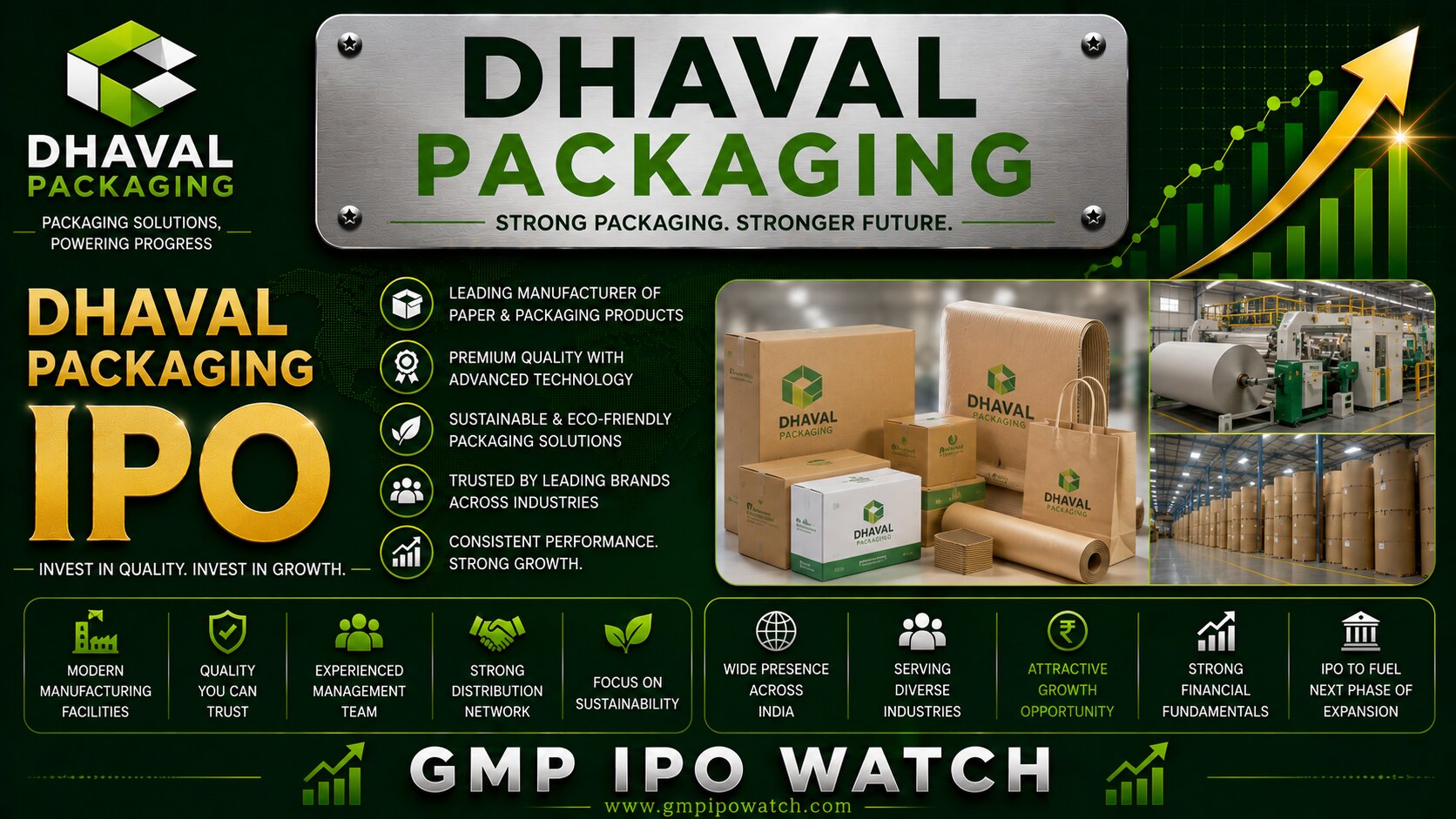
Dhaval Packaging IPO 2026: Business Expansion, Packaging Demand, Growth Drivers and Investor Outlook
Dhaval Packaging Limited is preparing for its IPO amid growing demand for packaging across consumer and industrial markets. This detailed review examines the company's business operations, manufacturing model, growth opportunities, financial factors, industry trends, competitive position, IPO outlook, and key risks investors should consider.
Live IPO tracking available
Check GMP movement, allotment details, subscription demand, and deeper IPO context for this company.
Use these shortcuts to keep exploring
The archive button opens all articles from this category. The IPO details button opens the live IPO page on your GMP site in a new tab.
Dhaval Packaging IPO 2026 – A Fresh Investor-Focused Analysis
Packaging is often treated as a supporting part of a product, but for manufacturers, retailers, and consumer brands, it performs several critical functions at the same time. Packaging protects products during transportation, improves shelf life, provides information to customers, supports brand recognition, and can influence purchasing decisions.
India's changing consumption patterns are therefore creating new opportunities for companies operating in the packaging industry.
The rapid expansion of food processing, pharmaceuticals, FMCG, e-commerce, retail, agriculture, manufacturing, and organised distribution has increased the requirement for reliable packaging at virtually every stage of the supply chain.
Against this backdrop, Dhaval Packaging Limited is attracting attention in connection with its proposed IPO.
Rather than looking at the company simply as another packaging manufacturer, investors need to understand how sustainable its demand is, whether it can improve margins as the business expands, how efficiently it manages working capital, and whether its capacity investments can generate sufficient returns.
This updated review examines Dhaval Packaging from that perspective.
Understanding Dhaval Packaging's Business
Dhaval Packaging operates within the packaging and manufacturing ecosystem, where customers typically require products based on specific dimensions, strength, design, printing, material, and end-use requirements.
An important feature of this industry is that packaging is generally a recurring requirement.
A customer purchasing machinery may make a large purchase once every several years. In contrast, businesses selling food, medicines, consumer goods, agricultural products, or industrial materials require packaging whenever they manufacture and dispatch their products.
This creates the potential for repeat orders for suppliers capable of maintaining consistent quality, competitive pricing, and reliable delivery.
For Dhaval Packaging, building and retaining such customer relationships can therefore become an important long-term growth driver.
What Makes the Packaging Business Interesting?
The underlying demand for packaging is connected with the quantity of goods manufactured, distributed, transported, and consumed.
When businesses expand their production, their packaging requirements generally increase as well.
Consider an FMCG manufacturer increasing annual production by 20%.
That additional production doesn't only require more raw materials. It also needs additional packaging before those products can reach distributors and consumers.
The same principle applies to pharmaceuticals, food processing, agriculture, chemicals, consumer products, and industrial goods.
This makes packaging an important supporting industry for India's broader consumption and manufacturing economy.
Business Model of Dhaval Packaging
The company's business model can broadly be understood through three activities:
Manufacturing → Customisation → Supply
Customers provide their product specifications and packaging requirements.
Dhaval Packaging then manufactures the required packaging according to factors such as:
- Product dimensions
- Material requirements
- Printing specifications
- Strength and durability
- Storage conditions
- Transportation requirements
- Customer branding
- Order volumes
Once manufactured and inspected, the finished packaging is supplied to customers according to their production and delivery schedules.
This model means operational efficiency, capacity utilisation, quality control, and raw material procurement can have a direct impact on profitability.
Importance of Repeat Customers
Customer retention can be particularly valuable for a packaging manufacturer.
Once a company finds a supplier capable of delivering acceptable quality consistently and on schedule, changing suppliers may introduce additional operational risks.
A new supplier may require product testing, design modifications, production trials, quality approvals, and commercial negotiations.
Established supplier relationships can consequently result in repeat orders.
For Dhaval Packaging, increasing the proportion of recurring business while adding new customers could help create more predictable revenue over the longer term.
Industries Creating Demand for Dhaval Packaging
Packaging requirements extend across several areas of the economy.
FMCG
Everyday products such as household items, personal care products, packaged foods, and consumer products require packaging before reaching retail shelves.
Food Processing
Processed and packaged foods require suitable materials for protection, handling, transportation, and storage.
Pharmaceuticals
Medicines and healthcare products require reliable packaging while also being subject to strict quality and regulatory requirements.
E-commerce
Online shopping has created enormous demand for transportation and protective packaging because products must travel from warehouses to individual customers.
Agriculture
Seeds, fertilisers, animal feed, agricultural inputs, and other products require durable packaging suitable for transportation and storage.
Industrial Products
Manufacturers also require packaging to protect components, machinery parts, chemicals, and other industrial products throughout their supply chains.
Exposure to several industries can reduce reliance on growth in only one end market.
Dhaval Packaging IPO 2026 – Key Details
| Particular | Current Status |
|---|---|
| Company | Dhaval Packaging Limited |
| Issue Type | Proposed IPO |
| IPO Structure | Subject to final offer documents |
| Issue Size | To be confirmed |
| Price Band | To be announced |
| Lot Size | To be announced |
| Opening Date | To be announced |
| Closing Date | To be announced |
| Allotment | To be announced |
| Listing Date | To be announced |
Investors should rely on the company's final offer documents and exchange announcements for confirmed dates, pricing, issue structure, and other subscription details rather than treating preliminary information as final.
Why Dhaval Packaging May Be Raising Capital
An IPO can become particularly important for a manufacturing company because business expansion requires capital before the resulting revenue is generated.
Funds can potentially be required for areas such as:
- Manufacturing capacity expansion
- New machinery
- Factory infrastructure
- Working capital
- Raw material purchases
- Technology upgrades
- Product development
- Debt reduction, where applicable
- General corporate requirements
The exact utilisation of proceeds disclosed in the company's offer documents will therefore be an important section for investors to examine.
Capacity Expansion Could Be a Major Growth Trigger
Manufacturing companies eventually reach a point where existing facilities limit their ability to accept additional orders.
Suppose a factory is already operating close to its practical production capacity.
Even when demand increases, the company cannot necessarily increase sales significantly without investing in additional machinery or production infrastructure.
Capacity expansion can solve this problem.
If Dhaval Packaging successfully uses fresh capital to increase production while maintaining customer demand, additional capacity could translate into higher sales.
But capacity expansion alone isn't enough.
Investors should determine whether the company has sufficient customer demand to utilise that additional capacity efficiently.
Working Capital Is Equally Important
Packaging manufacturing can require significant working capital.
A company may need to purchase raw materials today, manufacture the product, deliver it to customers, and then wait several weeks or months before receiving payment.
During this period, cash remains tied up in operations.
Rapid revenue growth can actually increase this requirement.
Therefore, investors shouldn't evaluate Dhaval Packaging based solely on reported profits.
Receivables, inventory levels, operating cash flow, and the working capital cycle deserve equal attention.
Financial Performance – What Investors Should Examine
Rather than focusing on one year's profit number, investors should examine the financial trend across multiple years.
Important metrics include:
Revenue Growth
Consistent revenue expansion can indicate increasing customer demand and successful business execution.
EBITDA Margin
EBITDA margin helps investors understand operational profitability before financing and accounting-related expenses.
Profit After Tax
PAT indicates how much profit remains after expenses, depreciation, interest, and taxes.
PAT Margin
An increasing PAT margin alongside revenue growth can indicate improving operating leverage.
Debt-to-Equity Ratio
This helps investors understand how dependent the company is on borrowed capital.
ROE
Return on Equity measures the profitability generated against shareholders' equity.
ROCE
Return on Capital Employed becomes particularly useful for manufacturing businesses because significant capital is required for plants, machinery, and working capital.
Operating Cash Flow
Healthy accounting profits accompanied by consistently weak operating cash flow deserve additional scrutiny.
These indicators should ultimately be evaluated using the audited figures contained in the company's IPO documents.
Revenue Growth vs Profit Growth
Investors should distinguish between increasing sales and improving profitability.
Consider two scenarios.
A company's revenue increases 30%, but its profit increases only 5%.
Alternatively, revenue increases 20% while profit increases 35%.
The second situation could indicate better operating efficiency, stronger pricing, improved capacity utilisation, or a more profitable product mix.
Therefore, Dhaval Packaging's revenue and profit trends should be analysed together.
Raw Material Costs Can Influence Margins
Packaging manufacturing requires various raw materials depending on the products manufactured.
When input prices increase rapidly, the company's production costs can rise.
Whether this becomes a serious problem depends partly on pricing power.
If Dhaval Packaging can pass higher input costs to customers relatively quickly, margins may remain protected.
If customer contracts prevent immediate price increases, profitability may temporarily decline.
This ability to pass through costs should be an important part of the IPO evaluation.
Sustainability Is Changing Packaging
One of the most important long-term developments in the packaging industry is the movement toward environmentally responsible materials.
Consumers, corporations, and regulators increasingly focus on:
- Recyclable packaging
- Reduced material consumption
- Lightweight packaging
- Sustainable materials
- Reusable designs
- Reduced waste
- Environmentally responsible manufacturing
This transition represents both an opportunity and a challenge.
Companies capable of developing cost-effective sustainable alternatives could gain customers.
Businesses unable to adapt could face additional investment requirements or lose competitiveness.
E-Commerce Creates Another Growth Opportunity
The expansion of online shopping has changed packaging requirements dramatically.
Traditional retail often involves moving large quantities of products between manufacturers, distributors, and stores.
E-commerce frequently involves shipping individual orders directly to customers.
Products therefore need packaging capable of surviving warehouses, sorting centres, transportation, last-mile delivery, and customer handling.
This creates additional demand for protective and transportation-focused packaging.
Continued e-commerce expansion could therefore provide another long-term demand driver for packaging manufacturers.
India's Manufacturing Expansion Could Help
India continues to encourage domestic manufacturing across electronics, automobiles, pharmaceuticals, chemicals, consumer products, engineering goods, and other industries.
Every additional factory ultimately creates supporting demand across logistics, transportation, warehousing—and packaging.
This creates an indirect opportunity for companies such as Dhaval Packaging.
Instead of relying exclusively on consumer spending, the company can potentially benefit from broader industrial expansion.
Competitive Strengths Investors Should Look For
Several factors could determine whether Dhaval Packaging builds a sustainable competitive position.
Product Customisation
The ability to design products according to individual customer requirements can differentiate the business from commodity suppliers.
Consistent Quality
Industrial customers need predictable packaging quality across repeated orders.
Delivery Reliability
Customers operating continuous production facilities cannot afford frequent packaging supply disruptions.
Cost Management
Efficient raw material sourcing and manufacturing can help protect margins.
Customer Relationships
Long-term customers create recurring revenue opportunities and lower dependence on continuous new customer acquisition.
Scalable Production
Additional capacity provides meaningful value when the company can fill that capacity profitably.
Growth Strategy After the IPO
Dhaval Packaging's next stage of expansion could revolve around strengthening its existing operations rather than merely adding volume.
Potential growth areas include:
- Higher-value packaging solutions
- New customer acquisition
- Increased production capacity
- Improved automation
- Geographic expansion
- Sustainable packaging
- Larger institutional contracts
- Additional end-user industries
- Export opportunities
Successful execution across even some of these areas could improve the company's long-term growth profile.
Key Risks Investors Should Understand
An IPO opportunity should always be evaluated alongside its risks.
Customer Concentration
If a significant percentage of revenue comes from a few customers, losing even one major account could materially affect sales.
Raw Material Volatility
Rapid increases in input costs can pressure margins.
Working Capital Pressure
Delayed customer payments could increase borrowing requirements.
Competition
Packaging remains a competitive industry with organised manufacturers and smaller regional suppliers.
Capacity Utilisation
Expansion becomes financially attractive only when additional production facilities are sufficiently utilised.
Environmental Regulations
Changing packaging and waste-management regulations may require investments in new materials or processes.
Economic Slowdown
Lower production and consumer spending across customer industries can temporarily weaken packaging demand.
What Investors Should Check Before Applying
Before subscribing to the Dhaval Packaging IPO, investors should carefully examine the final offer documents and answer a few important questions:
- Is revenue growing consistently?
- Is profitability increasing alongside revenue?
- Are margins stable?
- How much debt does the company carry?
- Is operating cash flow healthy?
- Are receivables increasing faster than sales?
- How dependent is revenue on the largest customers?
- What will the company do with the IPO proceeds?
- What valuation is being demanded?
- Does the valuation adequately reflect the company's risks and growth potential?
The answers to these questions provide a stronger foundation for an investment decision than IPO sentiment alone.
Should You Consider Dhaval Packaging IPO?
Dhaval Packaging operates in an industry benefiting from several structural trends: increasing consumption, growth in organised retail, e-commerce expansion, pharmaceutical manufacturing, food processing, industrial development, and demand for better packaging solutions.
These trends create an attractive industry backdrop.
However, a growing industry doesn't automatically make every IPO an attractive investment.
The investment case will depend on Dhaval Packaging's actual financial growth, margins, cash generation, customer diversification, balance-sheet strength, use of IPO proceeds, and valuation at the time of the issue.
Investors should therefore evaluate the company based on fundamentals rather than applying solely because packaging demand is increasing.
Final Outlook
The Dhaval Packaging IPO 2026 provides an opportunity to examine a business positioned within an essential but often overlooked part of India's consumption and manufacturing ecosystem.
Packaging demand grows alongside the products flowing through the economy—from medicines and packaged food to industrial components and online purchases. That gives the sector several long-term demand drivers.
For Dhaval Packaging, the larger opportunity will be converting this industry growth into profitable and cash-generating expansion through capacity utilisation, customer retention, product diversification, manufacturing efficiency, and disciplined capital allocation.
Investors considering the IPO should compare these business strengths against raw material volatility, working capital requirements, competition, customer concentration, and the valuation demanded during the offering.
Ultimately, Dhaval Packaging's IPO should be judged not simply on how quickly the packaging industry is expanding, but on how effectively the company can capture that growth while generating sustainable returns for shareholders.