 GMP IPO Watch
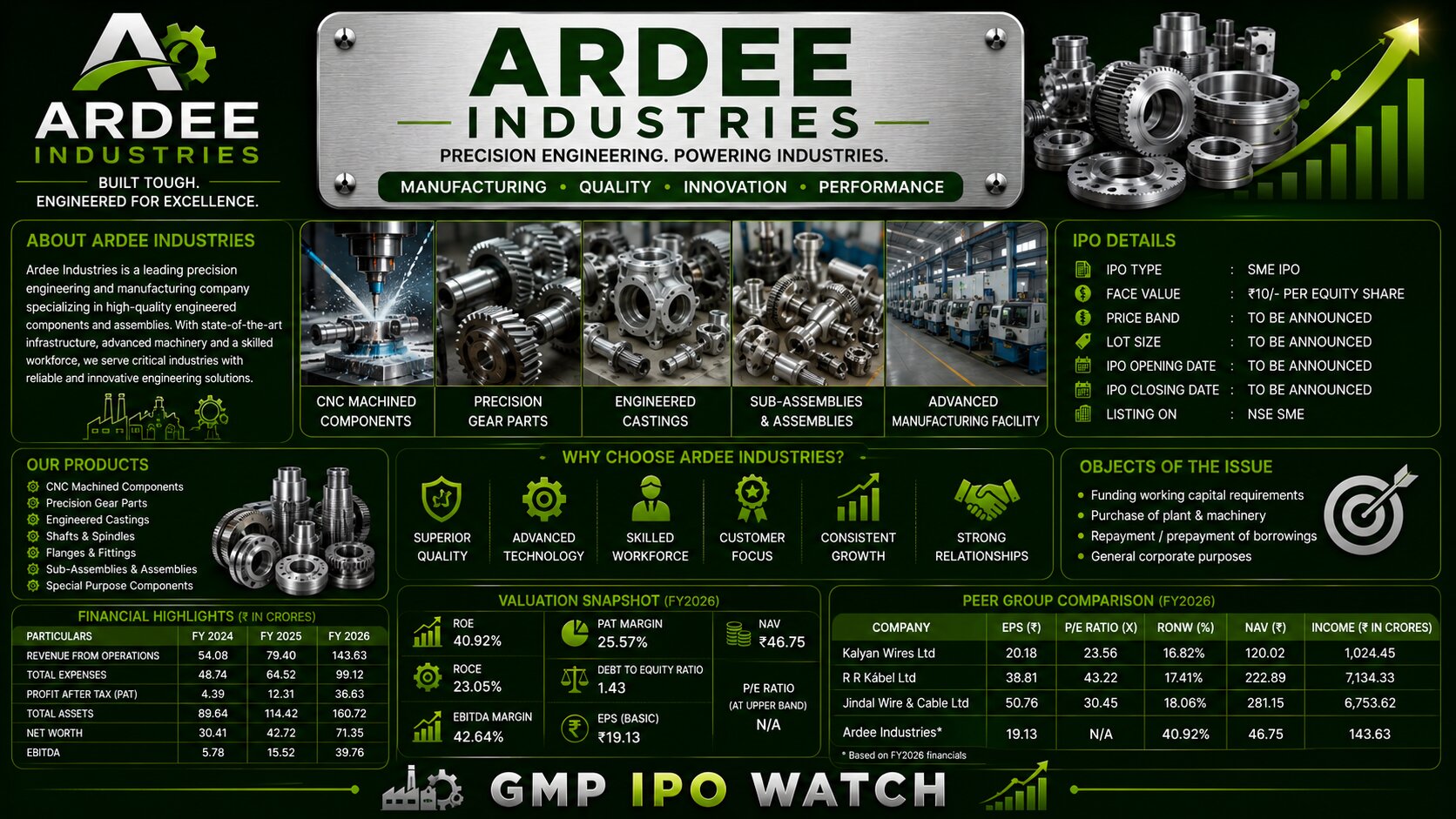
Ardee Industries IPO 2026: Lead Recycling Business, ₹425.87 Crore Issue, Financial Growth and Investment Review
Ardee Industries IPO opens from August 5 to August 7, 2026. Read the latest review covering its ₹425.87 crore mainboard issue, ₹50–₹53 price band, lead recycling operations, financial growth, IPO objectives, business strengths, major risks, GMP trend and investment outlook.
Live IPO tracking available
Check GMP movement, allotment details, subscription demand, and deeper IPO context for this company.
Use these shortcuts to keep exploring
The archive button opens all articles from this category. The IPO details button opens the live IPO page on your GMP site in a new tab.
Ardee Industries IPO 2026 – Complete and Updated Review
India’s rapid growth in automobiles, energy storage, telecom infrastructure, renewable-power backup systems and industrial manufacturing is increasing demand for lead and lead-based products. At the same time, environmental concerns and limited natural resources are encouraging industries to recover metals from used batteries and industrial scrap instead of depending entirely on newly mined material.
This shift has created a growing market for organised metal recyclers capable of collecting lead-bearing scrap, processing used batteries and supplying refined secondary lead to industrial customers.
Ardee Industries Limited operates in this specialised segment. The company recycles lead scrap and drained lead-acid batteries into refined lead and other lead-based products used by battery manufacturers and industrial customers. It describes itself as a secondary-metals company supplying lead to domestic and international markets.
The Ardee Industries IPO will open on August 5, 2026, and close on August 7, 2026. The company has fixed a price band of ₹50 to ₹53 per share, and the total issue size is approximately ₹425.87 crore. The shares are proposed to list on the BSE and NSE on August 12, 2026.
This review examines Ardee Industries’ recycling model, product portfolio, financial growth, IPO structure, use of proceeds, industry opportunity, business strengths, major risks and overall investment outlook.
About Ardee Industries Limited
Ardee Industries is engaged in the recovery and processing of lead from used lead-acid batteries, lead scrap and other recyclable materials.
Instead of relying only on primary lead extracted from mineral ore, the company processes recovered material and converts it into reusable metal products. This places Ardee Industries within the circular-economy and secondary-metals ecosystem.
Its business broadly connects three stages:
- Procurement of lead-bearing scrap and used batteries
- Recycling and refining of recovered lead
- Supply of processed lead products to industrial customers
The company’s customers are mainly associated with batteries, metals and manufacturing. Its principal manufacturing facility is located at Menakur Village, Naidupet Mandal, SPSR Nellore district in Andhra Pradesh.
Understanding the Lead-Recycling Business
Lead-acid batteries are widely used in:
- Passenger and commercial vehicles
- Inverters
- Telecom towers
- Data centres
- Industrial backup systems
- Solar and renewable-energy installations
- Uninterruptible power-supply systems
- Forklifts and material-handling equipment
These batteries eventually reach the end of their useful life. However, much of the lead contained inside them can be recovered and reused.
A lead recycler collects or procures drained batteries and lead scrap, separates recoverable materials, processes the lead-bearing components and refines the recovered metal to the required purity level.
The recycled lead can then be sold to battery manufacturers and other industrial users.
This closed-loop model reduces waste while creating a secondary supply of an industrially important metal.
How Ardee Industries Generates Revenue
Ardee Industries primarily earns revenue through the sale of recycled and processed lead products.
Its operating cycle may include:
- Procurement of used batteries
- Purchase of lead scrap
- Material segregation
- Smelting
- Refining
- Alloy preparation
- Product testing
- Packaging and dispatch
- Domestic and export sales
Profitability depends on several factors, including scrap-procurement prices, finished lead prices, recovery efficiency, production volume, energy costs and customer contracts.
The difference between the cost of recyclable input material and the realisation from finished products is particularly important for margins.
Product Portfolio
Ardee Industries supplies high-purity recycled lead and related secondary-metal products.
Its product categories may include:
- Refined lead
- Lead alloys
- Recycled lead ingots
- Battery-grade lead
- Customised lead products
- Other non-ferrous recycled materials
Different customers may require different lead purity levels or alloy compositions depending on the battery or industrial product being manufactured.
The company’s ability to maintain consistent chemical composition, quality and recovery rates can therefore influence customer retention and pricing.
Ardee Industries IPO Details
| Particular | Details |
|---|---|
| IPO Type | Mainboard Book-Built IPO |
| Total Issue Size | Approximately ₹425.87 crore |
| Fresh Issue | Up to ₹320 crore |
| Offer for Sale | Approximately ₹105.87 crore |
| Face Value | ₹2 per equity share |
| Price Band | ₹50 to ₹53 per share |
| Lot Size | 281 shares |
| IPO Opening Date | August 5, 2026 |
| IPO Closing Date | August 7, 2026 |
| Basis of Allotment | August 10, 2026 |
| Credit to Demat | Expected August 11, 2026 |
| Tentative Listing Date | August 12, 2026 |
| Listing Exchanges | BSE and NSE |
| Registrar | KFin Technologies Limited |
| Book-Running Lead Manager | Pantomath Capital Advisors Private Limited |
The IPO comprises a fresh issue of up to ₹320 crore and an Offer for Sale by existing shareholders. The company will receive only the fresh-issue proceeds; the OFS proceeds will go to the selling shareholders.
Lot Size and Minimum Retail Investment
The minimum application lot contains 281 shares.
At the upper price band of ₹53, the minimum retail investment is:
281 shares × ₹53 = ₹14,893
Investors can apply for additional lots subject to applicable category and investment limits.
Objectives of the IPO
The company intends to use the proceeds from the fresh issue mainly for:
- Funding working-capital requirements
- Repayment or prepayment of existing borrowings
- General corporate purposes
Working capital is especially important in metal recycling because the company must purchase large quantities of scrap before processing and selling finished lead.
Debt repayment may also reduce finance costs and improve the balance sheet.
Why Working Capital Is Critical
Ardee Industries may need to pay suppliers for battery scrap and lead-bearing material before receiving payment from customers.
Cash can therefore remain blocked in:
- Raw-material inventory
- Work-in-progress
- Finished goods
- Trade receivables
- Supplier advances
- Transportation and handling
Rapid revenue growth can increase this requirement.
A company may report strong accounting profits but still experience liquidity pressure when receivables and inventories grow faster than operating cash flow.
Investors should therefore examine Ardee Industries’ cash-conversion cycle, receivable days, inventory turnover and operating cash flow alongside reported profit.
Financial Performance
Ardee Industries has reported strong revenue and profit growth across the latest disclosed financial periods.
| Financial Year | Total Revenue | Profit After Tax |
| FY2023 | ₹411.84 crore | ₹8.57 crore |
| FY2024 | ₹463.39 crore | ₹8.95 crore |
| FY2025 | ₹743.53 crore | ₹33.27 crore |
| FY2026 | ₹1,168.88 crore | ₹84.68 crore |
Revenue increased from approximately ₹411.84 crore in FY2023 to ₹1,168.88 crore in FY2026. Profit after tax increased from ₹8.57 crore to ₹84.68 crore over the same period.
This indicates that the company’s profit expanded considerably faster than revenue.
Understanding the Growth Trend
Ardee Industries’ revenue rose by around 60% between FY2024 and FY2025 and increased substantially again in FY2026.
Possible drivers include:
- Higher recycled-lead production
- Increased scrap procurement
- Better plant utilisation
- Rising lead prices
- New customer orders
- Expansion in battery-sector demand
- Improved recovery efficiency
Profit growth was even stronger, which may reflect improved operating leverage and higher margins.
However, investors should determine whether the latest performance was supported by unusually favourable lead prices or a temporary improvement in the spread between raw-material and finished-product prices.
EBITDA and Profitability
Reported EBITDA increased from approximately ₹22.82 crore in FY2023 to ₹28.49 crore in FY2024 and ₹66.72 crore in FY2025. PAT increased from ₹8.57 crore to ₹33.27 crore over the same period.
IPO analysis indicates that the company’s return and margin profile improved significantly, with recent disclosures highlighting a PAT margin above 11% and ROCE above 40% for the latest period.
Investors should review:
- Gross margin
- EBITDA margin
- PAT margin
- Raw-material consumption
- Power and fuel costs
- Finance expenses
- Other income
- Recovery yield
- Inventory valuation
These figures will help establish whether the recent margin improvement is sustainable.
Cash-Flow Position
The company’s cash-flow record deserves careful attention.
Available financial data shows:
| Financial Year | Operating Cash Flow | Free Cash Flow |
| FY2023 | Negative ₹13.8 crore | Negative ₹35.5 crore |
| FY2024 | Negative ₹25.3 crore | Negative ₹45.8 crore |
| FY2025 | Positive ₹7.8 crore | Negative ₹17.4 crore |
Although operating cash flow turned positive in FY2025, free cash flow remained negative because of capital expenditure and business requirements.
This does not automatically indicate a weak business, especially during expansion. However, it shows that profit growth has not yet fully translated into free cash generation.
Lead-Recycling Industry Outlook
Organised lead recycling may benefit from several long-term trends:
- Growth in automobile ownership
- Increased battery replacement demand
- Expansion of telecom infrastructure
- Rising demand for power backup
- Growth of renewable-energy installations
- Expansion of data centres
- Formalisation of scrap collection
- Environmental regulation
- Circular-economy adoption
Lead-acid batteries continue to be widely used because of their reliability, recyclability and established supply chain.
Even as lithium-ion batteries expand in electric vehicles and energy storage, lead-acid batteries remain important in automotive starting applications, industrial backup and other specialised uses.
Circular-Economy Opportunity
Ardee Industries’ business is connected with the circular economy because it converts industrial waste into reusable metal.
A closed-loop recycling process can provide several benefits:
- Reduced dependence on mined lead
- Lower waste sent to landfills
- Recovery of valuable materials
- Formal treatment of hazardous battery waste
- Reuse of lead in new products
- Better environmental traceability
Large battery manufacturers may increasingly prefer formal and compliant recyclers because of environmental, social and governance requirements.
This creates an opportunity for organised operators with adequate licences, pollution-control systems and processing scale.
Competitive Strengths
Strong Recent Financial Growth
Revenue increased to approximately ₹1,168.88 crore in FY2026, while PAT reached ₹84.68 crore.
Exposure to Essential Battery Markets
Lead-acid batteries are used across automotive, telecom, industrial and power-backup applications.
Circular-Economy Business Model
The company recovers usable metal from waste batteries and scrap rather than relying only on primary mined lead.
Established Manufacturing Facility
The company operates a recycling and manufacturing facility in Andhra Pradesh, supporting large-scale processing.
Domestic and Export Presence
Ardee Industries supplies recycled lead products to both Indian and international markets.
Debt-Reduction Plan
Part of the IPO proceeds will be used to reduce borrowings, potentially lowering finance costs.
Major Risk Factors
High Customer Concentration
IPO risk analysis indicates that the company’s largest customer contributed as much as 72.42% of revenue during one reported period.
Dependence on one or a few customers creates significant risk. Losing a major buyer or facing delayed orders could materially affect revenue and cash flow.
Dependence on Battery Industry
A substantial portion of demand comes from battery manufacturers.
Changes in battery technology, customer sourcing policies or industry demand could influence future growth.
Raw-Material Availability
The company depends on consistent access to used batteries and lead scrap.
Competition for recyclable material may increase procurement costs.
Commodity-Price Volatility
Lead prices can fluctuate significantly.
Rapid changes may affect inventory values, sales realisations and margins.
Environmental Compliance
Lead is hazardous and requires strict handling, processing, emissions control and waste-management practices.
Non-compliance could result in penalties, shutdowns or reputational damage.
Working-Capital Pressure
Large inventories and customer receivables can create liquidity requirements.
Negative Historical Free Cash Flow
Despite profit growth, the company has reported negative free cash flow in recent periods.
Technology Substitution
Long-term growth of lithium-ion batteries may reduce lead-acid battery demand in selected applications.
Offer-for-Sale Component
Approximately ₹105.87 crore of the issue represents an OFS and will not be available for the company’s growth requirements.
Grey Market Premium and Current Sentiment
Unofficial grey-market trackers have reported Ardee Industries GMP in a broad range.
Recent indications include approximately:
- ₹6.75 per share on one tracker
- ₹8 per share on another tracker
- A recorded range between ₹0 and ₹13
At the upper issue price of ₹53, an ₹8 GMP would represent an unofficial premium of approximately 15%.
Grey Market Premium is unofficial, unregulated and highly volatile.
It should not be treated as a reliable prediction of the listing price or as the primary reason to apply.
Valuation Considerations
Investors should assess the IPO valuation using:
- FY2026 earnings per share
- Implied price-to-earnings ratio
- Post-issue equity capital
- Return on equity
- Return on capital employed
- Cash-flow generation
- Net debt
- Customer concentration
- Lead-price sensitivity
- Comparison with listed metal-recycling companies
The low absolute share price of ₹50–₹53 does not mean the company is inexpensive.
The relevant question is how the issue price compares with earnings, assets, cash flows and future business risk.
Recent financial growth may make the valuation appear attractive, but investors should determine whether FY2026 represents a sustainable earnings level.
Growth Opportunities After the IPO
Increased Scrap Procurement
Additional working capital may allow the company to purchase more recyclable material and increase production.
Higher Capacity Utilisation
Improved raw-material availability may help the company use its manufacturing assets more efficiently.
Debt Reduction
Lower interest costs may improve future profitability and cash flow.
New Customer Acquisition
Reducing dependence on the largest customers could improve revenue stability.
Export Expansion
International sales may provide access to additional markets and pricing opportunities.
Product Diversification
The company may expand into additional lead alloys or other recycled non-ferrous metals.
Formalisation of Recycling
Stricter environmental rules may benefit compliant organised recyclers over informal operators.
What Investors Should Check in the RHP
Before applying, investors should review:
- Revenue contribution from the largest five and ten customers
- Raw-material supplier concentration
- Lead-recovery efficiency
- Environmental approvals and compliance history
- Operating and free cash flow
- Receivable and inventory days
- Post-IPO debt level
- Capacity and utilisation
- Commodity-price hedging policy
- Related-party transactions
- Pending legal and tax matters
- Export contribution
- Promoter background
- Post-issue valuation
- Sensitivity of margins to lead prices
These disclosures are more important than short-term GMP movement.
Why Investors Are Tracking Ardee Industries IPO
The issue has attracted attention because of:
- Revenue exceeding ₹1,168 crore in FY2026
- PAT of approximately ₹84.68 crore
- Exposure to lead recycling and circular-economy growth
- A ₹425.87 crore mainboard issue
- Planned debt repayment
- Strong recent return ratios
- Demand from battery manufacturers
- A modest positive GMP before opening
- Listing on both the BSE and NSE
At the same time, customer concentration, commodity-price exposure and cash-flow performance remain important concerns.
Should You Apply for Ardee Industries IPO?
Ardee Industries presents a strong recent growth story within the secondary-metals and battery-recycling industry.
Its positive factors include:
- Strong revenue growth
- Rapid improvement in profitability
- Exposure to organised recycling
- Essential battery-sector demand
- Fresh funds for working capital
- Planned debt reduction
- Mainboard listing
- Circular-economy positioning
The major concerns include:
- Dependence on a limited number of customers
- Exposure to lead-price volatility
- Negative historical free cash flow
- Environmental and regulatory risk
- Raw-material availability
- Dependence on lead-acid battery demand
- Sustainability of recent margins
The IPO may suit investors who understand commodity-linked manufacturing businesses and can tolerate earnings volatility.
Conservative investors should study the company’s cash-flow position, customer concentration and valuation carefully before applying.
Final Verdict
The Ardee Industries IPO 2026 offers investors exposure to one of India’s growing organised lead-recycling companies at a time when battery demand, environmental compliance and circular-economy practices are becoming increasingly important.
The company’s revenue increased from approximately ₹411.84 crore in FY2023 to ₹1,168.88 crore in FY2026, while PAT increased from ₹8.57 crore to ₹84.68 crore. These numbers create an attractive financial-growth narrative.
However, investors should not overlook the company’s dependence on large customers, commodity-price movements, raw-material supply, environmental compliance and historical cash-flow weakness.
Ardee Industries should therefore be viewed as a growth-oriented metal-recycling IPO with strong recent earnings but meaningful concentration, commodity and cash-flow risks.
The final decision should be based on the company’s post-issue valuation, customer diversification, audited financials, operating cash flow, debt position and individual risk tolerance—not solely on Grey Market Premium or short-term listing expectations.