 GMP IPO Watch
Anawil Wire and Engineering IPO 2026: Wind-Tower Manufacturing, Financial Growth, Issue Details and Investment Review
Anawil Wire and Engineering IPO opens from August 3 to August 5, 2026. Read the latest review covering its ₹177.81 crore SME issue, ₹257–₹270 price band, wind-tower and heavy-fabrication business, financial growth, IPO objectives, strengths, risks, GMP and investment outlook.
Live IPO tracking available
Check GMP movement, allotment details, subscription demand, and deeper IPO context for this company.
Use these shortcuts to keep exploring
The archive button opens all articles from this category. The IPO details button opens the live IPO page on your GMP site in a new tab.
Anawil Wire and Engineering IPO 2026 – Complete Updated Review
India’s renewable-energy and industrial-infrastructure expansion is creating demand for heavy fabricated structures, wind-turbine towers, specialised wire products and machinery used by large manufacturing companies. These products may not be visible to end consumers, but they form an essential part of the power, engineering, paper and industrial-production ecosystem.
Anawil Wire and Engineering Limited operates within this specialised manufacturing segment. The company is engaged in heavy fabrication and manufactures products connected with wind-energy infrastructure, wire mesh and paper-production machinery.
The Anawil Wire and Engineering IPO opened on August 3, 2026, and closes on August 5, 2026. The company has fixed a price band of ₹257 to ₹270 per equity share, while the total issue size is approximately ₹177.81 crore. The shares are proposed to list on the NSE SME platform on August 10, 2026.
The issue has attracted attention because of the company’s strong recent profit growth, exposure to India’s wind-energy expansion and planned use of fresh capital for debt reduction and manufacturing investment.
This detailed review examines the company’s actual operations, manufacturing model, financial performance, IPO structure, growth opportunities, competitive strengths, major risks and overall investment outlook.
About Anawil Wire and Engineering Limited
Anawil Wire and Engineering was incorporated in 2021 and operates as an industrial engineering and heavy-fabrication company. Its activities include manufacturing large fabricated components, wire mesh and paper-manufacturing machinery. The company has also increasingly focused on structures used in wind-energy projects, including windmill towers.
The company’s registered and corporate presence is in Gujarat, while its manufacturing operations are spread across multiple locations.
Available company profiles indicate that it operates three manufacturing facilities:
- Heavy-fabrication operations in Karnataka
- Wire-mesh manufacturing in Jharkhand
- Paper-machine manufacturing in Valsad, Gujarat
This multi-location structure allows the company to serve different industrial product categories through specialised production facilities.
Understanding the Company’s Business
Anawil Wire and Engineering is not simply a wire manufacturer.
Its business combines three major industrial activities:
- Heavy engineering and fabrication
- Wind-tower and renewable-energy structures
- Wire mesh and paper-industry machinery
These activities require engineering expertise, large manufacturing facilities, specialised machinery, quality inspection and careful execution.
Customers typically provide technical specifications, drawings, dimensions and performance requirements. The company then manufactures the required structures or equipment according to those project-specific requirements.
Heavy Fabrication Business
Heavy fabrication involves manufacturing large steel structures and industrial components that cannot be produced through ordinary light-engineering processes.
The work may include:
- Cutting and preparing steel plates
- Welding large structural sections
- Bending and forming metal
- Machining selected components
- Surface treatment and painting
- Dimensional inspection
- Testing completed structures
- Transporting oversized products
The quality of fabrication is especially important because these products may operate under high mechanical loads, vibration, wind pressure and changing environmental conditions.
Mistakes in welding, dimensions or material selection can create serious project and safety risks.
Wind-Tower Manufacturing Opportunity
One of Anawil Wire and Engineering’s most important business opportunities comes from wind-turbine tower manufacturing.
A wind turbine requires a tall engineered tower to support the nacelle and rotor blades at a height where wind conditions are suitable for electricity generation.
Wind towers generally consist of large cylindrical steel sections manufactured separately and assembled at the project location.
Their production requires:
- High-grade steel plates
- Precision cutting
- Rolling and bending
- Specialised welding
- Flange installation
- Surface coating
- Structural testing
- Heavy transportation
India’s continued expansion of renewable-energy capacity is expected to create demand for engineering suppliers involved in wind-project infrastructure.
However, wind-tower manufacturing is also capital intensive and requires strong technical quality, production scale and customer approvals.
Wire-Mesh Manufacturing
The company also manufactures wire-mesh products through its Jharkhand facility.
Wire mesh can be used across industries such as:
- Mining
- Construction
- Industrial filtration
- Material screening
- Agriculture
- Engineering equipment
- Security fencing
- Infrastructure
The specifications may differ according to wire thickness, mesh opening, material strength and the customer’s application.
While wire mesh may contribute a smaller share than heavy fabrication, it provides the company with an additional industrial product category and a more diversified manufacturing model.
Paper-Machine Manufacturing
Anawil Wire and Engineering’s Valsad facility is associated with manufacturing machinery used by the paper industry.
Paper production requires large machines that process pulp through several stages before producing finished paper.
Equipment in this industry may require:
- Large fabricated frames
- Rollers
- Structural assemblies
- Precision engineering
- Mechanical systems
- Installation support
- Maintenance components
This business provides exposure to industrial capital expenditure and demand from paper manufacturers expanding or modernising their facilities.
Anawil Wire and Engineering IPO Details
| Particular | Details |
|---|---|
| IPO Type | Book-Built SME IPO |
| Total Issue Size | Approximately ₹177.81 crore |
| Fresh Issue | Approximately ₹142.69 crore |
| Offer for Sale | Approximately 13,00,800 shares |
| Face Value | ₹10 per equity share |
| Price Band | ₹257 to ₹270 per share |
| Lot Size | 400 shares |
| IPO Opening Date | August 3, 2026 |
| IPO Closing Date | August 5, 2026 |
| Basis of Allotment | August 6, 2026 |
| Credit to Demat | August 7, 2026 |
| Tentative Listing Date | August 10, 2026 |
| Listing Platform | NSE SME |
| Registrar | Bigshare Services Private Limited |
The issue includes both a fresh issue and an Offer for Sale. The company will receive the fresh-issue proceeds, while the proceeds from the Offer for Sale will go to the selling shareholders.
Lot Size and Minimum Investment
The IPO lot size is 400 shares.
Because SME IPO applications may require a minimum of two lots for retail investors under the applicable bidding structure, the minimum application can be 800 shares.
At the upper price band of ₹270, the approximate minimum retail investment would be:
800 shares × ₹270 = ₹2,16,000
Investors should verify the exact minimum application quantity displayed by their broker or ASBA bank before submitting the bid.
Objectives of the IPO
The company proposes to use the fresh-issue proceeds primarily for strengthening its financial position and manufacturing capabilities.
The stated objectives include:
- Repayment or prepayment of borrowings
- Capital expenditure for installing additional plant and machinery
- General corporate purposes
Earlier offer-document disclosures referred to approximately ₹54 crore being proposed for debt repayment and around ₹9.89 crore for additional plant and machinery.
Reducing borrowings could lower interest expenses, while additional machinery may improve capacity and production efficiency.
Why Debt Repayment Matters
Heavy fabrication is a capital-intensive business.
The company requires funds for:
- Steel procurement
- Machinery
- Factory infrastructure
- Labour
- Welding equipment
- Transportation
- Inventory
- Customer receivables
- Project execution
When production expands rapidly, borrowing requirements may increase because expenses occur before customers make the final payment.
Using IPO proceeds to repay debt may:
- Reduce finance costs
- Improve cash flow
- Strengthen the balance sheet
- Increase borrowing capacity for future projects
- Improve profitability
However, investors should also examine whether the company can generate sufficient operating cash flow after debt reduction.
Financial Performance
Anawil Wire and Engineering has reported substantial growth in revenue and profit.
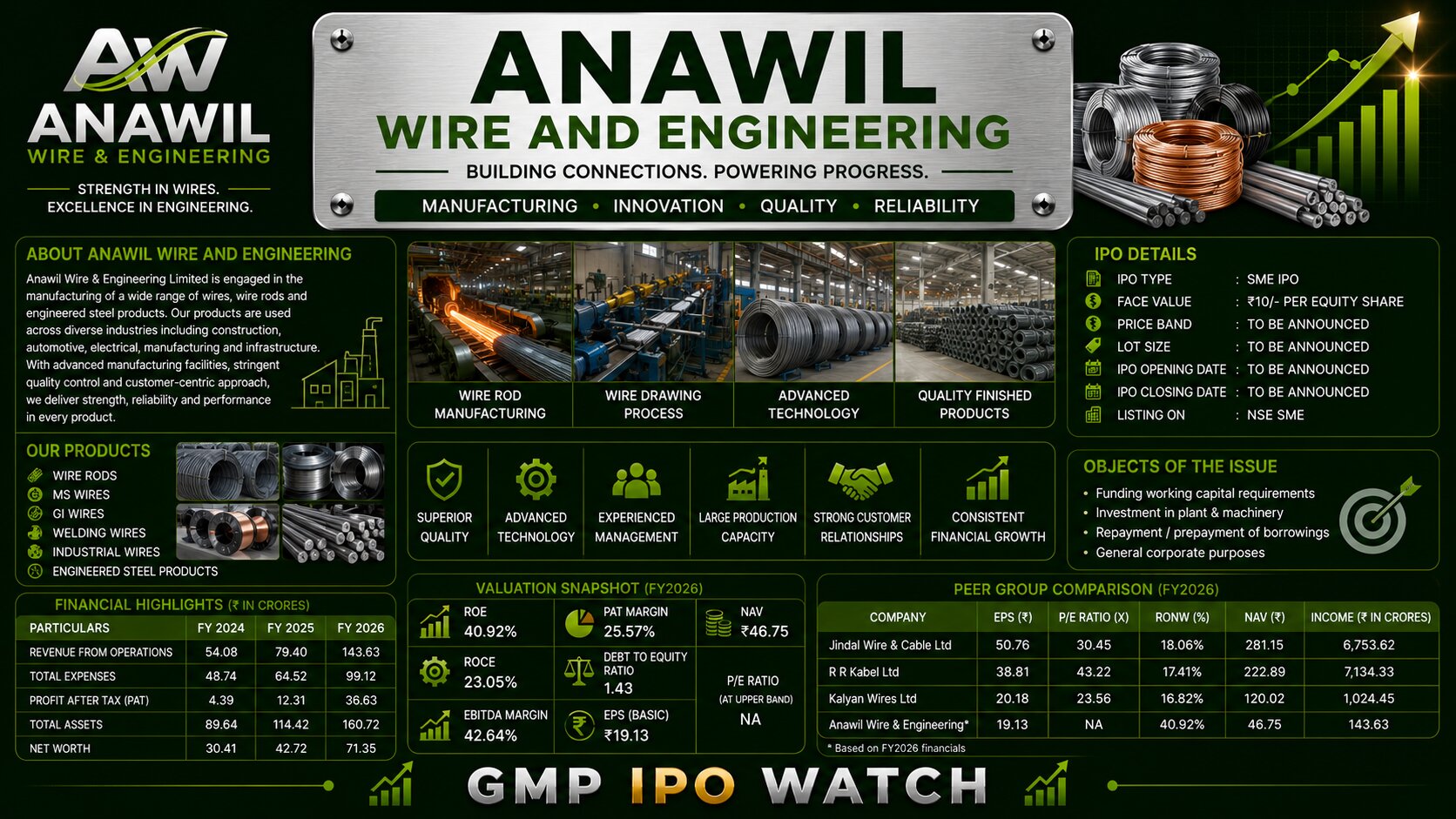
| Financial Period | Revenue | Profit After Tax | Total Assets |
| FY2024 | ₹54.08 crore | ₹4.39 crore | ₹89.64 crore |
| FY2025 | ₹79.40 crore | ₹12.31 crore | ₹114.42 crore |
| FY2026 | ₹143.63 crore | ₹36.63 crore | Data as disclosed in offer documents |
IPO-analysis platforms report FY2026 revenue of approximately ₹143.36 crore and PAT of around ₹36.62 crore, broadly consistent with the figures disclosed for the issue.
The company’s revenue increased by more than 80% between FY2025 and FY2026, while PAT nearly tripled.
This is an impressive financial trend, but investors should examine whether such rapid growth can be maintained after listing.
Profitability and Key Ratios
The company’s FY2026 financial indicators include:
| KPI | FY2026 Value |
| Return on Equity | 40.92% |
| Return on Capital Employed | 23.05% |
| EBITDA Margin | 42.64% |
| PAT Margin | 25.57% |
| Debt-to-Equity Ratio | 1.43 |
| Earnings Per Share | ₹19.13 |
| Net Asset Value | ₹46.75 |
A PAT margin above 25% and ROE above 40% appear strong for an industrial manufacturing company.
However, investors should investigate whether these margins were supported by:
- One or two unusually profitable contracts
- Changes in product mix
- High capacity utilisation
- Non-recurring income
- Lower raw-material costs
- Accounting recognition from large projects
If earnings depend heavily on a small number of contracts, future profitability may fluctuate.
Understanding the Revenue Growth
Revenue rose from approximately ₹54.08 crore in FY2024 to ₹79.40 crore in FY2025 and ₹143.63 crore in FY2026.
This growth may reflect:
- Increased wind-tower orders
- Better factory utilisation
- Expansion in heavy fabrication
- Completion of larger contracts
- Growing renewable-energy demand
- Higher average project values
The key issue is whether this growth comes from a diversified order book or from a limited number of large customers.
A concentrated order base can create rapid growth, but it also increases risk if future orders are delayed or cancelled.
EBITDA and PAT Margin
An EBITDA margin above 40% is unusually high for many traditional fabrication businesses.
This may indicate that the company is producing specialised, high-value equipment rather than commodity steel products.
It may also indicate strong operational leverage, where revenue increased faster than fixed costs.
Investors should compare:
- Gross margins
- Employee costs
- Power expenses
- Raw-material consumption
- Other income
- Depreciation
- Finance costs
- Related-party transactions
This analysis will help determine whether reported margins are sustainable.
Industry Outlook
Anawil Wire and Engineering operates at the intersection of several industrial growth areas.
Renewable Energy
India’s expansion of wind and hybrid renewable capacity may increase demand for wind-turbine towers and related components.
Heavy Engineering
Infrastructure, energy and industrial projects require fabricated steel structures and large engineering components.
Paper Manufacturing
Paper mills periodically require machinery upgrades, replacement parts and capacity expansion.
Mining and Industrial Screening
Wire-mesh products are used in material handling, construction, mining and industrial applications.
The company’s diversified operations provide access to several sectors, although wind-energy projects may become increasingly important to its growth.
Competitive Strengths
Presence in Wind-Energy Infrastructure
The company’s focus on windmill towers provides exposure to India’s renewable-energy expansion.
Multiple Manufacturing Facilities
Facilities in Karnataka, Jharkhand and Gujarat allow the company to manufacture different industrial products through specialised units.
Strong Financial Growth
Revenue and profitability increased significantly between FY2024 and FY2026.
High Reported Margins
The company has reported strong EBITDA and PAT margins, indicating high-value project execution.
Diversified Product Categories
Its operations include heavy fabrication, wire mesh, wind-tower structures and paper machinery.
Debt-Reduction Plan
The use of IPO proceeds for repayment of borrowings may strengthen the balance sheet.
Major Risk Factors
Short Operating History
The company was incorporated only in 2021.
Its recent financial growth is impressive, but it does not yet have the long public operating history of established engineering manufacturers.
Customer Concentration
Heavy-engineering businesses often depend on a small number of large contracts.
The loss or delay of a major order could materially affect revenue.
High Debt
The reported debt-to-equity ratio of 1.43 indicates meaningful leverage before the IPO.
Although fresh proceeds will be used to repay borrowings, investors should review the post-issue debt position.
Raw-Material Price Risk
Steel is a major input in wind-tower and fabrication projects.
Rapid increases in steel prices may reduce margins if costs cannot be passed to customers.
Project Execution Risk
Large fabricated structures require timely engineering, manufacturing, inspection and delivery.
Delays may result in penalties, higher costs or customer disputes.
Capacity Utilisation
New machinery creates value only if the company receives enough orders to utilise the added capacity.
Working-Capital Requirements
Large projects may require substantial upfront expenditure before customer payments are received.
Dependence on Renewable-Energy Investment
A slowdown in wind-project awards could affect demand for tower components.
SME Liquidity Risk
NSE SME shares may have lower trading volumes and greater price volatility than established mainboard shares.
Grey Market Premium and Market Sentiment
Unofficial market trackers reported a GMP ranging from approximately ₹60 to ₹90 per share around the opening of the IPO.
At the upper issue price of ₹270, a ₹60 GMP would imply an unofficial premium of around 22%, while a ₹90 GMP would imply approximately 33%.
Different trackers may show different figures because GMP is not traded on a regulated exchange.
GMP can change quickly and does not guarantee the eventual listing price.
Investors should not apply solely because of grey-market activity.
Valuation Analysis
At the upper price band of ₹270 and FY2026 EPS of ₹19.13, the implied price-to-earnings ratio is approximately:
₹270 ÷ ₹19.13 = 14.11 times
This appears moderate compared with many high-growth SME IPOs.
However, the valuation should not be judged only from the P/E ratio.
Investors should also consider:
- Sustainability of FY2026 earnings
- Customer concentration
- Debt levels
- Cash-flow generation
- Order-book visibility
- Margin stability
- Related-party transactions
- Post-issue equity dilution
- Working-capital requirements
If FY2026 profit represents a temporary high point, the effective valuation may be more expensive than it initially appears.
Growth Opportunities After the IPO
Wind-Tower Capacity Expansion
Additional plant and machinery may allow the company to execute more or larger wind-tower orders.
Renewable-Energy Growth
New wind and hybrid projects could increase demand for fabricated structures.
Debt Reduction
Lower interest expenses may support future profit growth.
Geographic Customer Expansion
The company can potentially serve additional wind and industrial customers across India.
Higher-Value Fabrication
Complex structures may generate better margins than commodity fabrication.
Paper-Machinery Expansion
Modernisation of paper mills may create demand for equipment and replacement components.
Wire-Mesh Growth
Infrastructure, mining and construction activity may support demand for wire-mesh products.
What Investors Should Check Before Applying
Investors should study the following information in the Red Herring Prospectus:
- Revenue contribution from the largest customers
- Current order-book value
- Share of revenue from wind-tower manufacturing
- Raw-material purchase arrangements
- Receivable and inventory days
- Operating cash flow
- Outstanding borrowings
- Related-party transactions
- Capacity utilisation at each factory
- Sustainability of FY2026 margins
- Promoter experience and background
- Pending legal or tax matters
- Post-issue shareholding
- Valuation compared with listed engineering companies
These factors will provide a more reliable assessment than GMP or subscription figures alone.
Why Investors Are Tracking Anawil Wire and Engineering IPO
The IPO is attracting attention because of:
- Strong revenue and PAT growth
- Exposure to wind-energy infrastructure
- High FY2026 margins
- A reported EPS of ₹19.13
- Debt repayment through fresh proceeds
- Expansion of manufacturing machinery
- An apparent P/E of around 14 times
- Positive unofficial GMP
- Demand for heavy engineering and renewable-energy components
The company’s recent growth is appealing, but investors must balance it against its short operating history, leverage and project-concentration risks.
Should You Apply for Anawil Wire and Engineering IPO?
Anawil Wire and Engineering presents a strong recent growth story within industrial fabrication and renewable-energy equipment.
Its positives include:
- Rapid revenue growth
- Strong improvement in profit
- Exposure to wind-tower demand
- Multiple manufacturing facilities
- Planned debt reduction
- Expansion-focused use of proceeds
- Apparently reasonable earnings valuation
The major concerns include:
- A relatively short operating history
- Dependence on large industrial orders
- High pre-IPO leverage
- Working-capital requirements
- Possible customer concentration
- Sustainability of unusually strong margins
- SME market liquidity
The issue may suit investors who understand manufacturing and project-execution risk and can tolerate SME share-price volatility.
Conservative investors should study the RHP carefully and avoid treating one year of exceptional profit growth as automatically sustainable.
Final Verdict
The Anawil Wire and Engineering IPO 2026 offers exposure to a fast-growing heavy-engineering company with operations spanning wind-tower structures, industrial fabrication, wire mesh and paper machinery.
The company’s revenue increased from ₹54.08 crore in FY2024 to ₹143.63 crore in FY2026, while PAT rose from ₹4.39 crore to ₹36.63 crore. This financial growth, combined with renewable-energy exposure and debt-repayment plans, creates an attractive investment narrative.
At the same time, investors should carefully assess whether recent margins and profit growth can be sustained. The company remains exposed to customer concentration, steel-price movements, project delays, working-capital pressure and SME liquidity risk.
The IPO appears to be a growth-oriented industrial SME offering with attractive recent financials but meaningful execution risk.
A final investment decision should be based on the confirmed valuation, order-book quality, customer diversification, audited cash flows, post-IPO debt levels and individual risk tolerance—not solely on Grey Market Premium or short-term listing expectations.