GMP IPO Watch
Shiprocket IPO 2026 – Complete Business Review
India's digital commerce ecosystem has grown at an extraordinary pace over the last decade. Millions of small businesses now sell products through marketplaces, social media, brand websites and direct-to-consumer (D2C) channels. However, running an online business requires much more than simply listing products—it also involves shipping, payments, warehousing, customer communication and returns management.
This demand has created opportunities for technology platforms that simplify e-commerce operations.
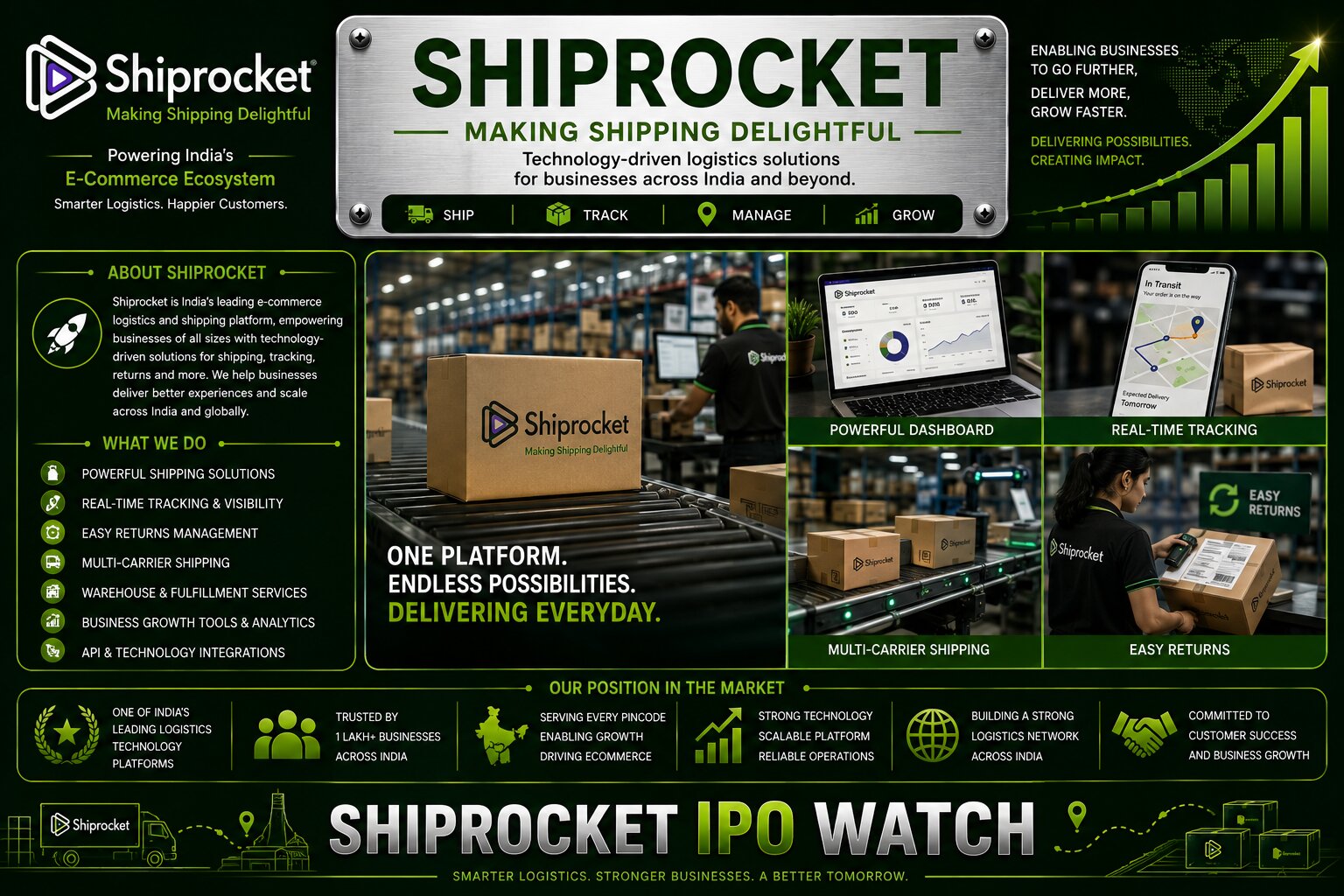
Shiprocket Limited is one of India's leading e-commerce enablement companies. Instead of operating as a courier company, it provides a technology platform that connects online sellers with multiple logistics partners, helping businesses manage shipping, fulfilment, order tracking, payments and customer experience from a single dashboard.
The Shiprocket IPO 2026 will open on August 12 and close on August 14, 2026. The company has fixed the price band at ₹92–₹97 per equity share, while the total IPO size has been revised to approximately ₹1,618 crore, comprising a fresh issue and an Offer for Sale.
This article takes a different approach from traditional IPO reviews by focusing on Shiprocket's technology ecosystem, recurring business model, merchant network, competitive positioning and long-term digital commerce opportunity.
About Shiprocket Limited
Shiprocket was founded to simplify logistics for online businesses.
Today, the platform offers an integrated ecosystem that includes:
- Shipping aggregation
- Order management
- Courier partner integration
- Warehouse fulfilment
- Cross-border shipping
- Payment collection
- Customer communication
- Returns management
- AI-powered logistics tools
Instead of building its own delivery fleet, Shiprocket follows an asset-light technology model, connecting merchants with numerous courier companies through a single platform.
How Shiprocket's Business Model Works
When an online seller receives an order, Shiprocket enables the merchant to complete the shipping process from one platform.
A typical workflow includes:
- Order received from website or marketplace
- Courier partner selection
- Shipping label generation
- Pickup scheduling
- Shipment tracking
- Customer notifications
- Delivery confirmation
- Returns processing
This reduces operational complexity for merchants while improving delivery efficiency.
Why E-commerce Sellers Use Shiprocket
Managing logistics independently can be expensive and time-consuming.
Shiprocket helps merchants by providing:
- Multiple courier options
- Competitive shipping rates
- Real-time shipment tracking
- Automated order processing
- COD reconciliation
- Return management
- Analytics dashboard
These services allow businesses to focus on sales while outsourcing logistics management.
Asset-Light Business Model
Unlike traditional logistics companies, Shiprocket does not own a nationwide delivery fleet.
Instead, it earns revenue by providing software and logistics technology.
This model offers several advantages:
- Lower capital expenditure
- Faster scalability
- Better operating leverage
- Wider courier network
- Technology-driven growth
The company benefits as merchant shipment volumes increase across its platform.
Technology Is the Core Strength
Shiprocket invests heavily in technology to improve merchant experience.
Its platform supports:
- AI-powered courier recommendations
- Automated shipping rules
- Order synchronisation
- Warehouse management
- Delivery analytics
- Fraud detection
- Customer notifications
As more merchants join the platform, technology becomes an increasingly important competitive advantage.
Growing Digital Commerce Opportunity
India continues to witness strong growth in online commerce because of:
- Smartphone adoption
- Digital payments
- Social commerce
- D2C brands
- Marketplace expansion
- Rural internet penetration
- Online shopping growth
Every new online seller represents a potential customer for logistics enablement platforms.
Shiprocket IPO Details
| Particular | Details |
|---|---|
| IPO Type | Mainboard Book Built IPO |
| Total Issue Size | Approximately ₹1,618 Crore |
| Price Band | ₹92 – ₹97 Per Share |
| IPO Opens | 12 August 2026 |
| IPO Closes | 14 August 2026 |
| Fresh Issue | ₹885 Crore |
| Offer for Sale | Approximately ₹732 Crore |
| Listing | NSE & BSE |
The IPO size was revised before launch as part of the company's final offering strategy.
Objectives of the IPO
According to public disclosures, Shiprocket plans to utilise the fresh issue proceeds primarily for:
- Technology development
- Platform expansion
- Product innovation
- Strategic acquisitions
- General corporate purposes
The company aims to strengthen its position as India's digital commerce infrastructure platform.
Revenue Model
Shiprocket earns income through multiple business streams, including:
- Shipping services
- Fulfilment solutions
- SaaS subscriptions
- Cross-border logistics
- Payment services
- Value-added merchant solutions
Diversified revenue reduces dependence on any single business segment.
Merchant Network
One of Shiprocket's biggest competitive advantages is its large merchant ecosystem.
Its platform serves:
- D2C brands
- Small businesses
- Marketplace sellers
- Enterprise customers
- Social commerce businesses
A larger merchant base creates stronger network effects because courier partners and technology services become more valuable as shipment volumes increase.
Financial Performance
Shiprocket has continued expanding alongside India's growing e-commerce industry.
Investors should evaluate:
- Revenue growth
- Gross merchandise volume
- EBITDA
- Operating losses or profitability
- Cash burn
- Customer acquisition costs
- Operating cash flow
Technology businesses should be assessed based on scalability, operating leverage and long-term profitability rather than only current earnings.
Industry Growth Drivers
India's logistics technology sector continues benefiting from:
- Growth in e-commerce
- Expansion of D2C brands
- Increasing digital payments
- Cross-border trade
- SME digitisation
- Warehouse automation
- AI adoption
These structural trends support long-term demand for integrated logistics software platforms.
Competitive Strengths
Shiprocket possesses several business advantages.
Large Merchant Ecosystem
A broad customer base strengthens platform adoption.
Asset-Light Operations
Technology-driven model reduces capital intensity.
Integrated Platform
Merchants manage shipping, fulfilment and returns from one dashboard.
Technology Focus
Continuous investment in AI and software improves efficiency.
Multiple Revenue Streams
Shipping, fulfilment and SaaS services diversify income.
Growing Industry
Digital commerce continues expanding across India.
Major Risk Factors
Investors should also evaluate the following risks.
Competitive Industry
The logistics technology sector includes several well-funded competitors.
Profitability
Technology companies may require continued investment before achieving consistent profits.
Merchant Retention
Maintaining customer loyalty remains important.
Courier Dependence
The platform relies on third-party logistics partners for deliveries.
Technology Investment
Continuous innovation is required to remain competitive.
Regulatory Changes
Changes affecting e-commerce or logistics may influence business operations.
Grey Market Premium
As of the latest available updates before the IPO opening, no established Grey Market Premium trend had emerged, as the issue was still approaching its subscription period. Investors should rely on company fundamentals instead of unofficial GMP movements.
What Investors Should Analyse
Before investing, prospective shareholders should examine:
- Merchant growth
- Shipment volume
- Revenue growth
- Customer retention
- Cash-flow generation
- Technology investment
- Competitive positioning
- Valuation
- Path to profitability
Technology platforms should be evaluated on scalability and sustainable business economics rather than only short-term listing gains.
Should Investors Consider the IPO?
Shiprocket offers exposure to India's rapidly expanding digital commerce infrastructure.
Positive factors include:
- Leading e-commerce enablement platform
- Asset-light business model
- Large merchant ecosystem
- Technology-driven operations
- Multiple revenue streams
- Strong long-term industry opportunity
Investors should simultaneously monitor:
- Profitability
- Competition
- Merchant retention
- Technology spending
- Valuation
Final Verdict
The Shiprocket IPO 2026 offers investors an opportunity to participate in one of India's leading e-commerce enablement platforms at a time when online retail, digital commerce and D2C businesses continue to expand rapidly.
Its technology-driven platform, asset-light operating model, integrated logistics ecosystem and large merchant network provide a strong foundation for long-term growth. The fresh issue proceeds are expected to support technology investments and business expansion, while India's growing e-commerce market continues to create favourable demand conditions.
However, investors should carefully evaluate the company's valuation, profitability roadmap, competitive landscape, cash-flow profile and customer retention before making an investment decision.
Overall, Shiprocket represents a high-growth technology and logistics platform with significant long-term potential, supported by India's digital commerce transformation, while carrying the execution and profitability risks common to fast-growing technology businesses.