GMP IPO Watch
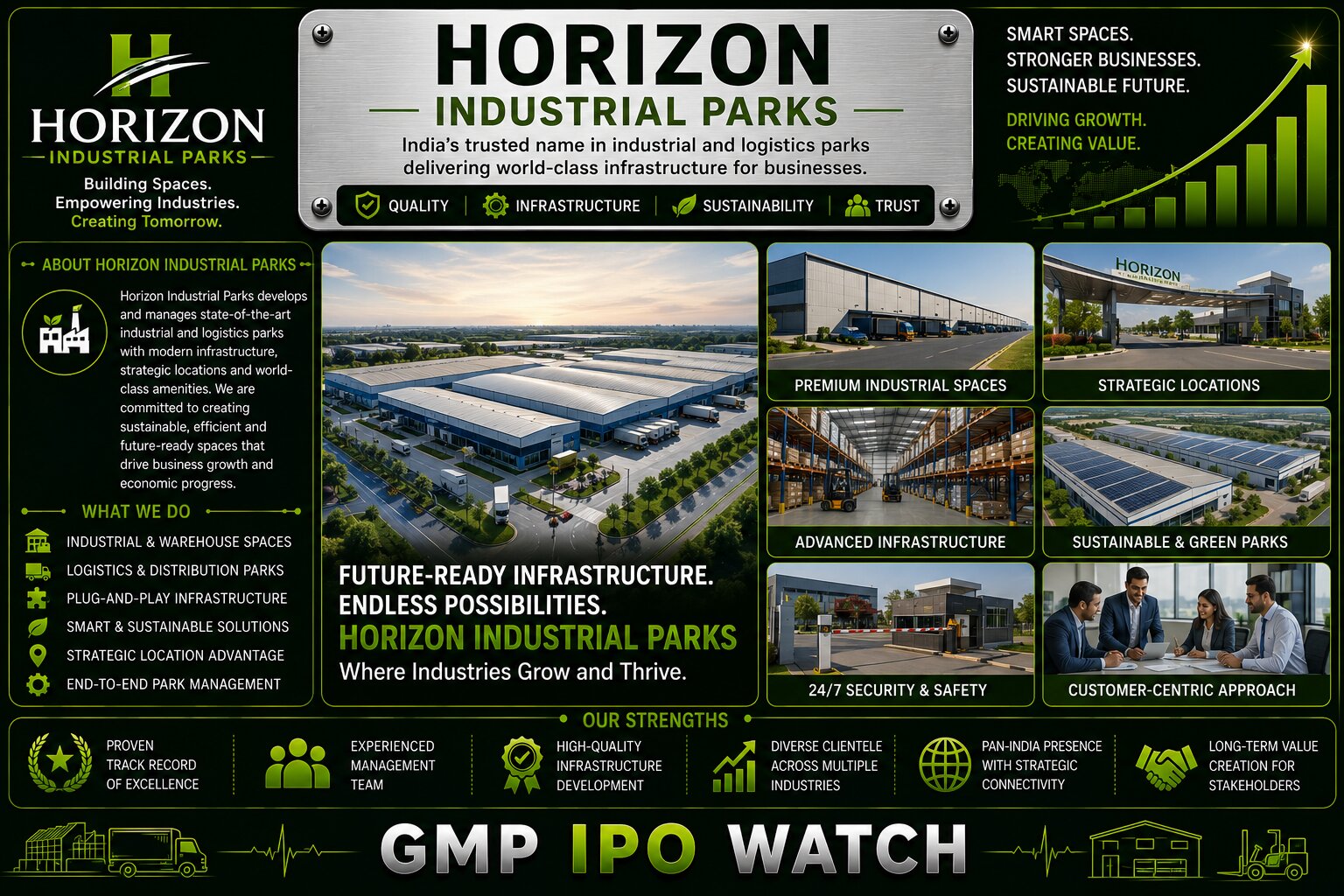
Horizon Industrial Parks IPO Lists Today – Flat Debut After ₹2,600 Crore Issue
Horizon Industrial Parks Limited entered the stock market today, August 24, 2026, following completion of its ₹2,600 crore mainboard IPO.
The stock made a muted debut. It opened at ₹60.25 on NSE, just above the ₹60 issue price, while the BSE opening price was ₹59.65, representing a small discount.
This means investors who were expecting a large listing gain based on early grey-market activity did not see that premium translate into the opening price.
Horizon Industrial Parks IPO Details
| Particular | Details |
|---|---|
| Company | Horizon Industrial Parks Limited |
| IPO Type | Mainboard IPO |
| Issue Type | Book Built Issue |
| Issue Size | ₹2,600 Crore |
| Fresh Issue | ₹2,600 Crore |
| Offer for Sale | Nil |
| Shares Offered | ~43.33 Crore Shares |
| Price Band | ₹57 – ₹60 |
| Final Issue Price | ₹60 |
| Face Value | ₹10 |
| Lot Size | 250 Shares |
| Investment at Issue Price | ₹15,000 |
| IPO Open Date | August 17, 2026 |
| IPO Close Date | August 19, 2026 |
| Allotment Date | August 20, 2026 |
| Listing Date | August 24, 2026 |
| Listing | BSE & NSE |
| NSE Listing Price | ₹60.25 |
| BSE Listing Price | ₹59.65 |
The IPO was entirely a fresh issue, with no Offer for Sale, making its structure particularly important for the company's balance sheet.
Horizon Industrial Parks Listing Performance
Today's debut was almost flat compared with the final issue price.
| Listing Particular | Price |
|---|---|
| IPO Price | ₹60.00 |
| NSE Opening Price | ₹60.25 |
| NSE Listing Gain | ~0.42% |
| BSE Opening Price | ₹59.65 |
| BSE Listing Return | ~-0.58% |
| Listing Date | August 24, 2026 |
Horizon therefore entered the public market without a significant listing-day premium.
That outcome was broadly consistent with the weaker grey-market sentiment seen toward the end of the IPO period. On the final bidding day, one report showed no GMP, while another tracker reported only a small premium.
IPO Received Moderate Investor Demand
Horizon Industrial Parks did not experience the extremely high subscription numbers seen in some recent IPOs.
Groww reported the final subscription at around 1.44 times as of August 19.
| Investor Category | Subscription |
|---|---|
| QIB | 1.85× |
| NII | 0.97× |
| Retail | 0.92× |
| Employees | 1.40× |
| Overall | 1.44× |
Retail and NII portions remained below full subscription on this data, while institutional investors provided relatively stronger demand.
What Does Horizon Industrial Parks Do?
Horizon Industrial Parks is an industrial and logistics infrastructure developer, owner and operator.
Its portfolio primarily consists of three types of infrastructure:
Fulfilment Centres
These are large warehousing facilities used by e-commerce companies, third-party logistics operators, FMCG companies and retailers.
Industrial Facilities
These support manufacturing, assembly, light engineering and storage requirements across sectors such as automobiles, EVs, renewable energy, electronics, aerospace and specialty chemicals.
In-City Centres
These are facilities positioned closer to urban consumption centres and can support last-mile delivery, micro-fulfilment, cold storage, R&D, retail and service operations.
This gives Horizon exposure to both India's manufacturing growth and the expansion of organised logistics infrastructure.
45 Assets Across 10 Major Markets
Horizon has already built substantial scale.
As disclosed around the IPO, the company's network comprised 45 assets across 10 major industrial and consumption markets, with total leasable area of approximately 58.58 million square feet.
| Portfolio Metric | Details |
|---|---|
| Total Assets | 45 |
| Major Markets | 10 |
| Total Leasable Area | 58.58 Million Sq. Ft. |
| Core Business | Industrial & Logistics Infrastructure |
| Key Formats | Fulfilment, Industrial & In-City Centres |
This portfolio scale is one of the central attractions of the Horizon Industrial Parks investment story.
Blackstone Backing Is an Important Part of the Story
Horizon Industrial Parks is backed by investment entities associated with Blackstone.
Before the IPO, three Blackstone investment entities together controlled approximately 88.74% of the company's equity.
This backing has helped Horizon develop a sizeable institutional-grade logistics and industrial real-estate platform.
However, investors should evaluate Horizon based on its own operating performance, leverage, occupancy and cash flows rather than treating sponsor backing alone as an investment reason.
₹2,600 Crore IPO Is Entirely Fresh Capital
One of the most notable aspects of Horizon's IPO is its structure.
| IPO Component | Amount | Share |
|---|---|---|
| Fresh Issue | ₹2,600 Cr | 100% |
| Offer for Sale | Nil | 0% |
| Total IPO | ₹2,600 Cr | 100% |
Unlike IPOs where existing shareholders sell a large portion of their holdings, all ₹2,600 crore is being raised through fresh shares.
This means the IPO primarily serves as a capital-raising exercise for Horizon itself.
Debt Repayment Is the Biggest IPO Objective
The most important reason for raising the money is deleveraging.
Around ₹2,250 crore of IPO proceeds is intended for repayment or prepayment of borrowings, according to reporting around the issue.
That represents roughly:
₹2,250 crore ÷ ₹2,600 crore = 86.5% of the IPO.
Use of IPO Proceeds
| Purpose | Approx. Amount |
|---|---|
| Debt Repayment / Prepayment | ₹2,250 Cr |
| General Corporate Purposes | Balance |
| Total Fresh Issue | ₹2,600 Cr |
This makes Horizon's IPO fundamentally a balance-sheet transformation story.
Why Debt Reduction Matters So Much
Industrial and logistics real estate is capital intensive.
Developing a large logistics park requires significant spending on:
land + construction + infrastructure + utilities + financing + maintenance.
Much of this capital is invested before rental income reaches its full potential.
Debt therefore becomes an important source of financing.
But high borrowing also creates large interest expenses.
The potential post-IPO equation is:
₹2,250 crore debt repayment → lower borrowings → lower finance costs → stronger cash flow → improved profitability.
This is one of the most important things investors should monitor in the next few quarterly results.
Horizon Is More Than a Traditional Warehouse Company
Calling Horizon simply a warehouse operator understates the broader business.
The company provides facilities and related infrastructure including built-to-suit and plug-and-play facilities, turnkey development, cold-storage solutions, energy solutions, staff accommodation, racking and material-handling equipment.
This allows Horizon to serve customers with specialised infrastructure requirements.
For example, an EV manufacturer may need a very different industrial facility from an e-commerce company operating a regional fulfilment centre.
Built-to-Suit Facilities Can Strengthen Customer Relationships
Built-to-suit projects are particularly interesting.
Instead of developing a generic warehouse and finding a tenant afterward, Horizon can develop facilities around the specific operating requirements of a customer.
This can create:
customised infrastructure → longer customer relationship → stronger occupancy visibility → potentially more predictable rental income.
The downside is that specialised assets can sometimes be harder to re-lease if the original customer exits.
E-Commerce Supports Warehousing Demand
India's e-commerce market continues to require larger and more sophisticated logistics infrastructure.
Online orders require physical infrastructure behind the digital transaction:
inventory → fulfilment centre → sorting → transportation → in-city facility → last-mile delivery.
Horizon can participate at multiple stages of this chain through fulfilment and in-city centres.
As online commerce expands, demand for strategically located logistics facilities can grow with it.
Manufacturing Growth Creates Another Opportunity
Horizon is also exposed to India's manufacturing expansion.
Its industrial facilities serve sectors including:
renewable energy + EVs + automobiles + electronics + aerospace + specialty chemicals + telecommunications.
These industries require more than basic storage.
Companies may need facilities capable of supporting manufacturing, assembly, testing and associated logistics.
This gives Horizon exposure to the broader shift toward domestic manufacturing.
In-City Logistics Could Become Increasingly Valuable
Large logistics parks are usually located outside dense urban areas because land is cheaper and larger sites are available.
But faster delivery expectations create demand for facilities closer to customers.
Horizon describes in-city centres supporting uses including:
last-mile delivery + micro-fulfilment + cold storage + retail + R&D + service centres.
As same-day and rapid delivery models expand, well-located urban logistics infrastructure could become increasingly valuable.
Occupancy Will Be a Critical Metric
For a logistics real-estate company, simply owning millions of square feet is not enough.
The assets must remain leased.
Consider two identical warehouses.
One operates at 95% occupancy.
Another operates at 65%.
The first property can generate significantly more rental income from essentially the same physical asset.
For Horizon, investors should therefore watch:
occupancy rate + leasing activity + rent per sq. ft. + lease renewals + customer retention.
Rental Escalation Can Support Long-Term Growth
Many industrial and logistics leases include contractual rental escalation.
This can allow revenue from an existing property to increase without constructing another facility.
The basic model becomes:
existing property + stable occupancy + periodic rental escalation = organic rental growth.
Combining this with new property development can produce two sources of growth:
same-asset rental growth + portfolio expansion.
Customer Diversification Matters
Industrial parks often lease substantial facilities to large corporate customers.
Large tenants can provide stable and sizeable rental income.
However, concentration creates risk.
If one major customer occupies a significant amount of space and later exits, the company may experience:
vacancy + lost rental income + re-leasing costs + fit-out expenses.
Tenant diversification therefore remains an important metric alongside occupancy.
Large Asset Base Requires Continuous Capital
Even after the IPO, Horizon will remain a capital-intensive business.
Industrial and logistics infrastructure requires continued investment in:
new projects + maintenance + infrastructure upgrades + tenant improvements + land acquisition.
The company therefore needs to balance future growth with financial discipline.
Reducing debt through the IPO can create additional borrowing capacity, but investors should watch whether leverage begins rising again as new projects are developed.
₹1,650 Crore Was Raised Before the IPO
Horizon also completed a ₹1,650 crore primary private placement in December 2025, before filing its DRHP.
The company said investors included 360 ONE, SBI Life and Radhakishan Damani, among others.
Combined with the ₹2,600 crore IPO, Horizon has therefore raised a substantial amount of equity capital ahead of and during its public-market transition.
How effectively that capital strengthens the balance sheet and supports future growth will be important.
Key Strengths of Horizon Industrial Parks
Horizon enters the public market with a substantial existing platform rather than an early-stage development story.
Its key strengths include a 58.58 million sq. ft. network across 45 assets and 10 markets, exposure to e-commerce and manufacturing demand, multiple property formats and Blackstone sponsorship.
The IPO structure is another important positive. The entire ₹2,600 crore issue is fresh capital, and approximately ₹2,250 crore is intended for debt reduction.
Major Risks
The major risks investors should watch include:
- High capital intensity
- Large historical debt burden
- Interest-rate exposure
- Occupancy fluctuations
- Tenant concentration
- Delays in new developments
- Land and regulatory approvals
- Construction-cost inflation
- Competition from other logistics developers
- Economic slowdown affecting warehousing demand
- Dependence on large corporate tenants
- Future refinancing requirements
The biggest near-term question is whether the large debt repayment translates into materially better financial performance.
What Investors Should Track After Listing
| Metric | Why It Matters |
|---|---|
| Occupancy Rate | Asset utilisation |
| Leased Area | Revenue-generating portfolio |
| Rental Income | Core operating performance |
| Rent per Sq. Ft. | Pricing strength |
| New Leasing | Demand momentum |
| Tenant Retention | Revenue stability |
| Debt | IPO deleveraging |
| Finance Cost | Debt-repayment benefit |
| Operating Cash Flow | Earnings quality |
| New Development Pipeline | Future growth |
| Portfolio Area | Business expansion |
| ROCE | Capital efficiency |
For Horizon, one of the most important post-IPO combinations will be:
high occupancy + rental growth + lower debt + declining finance costs.
Final View on Horizon Industrial Parks
Horizon Industrial Parks completed its ₹2,600 crore IPO at ₹60 per share and listed today, August 24, 2026. The stock opened at ₹60.25 on NSE and ₹59.65 on BSE, producing an essentially flat market debut.
The listing performance was consistent with the moderate IPO demand. Final subscription was reported around 1.44×, with QIB demand at 1.85×, while retail subscription stood at 0.92×.
The underlying business, however, is sizeable. Horizon operates 45 assets across 10 major markets with 58.58 million square feet of leasable area, spanning fulfilment centres, industrial facilities and in-city logistics centres.
The biggest financial development comes from the IPO itself. The issue is 100% fresh equity, and approximately ₹2,250 crore is intended for debt repayment or prepayment.