GMP IPO Watch
Anawil Wire and Engineering IPO 2026 – Latest Detailed Review
India’s renewable-energy expansion is creating a substantial supporting market for companies that manufacture turbines, towers, blades, electrical systems and other components used in wind-power projects.
While turbine technology often receives the most attention, the tower is an equally critical part of a wind-power installation. It supports the turbine’s nacelle and blades at the required height and must withstand substantial weight, vibration and wind pressure throughout the project’s operating life.
Anawil Wire and Engineering Limited operates in this specialised industrial segment. The company manufactures customised tubular steel towers for wind-turbine generators by fabricating heavy and precision steel components according to customer specifications. It began commercial operations in 2021 and strategically increased its focus on the wind-energy sector from 2023.
The Anawil Wire and Engineering IPO opened on August 3, 2026, and closes on August 5, 2026. The price band is fixed at ₹257 to ₹270 per equity share, while the total issue size is approximately ₹177.81 crore. The shares are proposed to list on the NSE SME platform on August 10, 2026.
This updated review examines the company’s manufacturing process, financial growth, capacity utilisation, IPO structure, use of proceeds, industry opportunity, current subscription response, GMP, competitive strengths and major investment risks.
About Anawil Wire and Engineering Limited
Anawil Wire and Engineering was incorporated in January 2021 and is principally engaged in manufacturing and fabricating tubular steel windmill towers.
The company produces heavy and precision steel structures customised for wind-turbine generator manufacturers and renewable-energy developers. Its towers are manufactured in multiple cylindrical sections, which are transported separately and assembled at the wind-project site.
Anawil’s principal wind-tower manufacturing plant is located in Karnataka. The company’s historical operations and group facilities have also included wire-mesh manufacturing in Jharkhand and paper-machinery production in Gujarat, although its current IPO growth story is primarily centred on wind-tower fabrication.
Understanding the Wind-Tower Business
A modern wind turbine generally consists of:
- Rotor blades
- Hub
- Nacelle
- Generator
- Tubular steel tower
- Foundation
- Electrical and control systems
The tower raises the turbine to a height where wind conditions are stronger and more consistent.
Anawil manufactures customised steel tower sections based on requirements provided by turbine manufacturers and renewable-energy companies.
The process is significantly more complex than ordinary steel fabrication because the tower must meet strict requirements for:
- Structural strength
- Welding quality
- Circular accuracy
- Wall thickness
- Flange alignment
- Surface coating
- Load-bearing capacity
- Fatigue resistance
- Dimensional tolerance
Even small manufacturing defects can affect installation, performance or long-term structural reliability.
How a Tubular Wind Tower Is Manufactured
The manufacturing process generally begins with large steel plates supplied according to technical specifications.
Steel-Plate Preparation
The plates are inspected for thickness, chemical composition and quality before entering production.
Cutting and Edge Preparation
Steel plates are cut to the required dimensions, while their edges are prepared for welding.
Rolling
Each steel plate is rolled into a curved or cylindrical shape using heavy industrial machinery.
Longitudinal Welding
The rolled plate is welded along its length to create a cylindrical section.
Section Assembly
Multiple cylindrical shells may be joined together to form a larger tower section.
Flange Attachment
Flanges are installed at the ends so separate tower sections can be bolted together at the wind-project site.
Surface Treatment
The finished sections undergo blasting, painting or protective coating to reduce corrosion.
Inspection and Testing
Welds, dimensions, alignment and surface quality are tested before dispatch.
The company manufactures customised tubular towers reportedly extending up to approximately 140 metres in height, depending on customer and turbine requirements.
Why Taller Towers Matter
Wind conditions generally improve at greater heights because obstacles and ground friction have less influence on airflow.
Taller towers can potentially allow turbines to:
- Access stronger wind speeds
- Generate more electricity
- Operate in lower-wind regions
- Use larger turbine capacities
- Improve project economics
However, taller towers also require greater engineering precision, stronger materials, complex transportation and larger manufacturing infrastructure.
This trend can favour tower manufacturers with sufficient equipment, plant space and customer approvals.
Customer Approval Is a Major Entry Barrier
Wind-tower manufacturers do not compete only on price.
Before receiving regular orders, a supplier may need approval from a wind-turbine generator manufacturer or project developer.
The approval process can involve:
- Factory inspection
- Welding-process qualification
- Material traceability
- Prototype manufacturing
- Product testing
- Quality-system review
- Safety compliance
- Trial orders
- Delivery-performance assessment
Once approved, a manufacturer may benefit from repeat orders because changing suppliers can involve new testing and qualification.
At the same time, dependence on a limited number of approved customers can create customer-concentration risk.
Manufacturing Capacity and Utilisation
Historical credit information indicated that the broader wind-tower operation had the capacity to manufacture approximately 30 towers per month, while actual production at one stage was around 15 towers monthly.
This distinction between installed capacity and actual utilisation is important.
If the plant operates below capacity, additional orders may increase revenue without requiring proportionate investment in new factory infrastructure.
Higher utilisation can improve:
- Fixed-cost absorption
- Employee productivity
- Machinery efficiency
- EBITDA margins
- Return on capital
However, rapid capacity growth has value only when supported by confirmed and profitable customer orders.
Business Model
Anawil Wire and Engineering operates primarily through a business-to-business, project-based manufacturing model.
Its revenue cycle may include:
- Receiving a purchase order
- Procuring steel plates and components
- Manufacturing tower sections
- Completing quality inspection
- Dispatching sections to the project location
- Raising invoices according to contract terms
- Collecting payment from the customer
Revenue is therefore influenced by:
- Number of confirmed orders
- Tower size
- Steel quantity
- Manufacturing schedule
- Customer inspections
- Dispatch timing
- Raw-material prices
- Payment terms
Because tower orders can be large, annual revenue may vary according to the timing of project execution and delivery.
Anawil Wire and Engineering IPO Details
| Particular | Details |
|---|---|
| IPO Type | Book-Built SME IPO |
| Total Issue Size | Approximately ₹177.81 crore |
| Fresh Issue | Approximately ₹142.69 crore |
| Offer for Sale | Approximately ₹35.12 crore |
| Face Value | ₹10 per equity share |
| Price Band | ₹257 to ₹270 per share |
| Base Lot Size | 400 shares |
| Minimum Retail Application | 800 shares |
| IPO Opening Date | August 3, 2026 |
| IPO Closing Date | August 5, 2026 |
| Basis of Allotment | August 6, 2026 |
| Refund and Demat Credit | August 7, 2026 |
| Tentative Listing Date | August 10, 2026 |
| Listing Platform | NSE SME |
| Lead Manager | Hem Securities Limited |
| Registrar | Bigshare Services Private Limited |
The total issue includes a fresh issue of about ₹142.69 crore and an Offer for Sale of approximately ₹35.12 crore.
Lot Size and Minimum Investment
The base IPO lot contains 400 shares, while the minimum retail application is 800 shares.
At the upper issue price of ₹270, the minimum retail investment is:
800 shares × ₹270 = ₹2,16,000
This is substantially higher than the minimum investment in most mainboard IPOs. Investors should therefore also consider post-listing liquidity before applying.
Purpose of the IPO
According to current IPO disclosures, the fresh issue proceeds will primarily be used for:
- Repayment or prepayment of borrowings
- General corporate purposes
Approximately ₹115 crore, representing around 80.6% of the fresh proceeds, is proposed for debt repayment, while the remaining amount is intended for general corporate requirements.
This differs from a capacity-expansion-focused IPO because most of the capital will strengthen the balance sheet rather than directly building a new manufacturing facility.
How Debt Repayment Could Help
Wind-tower manufacturing requires considerable capital.
The company must fund:
- Steel purchases
- Welding consumables
- Factory operations
- Labour
- Electricity
- Transportation
- Inventory
- Customer receivables
- Bank guarantees
Borrowings can support this operating cycle, but they also create interest expenses.
Debt repayment may help Anawil:
- Reduce finance costs
- Improve net profit
- Strengthen cash flow
- Improve the debt-to-equity ratio
- Increase financial flexibility
- Bid for larger projects
- Reduce refinancing risk
However, investors should examine whether the company will require fresh borrowing again as revenue and working-capital requirements expand.
Financial Performance
Anawil Wire and Engineering has reported rapid growth over its recent financial periods.
| Financial Year | Revenue | Profit After Tax |
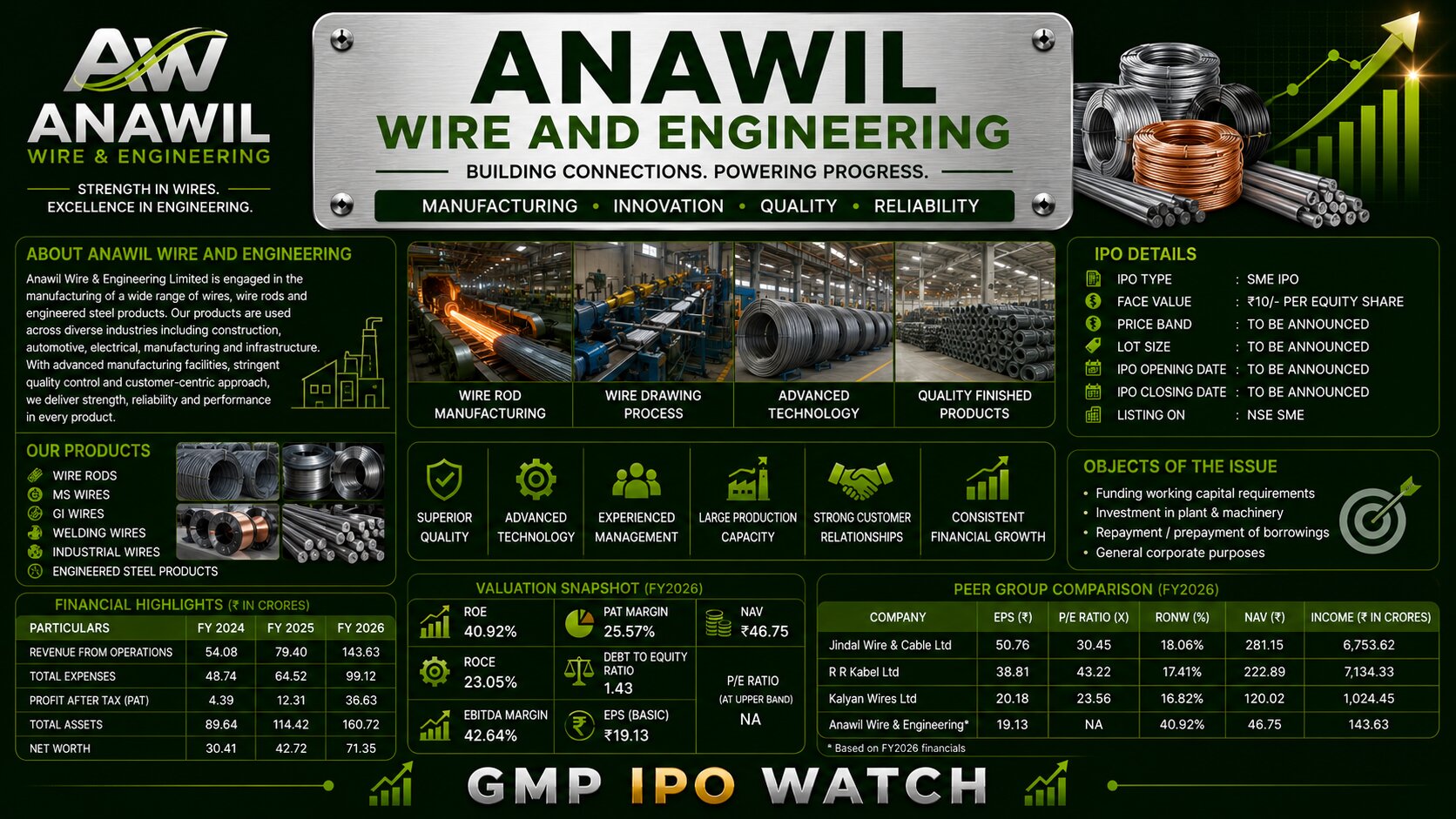
| FY2024 | ₹54.08 crore | ₹4.39 crore |
| FY2025 | ₹79.40 crore | ₹12.31 crore |
| FY2026 | ₹143.63 crore | ₹36.63 crore |
Revenue increased by approximately 47% between FY2024 and FY2025 and by roughly 81% between FY2025 and FY2026.
PAT increased substantially faster, rising from ₹4.39 crore in FY2024 to ₹36.63 crore in FY2026.
What Drove the Profit Growth?
The significant improvement in profit could have been supported by:
- Higher wind-tower production
- Better capacity utilisation
- Larger customer orders
- Improved product mix
- Better recovery of fixed manufacturing costs
- Reduced per-unit production costs
- Improved contract pricing
- Strong wind-energy demand
When revenue expands faster than fixed overheads, profit margins can improve substantially.
However, investors should examine whether FY2026 benefited from a limited number of unusually profitable contracts.
Valuation Considerations
Different IPO platforms report varying EPS calculations depending on whether pre-issue or diluted post-issue equity is used.
One current valuation source reports:
- Diluted EPS of approximately ₹14.65
- Implied P/E of around 18.43 times at ₹270
- Price-to-book ratio of approximately 5.78 times
- Return on net worth of approximately 40.92%
The valuation should be assessed in relation to:
- Sustainability of FY2026 profit
- Debt reduction after the IPO
- Customer concentration
- Order-book visibility
- Steel-price exposure
- Capacity utilisation
- Working-capital cycle
- Post-issue dilution
A moderate historical P/E may appear attractive, but the valuation becomes more demanding if recent earnings decline.
Working-Capital Requirements
Wind-tower manufacturing can require significant working capital because steel must be purchased before completed products are delivered and paid for.
Cash may remain blocked in:
- Raw-material inventory
- Work in progress
- Finished tower sections
- Customer receivables
- Supplier advances
- Transportation deposits
Growing revenue may therefore increase financing needs.
Investors should compare:
- Revenue growth
- Operating cash flow
- Inventory days
- Receivable days
- Short-term borrowings
- Customer advances
Strong accounting profit accompanied by weak operating cash flow would require additional caution.
Steel-Price Exposure
Steel is the principal raw material used in tubular wind towers.
A tower’s total cost can be significantly affected by changes in steel prices.
If the company can revise contract prices or use pass-through clauses, margin pressure may be limited.
If contracts are fixed-price and steel costs rise after the order is accepted, profitability may decline.
Investors should review:
- Raw-material contract terms
- Steel-procurement arrangements
- Price-escalation clauses
- Inventory policy
- Supplier concentration
- Hedging practices, if any
Transportation and Logistics Risk
Wind-tower sections are very large and difficult to transport.
Their movement may require:
- Special trailers
- Route surveys
- Transport permits
- Road clearances
- Coordination with authorities
- Handling equipment
- Escort vehicles
Transportation delays can affect project completion and may increase costs.
As wind towers become taller and wider, logistics can become more complicated.
A manufacturing plant’s proximity to wind-development regions and major transport routes can therefore influence competitiveness.
Wind-Energy Industry Opportunity
India continues to expand renewable-energy capacity as part of its broader clean-power transition.
Wind energy can complement solar because generation patterns may differ across seasons and times of day.
Demand for wind towers may be supported by:
- New wind-power auctions
- Wind-solar hybrid projects
- Replacement of older turbines
- Larger turbine installations
- Corporate renewable-power demand
- Renewable-energy targets
- Development of new wind corridors
However, project awards can be uneven and may depend on policy, tariffs, land availability and transmission connectivity.
Current IPO Subscription
Anawil Wire and Engineering’s IPO received bids above the shares offered during the second day of bidding.
One live market tracker reported overall subscription of approximately 4.80 times on August 4, 2026. Another exchange-data aggregator showed subscription near 4.42 times, indicating that demand had strengthened substantially after the opening day.
On the first day, the issue had initially reached approximately 70% subscription by early afternoon.
Final subscription may change further before the IPO closes on August 5.
Grey Market Premium
GMP estimates varied across unofficial market trackers on August 4.
Reported readings included:
- Approximately ₹58 per share
- Approximately ₹80 per share
- Rumours reaching ₹90 per share
At an ₹80 GMP and the ₹270 upper price band, the unofficial indicated premium is approximately 29.6%.
These differences show why GMP should be treated cautiously.
Grey-market activity is unofficial, unregulated and can change quickly. It does not guarantee the actual listing price.
Competitive Strengths
Specialised Wind-Tower Manufacturing
The company focuses on customised tubular steel towers for wind-turbine generator manufacturers.
Heavy-Fabrication Capability
Its manufacturing process requires specialised rolling, welding, testing and coating infrastructure.
Exposure to Renewable-Energy Growth
Anawil participates in the industrial supply chain supporting India’s wind-energy expansion.
Rapid Financial Growth
Revenue increased from ₹54.08 crore in FY2024 to ₹143.63 crore in FY2026.
Strong Profitability Improvement
PAT increased from ₹4.39 crore to ₹36.63 crore during the same period.
Capacity for Larger Production
Historical information indicates meaningful headroom between installed and previously utilised production capacity.
IPO-Funded Debt Reduction
The proposed repayment of approximately ₹115 crore may significantly improve the balance sheet.
Major Risk Factors
Short Operating History
The company was incorporated only in 2021 and shifted its strategic focus toward wind towers in 2023.
Its performance across a full wind-industry cycle has not yet been established.
Customer Concentration
A limited number of turbine manufacturers or renewable developers may contribute a substantial share of revenue.
Order-Based Revenue
Revenue can fluctuate according to customer project schedules and dispatch timing.
Steel-Price Volatility
Higher raw-material costs may reduce margins.
Working-Capital Pressure
Large orders require considerable cash before customer payments are collected.
Manufacturing Quality Risk
Welding defects or dimensional errors may result in rework, customer claims or order cancellations.
Logistics Risk
Transporting oversized tower sections can be costly and operationally complex.
Dependence on Wind-Project Activity
Slower wind-project awards may reduce demand.
Margin Sustainability
FY2026 profitability may not remain at the same level if product mix or contract pricing changes.
SME Liquidity
NSE SME shares can experience lower trading volumes, compulsory lot-based trading and significant price volatility.
Growth Opportunities After Listing
Increased Capacity Utilisation
Higher tower production could improve fixed-cost absorption.
Larger Wind Turbines
Taller and higher-capacity turbines may require larger, higher-value tower structures.
Hybrid Renewable Projects
Wind-solar hybrid capacity can create additional tower demand.
New Customer Approvals
Adding turbine manufacturers could reduce customer concentration.
Reduced Interest Cost
Debt repayment may improve future profitability.
Geographic Expansion
Supplying new wind regions could diversify the order book.
Higher-Value Fabrication
The company may expand into specialised renewable and heavy-engineering structures.
What Investors Should Check Before Applying
Investors should review the RHP for:
- Current order-book value
- Revenue contribution from the largest customers
- Monthly production and capacity utilisation
- Steel-price pass-through clauses
- Inventory and receivable days
- Operating cash flow
- Pre- and post-IPO debt
- Customer approval status
- Warranty obligations
- Transportation responsibilities
- Related-party transactions
- Pending legal and tax matters
- Sustainability of FY2026 margins
- Post-issue promoter holding
- Post-issue P/E and market capitalisation
These factors provide a stronger basis for evaluation than subscription or GMP alone.
Why Investors Are Tracking Anawil Wire and Engineering IPO
The IPO has generated interest because of:
- Exposure to the wind-energy supply chain
- Rapid revenue and PAT growth
- Specialised tower-manufacturing capability
- Significant proposed debt repayment
- Available manufacturing headroom
- Strong day-two subscription
- Positive unofficial GMP
- An implied valuation below many high-growth SME offerings
The positive market response should still be balanced against the company’s short history, customer concentration and working-capital requirements.
Should You Apply for Anawil Wire and Engineering IPO?
Anawil Wire and Engineering presents a compelling recent growth story within India’s renewable-energy equipment sector.
Its positive factors include:
- Strong FY2026 financial performance
- Specialised industrial capability
- Exposure to wind-energy expansion
- Potential operating leverage
- Debt reduction through IPO proceeds
- Increasing investor subscription
- Positive grey-market sentiment
The major concerns include:
- Limited operating history
- Dependence on large orders
- Customer concentration
- Steel-price volatility
- Working-capital pressure
- Sustainability of high margins
- SME-market liquidity
The IPO may be suitable for investors who understand project-based manufacturing businesses and can tolerate higher operational and market volatility.
Final Verdict
The Anawil Wire and Engineering IPO 2026 provides exposure to a specialised manufacturer of tubular steel wind towers at a time when India is expanding renewable-energy capacity.
The company has reported impressive recent growth, with revenue increasing from ₹54.08 crore in FY2024 to ₹143.63 crore in FY2026 and PAT rising from ₹4.39 crore to ₹36.63 crore. Its proposed use of approximately ₹115 crore for debt repayment may also improve future financial flexibility.
Investor interest has strengthened during the issue period, with live subscription estimates around 4.4 to 4.8 times on August 4 and unofficial GMP readings ranging broadly from ₹58 to ₹90 per share.
However, the company remains exposed to customer concentration, steel prices, project timing, working-capital pressure, product-quality requirements and SME liquidity risk.
Anawil Wire and Engineering should therefore be viewed as a high-growth renewable-equipment IPO with improving fundamentals, but meaningful execution and concentration risks.
The final investment decision should be based on the company’s order book, audited cash flow, customer diversification, post-IPO debt, valuation and individual risk tolerance—not only on subscription levels or Grey Market Premium.